


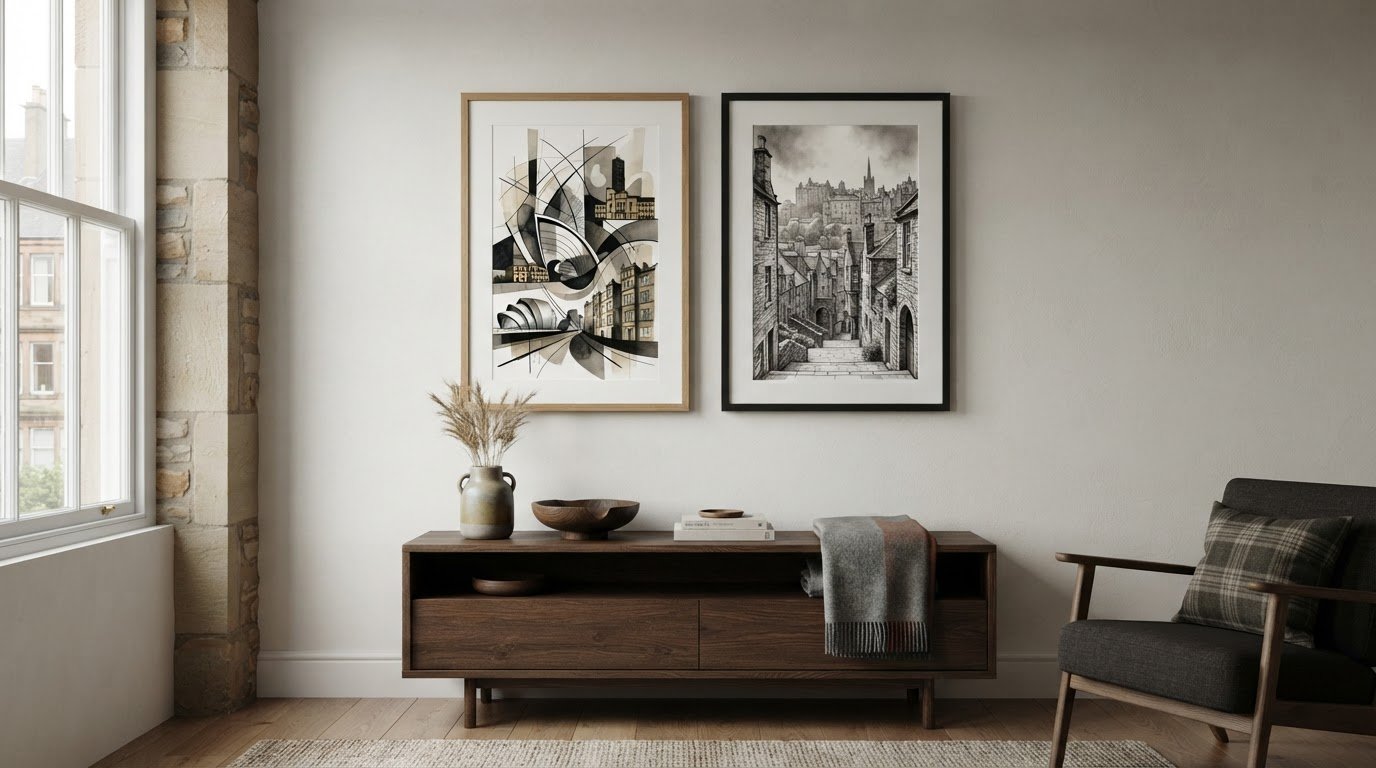
What if the print that feels most like your favourite city isn’t the one with its best-known landmark? Choosing architectural prints of Glasgow and Edinburgh means weighing two distinct moods: Glasgow’s expressive Mackintosh lines and Edinburgh’s close-packed stone streets, stairways and closes. Both make compelling wall art, but it can be difficult to judge online how a particular image or artistic treatment will look in your room.
A detailed monochrome drawing can feel calm and timeless, while a colourful or graphic interpretation makes a stronger contemporary statement. The right choice depends on the architecture you love, the atmosphere you want and the colours already in your space.
In this guide, compare the cities’ visual character, consider how artistic style changes a print’s impact, and use practical checks to choose a size and frame. You’ll also find ways to visualise art on your wall and see how individually crafted framing, made with high-quality materials, brings your chosen architectural print together as ready-to-display framed wall art.
Key Takeaways
- Choose between architectural prints of glasgow and edinburgh by the city and streetscape you feel most connected to, not by a “right” answer.
- Compare illustration, photography and contemporary treatments to find the colour, contrast and level of detail you enjoy.
- Start with the wall, then consider the print’s subject, scale and visual weight alongside your room’s colours and furniture.
- Pair your chosen print with a considered frame through online picture framing. Each First4Frames Gallery frame is individually crafted for its order using high-quality materials.
What Makes Glasgow and Edinburgh Architectural Prints Feel Different?
Choosing between two much-loved Scottish cities isn’t a test with one right answer. The appeal of architectural prints of glasgow and edinburgh often comes down to personal connection: a familiar street, a building you admire or the atmosphere you want to bring into a room.
Architectural art turns the shape of a street or the character of a façade into a daily reminder of a place.
| City | Possible mood and subjects | May suit |
|---|---|---|
| Glasgow | Varied, energetic; street scenes, cultural buildings and changing urban details | Rooms that welcome expressive, characterful imagery |
| Edinburgh | Historic and layered; stone streets, closes and rooflines | Spaces that call for depth, texture or a sense of history |
Which Glasgow architectural details might draw your eye?
Glasgow city prints can bring together contrasting façades, busy streets and cultural buildings, so even a restrained palette may feel lively. The Architecture of Glasgow offers context on the city’s Victorian buildings and Glasgow Style. Ashton Lane, Oran Mor and Glasgow Film Theatre are examples of subjects that could focus a print on a street’s atmosphere, a distinctive façade or a cultural landmark. As you browse, notice which details connect with your own experience of the city.
What gives Edinburgh architecture prints their distinctive appeal?
Edinburgh’s historic streetscape has a different visual rhythm. Closely set stone buildings, layered rooflines, narrow closes and stairways can create depth, with details unfolding as your eye moves through the scene. A familiar setting might bring back a visit or favourite walk; a broader street view can convey a quieter, timeless mood. Choose the image for the memory or atmosphere it holds for you, rather than to declare one city better than the other.
How Artistic Style Changes the Look of Glasgow and Edinburgh Prints
The same building can feel quiet, dramatic or full of movement depending on how an artist interprets it. In architectural prints of glasgow and edinburgh, the medium and composition shape the mood as much as the subject. Artistic treatment transforms a building’s lines, light and surroundings into the atmosphere a print brings to a room.
Illustration or photography: which architectural treatment suits you?
Illustrative linework can reduce a scene to outlines, shadows and selected details, directing attention to a doorway, window pattern or roofline. Photography prints capture a particular view, including its light, perspective and surrounding activity. Compare how clearly you can see the details, whether darker tones feel rich or heavy, and how the image is composed. Fine lines and open space often feel measured; strong tonal contrast can make the same subject more striking.
How do contemporary and fine art prints differ in feel?
Contemporary art prints may use cropped viewpoints, simplified shapes or unexpected colour to make familiar architecture feel fresh. Fine art prints can place more emphasis on texture, careful detail and the artist’s interpretation. When comparing them, notice how colour guides your eye, how much of the setting is included, and whether the composition feels balanced or deliberately energetic.
Scottish landscape art can include architectural elements, but for this choice, look for buildings that remain central to the image. Browsing works by best-selling artists and famous artists can introduce you to different approaches to fine art, photography prints and contemporary art prints.
As you compare, picture each print’s contrast and colour alongside your room’s existing palette. To explore possible subjects and treatments, browse architectural and city-inspired prints.

How to Choose Architectural Prints for Your Room
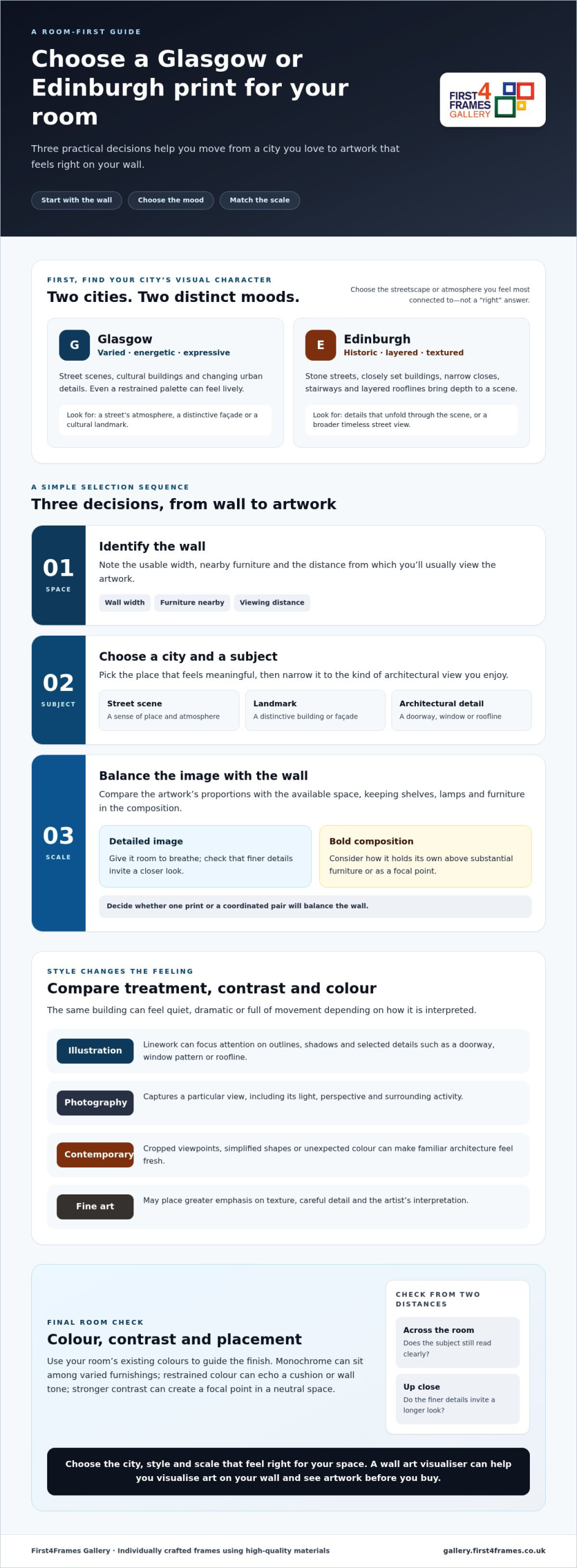
Choosing architectural prints of glasgow and edinburgh for a particular room is easier when you work from the space outward. Use this sequence to narrow your options:
- 1. Identify the wall. Note its usable width, nearby furniture and the distance from which you’ll usually view the artwork.
- 2. Choose a city and subject. Pick the place that feels meaningful, then decide whether you prefer a street scene, landmark or architectural detail.
- 3. Consider scale and visual weight. A detailed image needs room to breathe, while a bold composition can hold its own above substantial furniture. Decide whether one print or a coordinated pair will balance the wall.
Use your room’s existing colours to guide the finish. Monochrome can work well among varied furnishings; restrained colour can echo a cushion or wall tone, while stronger contrast can create a focal point in a neutral space. If you’re also browsing Coastal wall art or Landscape wall art, look for a clear architectural feature to keep the city’s buildings at the heart of your choice. A wall art visualiser can help you visualise art on your wall and see artwork before you buy. For broader display planning, consult Picture Frames: The Ultimate Guide to Choosing, Hanging, and Displaying Art.
How can print size and placement shape the result?
Compare the artwork’s proportions with the available wall space, allowing nearby shelves, lamps and furniture to remain part of the composition. From across the room, check whether the subject still reads clearly. Up close, consider whether the finer details invite a longer look. For practical UK size context, see Standard Photo & Picture Sizes: The Complete UK Guide for Framing.
How should the frame and glazing complement architecture prints?
A simple profile can define the print’s edges without competing with windows, masonry or fine linework. Each First4Frames frame is individually crafted for its order using high-quality materials, unlike cheap, standard frames that may not fit the artwork properly. First4Frames uses 2mm float glass for glazing, offering superior clarity to the perspex used by many competitors. For more bespoke framing guidance, explore Mastering Custom Picture Framing: The Expert Guide to Bespoke Art Display.
Ready to compare artwork for your space? Explore architectural and city-inspired prints.
From City Print to Bespoke Framed Wall Art
A city print becomes part of your room when its presentation feels as considered as the image. Online picture framing lets you pair a chosen architectural print with a frame that suits its lines and tones. With architectural prints of glasgow and edinburgh, a subtle frame can let fine details speak, while a stronger profile gives the artwork more presence.
What does the print-and-frame experience involve?
Browse a large online selection of artwork and frames, choose a print, then Choose your frame online to complement it. Design your framed artwork as bespoke framed wall art, with custom framed art prints individually framed for your order. This bespoke approach avoids the compromises of a standard frame that may not fit the artwork properly. Every frame is crafted using high-quality materials, so its proportions and finish are considered for the piece it holds.
An art print framing service brings the presentation choices together in one place. Select a finish that supports the artwork without overwhelming its architectural features, and consider how the completed piece will sit with your room. The print and frame work together as ready-to-hang framed art.
Can a digital photograph become a framed architectural keepsake?
Yes. The print-and-frame service can turn your own digital photograph of a Glasgow or Edinburgh building into a finished piece. Your photograph is printed to a high quality suited to bespoke framing, then paired with a frame you choose. It’s a way to keep a personal architectural view on display, whether it captures a memorable visit or a detail you pass every day.
Finished frames are fully packaged to help prevent damage and shipped via professional couriers. Explore framed architectural and city prints and find a piece that feels at home on your wall.
Make a Favourite City Part of Your Everyday
A well-chosen architectural print can do more than fill an empty wall. It can bring a place you love into your daily surroundings, whether that connection comes from a memorable visit, a familiar street or an appreciation of the buildings themselves. Let that personal response guide your choice. The most successful architectural prints of glasgow and edinburgh are the ones you’ll enjoy living with, not simply the ones that make the strongest first impression.
Before deciding, picture where your eye will meet the artwork during an ordinary day. A quiet corner might suit a detailed view; a prominent wall may welcome a composition with greater presence. Trust your sense of what belongs in the room, and give the print space to become part of its character.
Browse the gallery and find architectural prints for your space. Your chosen view of Glasgow or Edinburgh could be the detail that makes a room feel unmistakably yours.
Frequently Asked Questions
Can Glasgow and Edinburgh architectural prints work together on one wall?
Yes, prints from both cities can make a cohesive display when they share a visual point of connection. For example, align their centres and use the same frame finish, while choosing one broad street view and one closer façade. Before hanging, arrange the pieces on the floor to test their order and spacing against the wall.
What should I look for in an architectural print?
Choose a subject that matters to you, then check how clearly the image conveys its sense of place. Notice whether the viewpoint includes enough of the building to make it recognisable, and whether surrounding details add context or distract. For architectural prints of Glasgow and Edinburgh, a familiar doorway, roofline or street corner can make the artwork personal without requiring a panoramic city view.
Is float glass clearer than perspex for framed prints?
First4Frames uses 2mm float glass for glazing, which offers superior clarity to the perspex used by many competitors. Its clear presentation lets you appreciate the print’s fine lines, tonal changes and surface detail. The frame, artwork and surrounding light all contribute to how the finished piece looks on your wall.
How can I see artwork on my wall before buying?
Use a wall art visualiser to preview a chosen print in your room before making a decision. Compare its apparent size with nearby furniture, then check whether the image feels balanced beside shelves, windows or other wall features. If possible, view the preview in the room’s usual lighting as well as in daylight, so you can judge how the artwork fits your everyday space.