


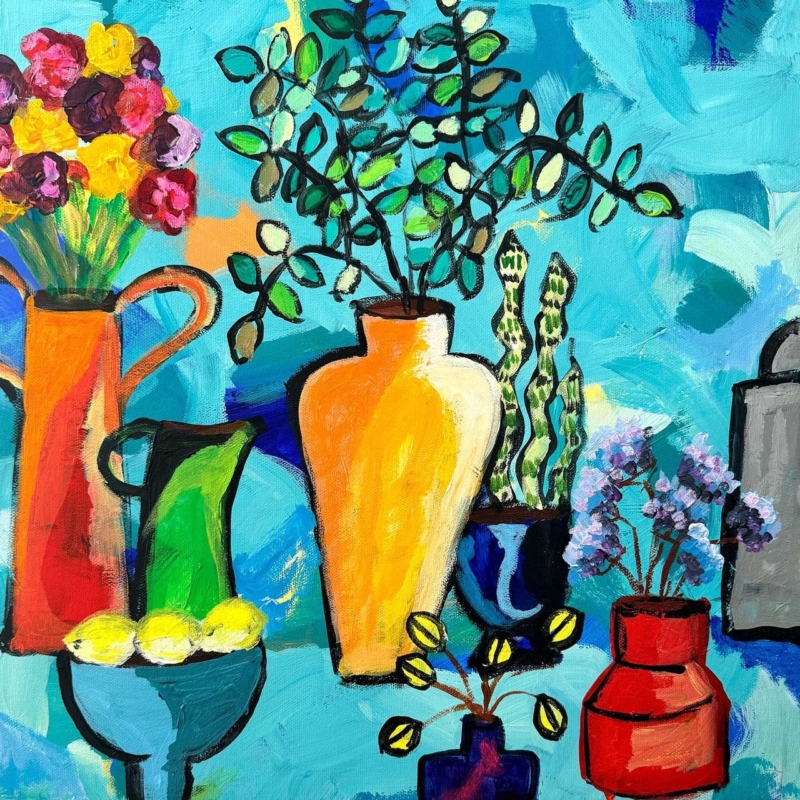
Contemporary framed art prints for a minimalist living room do not have to be quiet or obvious. Upside Down I can introduce a question into a restrained room. Its title invites a second look, while the square format gives that visual uncertainty a controlled boundary.
Let contemporary framed art prints for a minimalist living room create the question
A restrained room still needs a point of curiosity. Minimalism is not the same as removing every story.
Begin with the main seated view. A single work opposite the sofa can give the eye somewhere definite to rest. Avoid placing it beside a television, open shelving or a collection of sculptural accessories. Upside Down I should provide the visual puzzle; the surrounding wall can provide the pause.
Compare all three square sizes
- 265 x 265 mm: useful for a compact wall return or reading chair.
- 500 x 500 mm: a balanced choice above a console or beside a low cabinet.
- 800 x 800 mm: suitable for a broader statement wall when furniture width and viewing distance support it.
Make three paper templates and include an allowance for the frame. Live with them for a day before choosing. The largest print is not automatically the most minimal choice; a square that overwhelms its furniture can feel as busy as several smaller pictures.
Use the frame to make restraint feel intentional
Accurate mounting and a bespoke finish give a simple arrangement authority. First 4 Frames produces and hand-finishes the presentation in-house, helping the frame relate to the room’s timber, metal and upholstery without merely matching them.
For wider context on art made in the present, read Tate’s introduction to contemporary art. Browse other work in the David Short collection, or compare the three Upside Down I sizes.
Contemporary framed art prints for a minimalist living room work best when they add meaning rather than more objects. One carefully scaled Upside Down I can give the room personality while preserving its calm.