


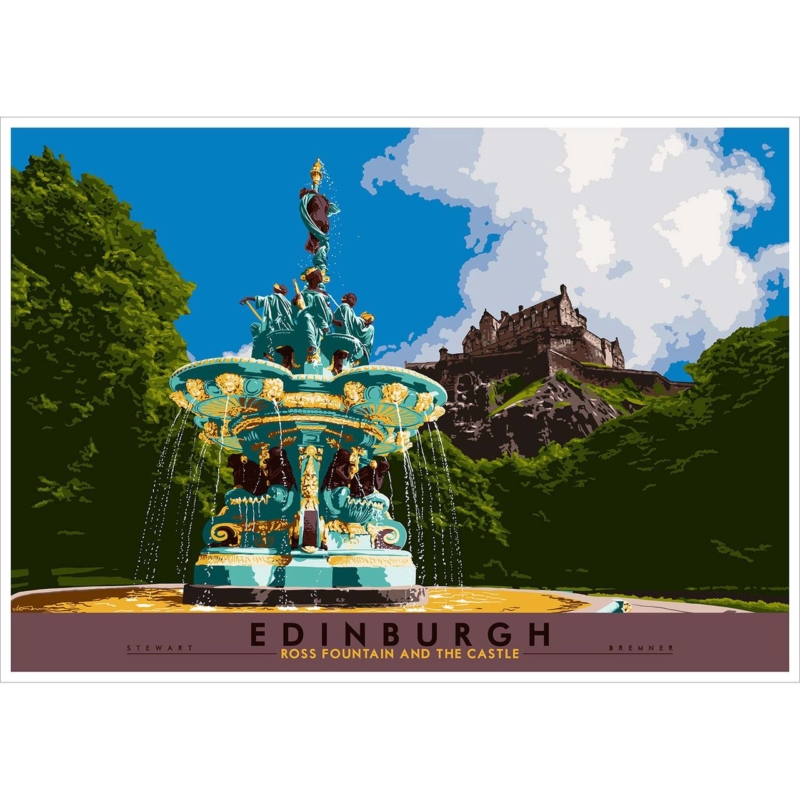
Edinburgh wall art for a marble entrance hall needs to respond to the room as well as the subject. Edinburgh: Ross Fountain and the Castle offers a useful starting point because Stewart Bremner’s graphic Edinburgh view brings colour and human-scale detail beside a hard, polished material without asking the stone itself to disappear.
Balance Edinburgh wall art for a marble entrance hall against shine
| Room question | Practical response |
|---|---|
| Is the marble polished? | Check reflections from the main seat and doorway. |
| Is it a console? | Measure the complete frame above it and leave a calm gap. |
| Is the floor veined? | Keep nearby textiles plain so lines do not compete. |
| Which print size? | Mark both 594 × 420 and 840 × 594 mm options with the frame added. |
Marble can make an entrance or living room feel crisp, but too many hard edges may also feel distant. The fountain, trees and Edinburgh skyline provide a more approachable layer. A rug or timber detail can support that softness without concealing the stone.
Let the picture warm the architecture; it does not need to imitate the marble’s veining.
Avoid defaulting to an ornate frame because the subject includes a historic fountain and castle. Compare clean and traditional mouldings against the print, stone and adjoining metalwork.
Frame wall art for marble surfaces without adding glare
Graphic shapes and layered colour need accurate separation beside a reflective surface. Colour-managed Giclée production keeps the Edinburgh detail clear, while bespoke framing allows the moulding, mount and glazing to be considered against the actual marble.
For background on the restored landmark shown in the print, visit the Ross Fountain history and restoration overview. Explore the Stewart Bremner collection, then view the exact product and framing choices.
Wall art for marble surfaces works when it introduces warmth without disguising the architecture. Ross Fountain and the Castle adds place and colour, while measured framing keeps artwork and stone distinct.