


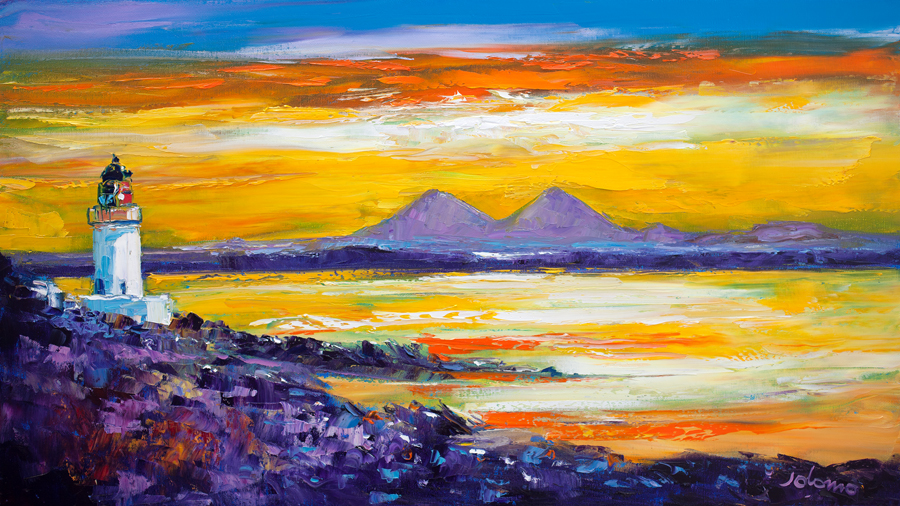
Islay wall art for a guest sitting room can give a smaller reception space a real identity without making it feel formal or over-planned. A Soft Dawnlight over Loch Indaal, Islay by John Lowrie Morrison OBE uses a broad stretch of water, a low horizon and luminous early colour to create breathing room. Warm orange and yellow notes sit beside cooler blue, while the darker shore gives the scene enough weight to remain grounded. It is a view that welcomes quiet conversation and unhurried pauses.
Give the guest sitting room a clear purpose
A second sitting room can easily become a collection of spare furniture. It may have a comfortable chair and a useful lamp, yet still feel less resolved than the main living area. One well-proportioned artwork can correct that imbalance. It establishes where the eye should settle and helps the furniture read as an intentional group.
The open water in A Soft Dawnlight over Loch Indaal, Islay is particularly helpful in a compact room. It creates visual distance without asking for a large wall. The picture also has a calm horizontal movement, so it can connect two chairs, a small sofa or a console without competing with the people using the space.
Plan Islay wall art for a guest sitting room around sightlines
Start at the doorway. A guest should be able to see the main subject before walking around a chair or opening a curtain. Next, sit in every principal seat. Check that the horizon remains visible above furniture and that a lamp shade does not interrupt the brightest area. These simple tests matter more than centring the frame on the wall by measurement alone.
| Room condition | Useful response | Check before hanging |
|---|---|---|
| Two chairs face each other | Use the picture as the shared visual anchor | Confirm both seats have a clear view |
| A low console fills one wall | Let the coastal horizon continue its horizontal line | Leave a calm gap above the furniture |
| The room has one small window | Use the painted distance to add openness | Avoid direct glare on the image |
| Books and objects are already present | Keep the artwork wall comparatively quiet | Remove one competing display rather than squeezing the frame |
Mark the complete framed dimensions with low-tack tape. Step into the hall, cross the room and sit down before deciding. The correct position should work through movement, not only from one standing viewpoint. It should also leave enough wall around the finished frame for the dawn sky and water to retain their sense of space.
Use dawn colour without making the room pastel
Soft early light can work with many schemes because it contains both warmth and coolness. There is no need to repeat every pink, gold and blue. Choose one connection already available in the room. A blue-grey chair might relate to the water, while a warm timber table can answer the shore and sunrise.
- For pale neutral walls, use a frame with enough definition to prevent the image from floating.
- For deeper painted walls, consider a lighter mount that preserves the brightness of the dawn.
- For patterned upholstery, keep cushions and nearby objects restrained so the horizon stays readable.
- For warm lamps, check that the cooler blue notes still remain visible after dark.
This selective approach keeps the space welcoming rather than coordinated to excess. Guests should feel that the room has been cared for, not that every item has been purchased as part of a fixed set. The artwork supplies atmosphere; the furniture can remain comfortable and personal.
Make the room work in daylight and lamplight
Dawn subjects change character as the room changes. In daylight, the cooler water and distant land may appear more prominent. In the evening, warm picture lighting can draw forward the yellow and orange passages. That shift is an advantage in a room used at different times, provided reflections do not obscure the quieter detail.
Use a shaded table or floor lamp for conversation, then add gentle, even light for the artwork if the room needs it. Avoid a narrow spotlight that creates one bright patch. View the glazing from every seat after sunset. A small change to the frame height or lamp position can often remove a distracting reflection.
Choose a frame for welcome, not formality
A restrained dark moulding can connect with the shore and give the lighter sky a crisp edge. Natural timber may suit a softer, less formal room. A well-proportioned mount gives the energetic painted colour a pause before it meets upholstery, books or a patterned rug. The choice should support the room’s everyday comfort rather than make it resemble a gallery corridor.
First 4 Frames uses colour-managed Giclée production and completes bespoke, hand-finished framing in-house at its Falkirk workshop. A personal consultation allows wall colour, furniture and the intended scale to be considered together. This is especially valuable where subtle blue, gold and pink need to remain balanced across the final presentation.
Explore Jolomo’s expressive island landscapes
John Lowrie Morrison OBE, widely known as Jolomo, is recognised for expressive Scottish landscapes shaped by strong colour and changing light. Learn more through John Lowrie Morrison’s official website, then browse the John Lowrie Morrison OBE collection at First 4 Frames to compare island, coastal and village subjects.
Well-chosen Islay wall art for a guest sitting room can turn a secondary room into somewhere guests genuinely want to sit. View the framed A Soft Dawnlight over Loch Indaal, Islay print for an open Islay scene that brings gentle colour, coastal depth and an unhurried sense of welcome.