


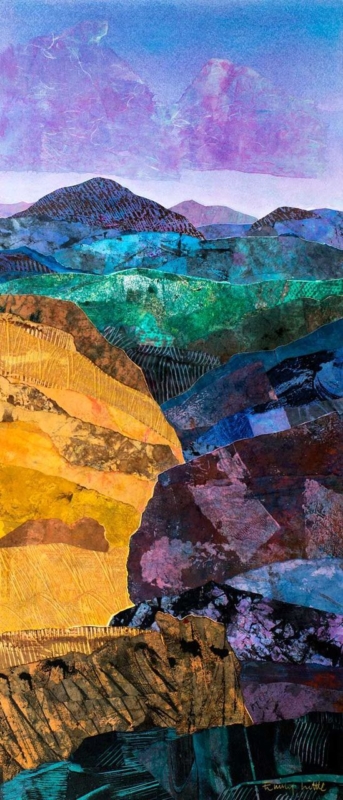
landing wall art has to work from below, at the turn and at close range instead of looking correct from only one straight-on position. Green Hill gives the decision a specific artwork, proportion and palette to test.
Plan landing wall art from the upward sightline
- Stand at the foot of the final stair flight and find the first clear view.
- Mark the full frame around the 120 × 280 mm and 240 × 560 mm print options.
- Walk through the turn while another person opens nearby doors.
- Check whether the handrail visually cuts across important colour.
- View the outline from the upper corridor before choosing a height.
Green Hill’s slim format naturally reinforces vertical movement. The smaller print can create an intimate pause on a compact return wall. The larger option can hold a taller field, but only if the frame keeps safe clearance from door architraves, switches and passing shoulders.
| Landing condition | Useful response |
|---|---|
| Low natural light | Add controlled picture lighting and test reflections at night. |
| Several doorways | Keep the slim outline centred in the wall that remains visible. |
| Strong wall colour | Use a framing boundary that separates rather than disappears. |
| Very close viewing | Leave texture and colour free from nearby family-photo clutter. |
A landing is transitional, yet the picture should not feel like a sign directing traffic. Avoid stacking arrows, quotations or several narrow frames around it. One semi-abstract composition can provide the pause while the stair itself supplies movement.
Give landing wall art a precise vertical frame
A slim semi-abstract work depends on accurate alignment and subtle colour separation. Colour-managed Giclée printing retains those transitions, while bespoke framing completed in-house can give the unusual proportion enough presence without adding unnecessary width.
For an accessible way into looking at non-literal colour and form, see the Tate introduction to abstract art. Browse the Emily Little collection, then view the exact product and framing choices.
Landing wall art succeeds when it belongs to the whole route. Green Hill creates an upward visual rhythm, while measured scale and clearance make the staircase safer and more resolved.