


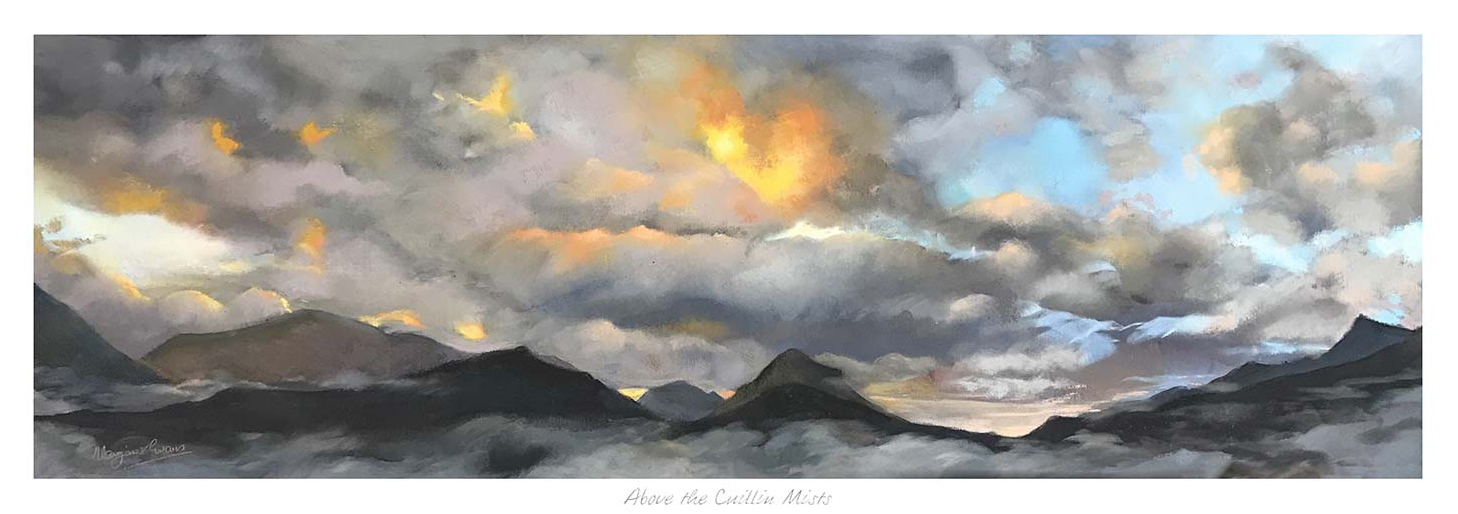
panoramic mountain wall art for a split-level landing needs to make sense from more than one height and direction. A split-level landing may be seen while someone climbs, pauses, turns and continues along a corridor. Above the Cuillin Mists by Margaret Evans is well suited to that changing view. Its wide Cuillin ridge, bands of mist and dramatic light create a stable horizontal destination without requiring a crowded arrangement of smaller frames.
Why the landing needs one strong horizon
Split-level spaces often contain several competing lines: stair strings, handrails, door heads, balustrades and changes in ceiling height. A group of small pictures can add even more stops. One panoramic composition gives the eye a longer, calmer line. It can make the wall appear wider and help the pause between floors feel purposeful.
The mountain ridge in Above the Cuillin Mists is not a rigid stripe. Peaks rise and fall, while low mist softens the transition to the foreground. This combination brings structure without making the architecture feel more angular. Golden light among darker clouds also gives the image enough contrast to remain readable in a space that may not receive even daylight.
Map every view before fixing the frame
Do not choose the height from the landing alone. Use a paper template matching the complete framed size and inspect it throughout the route. A position that looks correct while standing still may feel too high from the lower flight or too low when approached from the upper corridor.
Approaching from below
Check that the panorama appears before the top step, rather than being hidden by the landing edge. The main ridge should invite the eye upward without forcing anyone to tip their head sharply.
Standing on the landing
Keep the picture centred on the usable wall section, not automatically on the entire stairwell. Allow safe clearance from the handrail, door swing and turning space.
Looking back from above
Confirm that the frame still has clear wall around it. A nearby ceiling slope or door architrave should not cut too closely across the panorama’s outer edge.
Take photographs from all three positions. They reduce the temptation to optimise the artwork for a single viewpoint. Leave the template in place for a day so the household can test it during normal movement, in both daylight and evening lighting.
Size panoramic mountain wall art for a split-level landing
Measure the clear wall after subtracting switches, alarm controls, trim and the space people need to turn. A wide print should feel generous, but it should not stretch so close to adjacent features that the wall loses its margin. The panoramic ratio already creates width; it does not have to fill every centimetre.
| Landing condition | Useful response | Risk to check |
|---|---|---|
| Short, wide wall | Use the panorama as the single focal point | Frame edges crowding door trim |
| Low or sloping ceiling | Keep clear wall above and below | The artwork feeling squeezed into a strip |
| Dark lower flight | Light the wall evenly from the landing | Glare hiding the mist and golden sky |
| Open balustrade | Align visually with the calmest long line | Fixing the picture to every rail angle |
Use mist to add depth without visual clutter
The layered mist makes the mountain range recede. That effect can be valuable on a landing, where the actual wall may be close to the viewer. Instead of adding literal depth through shelves or projecting objects, the picture provides a sense of distance while keeping the physical route flat and clear.
Let the artwork carry most of the atmosphere. A simple runner, a warm wall light or one timber detail can connect with its muted gold and charcoal tones. Avoid filling the remaining wall with many small mountain souvenirs. Repetition would weaken the open space that makes the panorama effective.
Frame and light the changing tonal range
A slim dark moulding can define the dramatic cloud shapes, while a quiet natural timber can soften them and connect to stairs or flooring. A mount may add breathing room when the surrounding wall is dark. The complete choice should be judged from the lower flight, where a heavy frame can appear more dominant than it does at close range.
- Use broad, even illumination rather than a narrow beam on the brightest sky.
- Check reflections from both upper and lower approaches after dark.
- Choose secure fixings suited to the wall construction and a high-traffic route.
- Keep the finished frame clear of hands moving naturally along the rail.
First 4 Frames produces colour-managed Giclée prints and completes bespoke, hand-finished framing in-house at its Falkirk workshop. Careful reproduction supports the shifts from deep cloud to pale mist and warm light. A one-to-one consultation can also consider the actual wall, stair finishes and viewing distances before the final presentation is made.
Explore Margaret Evans’s Scottish landscapes
Margaret Evans is a Scottish contemporary artist whose work draws on dramatic skies, mountain landscapes and changing light. Visit Margaret Evans’s official website for more about her painting, then browse the Margaret Evans collection at First 4 Frames to compare other Highland and coastal views.
Thoughtfully positioned panoramic mountain wall art for a split-level landing can turn an awkward transition into a calm visual destination. View the framed Above the Cuillin Mists print for a wide mountain horizon with the mist, light and depth needed to connect several changing sightlines.