


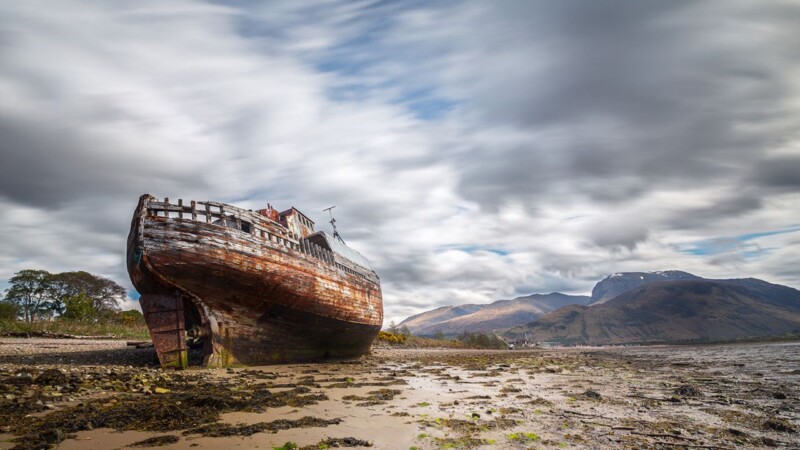
photography prints becomes more useful when the picture solves a real placement question. Doomed offers a clear starting point because the abandoned wooden vessel carries visible age while the broad shore, mountains and moving cloud open the story beyond the hull.
Judge photography prints by what keeps you looking
Start at the foreground. The worn timber provides grain, broken edges and evidence of exposure. Then follow the shoreline towards the distant mountains. That change of scale gives the eye a route and prevents the photograph from becoming only a picture of decay.
| Viewing question | What to examine |
|---|---|
| Does the subject hold attention? | Look for detail in the hull, shore and patches of water. |
| Is there enough distance? | Check how the mountains and sky balance the strong foreground. |
| Will the room light help? | Test glazing reflections across dark timber and soft cloud. |
| Which scale works? | Compare the finished outlines of the 400, 500, 600 and 700 mm widths. |
Place the photograph where there is time to pause: above a sideboard, opposite a reading chair or on a landing with a clear approach. Avoid surrounding it with rope, anchors or other maritime props. The vessel already carries the theme.
A narrative photograph should leave enough unanswered for the viewer to return and notice something new.
Protect texture across a wide tonal range
Doomed depends on separation between weathered timber, muted shore, distant land and soft cloud. Controlled fine-art printing preserves those transitions. Bespoke in-house framing can support the photograph without adding a showy maritime border.
For wider context on preserving Britain’s historic vessels, visit National Historic Ships UK’s maritime heritage resources. You can also browse the Noel Fenech Photography collection or view the exact framed product.
Photography prints earn their wall space through more than sharpness. Doomed combines material detail, open landscape and an unfinished story, making it a considered focal point rather than a quick coastal reference.