


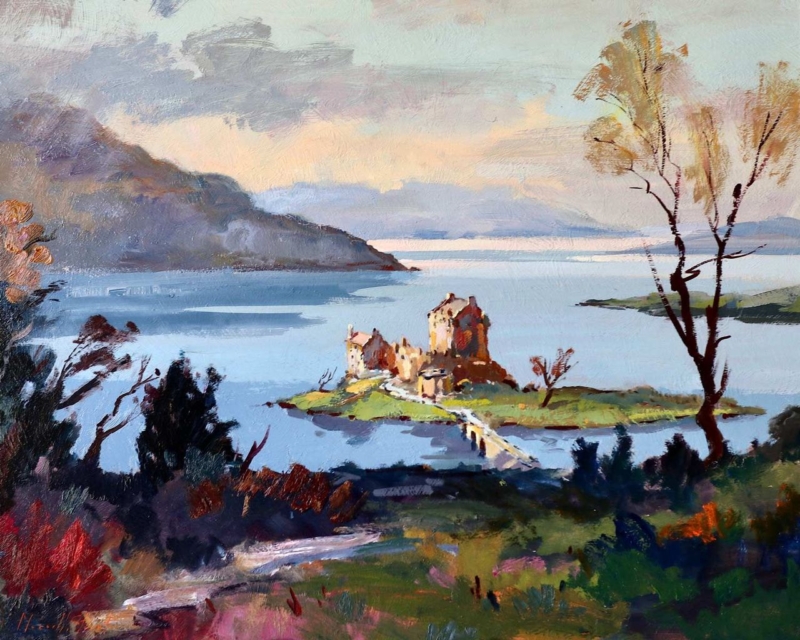
Scottish castle wall art for a formal living room can bring history into a carefully furnished room without making the interior feel like a heritage display. View to Eilean Donan Castle by Joseph Maxwell Stuart places the castle within water, distant hills and expressive foreground colour. The landmark is clear, but it does not dominate every part of the composition. That wider landscape gives a formal room atmosphere, depth and a welcome sense of movement.
Let the landscape soften a formal arrangement
Formal living rooms often rely on symmetry, matched seating and a strong central feature. Those choices can create calm, yet too many straight lines and dark finishes may make the room feel guarded. This painting introduces softer changes of light, water and vegetation. The causeway leads the eye towards the castle, while trees and brushwork stop the scene from feeling architectural or severe.
The view also offers more than one reading distance. From across the room, the castle and pale loch establish the composition. From a nearby chair, warmer marks in the foreground and the looser sky become more noticeable. That layered experience suits a living room used for conversation, reading and quieter evenings rather than a passage where art is seen only briefly.
Place Scottish castle wall art for a formal living room
Choose the wall in relation to the seating group, not simply the longest empty surface. Above a sofa, centre the finished frame on the main seat rather than the entire wall. Over a console, allow the picture to sit clearly above lamps and objects. On a chimney breast, check that the available width still leaves a generous margin around the landscape.
A formal room feels most comfortable when the artwork belongs to the seating arrangement but still has enough clear wall to be read as a complete landscape.
The available horizontal print proportions work naturally above longer furniture. Tape out the complete framed dimensions before deciding between sizes. Include any mount and moulding in the outline. Then sit in each principal chair to check that lamps, flowers and other guests will not block the castle or cause distracting reflections.
Build the palette from the quieter landscape colours
Do not begin by matching the brightest red or green mark. Start with the quieter blue-grey water, soft sky and deeper tree shapes. These colours can connect with larger areas such as upholstery, curtains or wall paint. Rust, moss and warm stone then work as smaller accents that give the room life.
- With dark wood: use a lighter wall or mount so the castle and water do not become visually heavy.
- With patterned upholstery: leave more plain wall around the frame and repeat only one subdued picture colour.
- With pale seating: a darker moulding can provide definition and connect with shadowed trees.
- With brass details: let the warmer foreground marks provide a gentle link instead of adding more gold decoration.
This restrained approach keeps the room from becoming a castle theme. Tartan, armour motifs and several landmark pictures are unnecessary. The artwork already carries a recognisable Scottish setting. Books, timber, wool and well-chosen lighting can support its atmosphere without turning the room into a collection of symbols.
Balance symmetry with one painterly focal point
If the living room has paired lamps or chairs, the artwork can sit on the central axis and provide a less rigid contrast within that symmetry. Keep objects below the frame low enough to preserve the causeway and water. A single bowl or a few books may be more effective than a dense row of ornaments.
An asymmetrical room can use the picture differently. A floor lamp on one side and a tall plant or cabinet on the other can create visual balance without exact matching. Step back to the doorway and check the whole elevation. The castle should remain the destination for the eye, not one small detail among competing furniture.
Light the water and sky without flattening the mood
Formal rooms are often used after dark, so judge the artwork under evening lighting. A shaded table lamp may reveal the warmer foreground while keeping the sky gentle. A picture light can suit a dedicated wall if its beam is even and reflections are controlled. Very cool bulbs may make the loch feel detached from the warmer land.
A frame should mediate between picture and furniture. A restrained dark moulding can pick up the trees and give the view definition. A warm timber may relate more comfortably to traditional cabinetry. A carefully proportioned mount can create light around the image, especially when the room contains deeper paint or patterned wallpaper.
Connect the landmark to its real setting
The official Eilean Donan Castle website provides background for visitors who want to understand the place beyond its familiar silhouette. You can also explore the Joseph Maxwell Stuart collection at First 4 Frames to see how the artist handles other landscapes, gardens and historic settings.
First 4 Frames uses colour-managed Giclée production and completes bespoke, hand-finished framing in-house at its Falkirk workshop. That process supports the pale transitions in the water and sky as well as the richer foreground marks. Personal framing advice also helps the finished work sit comfortably with existing furniture and lighting.
The best Scottish castle wall art for a formal living room adds character without making a carefully planned interior feel staged. View the framed View to Eilean Donan Castle print for a landscape-led interpretation of a famous landmark, with enough warmth and movement to make a formal room more inviting.