
Posted on

What is Tru Vue Museum Glass? The Ultimate Guide to Fine Art Glazing

What is Tru Vue Museum Glass? The Ultimate Guide to Fine Art Glazing

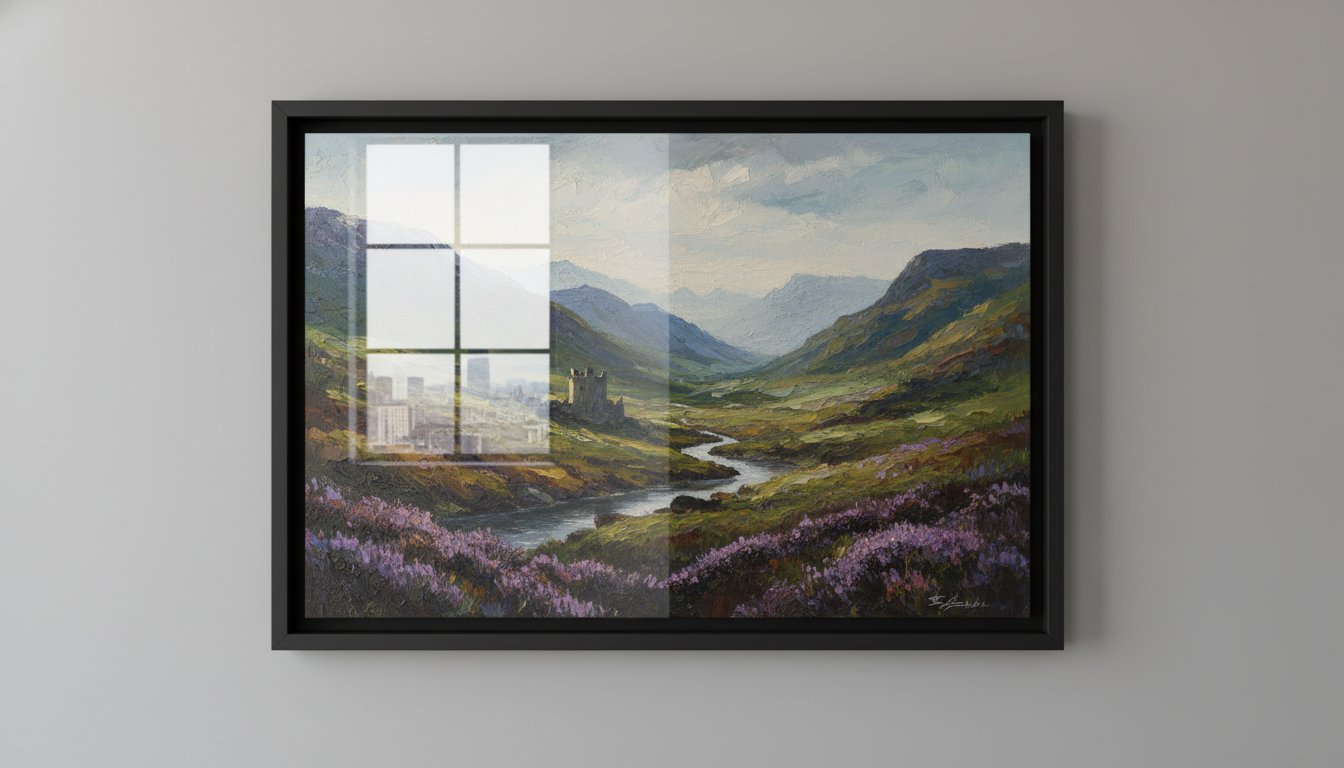
Have you ever noticed how a beautiful piece of art can disappear behind a wall of distracting reflections the moment the sun hits your living room? You’ve likely spent time carefully selecting a stunning piece from our gallery, perhaps a vibrant wildlife study by Kay Johns, only to find that standard glass turns your investment into a mirror. If you’ve found yourself asking what is Tru Vue museum glass, you’re likely looking for a way to enjoy every fine detail without the interference of glare. It’s a common frustration for art lovers across the UK, but you deserve a crystal clear view of the craftsmanship you’ve brought into your home.

At First4frames, we draw on over twenty years of expertise and our top-rated Google and Trustpilot reviews to help you make the best choice for your collection. This guide will show you how this premium glazing provides 99% UV protection to stop colours from fading while offering a nearly invisible finish. Whether you’re using our bespoke framing service at first4frames.co.uk or ordering a complete piece from prints.first4frames.co.uk, you’ll learn why this glass is the ultimate bridge between your room décor and your favourite artwork. We’ll explore the science behind the clarity and why it’s the gold standard for protecting your most cherished pieces.

Key Takeaways

  • Learn how 99% UV protection acts as a vital shield for your investment, ensuring your cherished artwork remains vibrant and “sunburn-free” for decades.
  • Discover exactly what is Tru Vue museum glass and how its advanced anti-reflective coating eliminates glare to reveal the true depth and saturation of every brushstroke.
  • Explore a side-by-side comparison with standard glass to understand why this premium choice is a cost-effective investment for preserving the long-term value of your collection.
  • Master the professional techniques for cleaning your glazing safely and identify the specific lighting conditions where Museum Glass makes the most spectacular visual impact.
  • See how our artisan team at First4Frames combines 20 years of expertise with Tru Vue technology to protect the stunning works of our featured gallery artists.

What is Tru Vue Museum Glass? Defining the Gold Standard

Tru Vue Museum Glass represents the pinnacle of framing technology, serving as the preferred choice for galleries and serious collectors across the United Kingdom. It’s a premium anti-reflective glazing solution that offers a nearly invisible appearance, allowing the true colours and textures of an artwork to shine without distraction. For those asking what is Tru Vue museum glass, it’s essentially an engineered barrier that combines 97% light transmission with the highest level of conservation-grade protection. By blocking 99% of harmful UV rays, it ensures that “Ready-to-Hang” art maintains its aesthetic and financial value for decades.

Selecting the right Picture-framing glass is a critical decision for any art lover. At the First4Frames Gallery, we believe that the glazing should never stand between you and the artist’s vision. Whether you are investing in a vibrant landscape or a delicate limited edition print, this glass acts as a protective shield that doesn’t compromise on clarity.

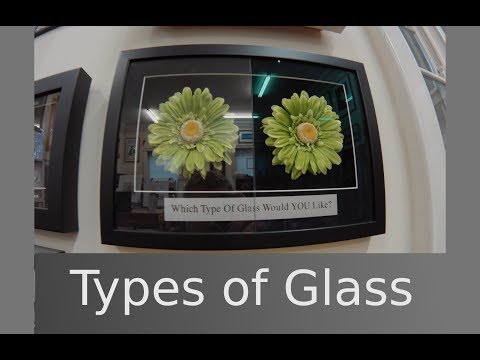
To see how this premium glass looks and behaves in a professional setting, watch this helpful video:

The Problem with Standard Picture Glass

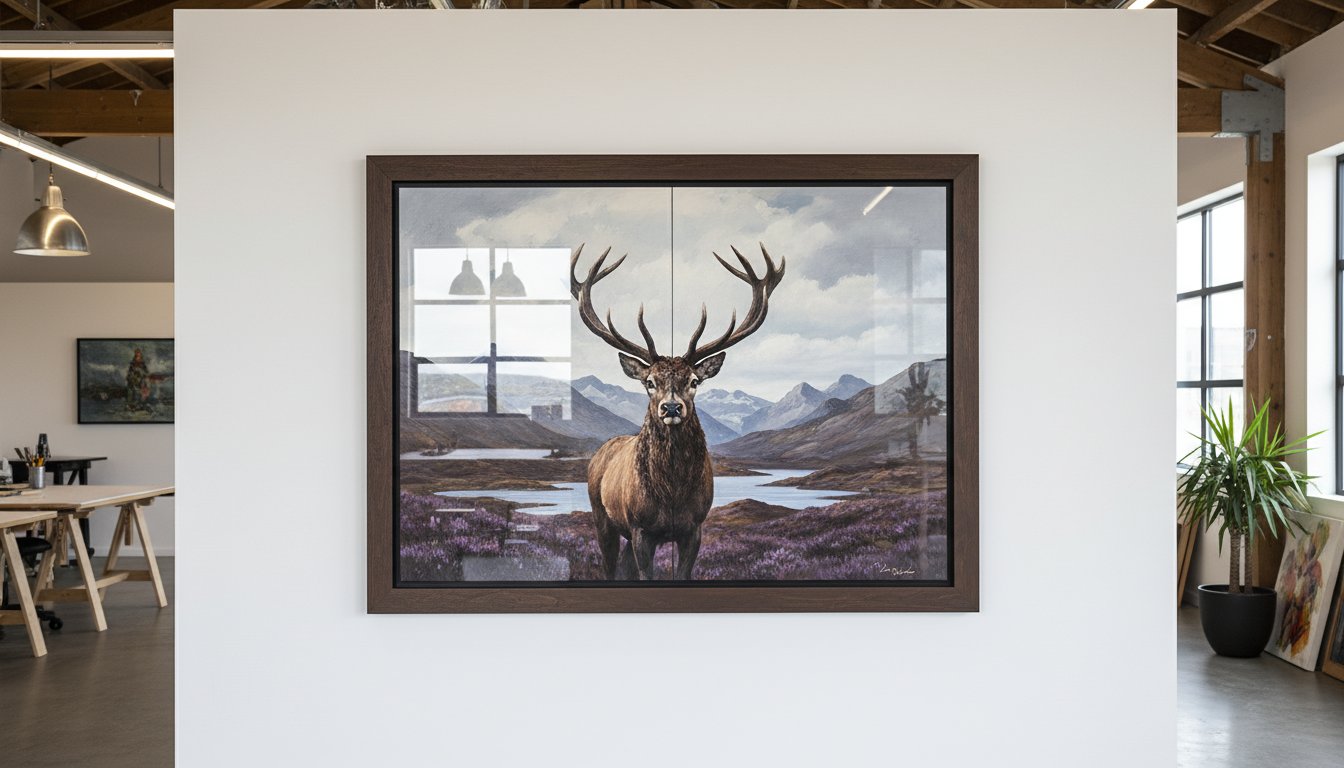
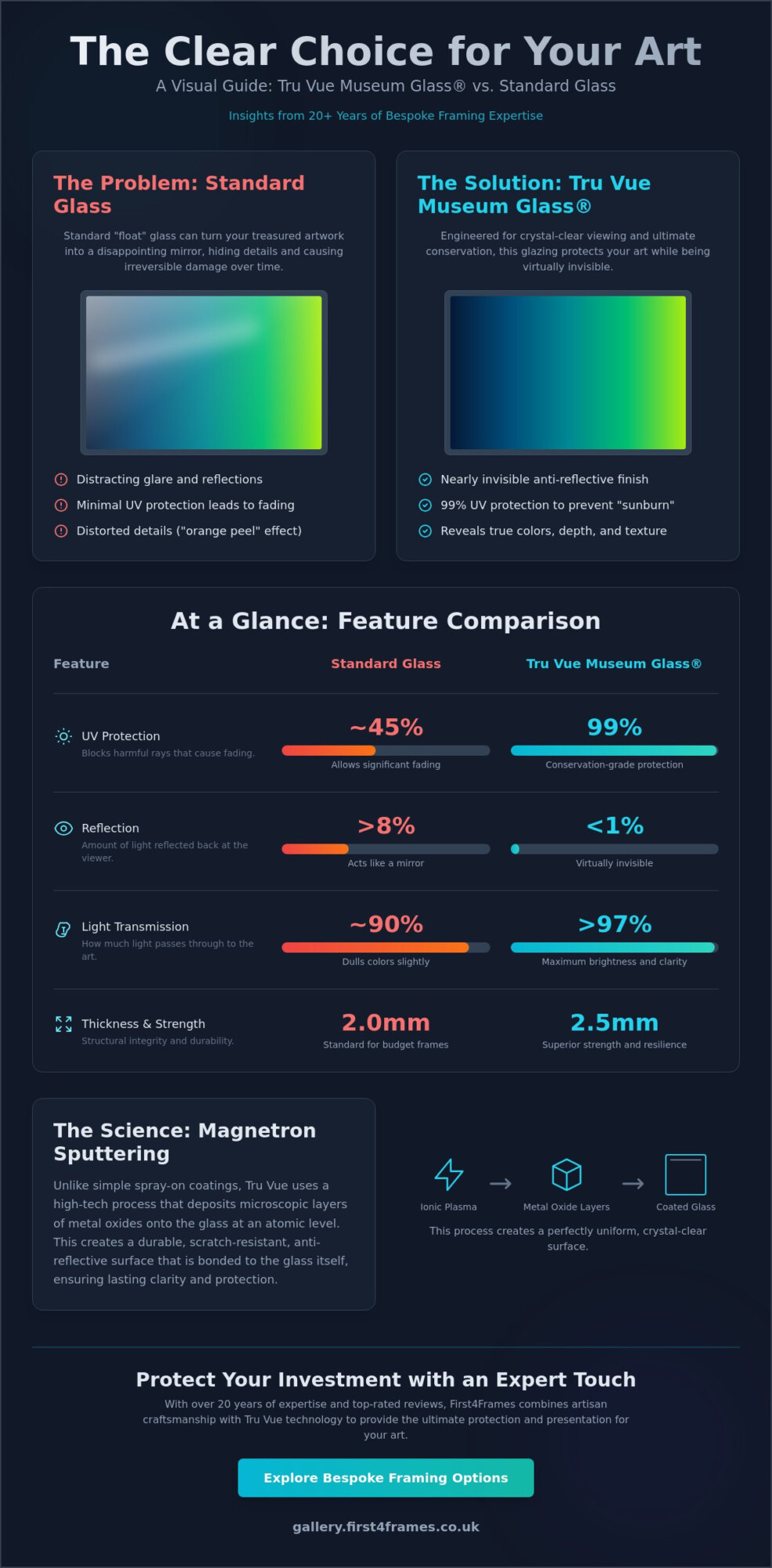
Standard “float” glass is the most common glazing used in budget frames, but it comes with significant drawbacks for fine art. In a typical bright room, standard glass acts like a mirror, reflecting windows and furniture rather than the artwork itself. It also frequently exhibits an “orange peel” effect, a subtle surface distortion that blurs the crisp details of high-quality Giclée prints. Most importantly, standard glass provides minimal protection against UV light. Over time, even indirect sunlight will bleach pigments and cause paper to become brittle, leading to irreversible damage to your collection.

The Tru Vue Difference: Science Meets Art

The superior performance of this glazing comes from a technical process known as magnetron sputtering. Unlike basic coatings that are sprayed on, magnetron sputtering deposits microscopic layers of metal oxides onto the glass surface at an atomic level. This creates a durable, anti-reflective finish that is far more resilient than budget alternatives. Additionally, the 2.5mm thickness provides much better structural strength than the 2mm glass found in high-street frames.

At First 4 Frames, we’ve built a reputation for excellence over twenty years, reflected in our outstanding Google and Trustpilot ratings. We operate three specialized sites to cover every artistic need: our main fine art gallery, our bespoke framing service, and our dedicated print and frame platform. By using Tru Vue Museum Glass, we ensure that the bridge between your room décor and your artwork remains perfectly clear and protected for a lifetime.

The Technical Brilliance: 99% UV Protection and Anti-Reflective Coating

Tru Vue Museum Glass isn’t just a physical barrier; it’s a sophisticated piece of optical engineering. When you ask what is Tru Vue museum glass, you’re looking at a product that filters out 99% of harmful UV rays while allowing nearly 99% of light to pass through. This balance is critical for preserving the integrity of fine art. At First 4 Frames, we’ve spent over 20 years helping customers understand that the glass you choose is just as important as the frame itself. Our expertise, backed by excellent Google and Trustpilot ratings, ensures your investment remains as vibrant as the day it was created.

Blocking the Silent Killer: UV Radiation

Light damage is cumulative and irreversible. The UV spectrum between 300nm and 380nm is particularly aggressive. It breaks down the chemical bonds in paper and pigments, leading to what professionals call “sunburn” for art. It’s a common misconception that only direct sunlight is dangerous. Modern indoor environments use LEDs and fluorescent bulbs that emit UV radiation, leading to significant fading over time. UV block is the primary defense against irreversible pigment loss. Proper Matting and Framing for Art requires this level of conservation to ensure a piece lasts for generations without the colours turning dull or the paper becoming brittle.

Virtually Invisible: Eliminating Glare and Reflection

Traditional glass often acts like a mirror. This is especially distracting when you’re framing dark-coloured prints or deep shadowboxes where the reflections can completely obscure the subject. Museum Glass uses a magnetron sputtered anti-reflective coating. This process applies microscopic layers of metal oxides that cancel out light waves as they hit the surface. The result is a reflection rate of less than 1%. It creates a “disappearing act” where the glass becomes invisible, pulling you directly into the artwork. Whether you’re displaying a delicate original or a vibrant Giclée print, this clarity makes colours look more saturated and blacks look deeper.

The durability of this coating is what sets it apart from cheaper alternatives. It’s not a flimsy film that can peel or bubble; it’s engineered for permanence. This glass has passed the Photographic Activity Test (PAT), a global ISO 18916 standard. This certification proves the materials are chemically inert and won’t react with your photographs or artwork. Whether you’re sourcing a new piece from our online art gallery or using our bespoke framing services at first4frames.co.uk, you can trust that these materials meet the highest archival standards.

  • 99% UV protection blocks the most damaging light waves.
  • Less than 1% reflection for an unobstructed view of your art.
  • 99% light transmission enhances colour depth and detail.
  • PAT certified for long-term archival safety.

By choosing this premium glazing, you’re creating a bridge between your room décor and the artwork. It allows the piece to do the heavy lifting in the relationship without the distraction of glare. If you’re looking to combine high-quality prints with this professional glazing, our dedicated print and frame service provides a seamless, one-stop-shop experience for all your artistic needs.

Museum Glass vs. Standard Glass: A Comparative Analysis

Choosing the right glazing is often the final, most critical step in the framing process. At First 4 Frames, we’ve spent over twenty years helping collectors understand that a frame isn’t just a border; it acts as a bridge between your room décor and the artwork. While standard float glass is the traditional choice for budget projects, it often creates a barrier of glare that obscures the very piece you want to admire. When you ask what is Tru Vue museum glass, you’re looking for a solution that eliminates that barrier while providing museum-grade protection.

  • Visual Clarity: Standard glass reflects about 8% of light, often creating a mirror effect. Tru Vue Museum Glass reduces reflections to less than 1%, making the glass appear invisible.
  • UV Protection: Standard glass blocks roughly 45% of harmful UV rays. Museum Glass blocks 99%, preventing irreversible fading and brittle paper.
  • Surface Quality: Unlike “Reflection Control” glass, which uses an etched surface that can look fuzzy or matte, Museum Glass uses a magnetron-sputtered anti-reflective coating for crisp, sharp details.
  • Investment Value: While the initial cost is higher, it prevents the loss of value in your art. Replacing a faded print can cost hundreds of pounds, making the glass a one-off insurance policy for your collection.

Visual Performance in Different Lighting

In rooms with large windows or direct sunlight, standard glass becomes a distraction. The clarity of Museum Glass is staggering, especially for high-contrast works. This level of detail is why Jolomo prints look so spectacular under this glazing. John Lowrie Morrison’s vibrant Scottish landscapes rely on saturated oranges and deep Atlantic blues; Museum Glass ensures these colours pop without the interference of room reflections. Similarly, the moody atmospheres and fine details in Jack Vettriano pieces require the absolute transparency that only Tru Vue provides. It allows you to see the texture of the print as if there’s no glass there at all.

Archival Longevity: Protecting Your Investment

There’s a significant difference between “decorative” framing and “conservation” framing. Decorative framing focuses only on looks, whereas conservation framing, which we specialise in at First 4 Frames, focuses on the long-term health of the piece. Professional galleries never compromise on UV filtration because they know light damage is cumulative and permanent.

If you’re considering Bespoke Picture Frames for a cherished original or a limited edition, opting for “Conservation Clear” provides the UV protection but lacks the anti-reflective beauty of Museum Glass. Our customers frequently tell us that the upgrade is the best decision they made, a sentiment reflected in our excellent Google and Trustpilot ratings. We source only the best materials across our three sites—whether you’re buying art at our gallery, using our general framing services, or visiting our “print and frame” shop—to ensure your art remains as vibrant as the day it was framed.

Practical Guidance: When to Choose Museum Glass and How to Care for It

Choosing the right glazing is a vital step in the framing process. At First4Frames, we believe that understanding what is Tru Vue museum glass helps you make the best decision for your collection. We recommend this premium option for three specific scenarios. First, for items with high emotional significance, like a family heirloom or a hand-signed limited edition print. Second, for pieces with a high financial value. Third, if your room has large windows or bright spotlights that cause distracting glare.

If you’re framing a piece from our gallery, such as a vibrant work by one of our featured artists, you want to see every brushstroke. Museum glass makes the glazing virtually disappear. While “Conservation Clear” is a solid budget-friendly alternative that offers 99% UV protection, it doesn’t have the anti-reflective properties. It can look like a mirror in a sun-drenched lounge. For the best viewing experience, the anti-reflective coating is essential.

Our team has over twenty years of experience helping customers protect their art. We’ve earned a 4.9-star rating on Google because we prioritise the longevity of your pieces. For every limited edition Giclée print we sell, we suggest Museum glass. It acts as the bridge between your room’s decor and the artwork itself, ensuring the colours stay as vivid as the day they were printed.

Is Museum Glass Right for Your Project?

You should opt for this glazing when the artwork’s details are the priority. It’s non-negotiable for dark, moody pieces where reflections would hide the composition. If you’re working with a tighter budget for a standard poster, Conservation Clear might suffice. Always evaluate your room’s lighting at different times of the day before you order. Direct sunlight at 2 PM might make standard glass unusable, whereas Museum glass handles those conditions with ease.

Safe Cleaning and Maintenance

Maintaining the clarity of your frame requires a specific routine. You must use an ammonia-free glass cleaner. Ammonia is too harsh and will eventually degrade the delicate anti-reflective coating. We always tell our clients to spray the cloth, not the glass. If you spray the glass directly, liquid can seep under the rebate. This causes “out-gassing,” which creates a hazy film inside the frame that’s difficult to remove. Use only clean micro-fibre cloths to prevent micro-scratches. By following these simple steps, your investment will look spectacular for decades.

Ready to protect your next masterpiece? Browse our collection of fine art prints and choose the perfect glazing for your home.

Bespoke Framing at First4Frames: Expert Craftsmanship Meets Tru Vue

For over 20 years, First4Frames has been a trusted name in Falkirk and throughout the UK for those who truly value their art. We’ve spent two decades perfecting the balance between aesthetic beauty and long-term preservation. When you ask what is Tru Vue museum glass, you’re looking for the best protection available, and our artisan workshop is where that protection meets world-class craftsmanship. We don’t just put a border around a picture; we create a custom environment that lets the art breathe and shine. Our team treats every project with the same passion we have for the artists featured in our own collections.

A Seamless Artisan Service

Our commitment to quality begins with the materials we source. We don’t settle for “good enough” when it comes to protecting your investment. By integrating Tru Vue Museum Glass into our artisan workflow, we provide a level of clarity that makes the glass virtually disappear. While our fine art gallery showcases incredible works from talented artists, you can visit First4Frames for all your general bespoke framing needs.

We’ve simplified the journey into a hassle-free three-step process that ensures a smooth customer experience:

  • Step One: Browse our collection of stunning prints or bring us your own cherished artwork.
  • Step Two: Work with our experts to select the perfect mount and frame style to match your décor.
  • Step Three: Relax while we professionally frame your piece using premium materials and expert techniques.

This “one-stop-shop” approach means you can move from selecting a beautiful Giclée print to receiving a professionally glazed masterpiece without any stress. We handle the technical details so you can focus on the beauty of the finished product.

Commercial and Individual Excellence

We’re proud to serve a diverse range of clients, from individual collectors to large-scale property developers and commercial galleries across the UK. Our expertise allows us to scale our services without losing the personal touch that defines an artisan business. The importance of social proof is central to how we operate. Our reputation as a trusted professional is backed by a 4.9-star rating on Google and excellent feedback on Trustpilot. These reviews reflect our dedication to providing a spectacular customer experience every single time.

We believe a frame does the heavy lifting in the relationship between the viewer and the art. It acts as a bridge between your room décor and the artwork, pulling you into the picture. When you understand what is Tru Vue museum glass and see it applied to a professional frame, the difference is immediate. It’s about more than just a clear view; it’s about ensuring your art remains as vivid as the day it was created. Contact us today to discuss your framing project or to learn more about our specialist glazing options.

Secure the Future of Your Fine Art Collection

Choosing the right glazing is the most vital step in preserving your investment. Now that you’ve discovered what is Tru Vue museum glass, you can see why it’s the gold standard for both protection and clarity. It offers 99% UV protection and a nearly invisible finish, ensuring your artwork remains vibrant for years. At First4Frames, we’ve built a reputation over 20 years as a trusted professional in the framing industry. Our Excellent ratings on Trustpilot and Google prove our commitment to quality craftsmanship. As an official Tru Vue glazing partner, we guarantee your pieces receive the highest level of care available in the United Kingdom.

Our gallery showcases incredible Giclée prints and works from talented artists that are ready to transform your home. We’re a one-stop-shop that makes fine art accessible, acting as the bridge between your décor and the art you love. While our gallery focuses on curated pieces, you can also access our bespoke framing or print and frame services across our sister sites. Discover your next favourite piece today and give it the protection it deserves.

Explore our Gallery and choose the perfect frame with Museum Glass protection

We’re excited to help you embark on your next journey of artistic discovery.

Frequently Asked Questions

Is Tru Vue Museum Glass worth the extra cost?

Yes, Museum Glass is a vital investment for any artwork you intend to display in a room with natural light or high-intensity lamps. While it carries a higher price point than standard glass, its 99% UV protection and anti-reflective properties ensure your art doesn’t fade or become obscured by glare. At First 4 Frames, we’ve spent 21 years helping customers protect valuable pieces from artists like Terry Bradley, ensuring the “heavy lifting” of preservation is handled by the best materials available.

How can I tell if my frame has Museum Glass installed?

You can identify Museum Glass by holding your frame at a 45-degree angle under a direct light source to check the reflection. Standard glass shows a bright, mirror-like reflection of the bulb, whereas Museum Glass will show a very dull, faint purple or green hue. If the glass appears almost invisible and you can see every detail of your print from gallery.first4frames.co.uk clearly, it’s likely you have this premium glazing installed. Our 4.9-star Trustpilot rating is built on providing this level of clarity and quality to every customer.

Can I use regular glass cleaner on Tru Vue Museum Glass?

No, you shouldn’t use standard household glass cleaners because they often contain ammonia which can leave a permanent film on the anti-reflective coating. Instead, use a clean microfibre cloth and an ammonia-free cleaner, or a solution of 50% distilled water and 50% isopropyl alcohol. This simple care routine is part of our three-step process to ensure your bespoke frames from www.first4frames.co.uk remain in gallery-standard condition for decades.

Does Museum Glass block 100% of UV rays?

Tru Vue Museum Glass blocks 99% of harmful UV rays, which is the highest conservation standard currently available in the framing industry. While no glazing provides 100% protection, this 99% rating is sufficient to prevent the significant fading and paper brittleness that occurs within 2 to 5 years of exposure to direct sunlight. When you’re investing in a “print & frame” service at prints.first4frames.co.uk, choosing this glass ensures your Giclée prints remain an identical copy of the original artist’s vision.

What is the difference between Museum Glass and Conservation Clear?

The main difference is that Museum Glass has an anti-reflective coating that makes it virtually invisible, while Conservation Clear has a standard reflective surface. Both products offer 99% UV protection to keep your artwork safe from sun damage. When people ask what is Tru Vue museum glass, they’re usually looking for that spectacular “no glass” look that allows the texture of a Danny Abrahams piece to shine through without distracting reflections.

Can Museum Glass be cut to any size for bespoke frames?

Yes, we cut Museum Glass to any bespoke size required for your project at our UK workshop, with sheets available up to 1220mm by 1727mm. Our expert craftsmen use precision cutting tools to ensure a perfect fit for every frame, whether it’s a small photo or a large-scale limited edition print. You can browse our full range of framing and mounting options at www.first4frames.co.uk to see how we tailor these premium materials to your specific requirements.

Does Tru Vue glass have a tint or colour cast?

Tru Vue Museum Glass is engineered to be colour-neutral, so it won’t distort the vibrant colours of your artwork or add a green tint like standard float glass. The magnetron-sputtered coating is designed to let 97% of light pass through, which actually enhances the colour contrast and brightness of the art. This clarity ensures that the bridge between your room decor and the artwork remains seamless and beautiful, pullng you into the picture exactly as the artist intended.

How do I remove fingerprints from the anti-reflective coating?

You can remove fingerprints by gently wiping the surface with a dry, clean microfibre cloth using light, circular motions. For more stubborn oily marks, apply a small amount of ammonia-free glass cleaner to the cloth rather than spraying the glass directly. Understanding what is Tru Vue museum glass means recognising that while it requires a gentle touch, the effort is rewarded with a spectacular view of your fine art collection that remains free from distracting smudges.

Posted on

Anti-Reflective Glass for Picture Frames: The Ultimate Guide

You’ve found the perfect piece of art, a beautiful photograph or a treasured print, and you’ve had it professionally framed. Yet, when you hang it on the wall, all you see is the reflection of your window or the ceiling light. This common frustration is why selecting the right glazing is so crucial, and where premium anti-reflective glass for picture frames can completely transform your experience. It eliminates that distracting glare, allowing the vibrant colours and fine details of your artwork to shine through with spectacular clarity.

But what exactly is this specialist glass, and how does it differ from standard or non-glare options? In this ultimate guide, we’ll demystify the world of picture framing glass. We will explore the technology, compare your choices, and explain the vital role it plays in protecting your art from UV damage and fading. You’ll discover how to make the perfect choice, ensuring your treasured pieces are protected and displayed to perfection for years to come.

What is Anti-Reflective Glass? (And Why It’s Not ‘Anti-Glare’)

You’ve found the perfect piece of art, chosen a beautiful bespoke frame, and hung it in just the right spot. But instead of admiring the intricate details and vibrant colours, you see a distracting reflection of your window, your lamp, or even yourself. Standard picture frame glass can act like a mirror, forcing you to find the ‘perfect angle’ just to see the artwork properly. This is where the magic of anti-reflective glass comes in, offering a crystal-clear viewing experience that makes the glass seem to disappear entirely.

To see the remarkable difference for yourself, this short video demonstration is incredibly helpful:

The Problem: How Glare and Reflections Ruin the View

Any light source in a room can create a mirror-like effect on standard framing glass. This unwanted reflection obscures the fine details your chosen artist worked so hard to create, dulls the richness of the colours, and creates a visual barrier between you and the art. It pulls you out of the picture, forcing your eyes to fight past the glare instead of immersing yourself in the image. True appreciation requires an uninterrupted view, something standard glass simply cannot provide.

Anti-Reflective vs. Anti-Glare: The Critical Difference

While often used interchangeably, these two types of glass are fundamentally different. Understanding this distinction is key to making the right choice for your artwork.

  • Anti-Glare Glass: This glass has a micro-etched surface designed to scatter light. While this reduces sharp reflections, the etching process slightly blurs the image, reducing its sharpness and clarity. It’s a more affordable option, but it comes at the cost of image fidelity.
  • Anti-Reflective (AR) Glass: This is a premium, high-tech solution. Instead of an etched surface, it features a micro-thin optical coating that allows over 99% of light to pass through. Think of it like a professional camera lens versus an uncoated one; the coating enhances light transmission for a sharper, more vibrant result.

For fine art, where every detail and colour matters, anti-reflective glass is the superior choice for unparalleled clarity.

How Does the Magic Work? The Science of AR Coatings

The technology behind anti-reflective glass is a marvel of optical physics. The glass is coated with incredibly thin, transparent layers that are precisely engineered to manipulate light waves. As light hits the surface, these coatings cause the reflected light waves to cancel each other out. If you are interested in the technical details, you can learn more about how anti-reflective coatings work and the science of destructive interference. This is the same technology trusted for high-end eyeglasses and professional photography lenses. The result for your artwork is a viewing experience so clear and intimate, it feels as though there is nothing between you and the print. This is why we believe premium anti-reflective glass for picture frames is an essential investment for protecting and showcasing treasured art.

The Spectrum of Glazing: From Standard Float to Museum Quality

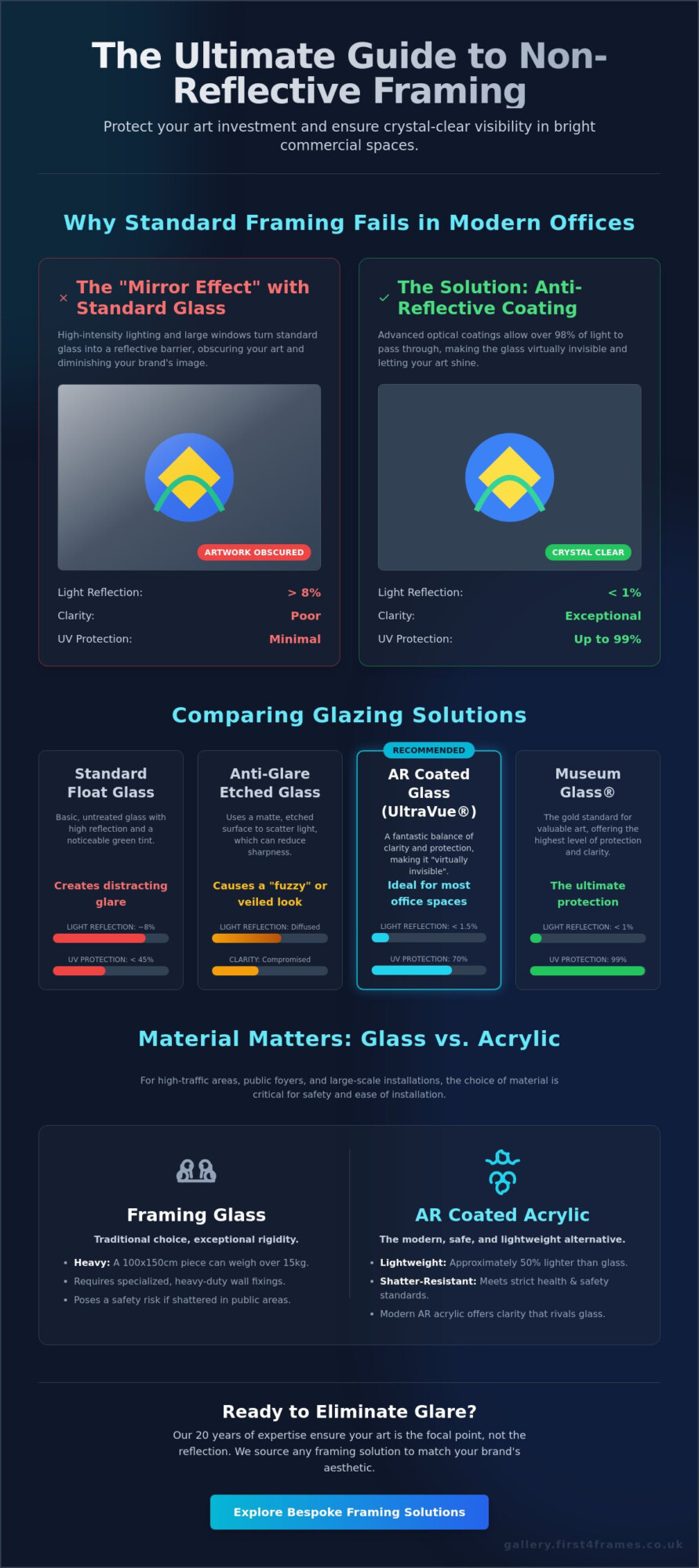
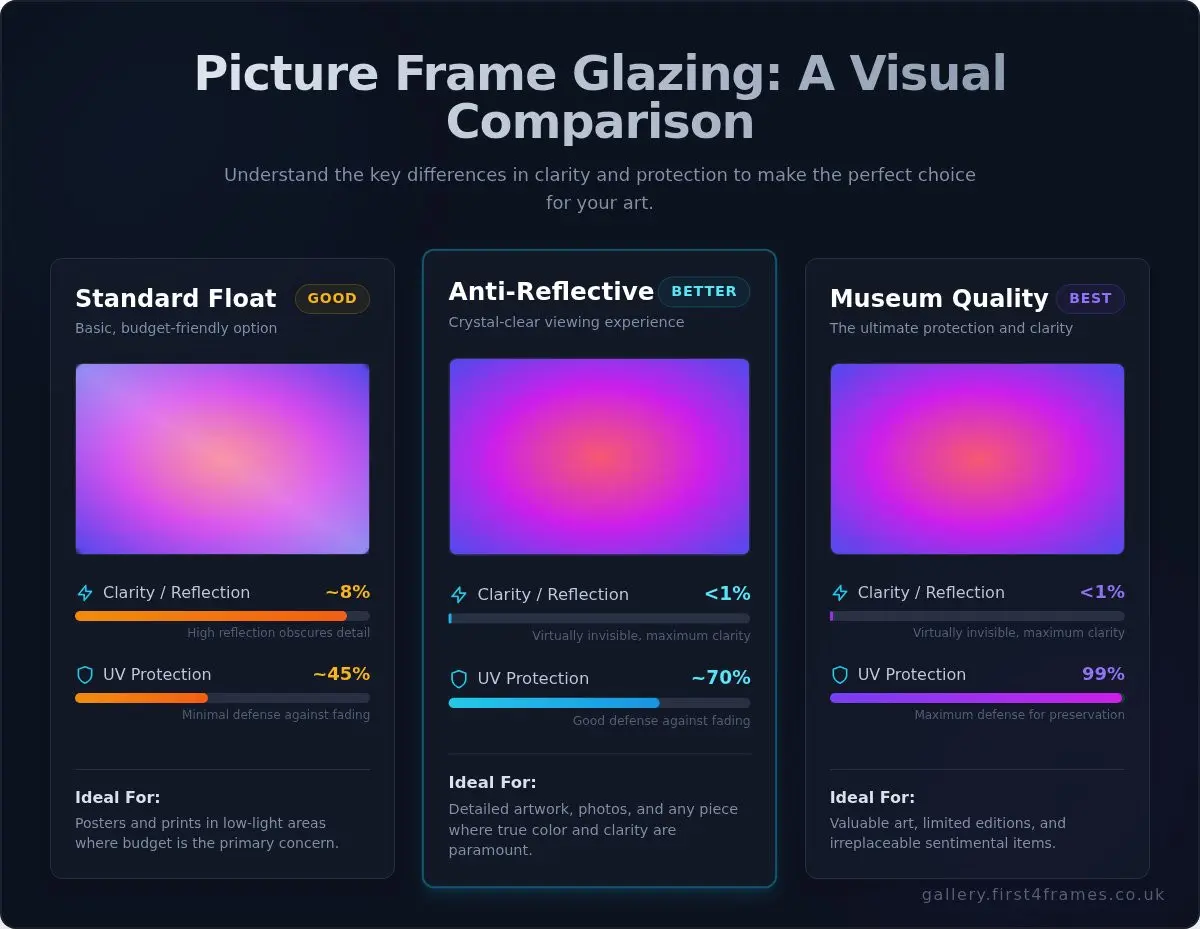
Choosing the right glazing is like selecting the perfect lens for a camera-it determines how clearly you see the picture. The glass or acrylic in your frame does more than just protect from dust; it manages reflection and shields your art from harmful light. To help you make the perfect choice for your artwork, we’ve broken down the options into a simple “good, better, best” guide that shows where anti-reflective glass for picture frames fits into the bigger picture.

Glazing Tier Clarity (Reflection) UV Protection Ideal For
Good: Standard Float ~8-10% Reflection ~45% UV Block Budget-friendly framing, posters, and prints in low-light areas.
Better: Anti-Reflective <1% Reflection ~70% UV Block Detailed artwork, family photos, and any piece where clarity is paramount.
Best: Museum Quality <1% Reflection 99% UV Block Valuable art, limited editions, and irreplaceable sentimental items.

Good: Standard Float Glass

This is the entry-level glazing you’ll find in most off-the-shelf frames. It offers basic protection from dust and physical contact but comes with significant drawbacks. Its surface reflects around 8% of light, creating noticeable glare that can obscure the details of your artwork. Furthermore, with only about 45% UV protection, it offers minimal defence against the fading effects of sunlight, making it suitable only for general-purpose framing where budget is the main concern.

Better: Anti-Reflective (AR) Glass

Here is where your viewing experience is truly transformed. Anti-reflective glass for picture frames is engineered to be virtually invisible. By using a sophisticated optical coating to reduce reflections to less than 1%, it removes the distracting glare, allowing the true colours, textures, and fine details of your art to take centre stage. It’s a spectacular upgrade that makes it feel like there’s nothing between you and the artwork. Standard AR glass also provides a better defence against fading, blocking around 70% of UV rays.

Best: Museum Glass & Optium Museum Acrylic

For treasured, valuable, or sentimental pieces, there is no substitute for museum-grade glazing. This is the pinnacle of protection and presentation, combining the incredible clarity of an anti-reflective coating with 99% UV filtering. This level of protection is the standard used by museums and professional conservators to safeguard irreplaceable works from fading and light damage. As detailed in this comprehensive conservation guide to framing glass, blocking UV radiation is critical for long-term preservation. For a shatter-resistant and lightweight alternative, Optium Museum Acrylic offers the same exceptional benefits.

The Key Benefits of Choosing Anti-Reflective Glass

Understanding the science behind anti-reflective glass is one thing, but experiencing its impact is where the true magic lies. Choosing to upgrade isn’t just a technical decision; it’s an emotional one. It’s about transforming your relationship with the art you love, removing every possible barrier to create a pure, intimate connection. Let’s explore the beautiful, practical advantages that make anti-reflective glass for picture frames a worthy investment in your home and your memories.

Unmatched Clarity: It’s Like the Glass Isn’t Even There

Imagine leaning in to admire a piece of art and seeing every delicate brushstroke, every subtle texture, and every intricate detail without a hint of glare. That is the breathtaking experience of anti-reflective glass. This incredible, ‘invisible’ effect is why it’s considered the premium glazing used by framing professionals, creating a direct and unfiltered connection between you and the artwork. It doesn’t just display your art; it invites you into it.

[Image Placeholder: A split image showing a framed picture with standard glass (heavy reflection) on the left and anti-reflective glass (crystal clear) on the right.]

True Colour Fidelity: See the Art as the Artist Intended

Standard float glass often carries a subtle green tint, a slight impurity that can dull vibrant colours and alter the artist’s original palette. Anti-reflective coatings, however, are applied to an optically pure, low-iron glass. This ensures that the colours you see are the colours the artist intended-rich, true, and full of life. For fine art Giclée prints where colour accuracy is paramount, this feature is absolutely essential for an authentic viewing experience.

Enhanced UV Protection: A Vital Shield for Your Art

While its main purpose is to eliminate reflections, premium anti-reflective glass also offers a significant level of UV protection-typically blocking up to 70% of harmful rays. Over time, UV light is the primary culprit behind fading and damage to photographs, prints, and original works. Think of this as an insurance policy for your most treasured pieces, preserving not just an image, but a memory or a valuable asset for years to come.

Reduced Distractions for a More Enjoyable Space

In a modern home with bright windows and layered lighting, a standard picture frame can quickly become a frustrating mirror. You find yourself shifting positions, closing curtains, or turning off lamps just to see the image behind the glare. With anti-reflective glass for picture frames, this problem vanishes. Your art remains a spectacular focal point day or night, allowing you to design your space for comfort and beauty, not to fight reflections.

Is Anti-Reflective Glass Worth It? A Practical Decision Guide

Let’s address the main question directly: premium anti-reflective glass costs more than standard options. We believe in transparency, and it’s important to see this not as an expense, but as an investment in the art you love. The real question is whether it’s the right investment for your specific piece. This guide is designed to help you decide with confidence.

To find the perfect balance between budget and visual perfection, consider these three key factors.

Consider the Artwork’s Value (Monetary and Sentimental)

The nature of your artwork is the best starting point. Not every piece requires the same level of protection or clarity. Think about what you are framing:

  • For original art, limited edition prints, or signed pieces: Museum-grade anti-reflective and UV-protective glass is essential. It preserves the monetary value by preventing fading and allows the artist’s true colours and textures to shine through without compromise.
  • For irreplaceable family photos and heirlooms: The sentimental value is immeasurable. Protecting these memories from light damage and ensuring they can be seen clearly from any angle makes the upgrade priceless.
  • For decorative posters or open-edition prints: If the piece is easily replaceable and displayed away from direct sunlight, our high-quality standard glass or acrylic may be perfectly sufficient for your needs.

Assess Your Room’s Lighting Conditions

The environment where your art will hang plays a huge role. The benefits of anti-reflective glass for picture frames are most dramatic in rooms with challenging light. Ask yourself:

  • Will the frame be placed opposite a bright window that gets hours of direct sun?
  • Is it going to be hung in a hallway or dining room directly under a spotlight?

If you answered yes, reflections will likely be a constant distraction. Here’s a simple test: hold an existing picture with standard glass in the exact spot you plan to use. If you see more of the room’s reflection than the image itself, an anti-reflective option will make a spectacular difference.

Budget vs. Long-Term Enjoyment

When you view the cost as part of the total bespoke framing project, it often represents a small fraction of the overall investment. This one-time upgrade ensures decades of perfect, uninterrupted enjoyment. Compare the modest additional cost-perhaps £30 to £60 depending on size-to the daily frustration of a glare-filled, poorly displayed piece. Investing in the right glass is an investment in your long-term connection to the artwork.

Ultimately, the choice is yours. Our passion is to ensure your art looks its absolute best on your wall. Get a bespoke framing quote with different glass options today, and our expert team will help you find the perfect solution for your art and your budget.

How to Choose and Care For Your Anti-Reflective Glass

You’ve learned the benefits, and now you’re ready to complete your project. Choosing the right glazing is a crucial final step in the bespoke framing journey. Here at First4Frames, we believe in empowering you with the knowledge to select the perfect finish and care for your beautiful investment for years to come.

Discussing Glazing Options With Your Professional Framer

The best way to understand the difference between glazing options is to see them for yourself. A trusted professional will have samples to demonstrate how each performs in the light. We encourage you to ask key questions to ensure you’re choosing the right protection for your artwork.

  • What level of UV protection does this glass offer? (e.g., 70%, 92%, or 99%)
  • Can you show me the difference in reflection between standard glass and this anti-reflective option?
  • Which material do you recommend for the size and value of my piece?

A passionate framer will be your partner, guiding you to a choice that perfectly suits your art and your space.

Glass vs. Acrylic (Plexiglass): Which is Right for You?

Both traditional glass and high-quality acrylic (often called Perspex or Plexiglass) are available as anti-reflective glass for picture frames. Your decision often comes down to the specifics of your project. Glass is renowned for its rigidity and superior scratch resistance, making it a premium choice for most standard-sized frames. Acrylic, however, is significantly lighter and shatter-resistant, making it the safer, more practical option for oversized artwork, frames in high-traffic areas, or pieces that will be shipped.

Cleaning and Maintenance: Protecting Your Investment

Proper care is essential to maintain the pristine, invisible finish of your anti-reflective coating. The most important rule is to never use ammonia-based cleaners (like Windex) or abrasive paper towels, as they can permanently damage the special coating.

For a perfect, streak-free finish, we recommend this simple method:

  • Step 1: Lightly spray an ammonia-free glass cleaner onto a clean, soft microfiber cloth-not directly onto the surface.
  • Step 2: Gently wipe the glass or acrylic in a circular motion to lift dust and smudges.
  • Step 3: Use a second, dry microfiber cloth to lightly buff the surface until it is crystal clear.

Following these steps will ensure your artwork remains the star of the show. To see beautiful examples of art protected by premium glazing, feel free to browse our online gallery.

The Final Frame: See Your Art, Not the Reflection

Choosing the right glazing is the final, crucial step in honouring your artwork. As we’ve explored, the difference is transformative: true anti-reflective glass provides an almost invisible barrier, offering superior clarity and vital UV protection that standard or anti-glare options simply can’t match. Making the decision to use high-quality anti-reflective glass for picture frames is an investment in the beauty and longevity of your most treasured pieces, ensuring they can be enjoyed without distraction for years to come.

At First 4 Frames, our passionate experts live and breathe this commitment to quality. With over 20 years of professional framing experience and a dedication to using only premium, conservation-grade materials, we ensure every piece is presented perfectly. Let us help you remove the reflections and reveal the true beauty of your art. Ready to see your art in perfect clarity? Explore our bespoke framing services today and discover the difference craftsmanship makes.

Frequently Asked Questions

How much more expensive is anti-reflective glass than standard glass?

As a premium product, anti-reflective glass represents a considered investment in your artwork’s presentation. While the exact cost depends on the size of the piece, you can generally expect it to be between £30 to £80 more than standard float glass for a medium-sized frame. This price reflects the advanced multi-layered coating that provides spectacular clarity, turning the glass virtually invisible so you can connect more deeply with the art itself.

Can I replace the glass in a picture frame I already own?

Absolutely. Upgrading the glazing in a beloved frame is a wonderful way to breathe new life into it and enhance the artwork within. We can professionally fit a new piece of bespoke anti-reflective glass into your existing frame, ensuring a perfect, secure fit. This simple change can make a dramatic difference, eliminating distracting reflections and allowing the true colours and details of your art to shine through without compromise.

Is anti-reflective glass the same as ‘museum glass’?

The terms are often used interchangeably, which can be confusing. “Museum Glass” is a brand name for a specific product that combines anti-reflective properties with high-grade UV protection (typically 99%). Many premium anti-reflective glass options we offer provide this same dual benefit of incredible clarity and conservation-grade UV filtering. Essentially, you are getting that museum-quality standard that protects and showcases your art perfectly.

Does anti-reflective glass scratch more easily than normal glass?

The advanced optical coatings on anti-reflective glass are more delicate than the surface of standard glass and require a little extra care. We recommend cleaning with a soft, ammonia-free glass cleaner and a clean microfibre cloth to avoid fine scratches. With proper care, its beautiful, reflection-free surface will remain pristine for years, ensuring your view of the artwork is always crystal clear. Think of it as caring for any piece of fine craftsmanship.

Is there an anti-reflective option that is also shatterproof for a child’s room?

Yes, there is a perfect solution. For spaces like a child’s room, nursery, or busy hallway, we recommend anti-reflective acrylic (often known as Perspex or Plexiglas). This premium material offers the same exceptional clarity and low-reflection properties as glass but is lightweight and shatter-resistant. It provides the ultimate peace of mind, ensuring your little one’s space is both beautiful and safe without compromising on the quality of the display.

Will anti-reflective glass stop my artwork from fading completely?

While no glazing can stop the effects of time completely, a high-quality anti-reflective glass for picture frames offers a spectacular level of protection. The best options block up to 99% of harmful UV light rays, which are the primary cause of fading and discolouration. This conservation-grade filtering drastically slows the ageing process, preserving the rich colours and fine details of your art for decades to come, especially when kept out of direct sunlight.