


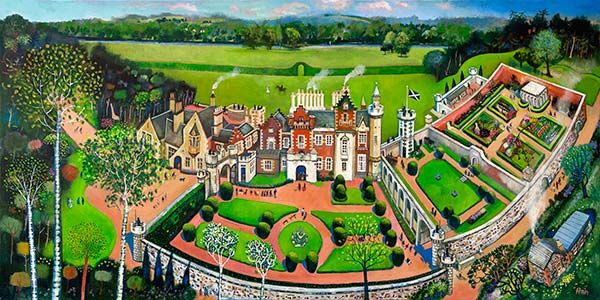
wall art for a landscape architect’s studio should do more than fill the wall beside samples, plans and project boards. It can reflect the way designed places bring structure, planting and people together. Palace of the Imagination by Rob Hain offers that connection without looking like a technical drawing. Its formal gardens and pathways reward professional eyes, while the colour and small human details keep the image welcoming for clients and colleagues.
Why a landscape architect’s studio needs art as well as project material
Studio walls naturally collect practical information. Drawings, pin-up reviews, material palettes and site photographs all have a job to do. If every visible surface is temporary or task-led, however, the room can feel unsettled. One permanent framed artwork creates a point of visual rest and shows that the practice values places as lived experiences, not only as deliverables.
The strongest choice should relate to the work without copying it. A conventional blueprint may feel too close to the documents already in the room. A generic motivational print can feel detached from the practice. Palace of the Imagination sits between those extremes. The high viewpoint makes the arrangement of gardens, buildings and routes legible, yet the painterly treatment keeps it imaginative.
What to look for in wall art for a landscape architect’s studio
| Visual quality | Why it works in a studio | Placement cue |
|---|---|---|
| Clear spatial structure | It echoes professional interest in routes, edges and relationships | Allow a direct view from the main meeting position |
| Human activity | It keeps the focus on how places are experienced | Use it where clients naturally pause |
| Layered colour | It softens screens, plans and neutral work surfaces | Repeat only one or two colours elsewhere |
| Imaginative detail | It rewards another look without interrupting concentration | Provide clear wall space around the frame |
That combination matters in a client-facing practice. Visitors may not read a drawing at the same speed as the design team, but they can respond immediately to an inviting scene. The artwork becomes a gentle conversation starter about movement, community, planting and the character of a place.
Give the picture a permanent wall, not the pin-up wall
Keep permanent art separate from the surface used for changing project work. A meeting alcove, reception wall or the end of a shared studio can provide a calmer setting. This separation protects the frame from frequent handling and prevents the picture from being buried by the next deadline.
- Map the main sightlines. Check what clients see when they enter and what the team sees from shared desks.
- Choose one stable position. Avoid a wall needed for reviews, storage or future shelving.
- Measure the framed scale. Include mount and moulding dimensions rather than judging from print size alone.
- Test the lighting. Make sure detail remains visible without strong reflections from glazing.
- Leave breathing room. Do not let sample racks or noticeboards touch the visual edge of the frame.
Use colour without turning the studio into a display set
The picture contains enough colour to enliven a practical workplace. It does not need a fully coordinated scheme around it. Pull one green into a planter, or echo a warmer note in a chair or acoustic panel. Keep desks and storage straightforward so the artwork remains the deliberate focal point.
A restrained frame can also help. Dark moulding may give the busy scene a clear edge, while natural timber can connect it to material samples and planting references. A well-proportioned mount creates a pause between the detailed image and an active studio wall. First 4 Frames can advise on that balance through a one-to-one framing consultation.
See how the artist builds places around people
Rob Hain paints cities, towns and villages with an emphasis on the people who make communities feel alive. That outlook is especially relevant to landscape practice, where successful space is measured through use as well as appearance. Explore the artist’s broader work on Rob Hain’s official website, then compare the Rob Hain collection at First 4 Frames.
First 4 Frames produces colour-managed Giclée prints and completes bespoke framing in-house at its Falkirk workshop. The process supports the fine detail and varied colour across the scene, while hand-finished presentation makes the print suitable for a professional reception, meeting area or shared studio.
Good wall art for a landscape architect’s studio can express design values without explaining them in words. View the framed Palace of the Imagination print for a lively study of planned space, built form and the people who give both meaning.