


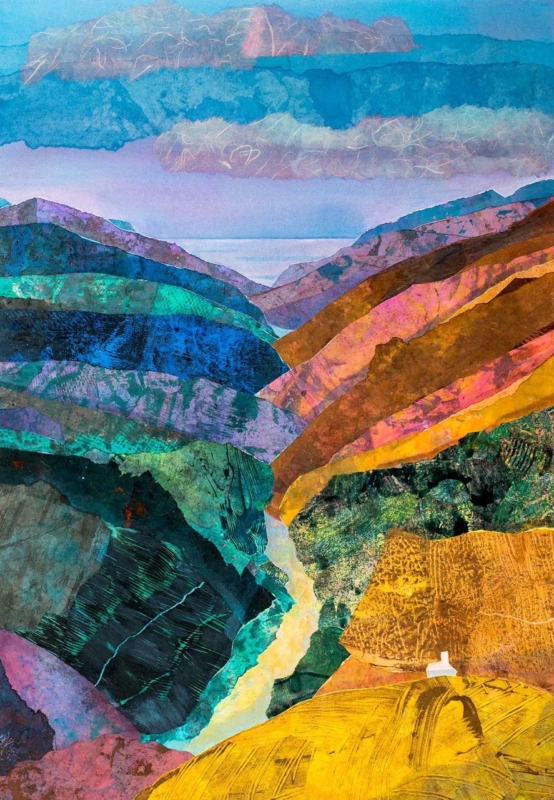
art for a room with ochre furniture should carry a warm upholstery colour into the room without making every surface yellow, brown, or gold. Avant Les Ténèbres by Emily Little offers a more layered route. Ochre rises through the foreground and right-hand hillside, while teal, violet, blue, and green open the landscape around it. The result can connect a strong furniture choice to a broader, calmer palette.
What art for a room with ochre furniture needs to balance
Ochre furniture has warmth and presence. A sofa, armchair, or upholstered bench in this colour can anchor a room, yet it can also pull nearby creams and timbers towards the same warm register. Artwork is an opportunity to widen the scheme. Cooler colour and visual distance prevent the interior from feeling dense or overly coordinated.
In Avant Les Ténèbres, the warm slope does not sit alone. Deep blue-green landforms create weight on the opposite side, a pale route leads towards the centre, and cooler water and sky recede beyond the hills. Fine drawn marks and translucent-looking layers keep the broad shapes active. These relationships make the print useful as a bridge between warm seating and cooler walls or textiles.
Build the palette in three measured steps
| Layer | Room element | Purpose |
|---|---|---|
| Warm anchor | Ochre sofa, chair, or bench | Gives the room weight and welcome |
| Cool counterpoint | Teal, blue, or violet artwork passages | Stops the palette becoming too warm |
| Quiet ground | Soft neutral wall, rug, or curtain | Allows both colour families to breathe |
Repeat colours sparingly. A small teal ceramic or one muted violet cushion can link the picture to the room. Avoid matching every passage with a separate accessory. The artwork should organise the palette, not become a checklist that fills every shelf and chair.
Use the portrait format to add height
The vertical composition makes the piece useful above a low ochre chair, beside a bookcase, or on the shorter wall at the end of a sitting area. Its rising hills lead the eye upwards, while the distant opening keeps the image from feeling closed. This can help a room with substantial furniture feel lighter and more spacious.
Measure the clear wall rather than the full elevation. The frame should relate to the furniture below but retain a visible margin on each side. Test a paper template from the main doorway and seat. From farther away, the warm and cool landforms should balance; closer viewing reveals the scratches, lines, and layered textures.
Check colour in daylight and lamplight
Warm evening lamps can intensify ochre upholstery and pull orange notes forward. Cooler daylight may strengthen the teal and violet. View the intended wall at both times. A soft wall wash can preserve the darker detail after dusk, but the light should not create glare across the glazing.
A mount can provide a calm interval between the richly layered image and the room. A dark slender moulding may sharpen the composition, while a quieter timber can connect naturally to warm furniture. Compare the actual print, wall, upholstery, and flooring before making the final framing decision.
Colour-managed detail and hand-finished framing
Layered colour depends on controlled reproduction. First 4 Frames uses colour-managed Giclée production and completes bespoke framing in-house at its Falkirk workshop. The process supports the shifts between dense blue-green, glowing ochre, pale distance, and fine surface marks while giving the finished piece a polished presence.
Emily Little studied drawing and painting at Edinburgh College of Art, and her semi-abstract work explores colour, memory, emotion, and landscape. Learn more on Emily Little’s official website, or browse the Emily Little collection at First 4 Frames.
Good art for a room with ochre furniture should expand the palette rather than simply repeat the upholstery. View the framed Avant Les Ténèbres print for a portrait landscape that brings warmth, cooler depth, and a clear route through the room’s colour.