


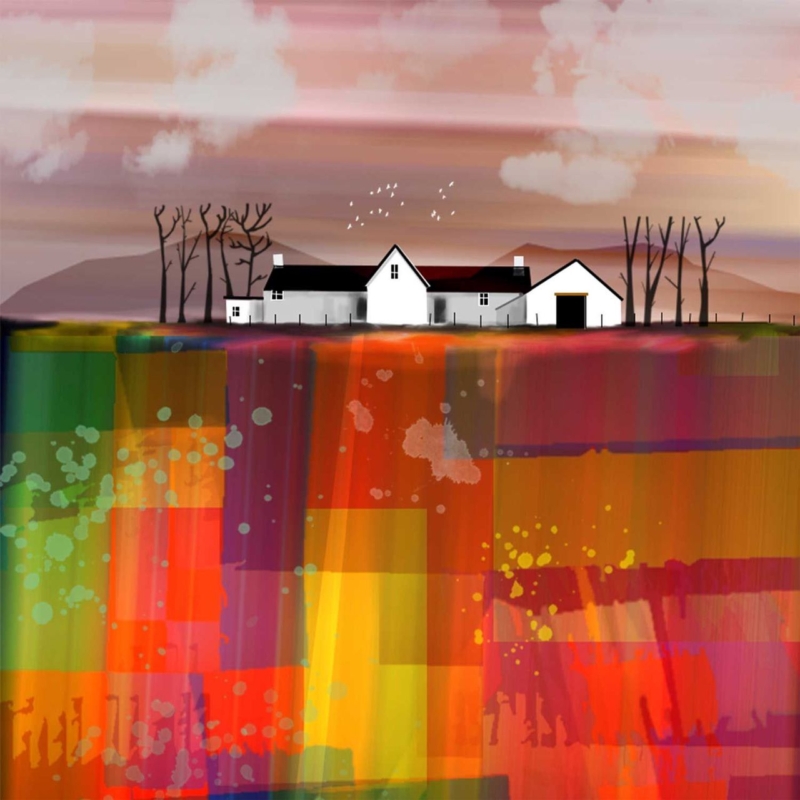
colourful wall art for a quilting room should feel at home beside fabric, thread, and works in progress without making a creative space busier. Winter Trees by Rikki O’Neill offers that balance. Its lower half resembles a glowing patchwork of red, orange, green, and violet. Above it, white cottages and bare trees form a calm horizon. The contrast gives the room energy and a visual place to rest.
Why colourful wall art for a quilting room needs structure
A quilting room already contains colour. Folded fabric, sample blocks, rulers, and pinned plans all compete for attention. The strongest artwork does not try to outdo those materials. Instead, it gathers similar visual ideas into one composed image. That makes the room feel intentional even when a project is spread across the table.
In Winter Trees, the broad bands and irregular blocks suggest piecing without copying a traditional quilt pattern. Splashes and transparent-looking layers add movement. The quieter sky and simple buildings then keep the picture open. This mix of order and experiment suits a room where careful measurement and creative instinct work together.
Give the working wall and display wall different jobs
Keep cutting instructions, reference notes, and current fabric choices close to the main table. Place the framed artwork on a separate wall, perhaps above low storage or where it is visible from the sewing machine. Dividing practical information from permanent display reduces distraction and makes tidying between projects much easier.
- Working zone: reserve pinboards and magnetic rails for changing project material.
- Storage zone: group fabric by a system you can maintain, rather than by every shade in the picture.
- Focal zone: leave clear wall around the artwork so its quieter upper half can breathe.
Echo one colour rather than the whole palette
The image contains enough colour to connect with many fabric collections. There is no need to match every tone. Pick one recurring shade, such as turquoise or burnt orange, for a chair cushion, storage label, or small tray. Let neutral shelving and the work surface hold the background. This keeps tools easy to find and allows changing textiles to remain the most flexible layer.
The square print format also helps. It can sit comfortably above a compact cabinet without stretching across valuable storage. Make a paper template using the finished frame dimensions, then view it from both the machine and the cutting table. The cottages should remain readable from a distance, while the layered foreground offers detail at closer range.
Choose a frame that settles the pattern
A simple frame will give the busy lower section a firm edge. Pale timber can relate to an oak table or shelving, while a slim dark moulding can pick up the tree silhouettes and roofline. Avoid selecting from a tiny colour sample alone. Compare the actual print with the room’s permanent finishes and the daylight used for detailed work.
First 4 Frames uses colour-managed Giclée printing and completes bespoke framing by hand at its Falkirk workshop. That in-house process supports the saturated blocks, pale sky, and crisp dark details while producing a polished piece that arrives ready to hang.
Landscape art with an imaginative edge
Rikki O’Neill is a self-taught illustrator, cartoonist, photographer, and digital artist known for vivid, characterful work. Explore more of his practice on Rikki O’Neill’s official Riko Art website, or browse the Rikki O’Neill collection at First 4 Frames.
Good colourful wall art for a quilting room can celebrate colour while making the room feel more settled. View the framed Winter Trees print for a square focal point that connects patchwork rhythm, winter calm, and a practical creative space.