

A single acidic backing board can quietly ruin a hundred hours of meticulous handiwork in under 60 months. It’s a common worry for many stitchers that a masterpiece will lose its tension or fade under the harsh glare of sunlight once it leaves the embroidery hoop. We know you’ve invested incredible patience into your craft, and the thought of a framing error causing permanent damage is genuinely stressful. You deserve a result that stays as crisp and vibrant as the day you finished it. This professional guide to framing a cross-stitch or needlepoint reveals the secrets to achieving a perfectly taut, centered finish that won’t sag over time. At First 4 Frames, we’ve spent over 20 years as a trusted artisan partner, earning top-tier ratings on Trustpilot for our bespoke craftsmanship. You’ll discover how to select UV-protective glass and choose a frame that acts as a beautiful bridge between your artwork and your room’s decor. We will cover everything from museum-grade mounting to the final aesthetic touches that turn your needlework into a lasting heirloom.
Key Takeaways
- Learn why professional “blocking” is the essential first step to square up your fabric and ensure a perfectly straight, professional finish.
- Discover the gold-standard mounting techniques, from archival lacing to stainless steel pinning, that preserve your needlework for generations.
- Explore how our signature “bridge” metaphor helps you choose the perfect materials for framing a cross-stitch or needlepoint to match your room’s personality.
- Understand how to safeguard your delicate threads from environmental damage using acid-free mounts and specialist protective glass.
- See why our customers trust our bespoke service for their most valuable heirlooms, supported by our top-rated expertise on Google and Trustpilot.
Why Framing a Cross-Stitch Requires a Specialist Approach
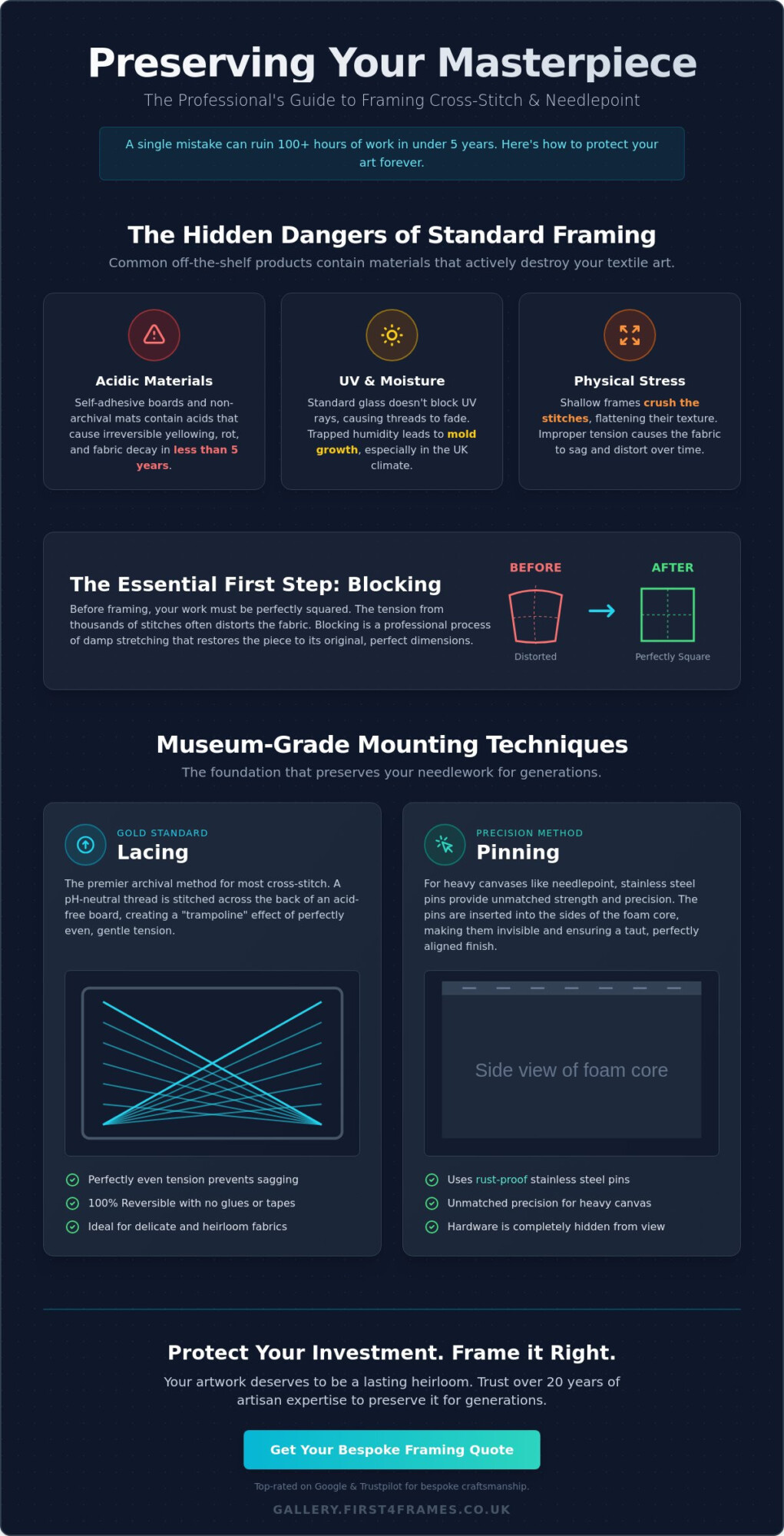
You’ve likely spent 100 or more hours meticulously completing your latest project. It’s more than just thread on fabric; it’s a piece of personal history. However, framing a cross-stitch or needlepoint requires a completely different technical skill set than framing a paper print. Textiles are organic materials that react to humidity and physical tension. Cross-stitch and other needlework techniques create internal pull that can warp the fabric over time if not correctly managed by a specialist.
To better understand this concept, watch this helpful video:

Professional framing involves “blocking,” which is the process of squaring up a piece that has become distorted through the repetitive tension of stitching. At First 4 Frames, we’ve spent over 20 years perfecting this delicate balance. We avoid “sticky” self-adhesive boards because they contain harmful acids. These chemicals eventually cause hand-dyed silks and wools to yellow and rot. We also ensure there’s sufficient “breathing room” between the glass and the fabric. This gap prevents moisture from being trapped against the fibres, which is a leading cause of mould growth in the UK’s climate.
The Danger of the ‘Quick Fix’
Standard off-the-shelf frames are rarely deep enough for needlework. When you force a textile into a shallow frame, the glass crushes the texture of your stitches, flattening the beautiful “loft” of the wool or silk. Using non-archival materials can ruin a piece in less than a decade. Our customers trust our high ratings on Google and Trustpilot because we use only premium, acid-free mounts that protect your work for a lifetime.
Identifying a Distorted Piece
Before you consider framing a cross-stitch or needlepoint, check if the canvas is “out of square.” Lay your work on a flat, gridded surface. If the corners don’t hit 90 degrees, it needs professional damp stretching. This involves carefully hydrating the fibres and pinned stretching to restore the original dimensions without snapping the delicate threads. It’s a precise task that transforms a skewed canvas back into a perfect rectangle ready for a bespoke frame.
Mounting Techniques: Lacing vs. Pinning
The longevity of your work depends entirely on the foundation. We use 5mm acid-free foam core as the base for every textile project to ensure no harmful chemicals leach into your embroidery over time. Our experts pay close attention to the fabric grain; if the weave isn’t perfectly square with the edges of the board, the final result will look skewed once it’s inside the frame. This precision is why our customers trust us with their most delicate pieces.
Why We Use Lacing for Fine Work
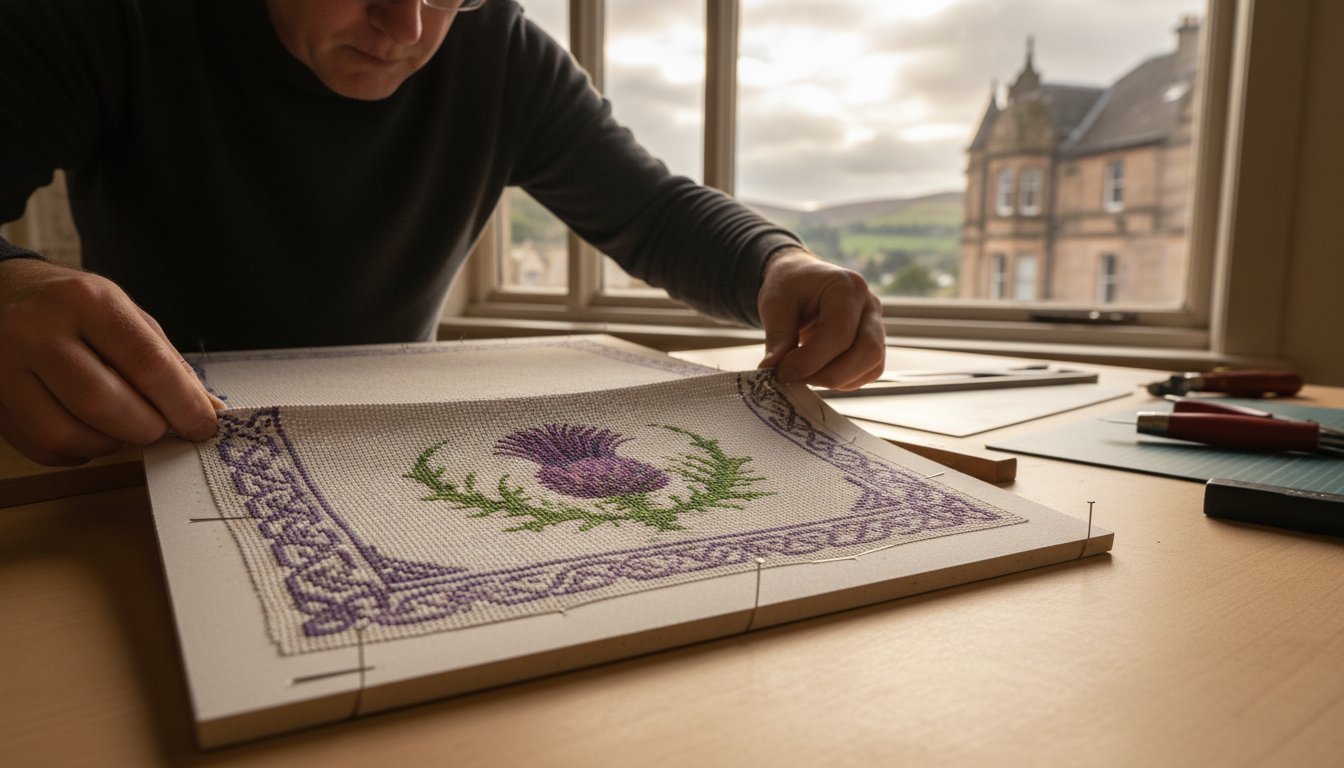
Lacing is the gold standard for framing a cross-stitch or needlepoint. We use pH-neutral thread to create a series of interlocking stitches across the back of the board. This method provides consistent, gentle tension that prevents the fabric from sagging during changes in UK humidity. Because it doesn’t involve glues or tapes, it’s 100% reversible. Professionals often refer to these archival mounting techniques to ensure the textile can be removed for cleaning or conservation decades from now without any damage to the fibers.
The Precision of Stainless Steel Pins
For heavy canvases like needlepoint, stainless steel pinning offers unmatched precision. We use specialized “lace pins” made from high-grade stainless steel to prevent rust spots. Standard pins can corrode in humid environments, leaving permanent orange stains on your work. Our team uses a technique where we insert the pins horizontally into the side of the foam core. This hides the hardware completely and allows us to pull the heavy canvas taut. It ensures every row of your stitching remains perfectly straight and aligned with the frame edge.
Our team at First4frames has spent over 20 years perfecting these methods. This commitment to quality has earned us excellent ratings on Google and Trustpilot from collectors across the country. If you’re looking for inspiration for your next project, you can browse our featured artists to see how professional mounting elevates the finished look of fine art textiles.

Designing the Perfect Bridge: Frames, Mats, and Glass
At First4Frames, we view a frame as a bridge. It’s the vital connection between your hand-stitched masterpiece and your home’s unique personality. When you’re framing a cross-stitch or needlepoint, this bridge does the heavy lifting by pulling the viewer into the intricate details of your work while anchoring the piece within its surroundings.
A mount isn’t just for show. It creates a necessary air gap between the fabric and the glass. Without this space, moisture can get trapped, leading to mould or permanent “glazing” of the threads. Experts at the Canadian Conservation Institute highlight these risks in their guide on Conservation Framing of Embroideries. Furthermore, needlepoint canvas is often 1mm to 2mm thick; you’ll need a frame with a deep rebate to house the mounting board, the textile, the mount, and the glass comfortably.
Selecting the Right Mount and Frame
A double mount adds immediate depth to your project. It creates a subtle shadow line that draws the eye toward the centre of the stitching. You can match the frame style to the era of your pattern. Whether you’re
Professional Framing vs. DIY: Protecting Your Investment
Deciding between a home project and professional help often comes down to the emotional or financial value of the piece. While a small, casual design might look fine in a standard hoop, framing a cross-stitch or needlepoint that represents months of labour requires a specialist’s touch. You’ve invested significant time and money into every single stitch. Risking that effort on a DIY attempt can lead to permanent damage like fabric distortion or acidic staining from low-quality backing boards.
Expertly framing a cross-stitch or needlepoint ensures the tension is perfectly even. This prevents the sagging effect often seen in home-framed works over time. Our professional service provides a “one-stop-shop” experience where 20 years of expertise meets premium materials designed to last a lifetime.
When to Call the Professionals
Heirlooms and large-scale tapestries are the most vulnerable to damage if handled incorrectly. If your work includes 3D embellishments like heavy beads, metallic threads, or delicate ribbons, a standard off-the-shelf frame won’t provide the necessary depth. You need a bespoke solution to keep the glass from crushing your hard work. For those looking for local expertise, you can contact First4Frames for a specialist consultation at our Falkirk workshop. We act as a bridge between your room décor and the artwork, ensuring the final result looks spectacular.
The First4Frames Quality Guarantee
We’ve spent over two decades refining our craft as a trusted artisan partner for textile artists. We source only the best materials, using acid-free mounting to prevent the yellowing that ruins fine art. This commitment to quality is why we maintain top-tier ratings on both Google and Trustpilot. We don’t just frame; we preserve your legacy. If you’re looking for inspiration on colour palettes or mounting styles, browse our online gallery to see how we elevate different artistic styles. For complex textile projects, our bespoke framing services provide the total peace of mind that your investment is safe for future generations.
Preserve the Legacy of Your Hand-Stitched Art
Your needlework represents hundreds of hours of focused dedication. Protecting that creative effort requires more than a standard shop-bought frame; it needs a specialist approach. By choosing professional lacing over damaging pinning and selecting high-quality UV-protective glass, you ensure your work won’t fade or sag as the years pass. We view the frame as the vital bridge between your home’s decor and your artistic achievement, pulling the viewer into the intricate details of your craft.
At First 4 Frames, we’ve spent over 20 years perfecting the delicate art of textile and memorabilia preservation. Our status as a top-rated service on Trustpilot and Google comes from a genuine passion for craftsmanship. When you’re considering framing a cross-stitch or needlepoint, our expert team provides the premium care your investment deserves. We’re a dedicated one-stop-shop that makes fine art preservation straightforward and accessible for every stitcher in the UK. Our expertise ensures your personal projects receive the same premium treatment as the professional artwork featured in our online gallery.
Request a bespoke framing quote for your needlework today
We look forward to helping you transform your latest project into a spectacular piece of wall art that lasts for generations.
Frequently Asked Questions
Can I frame a cross-stitch without glass?
You can frame your work without glass, but it’s not recommended if you want to protect your masterpiece from dust and atmospheric pollutants. Glass acts as a vital barrier that prevents oils and grime from settling into the delicate threads over time. When framing a cross-stitch or needlepoint, we suggest using UV-protective glazing to ensure the vibrant colours don’t fade. This professional touch keeps your artwork looking spectacular for decades.
Should I wash my needlework before framing it?
You should almost always wash your completed needlework to remove natural oils and invisible salts left by your hands during the stitching process. These residues can cause the fabric to yellow or develop spots after 12 months if they aren’t properly cleaned. Use a gentle, pH-neutral detergent and lukewarm water to soak the piece. This simple step ensures your work is pristine before it undergoes our bespoke framing process at first4frames.co.uk.
How do I get the wrinkles out of my cross-stitch?
The best way to remove stubborn wrinkles is to iron your work face down on a plush, clean white towel while the fabric is still damp. This method protects the texture of your stitches while the steam relaxes the base fibres for a smooth finish. If you’re hesitant to iron delicate threads, our team provides professional stretching services. We use our 20 years of expertise to ensure every piece is perfectly flat before it’s professionally framed.
What is the best way to centre my needlepoint in a frame?
Centring is best achieved by stretching the fabric over an acid-free foam board using stainless steel pins or archival lacing. This technique ensures the design is perfectly square and taut, acting as a bridge between your room décor and the artwork. When framing a cross-stitch or needlepoint, our artisans use precise measurements to align the design perfectly. This meticulous attention to detail is why we’ve earned a 4.9-star rating on Google and Trustpilot.
How much does it cost to have a needlepoint professionally framed?
Professional framing costs vary based on the project size and the premium materials you choose, such as specialist mounts or non-reflective glass. A bespoke frame for a 15cm square piece will require a different investment than a large-scale tapestry. For a clear idea of our quality and styles, you can browse the artists featured at gallery.first4frames.co.uk. Our transparent service ensures you receive a high-quality, handcrafted product that offers excellent value for your cherished art.