


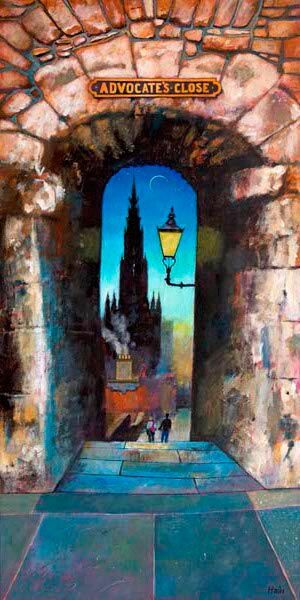
Edinburgh close wall art for a stairwell turn can make an awkward change of direction feel like a purposeful part of the home. Close Encounter by Rob Hain looks through the stone arch of Advocate’s Close towards the city beyond. Its tall format follows the rise of a staircase, while the view through the passage creates a strong sense of onward movement. The result is useful visual depth without adding furniture to a narrow route.
Why Edinburgh close wall art for a stairwell turn works
A stairwell turn is rarely a simple decorating space. The wall may be tall but narrow. The main viewpoint changes as someone climbs, and a handrail can interrupt the lower section. A portrait artwork can work with those constraints. Close Encounter leads the eye from the broad paving in the foreground, through the arch, and towards the illuminated city scene.
That composition suits movement. It does not need to be seen from one fixed chair or from directly in front. The arch reads clearly from a distance, then the smaller architectural details reward a slower view on the landing. The image also brings a recognisable Edinburgh setting into the home without using a conventional skyline.
Map the changing sightlines first
Before choosing a position, walk the stairs in both directions. Pause where the route turns and note when the wall first becomes visible. A good position should reveal most of the artwork on approach. It should also keep the framed piece clear of shoulders, moving furniture and the sweep of the handrail.
- Mark the finished frame. Use paper rather than judging from the print dimensions alone.
- Check from below. The arch should not disappear behind the landing edge.
- Check from above. The image should still look balanced when seen at a downward angle.
- Allow for the handrail. Leave enough space for hands and for safe cleaning around the frame.
- Test the turn. Carry a laundry basket or similar wide object past the paper template.
Use the picture’s depth to open the route
The stone arch acts like a frame within the frame. It gives the foreground weight, but the blue opening prevents the scene from feeling closed. This can help a stair corner that has little daylight or a blank wall directly ahead. The picture suggests another space beyond the surface while remaining clearly an artwork.
| Stairwell feature | How the artwork responds |
|---|---|
| Tall narrow wall | The portrait format uses height without spreading into the route |
| Change of direction | The close creates a visual journey through the arch |
| Limited daylight | The bright blue opening adds a controlled area of luminosity |
| Stone or timber detail | The warm masonry links naturally to textured materials |
Light the destination, not every surface
A stairwell needs safe, even lighting first. Once that is in place, check whether the picture falls into shadow at the turn. A nearby wall light or a broad ceiling beam can reveal the colour without creating glare. Avoid a tight spotlight that makes the arch look theatrical or leaves the steps around it comparatively dark.
View the glazing from several heights. A reflection that is harmless from the landing may cover the city view from lower down. Moving the light sideways is often more effective than increasing its brightness. The goal is to keep the blue opening and warm lamp legible throughout the climb.
Keep the surrounding wall calm
The painting already contains masonry, paving, architecture and small figures. A group of additional frames could make the stair turn feel fragmented. Give this piece a clear section of wall instead. If other pictures continue along the stairs, separate them from the turn and use a consistent frame line so that Close Encounter retains its role as the destination.
Colour matching should also be restrained. The turquoise paving or amber lamp may be echoed once in a runner or painted detail. There is no need to copy the full palette. Neutral walls, natural timber and darker metalwork can all support the image while allowing its depth to remain the main effect.
Finish an Edinburgh view with care
Rob Hain is a Scottish Borders artist known for lively depictions of places and the people who give them energy. Close Encounter uses a quieter viewpoint, yet the figures beyond the arch still make the city feel inhabited. Explore more work at Rob Hain’s official website, or browse the Rob Hain collection at First 4 Frames.
First 4 Frames uses colour-managed Giclée production and completes bespoke framing in-house at its Falkirk workshop. A precise, hand-finished presentation supports the crisp vertical outline and protects the detail in a busy part of the home. Secure fixings suited to the wall are especially important beside stairs.
Well-placed Edinburgh close wall art for a stairwell turn can make an awkward corner feel deeper, more connected and distinctly Scottish. View the framed Close Encounter print for an architectural focal point that gives the stairwell somewhere to lead.