


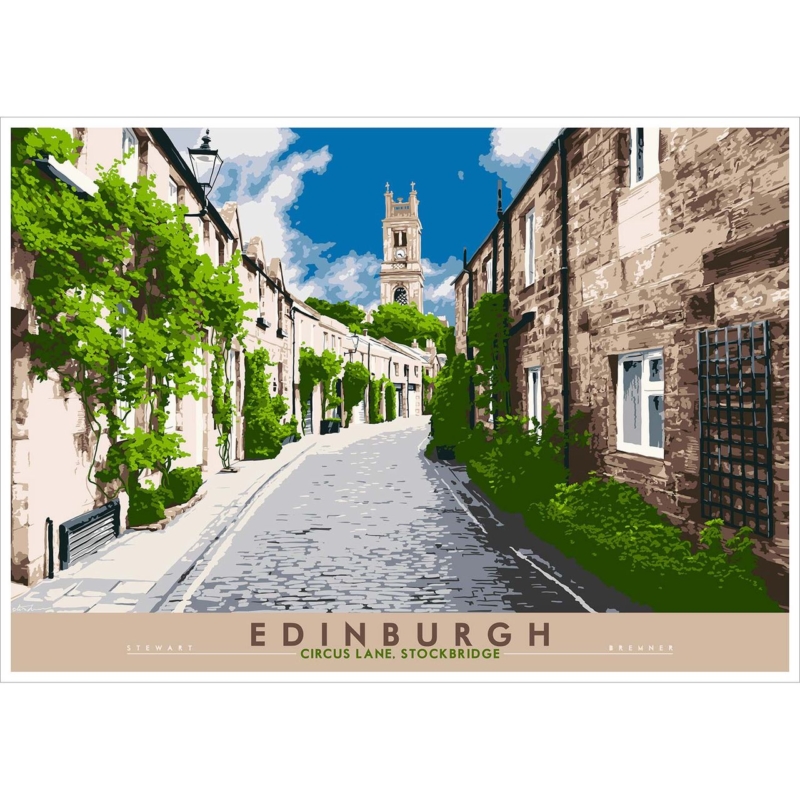
framed Edinburgh street art for a home office should connect subject, room and finished scale rather than fill an arbitrary gap. Edinburgh: Circus Lane, Stockbridge offers a specific starting point because Stewart Bremner’s view brings recognisable residential architecture into a work setting, while two print sizes can suit a cabinet wall or the area beyond a desk.
Measure framed Edinburgh street art for a home office from the desk
| Decision | Useful test |
|---|---|
| 594 × 420 mm print | Mark the full frame above a compact cabinet or on a side wall. |
| 840 × 594 mm print | View it from the doorway and seated desk position. |
| Screen relationship | Keep architectural detail clear of monitors and video-call backgrounds. |
| Lighting | Check window and task-light reflections through a working day. |
A local scene can make an office personal without motivational wording. Let Circus Lane carry the Edinburgh reference. Souvenirs, several skyline prints and tartan accessories would weaken its specificity.
Choose the wall from the working chair, not only from the empty doorway.
If the desk faces the wall, place the art beyond the monitor rather than directly behind it. On a side wall, align the finished frame with furniture instead of centring it on the entire room.
Finish framed Edinburgh street art for a home office with quiet authority
Graphic architecture and street detail need crisp colour relationships at both sizes. Colour-managed Giclée production preserves that definition, while a bespoke hand-finished frame gives the composition a professional boundary without making the office corporate.
For context on the neighbourhood represented in the print, explore Forever Edinburgh’s guide to Stockbridge. Browse the Stewart Bremner collection, then view the exact product and framing choices.
Framed Edinburgh street art for a home office can establish identity without demanding attention all day. Circus Lane works when scale, screen relationship and lighting are treated as part of the workspace plan.