


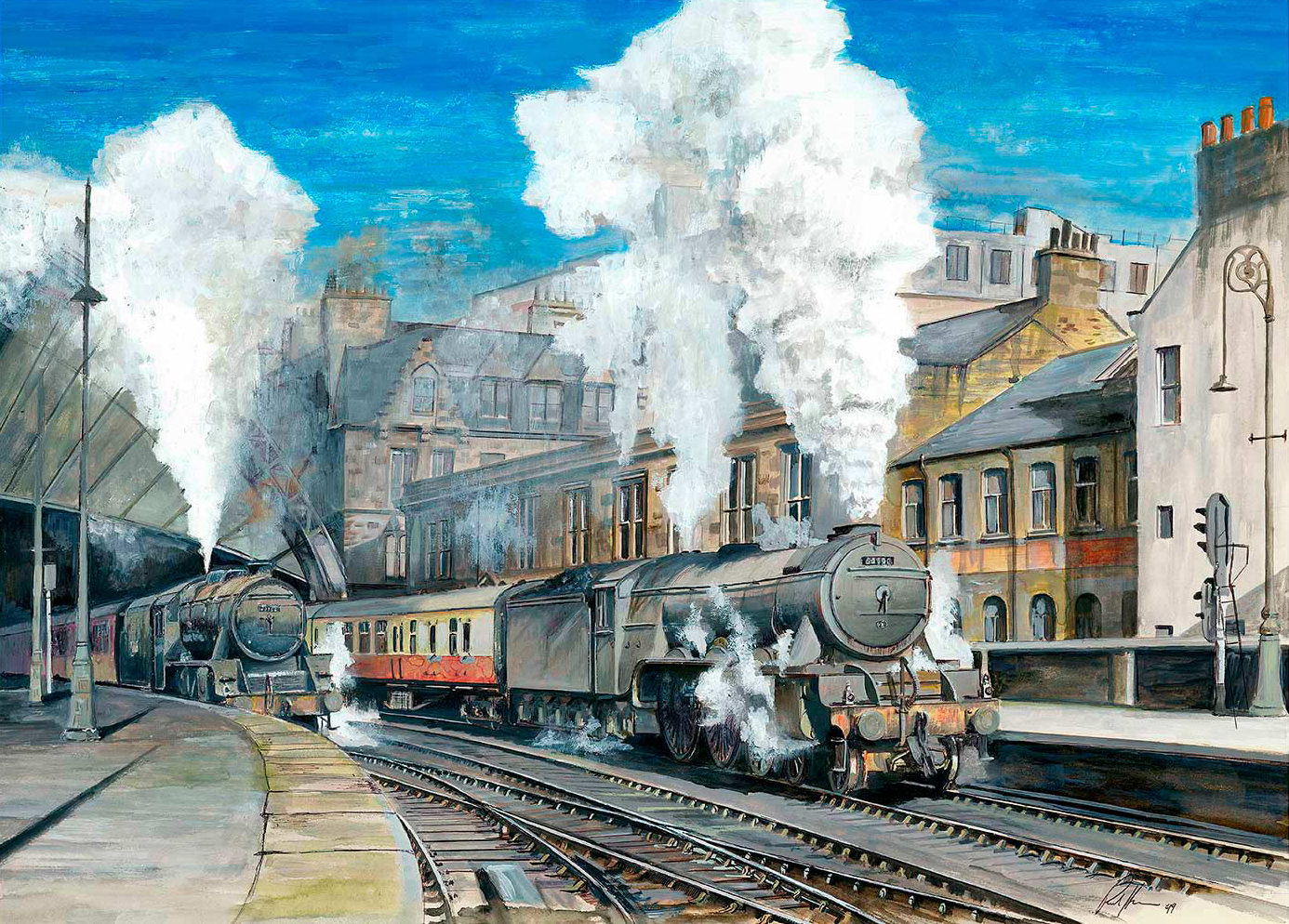
Glasgow railway wall art for a transport office can give a workplace genuine local identity without relying on corporate slogans or a generic city skyline. A3 at St Enoch Glasgow by Rod Harrison centres on a powerful A3 locomotive at the former St Enoch station. The subject connects Glasgow, engineering and movement, while the strong perspective gives it enough visual order for a reception, meeting room or shared workspace.
What Glasgow railway wall art for a transport office can communicate
Office art is often treated as a finishing detail. In a transport business, it can do more. A historically grounded railway image recognises that today’s planning, logistics and infrastructure sit within a much longer story of moving people and goods. St Enoch makes that connection specific to Glasgow rather than applying a broad transport theme to any location.
The locomotive also offers a useful visual language. Its engineering has weight, direction and precision. Tracks and station architecture lead the eye into the picture, making the composition feel active without becoming chaotic. That can suit a workplace where reliability and movement are central ideas but decorative branding needs to remain understated.
Start with the people who use the space
A reception needs a subject that visitors can understand quickly. A meeting room benefits from detail that rewards a longer look. A staff breakout area can carry a more nostalgic or conversational image. Before choosing the wall, decide whether the print should introduce the business, support discussion or give employees a stronger connection to place.
- Map the main sightline. Stand at the entrance and note the first uninterrupted wall.
- Include the finished frame. Measure the mount and moulding as well as the printed image.
- Check seated views. Meeting-room chairs may place reflections differently from the standing position.
- Protect circulation. Keep the frame clear of doors, coat storage and narrow routes.
- Review the brand palette. Look for one genuine connection rather than forcing every colour to match.
Choose the right workplace wall
| Location | What the artwork contributes | Placement check |
|---|---|---|
| Reception | An immediate link between Glasgow and transport history | Keep the locomotive visible beyond the reception desk |
| Boardroom | Structure and engineering interest without distracting text | Test glare from screens and ceiling lights |
| Project room | A reminder of long-term infrastructure and changing networks | Leave whiteboards and pinned plans enough clear space |
| Breakout area | A conversational subject with local character | Hang clear of food preparation and busy circulation |
The largest empty wall is not always the best wall. A print seen clearly on the approach to a meeting room may have more impact than one placed behind a bank of monitors. Use a paper template and walk the normal route through the office. The locomotive should read as a complete form before smaller railway details come into view.
Keep railway heritage professional rather than themed
One strong image can establish the subject. It does not need station signs, model trains or several pieces of railway memorabilia beside it. Those additions may suit a private collection, but a shared office usually benefits from restraint. Let the historic locomotive carry the reference, then use the surrounding furniture and signage to serve the practical needs of the business.
Materials can create quieter connections. Black metal, dark timber and controlled grey-blue upholstery may relate to the industrial subject without copying it. A small accent drawn from the image can link the print to a meeting chair or planter. The objective is coherence, not a literal reconstruction of a station.
Frame detail-rich railway art with clarity
Locomotive wheels, track, steam and station structure depend on clean separation. A restrained dark frame can reinforce the engineering lines, while a pale mount gives the busy subject breathing room. In a modern office with black-framed glazing, the moulding can relate to that finish. In an older Glasgow building, a warmer timber option may connect more naturally with existing doors and floors.
Glazing needs attention in workplaces with bright ceiling panels and presentation screens. View the proposed wall with all normal lights switched on. If a broad reflection crosses the locomotive, try a wall perpendicular to the windows or shift the position away from the strongest fitting. Good placement should make the art easy to see during a normal working day.
Connect the image to Glasgow’s transport story
St Enoch station gives the print historical depth and a direct city connection. Teams can explore more of that wider story through Glasgow’s Riverside Museum of transport and technology. For other locomotive and engineering subjects, browse the Rod Harrison collection at First 4 Frames.
First 4 Frames uses colour-managed Giclée production and completes bespoke framing in-house at its Falkirk workshop. This careful process keeps the detailed rail subject legible and gives the final piece the polished finish expected in a client-facing workplace. Framing advice can also account for the office lighting, wall construction and nearby finishes.
Well-chosen Glasgow railway wall art for a transport office can express local knowledge and respect for engineering without making a shared room feel like a hobby display. View the framed A3 at St Enoch Glasgow print for a historic Glasgow subject with direction, structure and lasting professional presence.