


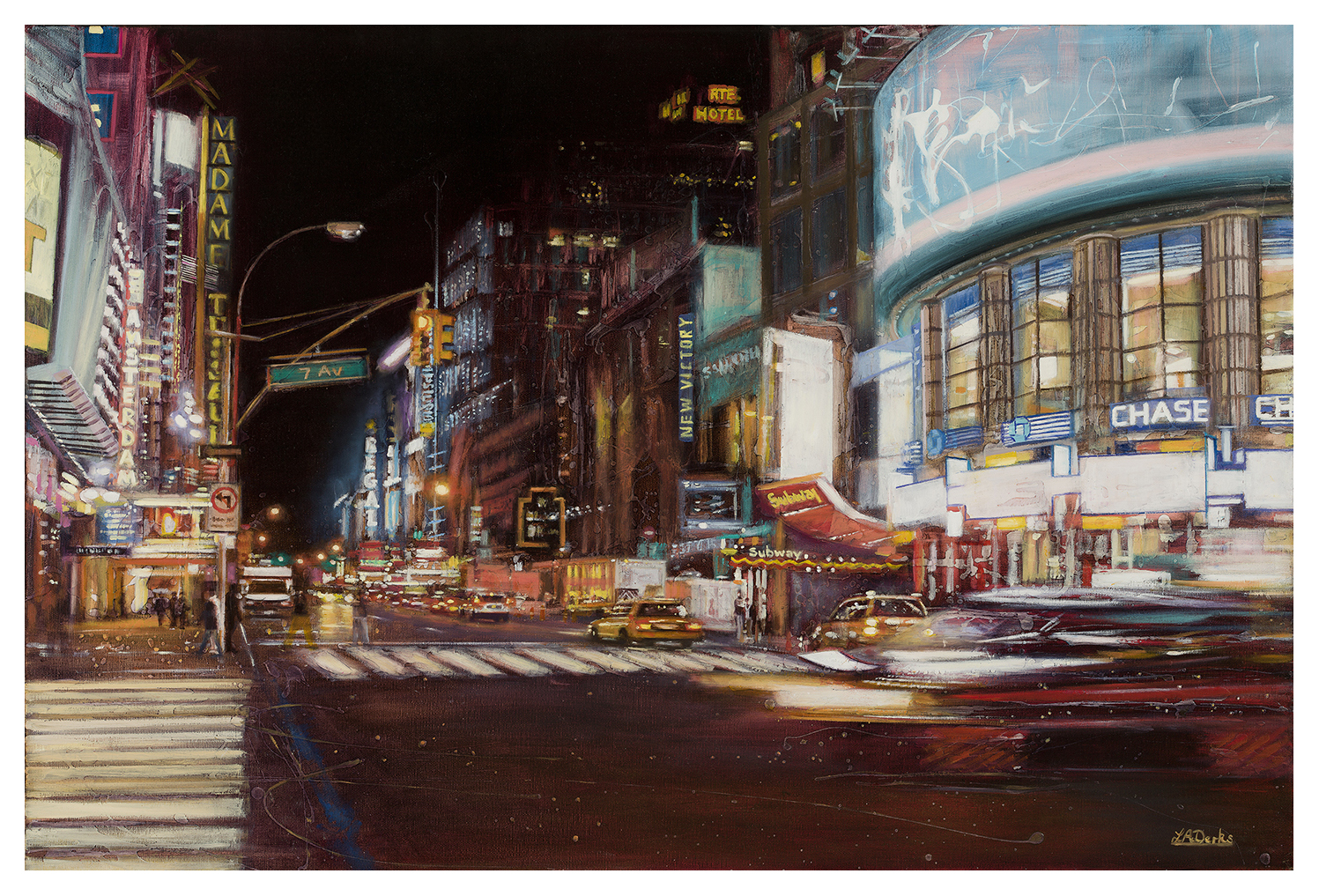
night city wall art for layered lighting should feel lively when the lamps come on, but it should not turn the room into another bright street. 7th Avenue, New York by Lesley Anne Derks captures illuminated signs, yellow taxis, wet-looking reflections and the movement of traffic after dark. Its deep central sky gives those lights room to breathe. That balance makes the print a useful starting point for an evening interior with several softer light sources.
Why night city wall art for layered lighting needs contrast
A city at night depends on bright and dark areas working together. If every part of the room is lit at the same intensity, the white signs and moving headlights lose their impact. If the room is too dark, the deeper burgundy buildings and fine street detail disappear. Layered lighting lets the artwork retain both ends of that range.
Begin with gentle ambient light for safe movement. Add one lamp at seated height and a controlled source near the picture if needed. The aim is not to make the print the brightest object in the room. It is to reveal the brushwork, traffic and architecture while keeping the black sky convincingly deep.
Build the room’s lighting in three practical layers
- Set the ambient level. Use a dimmable ceiling light or indirect source that lets people move comfortably without flattening the scene.
- Add task lighting. A reading lamp or table lamp should illuminate its own area rather than washing across the whole wall.
- Review the artwork. If the picture still falls into shadow, use a broad, carefully angled picture light instead of a narrow spotlight.
Switch each layer on separately before judging the result. This makes glare easier to trace. It also gives the room more than one evening setting. A quiet lamp may suit reading, while the full combination can support conversation or entertaining.
Control reflections before choosing the final position
The picture contains painted reflections, so real reflections across the glazing can be especially distracting. Tape a paper template to the proposed wall. Then sit in the main chairs and switch on every evening lamp. A bright shade or bare bulb should not appear over the taxis, central street or illuminated building on the right.
Moving a lamp sideways is often more successful than dimming it. A small change in picture height can also send the reflection above the main viewing position. Check the wall in daylight too. A window opposite may create more glare than all the artificial sources combined.
| Lighting issue | Useful adjustment |
|---|---|
| Lamp reflected in the centre | Move the lamp to the side or lower its shade |
| Bright signs look washed out | Reduce broad overhead light near the wall |
| Dark buildings lose detail | Add a soft source from one side |
| Glare changes by seat | Test several frame heights with a template |
Use the city colour as a concentrated accent
7th Avenue, New York carries turquoise, red, amber, cream and electric blue through a much darker field. Those accents can wake up a neutral room, but they do not all need to be repeated. Choose one cool and one warm note at most. A muted teal chair and a small rust-coloured object can connect with the image without copying Times Square.
Plain textiles are helpful near the frame. The street already contains signs, windows, crossings and moving vehicles. Busy patterns on curtains or cushions may compete with that detail. Charcoal, warm grey, dark timber and soft cream give the city lights a calmer setting.
Give the wide street scene enough visual space
The landscape format follows the direction of the avenue and the horizontal sweep of the traffic. It suits a wall above a sofa, low sideboard or long desk. Mark the complete framed size rather than only the printed image. Leave clear wall at both ends so the composition still feels expansive.
A gallery wall is not essential here. The city scene already behaves like a collection of smaller moments held inside one frame. One substantial presentation can feel more ordered than several competing prints, especially in a room that also contains screens, shelving or audio equipment.
Keep motion sharp through careful presentation
Lesley Anne Derks paints cityscapes that explore movement, light and sound rather than recording every edge literally. The blurred vehicles and broken reflections in 7th Avenue make the scene feel active, while its architecture keeps that energy organised. Explore more work at Lesley Anne Derks’ official website, or browse the Lesley Anne Derks collection at First 4 Frames.
First 4 Frames uses colour-managed Giclée production and completes bespoke framing in-house at its Falkirk workshop. That process helps the darker reds remain distinct from black, while preserving the cleaner whites and blues. A hand-finished frame gives the moving street a precise edge and arrives ready to hang.
Well-planned night city wall art for layered lighting can make an evening room feel deeper and more alive while the lighting remains comfortable. View the framed 7th Avenue, New York print for a wide New York scene that rewards both a quick glance and a longer look.