



A certificate of authenticity can be useful evidence, but its details should match the print and fit a consistent record of the edition and provenance. To understand how to verify the authenticity of a print, compare the artist, title, medium and edition details with the certificate. Then check the artist’s authentication methods and the work’s ownership history.
It’s natural to look first for a signature or certificate, but neither proves authenticity on its own. This guide explains what a certificate can establish, how edition numbers and provenance support an assessment, and why the right checks vary by artist. Use these steps to weigh the evidence before deciding what claims about a print’s authenticity mean.
Key Takeaways
- Compare a print’s edition details with its certificate, and look for consistency across the artwork and its records.
- Assess a certificate by how specifically it identifies the print, its edition and its issuer.
- Use invoices and earlier sale records to build a clearer picture of a print’s ownership history.
- Research the authentication practices relevant to the individual artist, as methods and records can differ.
Signed prints compared with documented editions
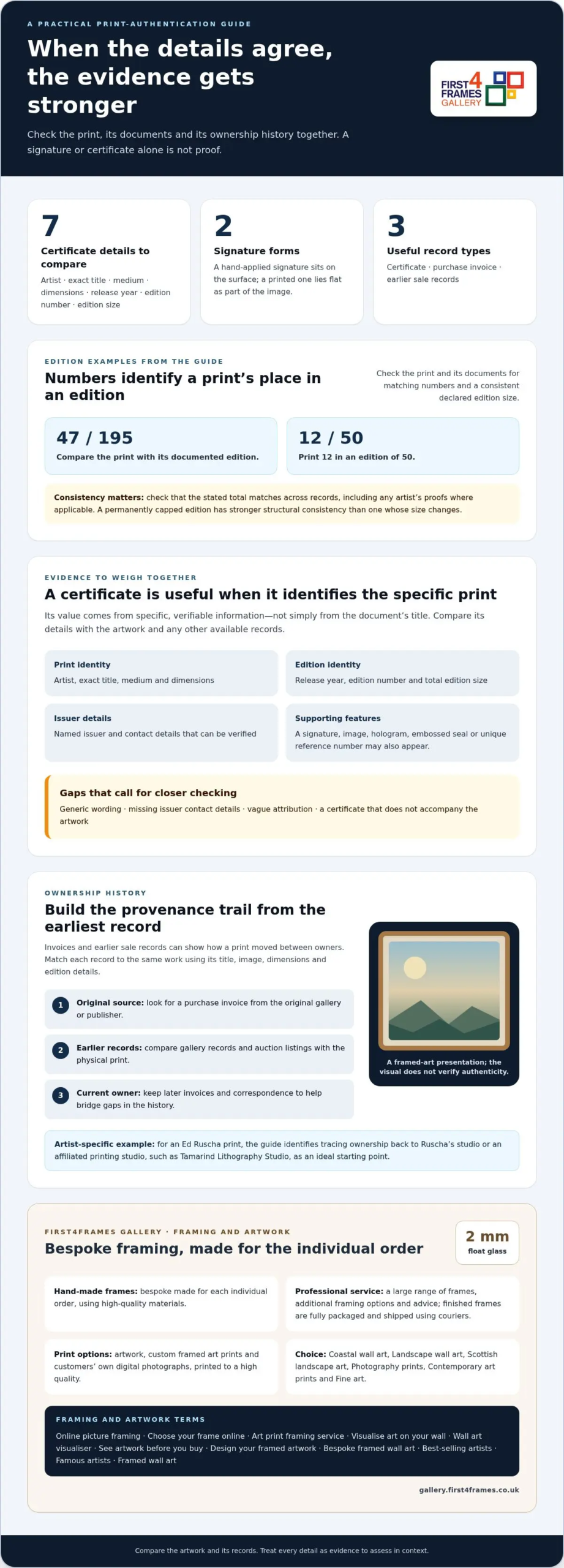
A signature can support an attribution, but edition records give it context. Compare the print with its documented edition, such as 47/195.
An original print is created as an artwork through a printmaking process; a reproduction copies an existing image. Compare the print’s production details and edition records with information about that specific work.
There is no single UK authentication or appraisal fee. The cost depends on the work and the assessment required, including whether it involves examining the print or tracing its records.
Compare the artist’s signature, edition number and printer’s mark with the certificate or edition documentation. A hand-applied signature sits on the surface and may show variations in pressure; a printed signature is part of the image and lies flat.
Paper, ink and printing technique can help when they match the edition’s recorded specifications. A difference may call for closer comparison, but materials alone cannot establish authenticity.
Signature and Edition Number Checks
A signature and edition number identify a print’s claimed place in an artist’s edition. Check the number, title and date against supporting documents rather than treating a signature as proof. A hand-applied signature shows surface variation, unlike one printed as part of the image. This distinction helps clarify what the signature actually demonstrates.
Declared Edition Size and Numbering
The declared edition size sets the total number of prints in a limited edition, while each number identifies an individual impression. Compare the print and certificate: 12/50 means print 12 in an edition of 50. Check that the stated total matches across records, including any artist’s proofs where applicable. A permanently capped edition has stronger structural consistency than an edition whose size changes.
Paper, Ink, and Printing Techniques
Compare the paper, ink and printing method with the specifications recorded for that edition. Check documents for details such as print method, ink and substrate, then see whether the physical work aligns. A printer’s mark may help identify how the print was produced, but it needs context from edition records. Differences can guide further scrutiny; appearance alone cannot settle authenticity.
What is a Certificate of Authenticity?
A certificate of authenticity records details linking a print to an artist and often to a particular edition. Its value lies in specific, verifiable information, not simply in the document’s title.
What a Certificate Confirms
A certificate identifies a print and its claimed place in an edition, allowing you to compare its details with the artwork. Look for the artist, exact title, medium, dimensions, release year, edition number and total edition size. The document should name its issuer and include contact details you can verify. It may also include a signature, image, hologram, embossed seal or unique reference number.
For a limited edition, the publisher usually issues a certificate for a specific print. Compare its details with the artwork and any accompanying records instead of treating the certificate alone as conclusive.
Documents that may accompany an authenticated print include its certificate, purchase invoice and earlier sale records. Together, these can help connect the artwork with its seller and ownership history.
These records can support provenance, the documented history of ownership and issue. A certificate can strengthen the paper trail, but it does not guarantee future market appreciation. The integrity of the edition matters more than the certificate alone.
Warning Signs in Questionable Certificates
A questionable certificate may use generic wording, omit the issuer’s contact details, give vague attribution or not accompany the artwork. These gaps make it harder to connect the document to a specific print. If a UK seller may have misrepresented a work, keep the listing, messages, invoice and photographs, then raise the discrepancy with the seller in writing.
When contacting the named publisher or gallery, provide the print’s title, edition number and a photograph of the certificate. Compare the response with the print and sales records before deciding what the paperwork establishes.
Keep the certificate flat, dry and out of direct sunlight. Store it in a folder with the invoice so the records stay together if the print changes hands.
If you’re choosing a separate artwork, explore Giclée fine art prints; a new purchase is distinct from authenticating a print you already own.

Checking artwork provenance
Provenance is the traceable history of a print’s ownership and movement between sellers. It can connect the physical work to its original source, publisher and later sales. A signature or edition number identifies a claim; invoices and sale records show how the print changed hands. To assess the history, build a timeline from the earliest available record to the present owner.
Start with the purchase invoice from the original gallery or publisher. Check that it names the artist and artwork, then compare those details with the print. An invoice that identifies only a broad category provides less context than one that names the specific work. Keep later invoices and correspondence too, as each can help bridge a gap between owners.
Earlier gallery records and auction listings can add further points to the timeline. Compare the title, image, dimensions and edition details in each record. A listing for the same artist is not enough if it describes a different work. Matching details help show that separate documents refer to the same print, rather than to a similar edition or image.
For an Ed Ruscha print, tracing ownership back to the original source is the first authentication step. Ideally, the history leads to Ruscha’s studio or an affiliated printing studio, such as Tamarind Lithography Studio. This example shows why provenance checks must be artist-specific: the relevant starting point depends on the artist and the work’s production history.
Look for unexplained gaps in ownership, but assess them alongside the records that do exist. A missing invoice does not tell the whole story; identifiable gallery documents, earlier sale records and consistent print details can still provide context. Record each owner or transaction in order, noting the document that supports each link.
To understand how to verify the authenticity of a print, compare its provenance with the publisher’s edition records and the artwork itself. Consistent dates, titles and numbering strengthen the account; conflicting details call for closer scrutiny. A clear ownership trail supports attribution, but should be considered alongside physical and edition evidence, not treated as proof on its own.
Artist-specific authentication methods
Authentication routes differ by artist, and some once-used processes no longer operate. Match your research to the artist’s estate, publisher and catalogue records.
Artist, Publisher, and Catalogue Checks
Artist-specific checks use records connected to the maker or edition, rather than relying on generic authentication advice. Contact the artist’s studio or publisher with the print’s title, edition details and photographs. Then compare their information with a relevant catalogue raisonné, a scholarly record of an artist’s works.
For Jean-Michel Basquiat, the estate stopped authenticating artworks in 2012. Its posthumous editions were authorised through Flatiron Editions and Pace Prints, so publisher records can offer a relevant line of enquiry. Enrico Navarra’s survey was first published in 1996 and updated in 2000. These records serve different purposes and should not be treated as interchangeable.
Authentication by Art Experts and Print Specialists
An art expert or print specialist can assess a work using its physical features and available documentation. In the UK, look for someone familiar with the specific artist and printmaking method, and ask for a written assessment explaining the evidence considered. An expert opinion can add context, but it is not automatically an authentication by the artist’s estate or publisher.
Past procedures matter. The Andy Warhol Foundation for the Visual Arts ceased operating its authentication board in 2012 and does not issue certificates or appraisals. The latest catalogue raisonné volume mentioned here was published in 2024 and covers 1977-1980. For Keith Haring, the foundation managed print authentication until its dissolution in 2012. A former route may no longer be available.
Francis Bacon’s estate stamped some print editions after his death in 1992; its catalogue raisonné appeared in 2016. Compare the print against the relevant catalogue and estate records, while distinguishing documented marks from later claims. For an unrelated purchase, browse fine art prints by artist.
Ed Ruscha’s artist’s proofs comprise roughly 10% of the total edition, so proof status alone should be checked against the edition record rather than treated as a guarantee. Francis Bacon reproduced roughly 36 of his paintings as print editions, making comparison with the relevant catalogue especially useful when assessing a claimed relationship to a particular painting.
First4Frames Gallery: Ready-to-Hang Framed Art
First4Frames Gallery offers Ready-to-Hang Framed Art and Custom Picture Framing. Its online picture framing gives you a large range of frames to choose from, with each frame handmade to order using high-quality materials. Choose your frame online to create custom framed art prints and bespoke framed wall art, made to suit the individual artwork. Frames come glazed with 2 mm float glass.
Whether you’re looking for framed wall art or need an art print framing service for a piece you already own, professional framing can bring the artwork and its presentation together. Explore fine art prints and framing options at the First4Frames Gallery.
Choose the Next Step for Your Artwork
Knowing how to verify the authenticity of a print helps you decide what to do next. As you explore art for your space, consider whether coastal wall art, landscape wall art or Scottish landscape art suits the room. Browse contemporary art prints and photography prints, and consider work by best-selling artists as you choose a direction.
View the artwork before you buy, then consider how it will look on your wall. A wall art visualiser can help you picture its scale and placement; you can also mark out a simple outline on the wall. Once you’ve found a print, choose a frame that complements its colours and setting.
Explore the First4Frames Gallery artwork and find a piece that feels right for your home.
Frequently Asked Questions
How can I check a print’s provenance and exhibition or sales history?
Build a dated record of the print’s ownership, exhibitions and sales, keeping each type of evidence distinct. Match exhibition catalogue entries or labels to the specific artwork, not just the artist’s name. Record seller names and transaction dates from available paperwork, then compare them with the print’s title and edition details. An exhibition record shows display history, while invoices and sale records trace changes in ownership.
What are common signs of forged signatures, edition numbers or certificates?
Look for visible alterations, such as overwritten edition numbers, inconsistent handwriting or a signature that appears unusually uniform across separate copies. Check whether the certificate and print show conflicting titles, dates or numbering formats. A mark in an unexpected position may also warrant comparison with documented examples of that artist’s prints. Treat these clues as reasons for further investigation, not proof of forgery on their own.