


A polished gallery page doesn’t prove a seller is trustworthy. The safest way to buy art online is to look for consistent signs of credibility: independent customer feedback, clear information about the artwork, and transparent policies. These tips for buying art online safely will help you judge the seller as well as the piece.
It’s reasonable to hesitate when you can’t see artwork in person. Screen colours vary, and a listing may not show details such as texture, condition or full dimensions. Take time to assess the seller’s reputation, read a range of reviews, and check the website’s security and returns information before paying.
You’ll also learn what to ask an artist or gallery, how to assess an artwork’s images and description, and how to picture its size and colours in your home. A few thoughtful checks can help you make an informed choice and find art you’ll be glad to live with.
Key Takeaways
- Compare artwork images carefully and consider how screen settings may affect the colours you see.
- Assess a seller’s reputation using customer feedback, website security and clear purchase policies.
- Ask focused questions about the artwork, its materials and the artist’s background before deciding.
- Use a gallery’s transparency and professional presentation to help judge whether it’s a trustworthy place to buy.
1. Is it just too big a risk to buy an original artwork without seeing it in person first?
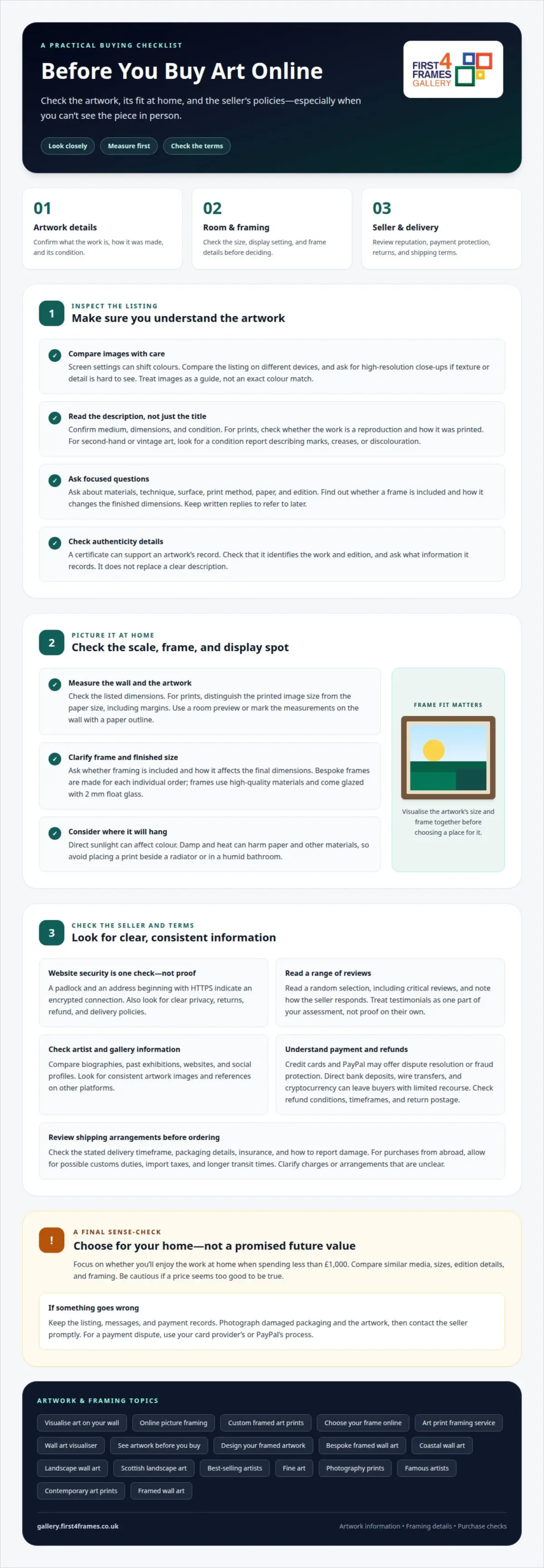
Buying an original artwork unseen involves some uncertainty, but clear images and useful details help you assess it. Screen settings can shift colours, so a painting’s reds or blues may look different on your phone and laptop. Compare the listing across devices, then request high-resolution close-ups if details or texture are difficult to see. Since a screen can’t fully reproduce an artwork’s surface, treat images as a guide rather than an exact colour match.
Measure your wall before choosing a size. Check the artwork’s dimensions, and for prints, distinguish the printed image from the paper size, including any margins. A room mock-up can help: use the seller’s image preview or mark the measurements on your wall with a paper outline. A large landscape above a sofa will make a different impression from the same print in a narrow hallway.
Choose work that suits your taste, room and budget, rather than relying on possible future value. An artist’s advice is to focus on whether you’ll enjoy a work at home when spending less than £1,000. Compare prices for similar media, sizes, edition details and framing. Be cautious if a price seems too good to be true; according to UK Government, some sellers make discounts look larger by setting an unrealistically high original price.
Before paying, confirm the medium, dimensions and condition in the listing. For second-hand or vintage art, look for a condition report that notes issues such as creases, discolouration or handling marks. For prints, check whether the work is a reproduction and how it was printed. A certificate can support authenticity, but its details should identify the artwork and edition.
Finally, consider where the artwork will hang. Direct sunlight can affect colour, while damp and heat can harm paper and other materials. Avoid placing a print beside a radiator or in a humid bathroom. If you’re choosing Giclée fine art prints, consider how the print’s materials and display location will suit your space.
2. Is the website secure?
Start with the address bar: a padlock and an address beginning with HTTPS indicate an encrypted connection. They don’t prove the seller is trustworthy, so also look for clear privacy, returns, refund and delivery policies. Check that the terms explain what happens if artwork arrives damaged, differs from its description or never arrives. If key information is hard to find, pause before entering payment details.
Assess the artist as well as the website. Compare the artist’s biography, past exhibitions and website with their social media profiles. Look for consistent artwork images and an established presence, including references on other platforms. A signed certificate can support an artwork’s authenticity, but review details such as the artist’s name and the work it identifies. Read a random selection of customer reviews, including critical ones, and note how the seller responds.
Check accepted payment methods and refund terms before checkout. Credit cards and PayPal may offer dispute resolution or fraud protection, while direct bank deposits, wire transfers and cryptocurrency can leave buyers with limited recourse. Read the refund policy for conditions, timeframes and return postage. Treat testimonials as one part of your assessment, not proof on their own, since reviews can be unreliable.
For purchases from abroad, allow for possible customs duties, import taxes and longer transit times. Read the shipping terms to understand how delivery is arranged and whether insurance applies. Check the stated delivery timeframe, packaging details and process for reporting damage. Clarify any unclear charges or delivery arrangements with the seller before ordering.
To assess whether a UK seller is legitimate, review its reputation and look for trade association membership; according to UK Government, both can help inform your judgement. If an artwork is fake, damaged or missing, keep the listing, messages and payment records. Photograph damaged packaging and the artwork, then contact the seller promptly. If a payment dispute is needed, use your card provider’s or PayPal’s process. You can also browse available artwork while considering what details make a listing clear and trustworthy.

3. Asking the artist questions before buying
A focused question can reveal details a listing leaves out. Ask the artist or gallery what materials and techniques they used, how the work was made, and whether it belongs to a limited edition. For example, “Is this an original painting or a print after an original?” clarifies what you’re considering. Ask for a written reply so you can refer back to the details when deciding.
Ask questions that help you understand how the artwork will look and feel. Find out whether the surface is textured, glossy or matte, and whether colours or details vary across the piece. For a print, ask about the printing method, paper and edition size. If you’re considering a particular frame, ask whether it’s included and how it affects the finished dimensions.
Condition deserves a direct conversation, especially for older or previously owned work. Ask whether there are marks, repairs, fading or other changes, and request close-up photographs of any imperfections. If the listing mentions a certificate of authenticity, ask what information it records and whether the artist has signed it. A certificate supports the artwork’s record, but it doesn’t replace clear details about the work itself.
Research the artist alongside your questions. Read their biography, explore their website and look for past exhibitions or shows. These details can help you understand their practice and place in the art world. For a gallery, its founders’ backgrounds and careers can also provide context about its experience with artists and artwork.
Ask for advice if you’re unsure how a work will suit your room or collection. A gallery or artist may be able to explain its scale, medium and display considerations in practical terms. Keep questions specific, such as whether a print has a border or how its condition is described. Clear, consistent answers help you make a considered choice; evasive or conflicting replies are a reason to pause and review the listing before buying.
4. Choosing a reputable online gallery
First4Frames Gallery makes it easier to assess what you’re choosing by bringing Ready-to-Hang Framed Art, Giclée Fine Art Prints and Custom Picture Framing together. Look for clear distinctions between a print and framed artwork, and consider whether the framing suits the piece. Bespoke framing is made for the individual order, rather than selected as a one-size-fits-all finish. This is useful whether you’re exploring online picture framing or custom framed art prints.
Start with your own taste and the room. You might be drawn to coastal wall art, landscape wall art or Scottish landscape art, or prefer contemporary art prints and photography prints. Search terms such as best-selling artists and famous artists can help you explore different interests, but judge each piece by its description and how much it appeals to you. To Visualise art on your wall, use your measurements and a simple room mock-up; a wall art visualiser can also help if available.
A clear buying journey lets you see artwork before you buy and understand what you’re selecting. Choose your frame online, design your framed artwork and consider how bespoke framed wall art or framed wall art will sit in your space. An art print framing service should make the artwork and framing choices easy to understand. First4Frames Gallery offers print and framing options, so you can browse its fine art and framed artwork with those decisions in mind.
According to UK Government, checking a seller’s reputation or trade association membership can help inform your judgement. For First4Frames Gallery, consider the specific offerings and framing information presented, then decide whether they suit your artwork and priorities. A gallery should help you make a considered choice, not rush you into one.
First4Frames Gallery
First4Frames Gallery helps you move from choosing an artwork to presenting it beautifully at home. If you want a print with a considered finish, its Giclée Fine Art Prints and Ready-to-Hang Framed Art offer clear ways to explore your options. For a piece you already own, Custom Picture Framing lets you choose a bespoke frame suited to the artwork.
Every frame is made by hand for the individual order using high-quality materials, and finished frames are glazed with 2 mm float glass. This is useful when fit, finish and clarity matter as much as the artwork itself. Commercial clients can also turn to Commercial Artwork Curation when selecting art for a property or workplace.
If you’d like guidance on choosing art or framing, contact First4Frames Gallery to discuss what you have in mind.
Choose art you’ll enjoy living with
Let the artwork that feels right for your space guide your next step, rather than pressure to buy quickly. The best choice is one you understand clearly and can picture enjoying over time. Use the tips for buying art online safely to make a considered decision, then think about how presentation can help the piece feel at home.
First4Frames Gallery brings together Ready-to-Hang Framed Art, Custom Picture Framing and Giclée Fine Art Prints, giving you different ways to find or finish artwork. Whether you’re choosing a framed piece or planning a bespoke look, consider how the frame, scale and subject will work together in your room.
Explore artwork at First4Frames Gallery and find a piece that speaks to you. A thoughtful choice can make your wall feel distinctly yours.
Frequently Asked Questions
Does the website have a good reputation?
A website’s reputation is more convincing when its identity and activity are consistent across independent sources. Compare the gallery’s name on artist biographies, exhibition announcements and business profiles, then check whether artists also identify their relationship with it. Look for specific customer experiences, not just praise on the gallery’s own pages. A consistent record provides more context than a single high rating or polished claim.
How do you know you can trust the website?
Check that the seller’s name is consistent across the artwork listing, checkout page and order confirmation. Before paying, save the listing and the policies that apply to your purchase. This gives you a record of what was described, including the artwork type and any edition details. If the payment recipient has a different name from the seller, pause and clarify the connection before proceeding.
Is it just too big a risk to buy an original artwork without seeing it in person first?
Buying an original unseen involves a different decision from choosing a reproduction, because each original is unique. Decide whether you value the piece for its subject, materials or connection with the artist, then weigh those priorities against what the listing lets you assess. If an important feature remains uncertain, such as the surface or a repair, factor that uncertainty into your decision rather than assuming it won’t matter.
Is it safe to buy art online?
Online art buying can be approached carefully by keeping a record of the transaction from selection through delivery. Save the product description, confirmation and messages, and compare the delivered artwork with the order details. If something differs, having those records makes it easier to describe the issue clearly. Avoid rushing because of a countdown or a seller’s pressure; take time to decide whether the artwork and terms suit you.
Is the payment process secure?
Use the seller’s usual checkout rather than a payment link sent separately in an unexpected message. Before approving a transaction, check that the amount and currency match your order and that you recognise the payment provider’s page. Don’t enter card details on a page reached through a suspicious pop-up. Keep the payment confirmation with your order records so you can identify the transaction if questions arise.
Is the website secure?
A secure connection helps protect information sent between your browser and a website, but it doesn’t establish the seller’s identity. Read the domain carefully for misspellings or extra characters, especially before signing in or paying. Avoid entering payment details on shared devices, and don’t save card information on a computer other people use. These habits add practical protection alongside checks of the seller and purchase terms.