


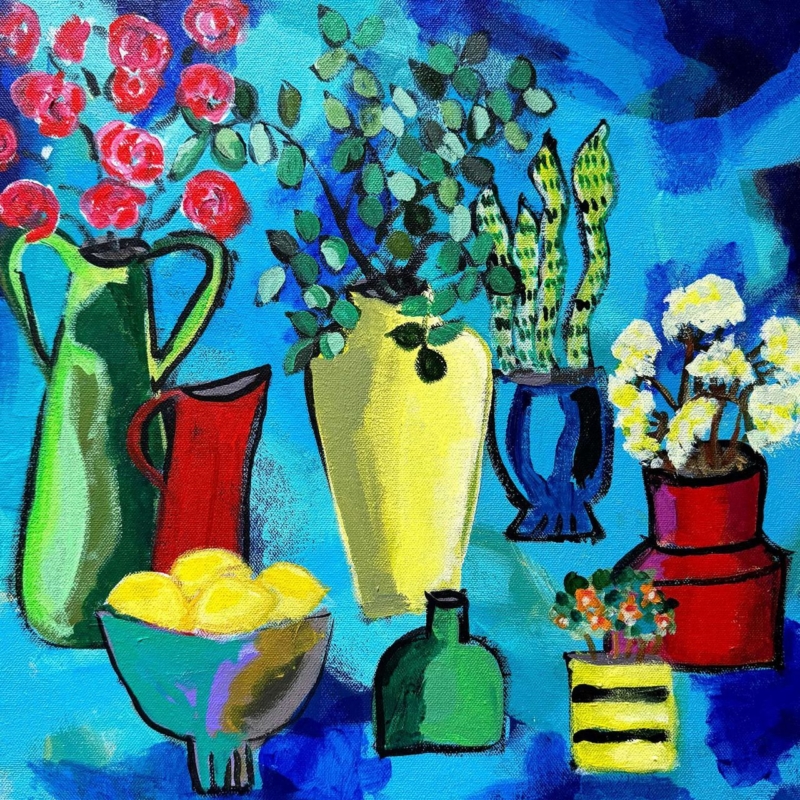
abstract landscape art becomes more useful when the artwork answers a real feature of the room. Upside Down II offers a clear example because its 265 mm, 500 mm and 800 mm square print choices allow the same composition to move from an intimate accent to a substantial focal point.
Judge abstract landscape art by distance as well as dimensions
| Print size | Likely role | Planning priority |
|---|---|---|
| 265 × 265 mm | Close-view accent | Keep nearby objects sparse. |
| 500 × 500 mm | Independent focal point | Align with a cabinet or chair grouping. |
| 800 × 800 mm | Room anchor | Confirm viewing distance and finished frame size. |
Square artwork creates a stable visual centre, but that does not mean it should be centred on every wall. Relate it to the furniture group used most often. An offset position above a sideboard may feel more balanced than the mathematical middle of a long open-plan wall.
At larger scale, remove small competing pictures from the immediate area. At compact scale, leave enough blank wall that the piece does not look like an afterthought among shelves and switches.
Use the frame to clarify an open composition
Abstract work benefits from accurate colour separation and a frame chosen for the whole composition, not one isolated tone. Colour-managed Giclée production and bespoke in-house framing give Upside Down II a precise square boundary at each available scale.
For context on abstraction and interpretation, see Tate’s guide to abstract art. You can also browse the David Short collection or view the exact framed product.
Abstract landscape art can shift role dramatically as it grows. Upside Down II makes that choice practical: decide whether the room needs a detail, a focal point or a true anchor before choosing the size.