


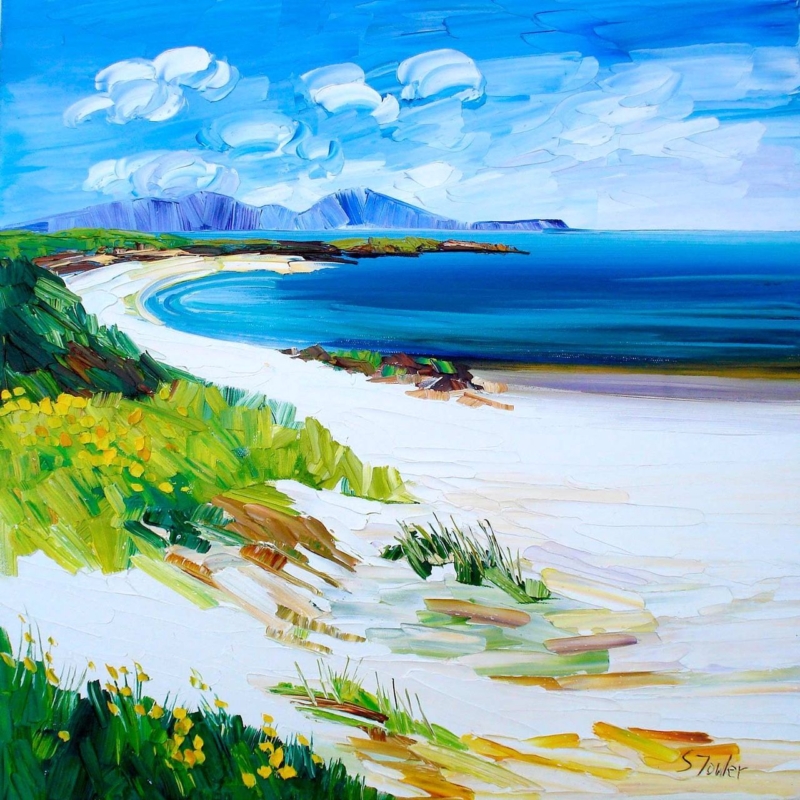
coastal wall art for a room with a limited outlook can give the eye somewhere to travel when the real window faces a wall, neighbouring building or narrow side return. Traigh Iar, North Uist by Sheila Fowler creates that sense of distance through a sweeping white beach, deep blue water and low island horizon. It does not need to imitate a window. Instead, the square painting offers a distinct, colourful destination within the room.
How coastal wall art for a room with a limited outlook creates depth
Rooms with small windows can feel visually compressed even when their floor area is generous. A landscape helps because it contains foreground, middle distance and horizon. In Traigh Iar, grasses and pale sand begin close to the viewer. The bay curves away, while distant headlands sit under a broad sky. Those layers encourage the eye to move through the image rather than stopping at the wall surface.
The square format prevents the scene from behaving like a false panoramic window. It remains clearly an artwork, with expressive palette-knife marks and saturated colour. This distinction matters. The aim is to add openness and interest, not disguise the architecture or promise a view that is not there.
Start with the sightline that needs relief
Stand where the room is used most. In a dining room, that may be a chair facing a blank wall. In a study, it could be the view beyond the monitor. In a basement sitting room, it may be the first wall seen from the stairs. Place the picture where it can interrupt the most enclosed sightline, not automatically above the largest item of furniture.
- Identify the longest seated view. Mark the wall that receives the most attention during daily use.
- Test the finished size. Make square paper templates for both available print sizes, including an allowance for mount and frame.
- Check the horizon height. It should feel comfortable from the main chair, rather than hanging close to the ceiling.
- Review natural light. Make sure the glazing does not simply reflect the limited window opposite.
- Clear the lower edge. Remove tall ornaments that block the pale beach and break the scene’s depth.
A larger version can give a substantial wall more presence, but bigger is not always more expansive. If the frame almost touches shelving or a door, the scene will feel boxed in. A smaller print with a generous area of clear wall can create a calmer pause.
Use the bright beach without making the room nautical
The painting contains turquoise shallows, cobalt water, white sand, green grasses and small yellow flowers. These colours can lift a room whose real outlook is grey or shaded. They do not require striped fabrics, shells or seaside signs. One or two connections will make the artwork feel settled while preserving its ability to open the view.
| Room element | Colour to borrow | Reason |
|---|---|---|
| Plain cushion or chair | Deep sea blue | Anchors the brighter turquoise |
| Natural timber | Warm sand and ochre marks | Stops the palette feeling cold |
| Small ceramic or lamp | Soft yellow | Connects with the foreground flowers |
| Wall colour | Warm off-white | Supports the beach without copying it exactly |
Keep patterns quiet near the frame. The brushwork already provides texture in the clouds, dunes and grassy bank. Plain upholstery and simple storage let those marks supply the room’s movement without turning a smaller space into a collection of competing surfaces.
Balance blue with warmth and solid edges
Blue can make a shaded room feel fresher, but too much cool colour may leave it feeling less welcoming. Traigh Iar avoids this through yellow-green vegetation, ochre sand strokes and dark rocky edges. Repeat one of those warmer notes in timber, woven material or a small textile. The contrast makes the water look clearer and gives the whole scheme more depth.
The dark green bank on the left also performs an important job. It forms a strong near edge before the beach opens out. A frame with enough definition can echo that boundary and separate the luminous scene from the wall. Very pale framing against a pale wall may lose the crisp edge that helps the image read as a deliberate focal point.
Manage reflections in a room with awkward daylight
A limited outlook does not always mean low light. A close neighbouring wall can reflect a bright patch directly into glazing, while a small high window can produce strong glare at one time of day. Tape the paper template in place and observe it through morning, afternoon and evening. A move of only a few centimetres, or choosing the adjacent wall, may keep the horizon visible.
Artificial lighting should reveal the picture rather than flatten it. A lamp positioned to one side can bring out the variation in blue and the expressive cloud shapes. Avoid a bare spotlight directly opposite the glass. The goal is an inviting visual pause during both daylight and evening use.
Preserve the separation between sand, sea and sky
Sheila Fowler paints Scottish landscapes and coastlines with expressive brushwork, palette knife and rich colour. Traigh Iar depends on subtle separation as well as bold blue: pale sand shifts into shallow water, deeper sea meets a narrow headland, and white cloud marks move across the sky. Explore more of her work at Sheila Fowler’s official website, or compare the Sheila Fowler collection at First 4 Frames.
First 4 Frames uses colour-managed Giclée production and completes bespoke framing in-house at its Falkirk workshop. That process helps the pale beach remain distinct from the cloud whites, while retaining the turquoise transitions and darker blue water. A hand-finished frame then gives the open landscape a calm, precise edge within the room.
Well-placed coastal wall art for a room with a limited outlook can make an enclosed sightline feel more generous without pretending the artwork is a substitute for a real window. View the framed Traigh Iar, North Uist print for a North Uist scene that brings light, colour and convincing visual distance to the wall.