


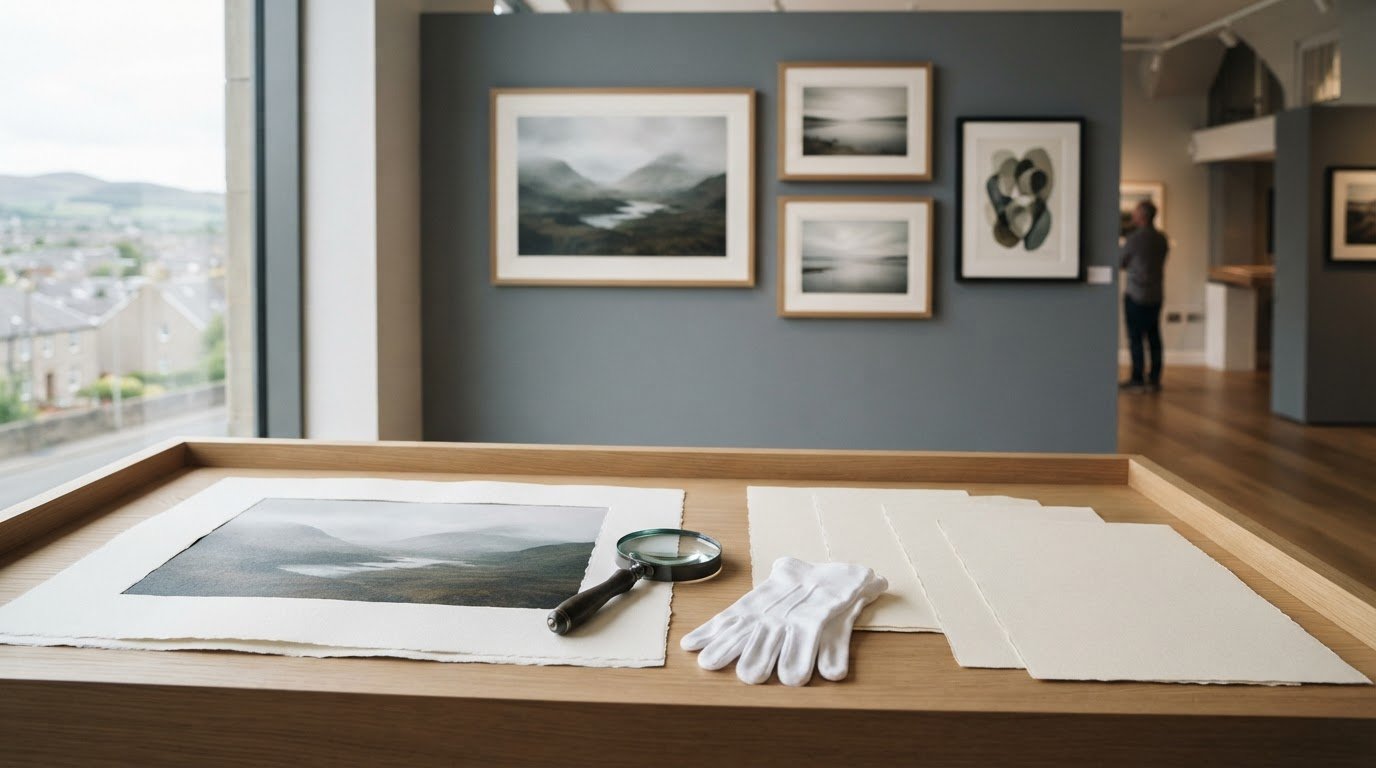
A lower number on an art print doesn’t automatically make it better or more valuable. If you’ve looked at a mark such as 7/50 and wondered what the two numbers mean, you’re not alone. Understanding art print edition numbers starts with separating what the mark records from what it can’t tell you: the first number usually identifies the print’s place in the edition, while the second gives the edition’s stated size. Practices vary, so the surrounding artwork information matters too.
This guide explains how to read the numerator and denominator, what edition size tells you, and how limited editions differ from open editions. You’ll also learn why a number alone can’t establish a print’s quality or value, and which other details to consider when choosing artwork. With a clearer picture of the edition, you can explore fine art prints with more confidence and plan how the artwork will look in your home.
Key Takeaways
- Understanding art print edition numbers helps you interpret edition details, but the number isn’t a measure of quality or value.
- Distinguish limited editions from open editions, and remember that different sizes or print processes may have separate edition counts.
- Read edition numbers alongside other artwork details. Signatures and proof marks provide different information, and conventions can vary.
- Choose artwork that speaks to you, then use edition details as context while exploring themes such as Scottish landscape art, coastal wall art and contemporary art prints.
What Do Art Print Edition Numbers Mean? Read the Mark at a Glance
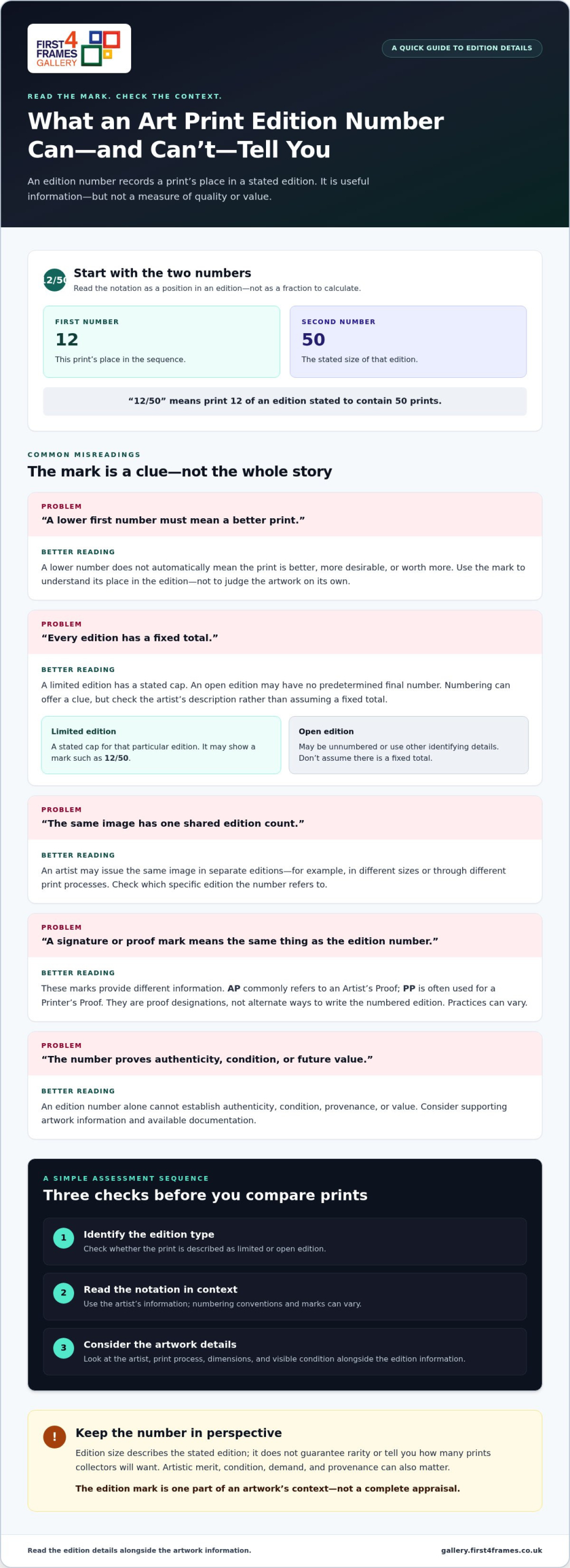
Edition numbers identify a print’s position within a stated edition. A mark such as 12/50 commonly means that the print is number 12 in an edition of 50. The first number identifies its place in the sequence; the second gives the stated edition size.
Edition size is the total number of prints stated as belonging to a particular edition. It describes the edition, but doesn’t guarantee rarity or tell you how many prints collectors will want. A lower first number doesn’t automatically mean the print is better, more desirable or worth more. Understanding art print edition numbers helps you read the notation, not judge the artwork by the mark alone.
How to read a number such as 12/50
If a print is numbered 12/50, read it as “print 12 of an edition stated to contain 50 prints”, not as a fraction to calculate. The artist’s information provides the best context for interpreting the number. If the mark is unclear or uses a different format, look for the accompanying artwork details rather than assuming the usual convention applies.
Where edition details may appear
Numbering is often written in the print’s margin, the unprinted border around the image. Edition information may also appear on an accompanying label, certificate or artwork description. Signatures and other marks are separate details. For example, an Artist’s Proof is a distinct printmaking designation, not another way of writing the edition fraction.
Artists and printmaking practices vary, so the placement, wording and marks aren’t universal. Read the number alongside the artist’s description to understand what the stated edition covers. This provides useful context, while print quality and personal appeal should be considered on their own merits.
Limited Edition vs Open Edition Prints: What the Number Tells You
A limited edition has a stated cap for that particular edition. An open edition may have no predetermined final number, so it can be produced without the same declared limit. Numbering can offer a clue, but the artist’s description is important because practices and ways of presenting edition details vary.
Does a smaller edition mean a more valuable print?
Not by itself. A smaller edition may mean fewer prints were made in that particular run, but scarcity is only one part of a print’s context. Artistic merit, condition, demand and provenance can all matter. No edition number guarantees authenticity or future resale value. Christie’s collecting guide offers further context on prints and multiples, including the idea of an original print. Treat the edition mark as useful information, not a promise of price.
Can one artwork have more than one edition?
Yes. An artist may issue the same image in separate editions, for example in different sizes or through different print processes. Don’t assume that the numbers belong to one shared count. Check the details for the specific print to see which edition its number refers to.
Once you understand what an edition label can tell you, explore artwork that suits your space and taste in the online art print gallery.

How to Assess Art Print Edition Details Before You Choose
Use this sequence to assess edition information without reading too much into the number:
- Identify the edition type. Check whether the print is described as limited or open edition.
- Read the notation. Interpret the number using the artist’s information, rather than assuming every mark follows the same convention.
- Check the artwork details. Consider the artist, print process, dimensions and visible condition alongside the edition information.
Signatures, proof marks and edition numbers are different details. A signature may identify or be attributed to the artist, while a proof mark describes a print’s relationship to the edition or production process. Their use can vary between artists and printmaking practices. Christie’s collecting guide offers further background on limited editions and how prints are made.
What do AP, PP or other proof marks mean?
AP commonly refers to an Artist’s Proof, while PP is often used for a Printer’s Proof. These are proof designations, not alternative ways of writing the numbered edition. Interpret them alongside the specific artwork information. Their meanings, use and numbering practices can differ, so don’t assume a universal quantity or significance from the letters alone.
What edition numbers cannot prove on their own
An edition number by itself doesn’t establish authenticity, condition, provenance or value. It tells you something about a print’s place in a stated edition, but it can’t provide a complete account of the artwork. Look for supporting information that identifies the artist, process and edition, and consider any available documentation. This broader context makes understanding art print edition numbers more useful when comparing prints.
An edition number is one part of an artwork’s context, not a complete appraisal. Keep that in mind as you browse the art print and framed art gallery, weighing the edition details alongside the image that feels right for your space.
Choose and Display an Art Print with Confidence
Choose a print because you enjoy looking at it, then use its edition details as context. Understanding the number can inform your decision, but it needn’t outweigh the image or how it will look in your home. Explore fine art, Scottish landscape art, coastal wall art, photography prints and contemporary art prints. A wall art visualiser can help you visualise art on your wall and see artwork before you buy.
Pair a print with a considered frame
A well-chosen frame completes an artwork’s presentation without changing what its edition number means. First4Frames Gallery creates bespoke framed wall art, with each frame individually crafted to order from high-quality materials. Unlike cheap, standard frames that may not fit artwork properly, a bespoke frame is made for the individual order. With Online picture framing, you can Choose your frame online and Design your framed artwork to suit the print and your space. The Art print framing service uses 2mm float glass, offering superior clarity to the perspex used by many competitors.
Explore artwork and plan the finished display
Browse an extensive online selection of artwork and frames, including framed wall art featuring works by best-selling artists and famous artists. Find Custom framed art prints and consider how the frame will complement the image. For digital photographs, the online photo printing and framing service combines high-quality printing with bespoke framing. Finished framed orders are fully packaged to help prevent damage and shipped via professional couriers.
Explore the framed art and print gallery to find an image that feels right for your space.
Choose a Print That Feels Right for Your Space
Understanding art print edition numbers gives you a useful starting point: the first figure commonly shows a print’s position, while the second indicates the stated edition size. The mark alone doesn’t prove a print’s quality, authenticity or future value. Read it alongside the artwork information, and remember that edition practices can vary.
Use those details as context, then let the image, artist and the way it will look in your home guide your choice. First4Frames Gallery offers Giclée fine art prints from a range of artists, primarily from Scotland, with bespoke frames individually crafted for each order using high-quality materials. Thoughtful framing helps the chosen artwork feel at home on your wall.
Ready to find an image that speaks to you? Explore framed art prints in the gallery and discover artwork you’ll be glad to display.
Frequently Asked Questions
What does 12/50 mean on an art print?
12/50 commonly means print number 12 in a stated edition of 50. The first number identifies the print’s place in the edition, and the second gives the edition size. Read the notation alongside the artist’s description because numbering practices can vary. The mark provides edition context, but it doesn’t by itself tell you about the print’s quality or value.
Is a lower-numbered art print more valuable?
No. A lower number doesn’t automatically make a print more valuable. A number such as 2/50 records its position in the edition, not its quality or desirability compared with 28/50. Value can depend on factors such as the artist, demand, condition and provenance. Treat the number as one piece of information, not a guarantee of a particular price or future resale value.
What is the difference between a limited edition and an open edition print?
A limited edition has a stated cap for that particular edition. An open edition may not have a predetermined total, so it can be produced without the same declared limit. The artwork’s description should clarify which type it is. Artists may also issue separate editions for different sizes or print processes, so don’t assume all versions share one edition count.
Do all art prints have edition numbers?
No, not all art prints are numbered. Open editions may be unnumbered, and artists or printmaking practices can use different ways to identify a work. You may find information in an artwork description or accompanying documentation instead. If a print has no edition number, that alone doesn’t establish its quality, authenticity or value. Consider the artwork details as a whole.
What does AP mean beside an art print edition number?
AP commonly stands for Artist’s Proof, a proof designation associated with the artist and distinct from the numbered edition. It may appear beside a print rather than as a fraction such as 12/50. Proof practices and meanings can vary by artist and print process, so interpret the mark using the accompanying artwork information. An AP mark alone doesn’t prove greater quality or value.