Posted on

How to Frame a Silk Painting: A Careful Step-by-Step Guide

How to Frame a Silk Painting: A Careful Step-by-Step Guide

A silk painting needs to be treated as a textile before it’s treated as a picture. If you’re wondering how to frame a silk painting without pulling the fabric unevenly or letting glazing press against its surface, start by considering how the silk is supported. A thoughtful presentation can also help the piece sit beautifully alongside other framed art in your home.

It’s natural to feel cautious: silk is delicate, and a frame that works for a paper print may not suit a textile. As you plan the display, consider the artwork’s colours, scale and surroundings, whether you’re pairing it with Coastal wall art, Scottish landscape art, Fine art or Contemporary art prints. A Wall art visualiser can help you Visualise art on your wall before deciding on an arrangement.

This guide explains how to support and frame silk carefully, and when bespoke framing may be a sensible choice. If you’re exploring Online picture framing, comparing Custom framed art prints or looking to Choose your frame online, keep the artwork’s individual needs in mind. The same thoughtful approach can help you Design your framed artwork and find a place for Photography prints or Bespoke framed wall art, too.

Key Takeaways

  • Think of silk as a delicate textile: plan how to support it without disturbing its painted surface.
  • When considering how to frame a silk painting, choose a setup that holds the fabric evenly and keeps it clear of the glazing.
  • Follow a careful sequence, beginning with clean hands and a clear work surface, then inspect the artwork before framing.
  • If the piece needs an individually considered fit or presentation, bespoke framing offers another route. First4Frames Gallery professionally frames customer-supplied artwork in-house.

Why framing a silk painting calls for a textile-first approach

A silk painting may look like a flat picture, but its support behaves differently from paper. Silk is flexible, so it can shift, sag or crease if it isn’t supported evenly. The painted surface also needs space: pressure from a mount or contact with glazing can affect how the work sits and looks.

Textile-first framing means supporting the fabric evenly while keeping its painted surface undisturbed. That principle is central to how to frame a silk painting. The aim is to give the material a stable presentation without pulling it taut, trapping folds or allowing the glazing to rest against it.

What makes a silk painting different from a paper artwork?

Paper usually holds its shape as a sheet; silk can move with handling and gravity. A small fold may become more noticeable once the work is displayed, while uneven support can leave one area slack and another under tension. Touching the painted face may also leave handling marks. Handle the artwork gently, and don’t try to smooth, stretch or flatten it by force.

What should you consider before choosing a frame?

First, establish whether the silk is already mounted or remains loose. A mounted piece may have a support that affects the frame depth and how it can be presented. With loose silk, the support and fitting need particular thought so the fabric can sit evenly without being compressed.

Consider the painting’s overall size, visible condition and intended display position. A larger piece may need a different support approach from a small one, while the available wall space can help determine a suitable frame proportion and orientation. Plan for clearance between the silk and glazing, too: the painted surface shouldn’t rest against the glass.

If you notice existing creases, distortion, fragile areas or other condition concerns, pause rather than trying to correct them as part of a DIY framing project. A qualified textile conservator can assess the artwork before framing. Careful assessment helps you choose an approach that respects the piece instead of forcing it to fit a standard frame.

Choose suitable support, mount and glazing for a silk painting

Support, mount and glazing work together, but each has a different job. The support steadies the textile, the mount helps position it within the frame, and the glazing provides a front barrier. Base these decisions on the silk’s construction and condition, not a one-size-fits-all method. This is an important part of how to frame a silk painting without pulling or compressing it.

How should the silk be supported?

Aim for even, stable support that holds the artwork in position without stretching it excessively. The right attachment and tension method depends on whether the silk is loose, already mounted or has areas that need particular care. Don’t treat adhesives, pins or stitching through the artwork as universal solutions. Any of these may be unsuitable for a particular piece, so avoid choosing a method without considering the textile’s construction and condition. The American Institute for Conservation’s Textile Conservation Catalog offers further reference on textile conservation methods and material considerations.

Should glazing touch a silk painting?

Don’t assume the painted surface can safely rest against glass or acrylic. Contact may press against the textile, so consider a mount or frame spacing that creates a clear gap where appropriate. The amount of clearance and the framing arrangement should suit the artwork, not just the frame’s appearance.

First4Frames Gallery uses float glass as standard. The glazing choice should still be considered alongside the silk’s support and the space needed between the artwork and the glass. Float glass is not specialist conservation glazing, and no UV-filtering or conservation properties are claimed for it. For more on framing options, read the custom picture framing guide. You can also browse framed artwork for presentation ideas.

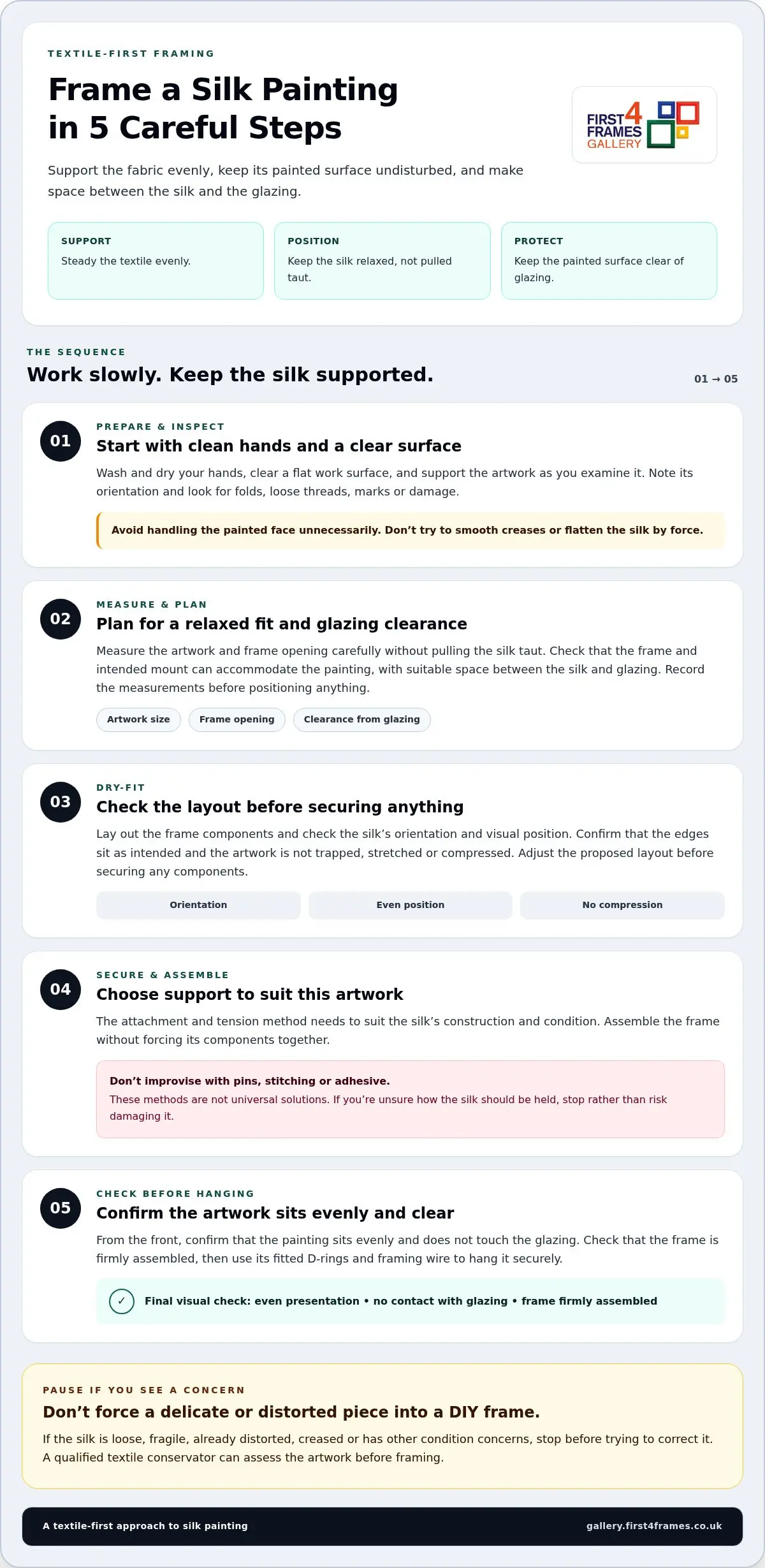
How to frame a silk painting step by step

Work slowly and keep the silk supported throughout. If the fabric is loose, fragile or already distorted, don’t try to correct it by pulling or pressing. Pause before proceeding with a DIY frame.

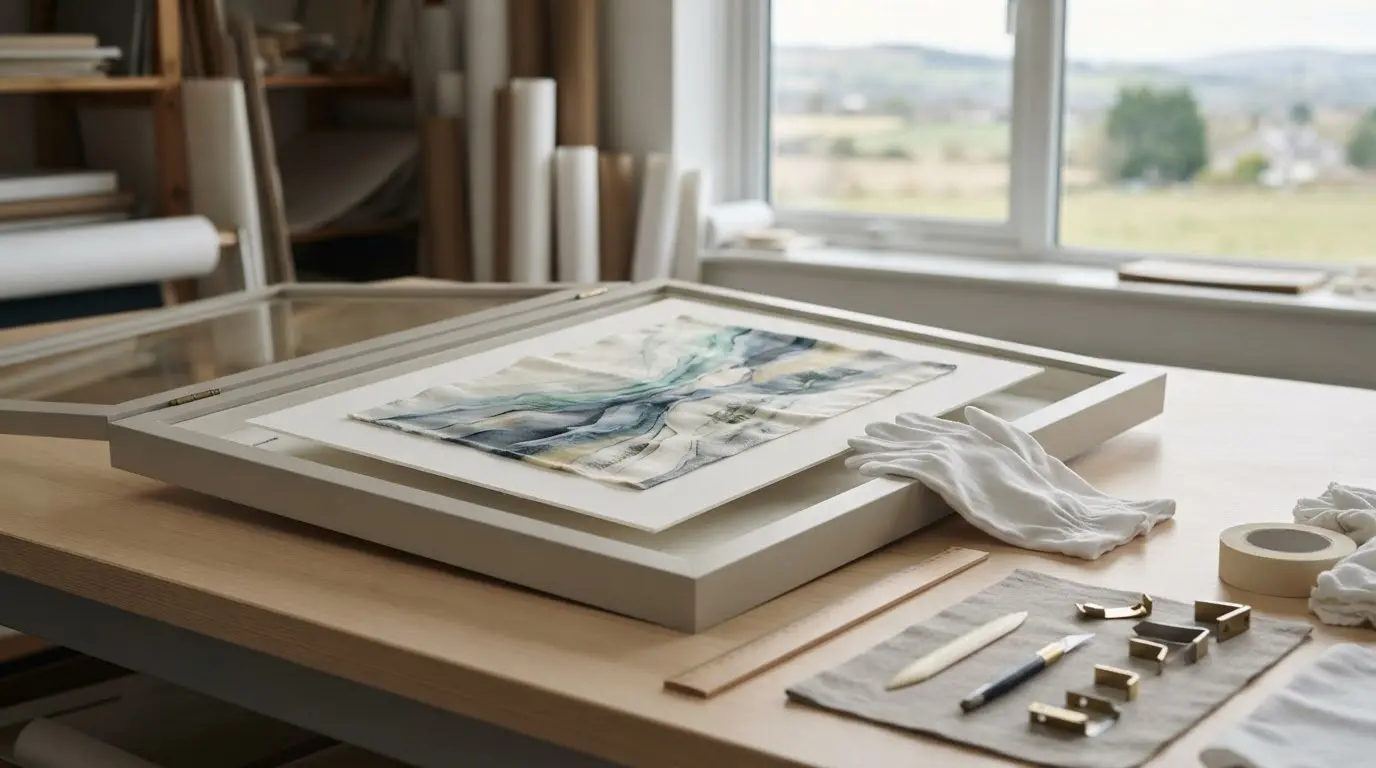
  1. Prepare and inspect. Wash and dry your hands, clear a flat work surface, and support the artwork as you examine it. Look for folds, loose threads, marks or damage, and note the painting’s orientation. Avoid trying to smooth creases or handling the painted face unnecessarily.
  2. Measure and plan. Measure the artwork and frame opening carefully, keeping the silk relaxed rather than pulling it taut. Check that the frame and intended mount can accommodate the painting and allow suitable clearance from the glazing. Record the measurements before positioning anything.
  3. Dry-fit before securing. Lay out the frame components and check the orientation and visual position of the silk. Confirm that the edges sit as intended and that the artwork isn’t trapped, stretched or compressed. Adjust the proposed layout before securing any components.
  4. Secure and assemble with care. Any attachment and tension method needs to suit the artwork’s construction and condition. Don’t improvise with pins, stitching or adhesive. If you’re unsure how the silk should be held, stop rather than risk damaging it. Assemble the frame without forcing its components together.
  5. Check before hanging. From the front, confirm that the painting sits evenly and doesn’t touch the glazing. Check that the frame is firmly assembled, then use its fitted D-rings and framing wire to hang it securely and verify that it sits straight.

In short: inspect, measure, dry-fit, secure appropriately, then check clearance and hanging alignment. These are the essential stages in how to frame a silk painting, but the right attachment method depends on the piece itself. For inspiration on framing and presentation, explore framed artwork.

When bespoke framing is the better route for a silk painting

A standard frame may not suit silk that is loose, unusually sized or already mounted in a way that affects how it fits. Bespoke framing is worth considering if the artwork needs a particular frame depth, a carefully chosen proportion or a presentation that works around its existing support. Unlike cheap, standard frames that may not fit the artwork properly, each First4Frames Gallery frame is individually crafted for the order using high-quality materials.

If you’re unsure how to frame a silk painting or feel uneasy handling the piece, a professionally framed, individually considered fit may be a more comfortable route. Address any condition concerns before framing.

What can a bespoke framer contribute?

First4Frames Gallery professionally frames customer-supplied artwork in-house, with precision cutting and expert mounting. Customers can choose from extensive frame and mount selections on product pages, helping shape a finish that complements the artwork rather than overwhelming it. Frames use float glass as standard. Finished frames are prepared for display with D-rings and high-quality framing wire for straight wall mounting.

How to take the next step

Consider whether you’re comfortable assessing and handling the silk yourself. If it’s difficult to support evenly or you’re uncertain about its presentation, custom framing offers a professional alternative. First4Frames Gallery brings over 20 years of professional framing experience in Falkirk to customer-supplied pieces, with a wide choice of frame and mount options.

Explore frame styles and presentation ideas, then browse the gallery to find artwork that inspires your next display.

Give your silk painting a considered place to shine

Choosing how to frame a silk painting is also a chance to think about how the artwork will live in your home. Consider the wall, the light in the room and the feeling you want the finished piece to bring to the space. A thoughtfully chosen frame can give the painting a clear visual setting without asking it to fit a standard format.

If you’re still weighing up a DIY approach, decide whether you feel comfortable handling and positioning the silk. Bespoke framing offers an alternative for artwork that needs an individual fit, with frame and mount options to shape its presentation. Let the painting guide the next decision, from a quiet, understated finish to a frame that makes it a focal point.

Explore framed artwork in the gallery for ideas and inspiration. Your silk painting deserves a setting that feels right for both the artwork and the room. Browse First4Frames Gallery’s framed artwork to plan your next display.

Frequently Asked Questions

Can you frame a silk painting without glass touching it?

Yes. A frame can be arranged so the silk is separated from the glazing, but suitable spacing depends on the artwork’s construction and condition. A painting with a raised or uneven surface, for example, may need a different arrangement from a flat, securely mounted piece. Don’t assume direct contact is safe. If the painted surface or its support seems fragile, pause and have the piece assessed before framing.

Should a silk painting be stretched before framing?

Not necessarily. Stretching isn’t right for every silk painting, and pulling the fabric too tightly may alter how it looks. The decision depends on the textile’s construction, condition and any support it already has. Avoid experimenting on valuable or delicate work, particularly if it has existing folds or distortion. If you’re uncertain, have the piece assessed before changing its tension.

Can I frame a silk painting myself?

Possibly, if the painting is securely mounted and a simple, sturdy frame suits its size. If you’re learning how to frame a silk painting, consider whether you can position it without handling the painted face or straining its support. Don’t use adhesives or fasteners through the painted silk. For delicate, valuable or unusually sized pieces, bespoke framing can offer a more considered fit.

What is the best frame for a silk painting?

There isn’t one frame that’s best for every silk painting. Choose a proportion and finish that complement the artwork’s dimensions and colours without crowding it, and consider how its condition and display setting affect the support and glazing arrangement. A narrow mount may suit a small work, while a larger piece may need a different visual balance. Pause before framing if the silk is fragile or damaged.

Can a picture framer frame artwork supplied by a customer?

Yes. First4Frames Gallery offers custom framing for customer-supplied artwork, with in-house precision cutting and expert mounting. Customers can select from frame and mount options to tailor the presentation to the piece. Because silk paintings vary in construction and condition, consider the framing approach individually rather than applying one mounting method to every artwork. Note the dimensions and current support when planning the frame.
Posted on

Prints of the Isle of Skye: A Guide to Choosing Your Perfect Landscape

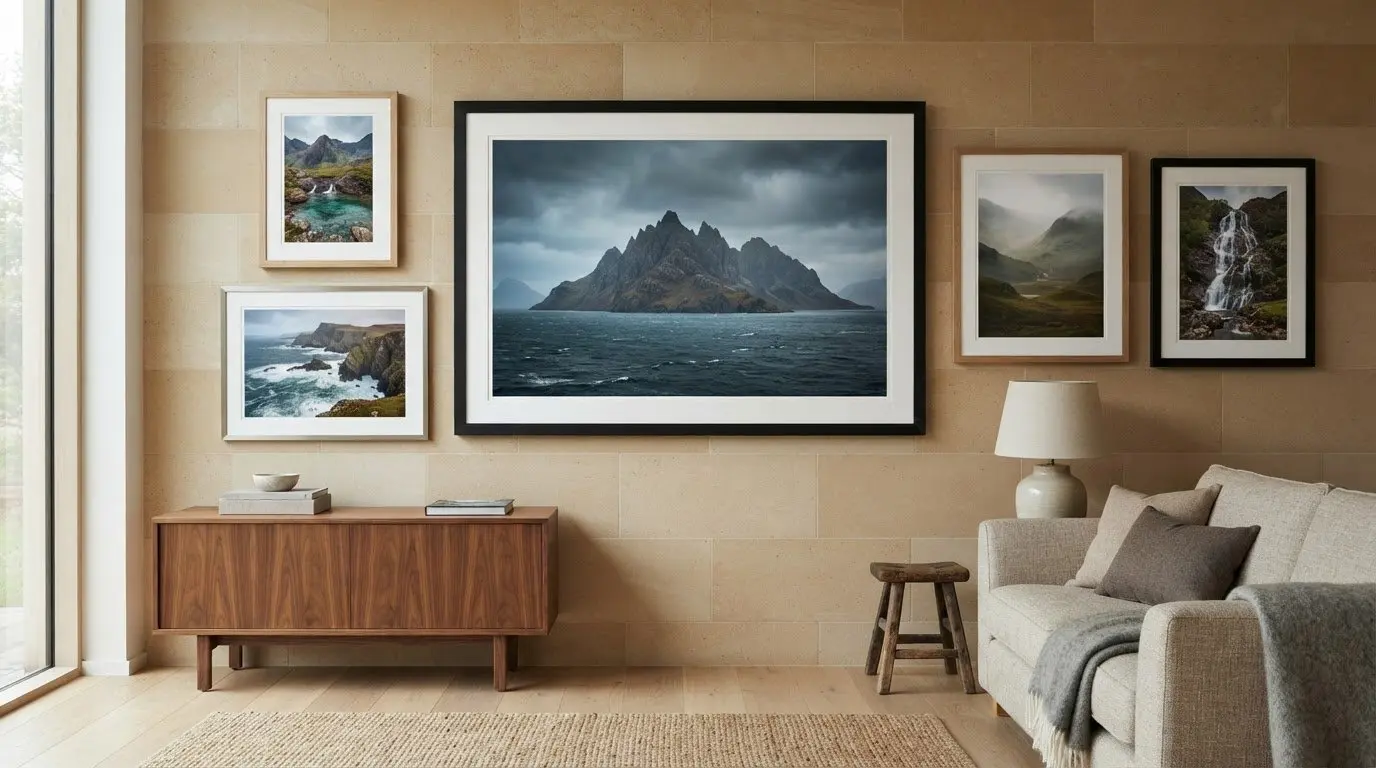
What if the Skye print that feels most at home in your room isn’t the island’s most famous view? It’s easy for landscape images to blur together at first glance, but prints of the isle of skye capture very different moods, from the dramatic shape of the Old Man of Storr to the softer colours of the Fairy Pools. The right choice is the scene that means something to you and sits naturally within your space.

This guide will help you compare Skye’s distinctive landscapes, match a print’s subject and scale to your room, and choose a frame with confidence. At First4Frames Gallery, every frame is individually crafted for each order using high-quality materials. We use 2mm float glass for its clarity, rather than the perspex used by many competitors. Consider how the landscape, print size and frame work together to create a personal, professionally presented piece that’s ready to display.

Key Takeaways

  • Compare prints of the isle of skye by subject and mood, not just by recognisable landmark, to find a landscape that feels personal.
  • Match the artwork’s orientation and composition to your available wall space for a balanced display.
  • Consider how a Giclée print and a carefully chosen frame work together to create a finished piece for your room.
  • Explore framing options that turn your chosen artwork into a considered focal point at home.

Why choose prints of the Isle of Skye for your walls?

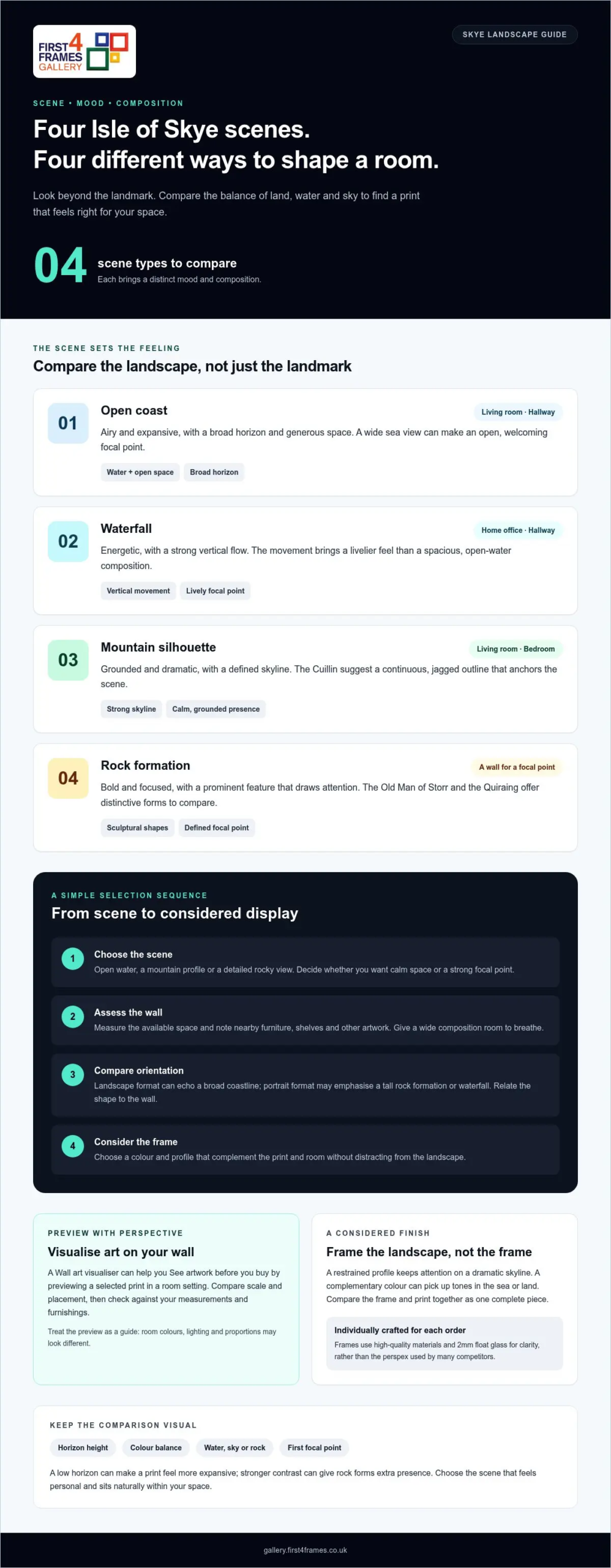
Dramatic ridgelines meet rugged coast on Skye, where waterfalls, sea views and shifting light make each scene feel different. A landscape print can bring that sense of place indoors, adding colour and atmosphere while giving the room a natural point of focus. This guide compares Skye subjects, so you can choose the scene and composition that best suit your space.

Skye landscapes bring rugged landforms, open water and changeable light together in distinctive combinations. That contrast gives the artwork character, whether you’re drawn to a dramatic mountain view or a quieter coastal mood.

What makes Skye landscapes visually distinctive?

The Cuillin’s strong mountain silhouettes and the sculptural ridges of the Quiraing are useful visual references when comparing compositions. Some scenes centre on bold rock forms; others give more space to sea and sky. Mist can soften distant contours, while changing light brings different tones to the landscape. For wider geographical and cultural context, see the Isle of Skye overview.

Which rooms suit Isle of Skye wall art?

Start with the atmosphere you want. A broad coastal view can create an open, airy focal point in a living space, while a mountain silhouette can bring a calm, grounded presence to a bedroom. In a hallway, a clear composition makes a welcoming first impression. For a home office, consider a scene with layered land and sky that gives the eye somewhere to rest. Before choosing a size, measure the wall and note the furniture or shelving nearby so the print feels in proportion.

If you’re considering Skye alongside landscapes from elsewhere in Scotland, our broader guide to Scottish landscape art can help you explore the wider subject. Here, the focus is on Skye’s distinctive contrasts and finding a scene that feels at home in your room.

Compare Isle of Skye print subjects by scene, mood, and composition

Two prints can show equally rugged scenery yet create very different impressions. As you compare prints of the isle of skye, look beyond the landmark. Notice how much space the artwork gives to water, sky or rock, and where your eye lands first. These details help you choose for both subject and mood.

Coastal and water scenes for an open, airy feel

A broad sea view can feel expansive, especially when the composition gives the water plenty of room. A closer shoreline brings more texture and detail. Waterfalls create a different effect: their vertical movement can make a composition feel lively rather than spacious. Compare the balance of colour, movement and open space, rather than choosing simply because water appears in the image.

Mountain and rock formations for dramatic impact

Mountain silhouettes tend to anchor a scene, while striking rock formations create a more focused focal point. The Cuillin suggest a continuous, jagged skyline; the Old Man of Storr and the Quiraing offer distinctive forms that can command attention. Use these landmarks as visual references when comparing artwork, rather than assuming they appear in a particular print. For a broader view beyond Skye, explore the Scottish landscape print guide.

Scene Typical mood and composition Room to consider
Open coast Airy, with a broad horizon and generous space Living room or hallway
Waterfall Energetic, with a strong vertical flow Home office or hallway
Mountain silhouette Grounded and dramatic, with a defined skyline Living room or bedroom
Rock formation Bold and focused, with a prominent focal point A wall where the artwork can draw attention

As you browse the framed art gallery, compare horizon height and colour balance as well as the subject. A low horizon can make a print feel more expansive, while stronger contrast can give rock forms extra presence. Think about which parts of the image you want to notice first from across the room.

How to choose and visualise an Isle of Skye print for your space

Use a simple sequence to move from inspiration to a confident choice. The scene sets the mood; the wall, orientation and frame determine how naturally the print sits in your room.

  1. Choose the scene. Decide whether you’re drawn to open water, a mountain profile or a detailed rocky view. Consider whether you want a calm, spacious feel or a strong focal point.
  2. Assess the wall. Measure the available space and note nearby furniture, shelves and other artwork. A wide composition needs room to breathe, while a strong central feature can suit a more contained space.
  3. Compare orientation. A landscape format can echo a broad coastline, while a portrait format may emphasise a tall rock formation or waterfall. Relate the artwork’s shape to the wall, not just to the image itself.
  4. Consider the frame. Choose a colour and profile that complement the print and your room without distracting from the landscape.
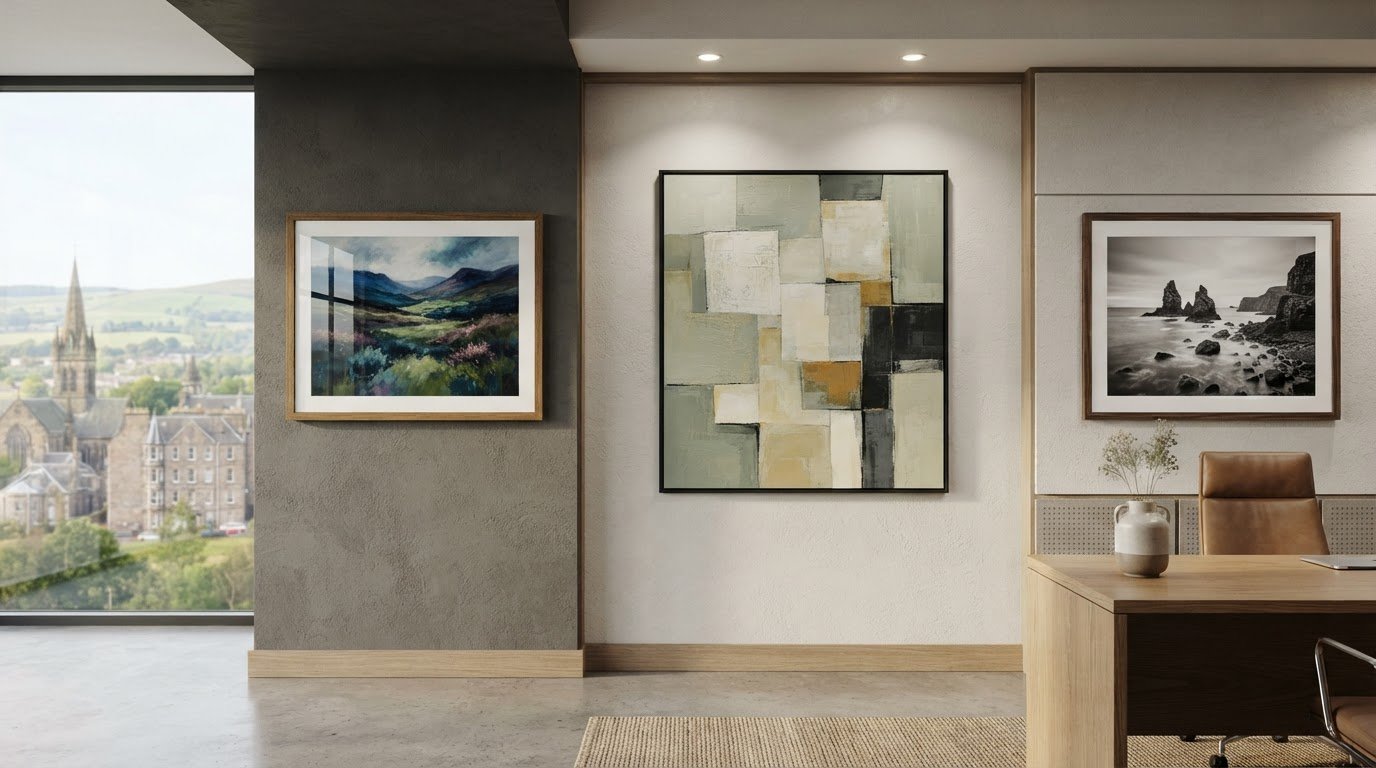
See artwork before you buy

A Wall art visualiser can help you Visualise art on your wall by previewing a selected print in a room setting. Use it to compare scale and placement, then check the result against your measurements and furnishings. It’s a useful way to See artwork before you buy, but treat the preview as a guide: your room’s colours, lighting and proportions may look different.

Choose a frame that supports the landscape

A frame should give the image a considered finish, not compete with its subject. A restrained profile keeps attention on a dramatic skyline, while a complementary colour can pick up tones in the sea or land. With Bespoke framed wall art and Online picture framing, you can shape the display around the artwork and your space. Use a picture-frame guide to consider proportions and display options, then compare the frame with the print as a complete piece.

Explore the framed artwork selection to compare landscape prints and begin picturing the right one in your home.

Create bespoke framed wall art with a professional finish

A considered frame helps an artwork feel complete. Pair a Giclée fine art print with a frame that complements its proportions and palette to create Custom framed art prints with a personal finish. Every First4Frames frame is individually crafted for its order using high-quality materials. Unlike cheap, standard frames that may not fit the artwork properly, a bespoke frame is made for the piece. First4Frames uses 2mm float glass for glazing, offering superior clarity compared with perspex used by many competitors.

From print choice to a framed finish

Choosing artwork and framing online makes it straightforward to shape a display around your taste and room. Browse framed wall art, including Fine art, Coastal wall art, Landscape wall art, Scottish landscape art, Photography prints and Contemporary art prints, with works by Best-selling artists and Famous artists. Choose your frame online and Design your framed artwork as one considered choice. Each finished frame is fully packaged to help prevent damage and shipped via professional couriers.

A print-and-frame option for personal photographs

Your own digital photograph can also become framed wall art. With First4Frames’ print-and-frame service, photographs are printed to the highest quality to match the bespoke framing. Choose an image with personal meaning, consider how it will work as wall art, then select a frame suited to your space. The Art print framing service brings those choices together. Explore the photo printing and framing service for your own photographs.

Browse the framed art gallery to explore the artwork and find a landscape that feels at home in your space.

Choose a landscape that feels like yours

The right artwork can become more than a finishing touch. It can hold a memory of a visit, reflect a place you hope to see, or bring a landscape you love into everyday life. Let that personal connection guide your choice of prints of the isle of skye. Take time to find an image you’ll enjoy living with, rather than choosing only to match a colour scheme.

Think of your chosen print as the beginning of a lasting story in your home. The view may draw your eye at first, then become part of familiar routines and changing seasons. Choosing art with care helps it feel at home because it speaks to you.

Browse Isle of Skye prints and framed artwork to find a landscape that resonates with you. Explore the collection and choose a print to complete with a bespoke frame.

Frequently Asked Questions

Can I preview an Isle of Skye print on my wall before buying?

Yes, a wall art visualiser can show how an artwork might look in your space and help you judge its scale and overall feel. Compare a print above a sofa with one on a smaller, open wall to see how placement changes its presence. Treat the preview as a guide: your room’s lighting, wall colour and nearby furnishings also affect how the artwork appears.

How do I choose the right size for an Isle of Skye print?

Measure the wall area you want to fill, then consider the furniture below it and how far away you’ll usually view the print. A wide landscape image may sit comfortably above a sofa, while a portrait composition can work in a narrower space. Compare the print’s proportions with the wall before choosing a frame; a thumbnail alone can make prints of the isle of skye seem larger or smaller than they’ll feel at home.

What is the difference between a Giclée print and a standard art print?

Giclée describes a fine-art printing approach used to reproduce detailed artwork. It’s a useful term to know as you browse, but the best choice still depends on the image and how you want it to look on your wall. Consider the subject, print finish and frame together. For example, a detailed coastal scene may call for a frame that keeps attention on the artwork rather than drawing the eye away.

Is 2mm float glass a good choice for framed landscape prints?

First4Frames uses 2mm float glass to glaze framed landscape prints. Consider where the finished artwork will hang in relation to windows and other light sources when deciding on its presentation. Glazing is one part of the finished piece, alongside the print and frame, so assess the artwork as a whole when choosing a display that suits your space.

Can I have my own photograph printed and framed?

Yes, First4Frames offers a print-and-frame service for your digital photographs, with printing chosen to complement bespoke framing. Start with a personal image, think about how its subject and orientation will work as wall art, then choose a frame that suits the room. Explore the photo printing and framing service to create a finished display from your own photograph.

Posted on

Minimalist Line Art Prints for Sale: How to Choose the Right Print and Frame

What if the frame is just as important as the drawing? Minimalist line art prints for sale can look deceptively similar online, yet the subject, scale and finish all affect how a piece feels in a room. Choosing the print and frame together helps the artwork sit comfortably on your wall, with a considered look that doesn’t overwhelm the space.

It’s natural to wonder how a design will look at home, or whether a standard frame will fit and do it justice. This guide explains how to compare line art styles, measure for the right print size and choose a frame to suit your space. You’ll also find practical ways to visualise art on your wall before you buy, plus what to look for in bespoke framing. At First4Frames Gallery, each frame is individually made for the order using high-quality materials, with 2mm float glass for clear viewing. Finished frames are fully packaged to help prevent damage in transit and shipped via professional couriers.

Key Takeaways

  • Compare abstract faces, figurative sketches, botanical lines and geometric designs to find minimalist line art prints for sale that suit your room’s mood.
  • Match print size and frame width to the wall and nearby furniture, allowing negative space to keep a simple composition balanced.
  • Before buying online, choose a subject, measure the display area and review the artwork presentation and product details.
  • Decide whether framed or unframed art suits your plans, and consider how bespoke framing can complete the artwork.

How to Choose Minimalist Line Art Prints for Sale That Suit Your Space

Pared-back drawings can bring a sense of calm, but a simple image still changes a room’s mood. A fine, flowing line may feel gentle and intimate, while bold black strokes create a stronger focal point. Contrast affects how clearly the artwork stands out from its surroundings; negative space gives the eye room to rest and keeps a composition feeling light. In minimalist line art, deliberate lines and open space do much of the work.

For a broader introduction to the form, explore What is Line Art?. Then consider how the drawing relates to the room. It might echo existing shapes and tones, or provide a deliberate point of contrast.

Which minimalist line art style fits your room?

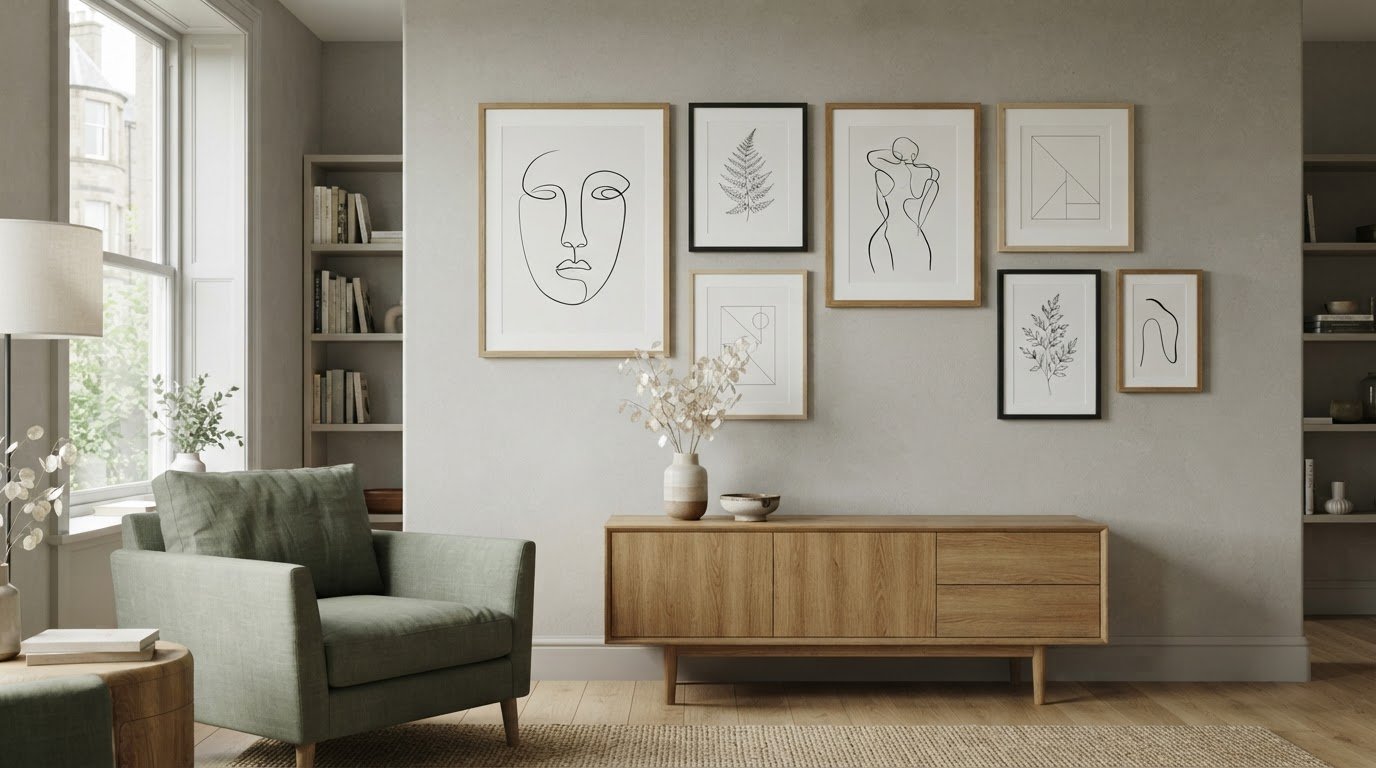
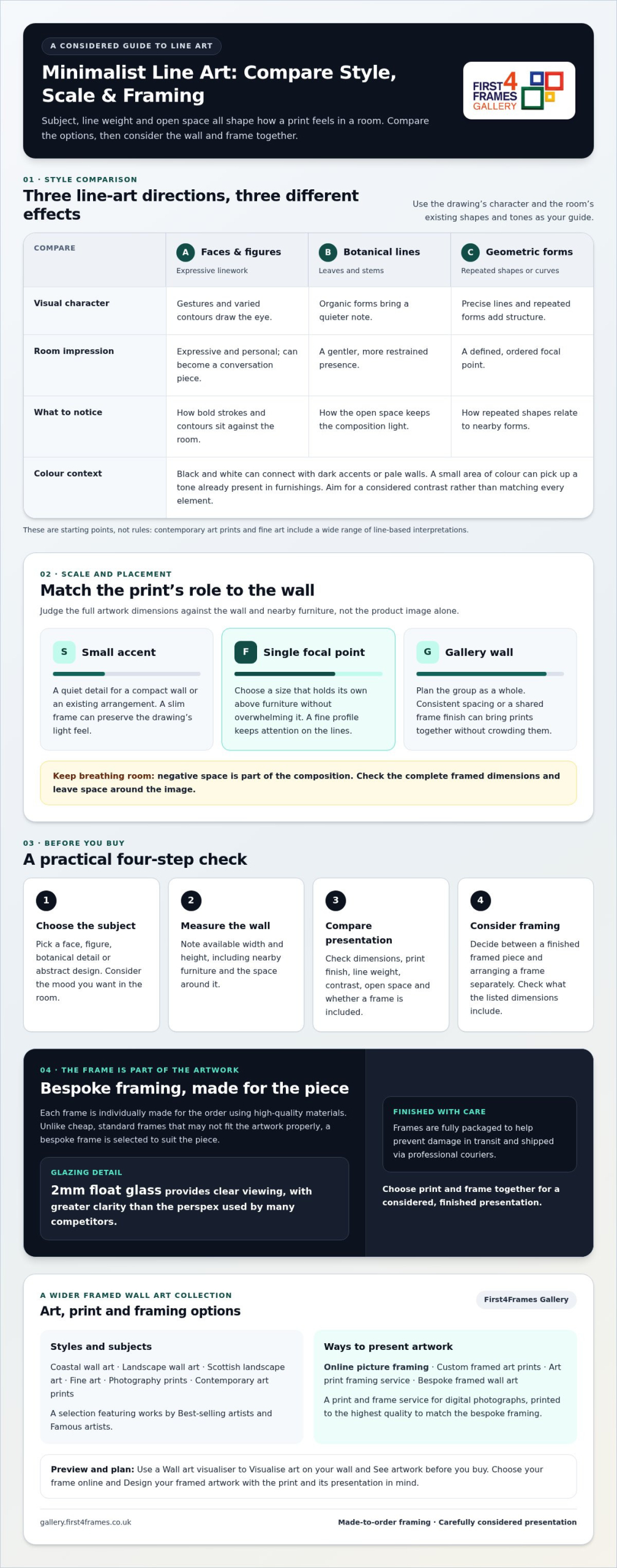
Abstract faces and figurative sketches often feel expressive and personal. Their gestures and varied contours draw attention, making them a good choice when you want the print to become a conversation piece. Botanical lines tend to feel quieter, with leaves and stems bringing an organic note. Geometric compositions, built from repeated shapes or precise curves, add structure.

These are starting points, not rules about which interior style can accommodate each design. Contemporary art prints and fine art offer broader contexts for line-based work, from playful modern interpretations to restrained drawings. Black-and-white art can connect with dark accents or pale walls; a small area of colour can pick up a tone already present in cushions, ceramics or furnishings. Let the room guide your choice without trying to make every element match.

How can you visualise art on your wall before buying?

Measure the area you’re considering, then mark the intended artwork dimensions on the wall with removable tape or paper. This outline helps you judge the scale beside furniture, switches and nearby pictures. Stand back to assess it from the room’s entrance and from the place where you’ll usually sit.

A wall art visualiser can help you visualise art on your wall and see artwork before you buy by previewing a design in your space. Use the preview as a guide, then compare the stated artwork dimensions with your measurements before choosing a print.

Choose the Right Size, Print Finish, and Framing for Line Art

Judge print size against both the wall and the furniture beneath it, not in isolation. A design that looks generous on a product page may feel lost above a broad sofa, while a large print can crowd a narrow wall. Check the artwork’s full dimensions, including the frame, and leave breathing room around the image so its open space remains part of the composition.

Small accent

Use a smaller print to add a quiet detail to a compact wall or an existing arrangement. A slim frame can preserve the drawing’s light feel.

Single focal point

Choose a size that holds its own above furniture without overwhelming it. A broader frame adds visual presence, while a fine profile keeps attention on the lines.

Gallery wall

Plan the group as a whole. Consistent spacing or a shared frame finish can bring different prints together without making each image feel cramped.

When comparing minimalist line art prints for sale, check the artwork dimensions as well as the image preview. Review the print-finish details and consider how the surface will look in the room’s light. Keep the frame colour and profile in proportion to the linework: strong contrast can emphasise a spare drawing, while a quieter edge lets delicate marks lead.

What should you consider when choosing a frame online?

Choose your frame online with the drawing’s character and intended position in mind. Bespoke framing brings print and frame together, with each frame individually made for the order using high-quality materials. Unlike cheap, standard frames, which may not fit the artwork properly, a made-to-measure frame is selected to suit the piece. Design your framed artwork as one considered whole rather than choosing a frame as an afterthought.

Why does glazing matter for minimalist artwork?

Clear glazing helps fine marks remain crisp. First4Frames uses 2mm float glass, which offers clearer viewing than the perspex used by many competitors. For more on frame choices and display, see Picture Frames: The Ultimate Guide to Choosing, Hanging, and Displaying Art.

Explore the online art gallery with your measurements in mind, so you can consider the artwork and its eventual presentation together.

Minimalist Line Art Prints for Sale: How to Choose the Right Print and Frame

How to Buy Minimalist Line Art Prints Online With Confidence

A clear order of decisions makes choosing minimalist line art prints for sale more straightforward. Work through these steps before placing an order:

  1. Choose the subject. Decide whether you want a face, figure, botanical detail or abstract design, and consider how its mood will suit the room.
  2. Measure the wall. Note the available width and height, including space around nearby furniture, so you can compare the artwork’s dimensions with its intended position.
  3. Compare the presentation. Review product imagery from different views and read the details for print dimensions, finish and whether a frame is included. Look closely at line weight, contrast and open space, not just the thumbnail.
  4. Select framing. Decide whether you want a finished framed piece or prefer to arrange a frame separately. Consider how its profile and colour will complement the drawing.

Online picture framing and an art print framing service bring these decisions into one process, helping you weigh the artwork and its presentation together. Check whether the stated dimensions refer to the complete framed piece or the print alone, as this affects how much space it will occupy.

How do you compare framed and unframed art prints?

Ready-to-hang framed wall art offers convenience: the print arrives as a complete piece, so you don’t need to source and fit a separate frame. An unframed print gives you flexibility to choose framing later, but you’ll need to consider fit and finish yourself. Custom framed art prints are made to suit the artwork rather than relying on a standard frame that may not fit its dimensions.

What should buyers know about packaging and delivery?

Finished frames are fully packaged to help prevent damage in transit and shipped via professional couriers. This is useful reassurance when ordering framed artwork online. You can also make a more confident choice by reviewing the print’s details and presentation before buying.

Ready to compare artwork options? Browse the gallery’s framed art and prints and consider which designs fit your measurements and framing preference.

Find Bespoke Framed Minimalist Line Art That Feels Finished

The final choice depends on how you want the artwork to arrive and fit into your plans. An unframed print leaves you free to arrange the presentation later; ready-to-hang framed art brings print and frame together as a finished piece. Bespoke framing lets you consider the artwork and its setting as one, with choices tailored to the individual piece.

What makes bespoke framed wall art a considered choice?

First4Frames offers a wide online selection of artwork and frames, alongside custom picture framing for a tailored result. Browse coastal wall art, landscape wall art, Scottish landscape art, photography prints and contemporary art prints, as well as works by best-selling artists and famous artists. With a broad choice of frame styles, you can choose an understated finish that lets delicate linework lead or a more defined profile that gives it presence.

Can you print and frame a digital photograph?

Yes. First4Frames’ print-and-frame service turns a digital photograph into finished wall art, with high-quality printing to complement its bespoke framing. Explore the online photo printing and framing service to create a framed piece from your own image.

Choose artwork that feels right for your room, then explore framing options to complete the look. Explore the gallery and choose artwork for your space.

Let the Right Line Drawing Find Its Place

A well-chosen piece can become a quiet part of your everyday routine, catching your eye as you pass or bringing calm to a busy corner. As you browse minimalist line art prints for sale, picture the feeling you want the room to hold, not just the colours or shapes that match it. A graceful outline might soften a space, while a more expressive drawing can add personality without filling the wall with visual noise.

Give yourself time to notice which artwork you keep returning to. The strongest choice often feels natural in the room and meaningful to you, rather than simply following a trend. Once a design has caught your attention, explore the gallery’s selection of artwork and framed prints.

Explore minimalist art and framed prints in the gallery, and find a piece that feels at home in your space.

Frequently Asked Questions

What is minimalist line art?

Minimalist line art uses a pared-back visual approach, often relying on a small number of marks rather than detailed shading or colour. A single continuous outline might suggest a face, while a few curved strokes can evoke a leaf or figure. The viewer’s eye fills in what’s left unsaid, making the artwork feel simple but expressive.

How do I choose the right size for a minimalist line art print?

Compare the print’s stated dimensions with the clear wall space, then consider nearby furniture and how far away you’ll usually view it. A small design above a narrow side table can feel deliberate, while the same print may look undersized over a broad sofa. Include the frame in your measurements when comparing finished minimalist line art prints for sale.

Are minimalist line art prints suitable for a gallery wall?

Yes. Their clean compositions can sit comfortably alongside photography, abstract work or other illustrations. To make a group feel connected, repeat one feature, such as a frame colour, while varying image shapes or subject matter for interest. Lay out paper templates on the floor first, then adjust spacing and order before marking positions on the wall.

Is framed line art better than an unframed print?

Neither option is automatically better; it depends on how much choice and preparation you want. A framed print gives you a complete presentation, while an unframed one lets you select a frame later to suit a changing room or an existing collection. If choosing separately, check that the frame opening and print dimensions are compatible before purchasing.

What glazing does First4Frames use for framed art prints?

First4Frames uses 2mm float glass for framed art prints. It offers clearer viewing than the perspex used by many competitors. When deciding where to hang a print, consider daylight and room lighting, and choose a position where reflections are less likely to distract from the artwork.

Posted on

Modern Botanical Prints UK: Find Art That Feels at Home

The right botanical print can make a room feel more like yours, rather than simply following a trend. Choosing among modern botanical prints for sale uk homes can feel tricky when style, scale and colour all need to work together, and an online image doesn’t always show how a piece will look on your wall.

Start with the room: consider its colours, the available wall space and whether you’re drawn to delicate leaves, bold forms or atmospheric florals. This guide will help you choose botanical wall art that feels personal, compare print and frame options, and preview the artwork at home with a wall art visualiser. First4Frames Gallery offers a large online selection of artwork and frames, bespoke framing, and Giclée prints that can be ordered ready to hang. Each frame is individually crafted for the order using high-quality materials, with 2mm float glass for a clear view of the artwork.

Key Takeaways

  • Explore modern botanical prints for sale uk and compare contemporary interpretations with traditional botanical illustration to find a style that suits your home.
  • Use your room’s palette and available wall space to narrow down artwork and choose a print size that feels balanced.
  • Giclée printing reproduces artwork with attention to colour and detail, while a frame crafted for your order completes its presentation.
  • Preview your selection with the wall art visualiser, then use the online process to create framed art ready to display.

Modern botanical prints for sale in the UK: choose a style that suits your space

Botanical art brings natural forms, colour and a sense of life into everyday spaces. Modern prints range from carefully observed leaves to simplified shapes and expressive compositions. Traditional botanical illustration often records plants in precise detail, while contemporary work may interpret them more freely. Both approaches have their own appeal: choose according to the room and the atmosphere you want to create. For background, explore the history and purpose of Botanical illustration.

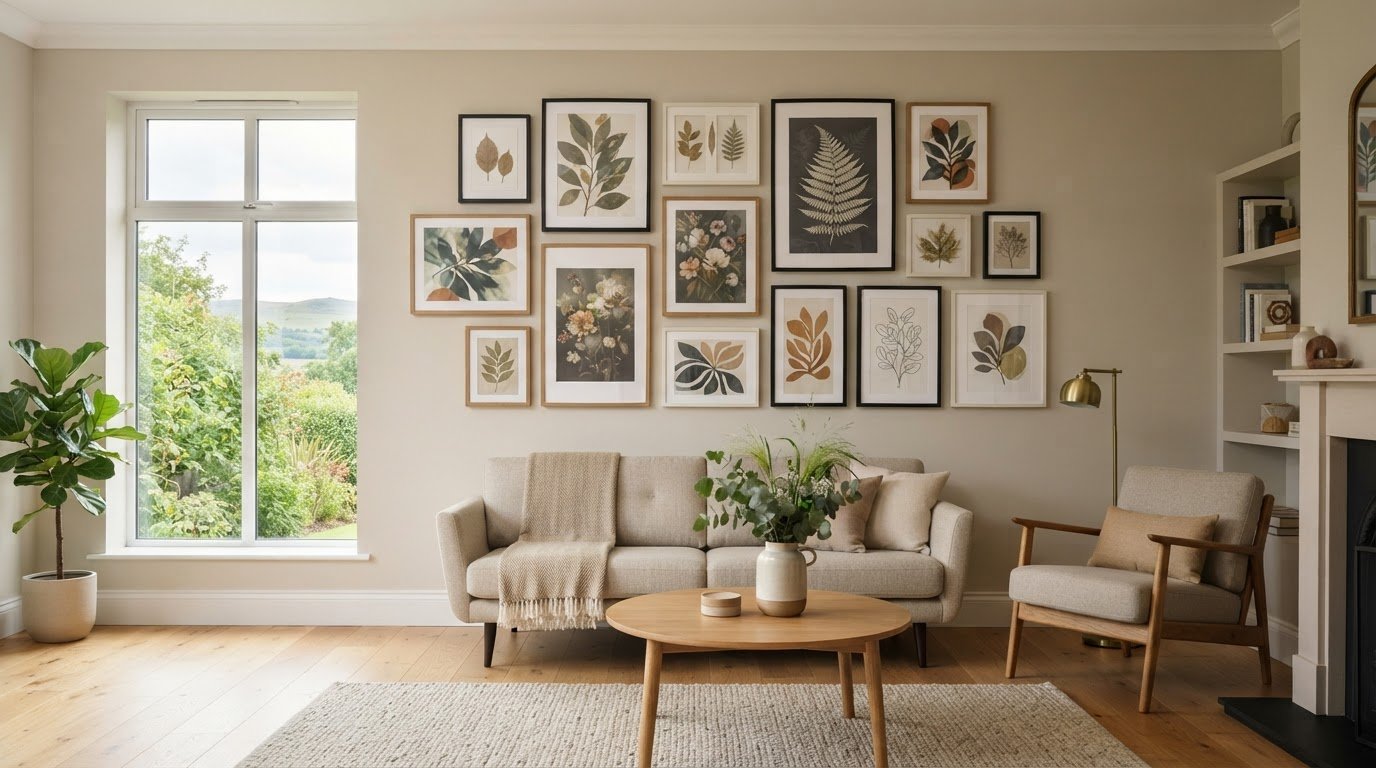
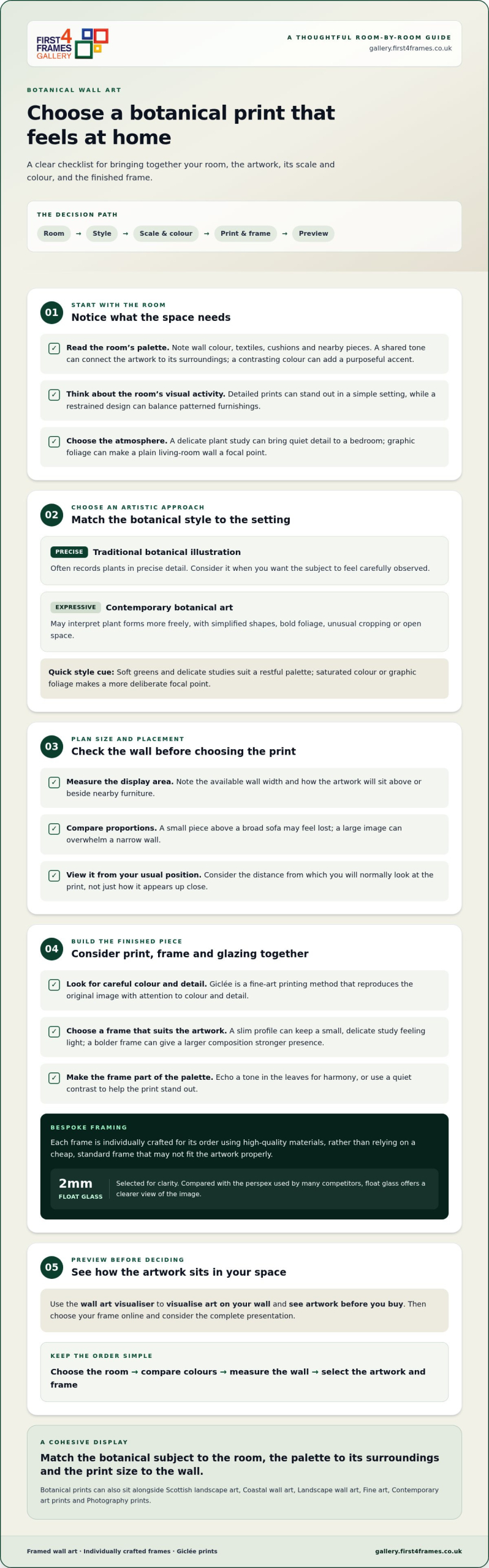
When looking at modern botanical prints for sale uk, begin with the room rather than a passing trend. A delicate plant study can bring quiet detail to a bedroom, while graphic foliage can turn a plain living-room wall into a focal point. Think about how much visual activity the room already has. A detailed print may stand out in a simple setting, while a restrained design can balance patterned furnishings.

For creative inspiration, watch this watercolour and linework demonstration.

Which botanical print style works in your room?

Delicate plant studies and soft greens work well with an existing restful palette. Bold foliage or saturated colours make a more deliberate focal point, especially against simpler décor. Contemporary compositions may use unusual cropping or open space to keep the image feeling light. Botanical prints can also complement modern framed wall art, including works by best-selling artists and famous artists, alongside Coastal wall art or Landscape wall art.

How can you judge scale and colour before buying?

Measure the available wall width and consider the distance from which you’ll usually view the print. Compare its proportions with nearby furniture: a small piece above a broad sofa may feel lost, while a large image can overwhelm a narrow wall. Notice whether the artwork’s colours echo or contrast with cushions, paint and other nearby pieces. Use the wall art visualiser to visualise art on your wall and see artwork before you buy.

For a cohesive display, match the botanical subject to the room, the palette to its surroundings and the print size to the wall.

What makes a quality modern botanical print and frame?

A botanical image’s fine lines, layered greens and subtle changes in tone deserve a print that reproduces the artwork faithfully. Giclée is a fine-art printing method that captures the original image with careful attention to colour and detail. It offers a considered way to enjoy botanical work alongside other gallery categories, including Fine art, Contemporary art prints and Photography prints.

When comparing modern botanical prints for sale uk, look beyond the image alone. With online picture framing, you can consider how a frame will sit with the print. A slim profile can keep a small, delicate study feeling light, while a bolder frame may give a larger composition a stronger presence. Colour matters too: a frame that picks up a tone in the leaves or provides a quiet contrast can help the print feel at home in its setting.

How does bespoke framing change the finished print?

Each frame is individually crafted for its order using high-quality materials, rather than relying on a cheap, standard frame that may not fit the artwork properly. This bespoke approach lets the frame complement the print’s scale, palette and presentation. For an overview of available framed artwork, explore the online art gallery and its custom framed art prints.

Framed artwork uses 2mm float glass, selected for its clarity. Compared with the perspex used by many competitors, float glass offers a clearer view of the image, so fine details and colours are easy to appreciate. The glazing is an important part of the finished presentation, not just a final detail.

The print carries the image, the frame shapes its presentation, and the glazing provides a clear view. Together, these choices turn a botanical print into a finished piece of framed art, thoughtfully suited to its subject and setting.

How to choose modern botanical wall art for your home

A thoughtful choice starts with the room, not the frame. Decide where the artwork will hang, then note the wall colour, textiles and nearby furniture. A print that picks up a quiet green in your cushions can bring the room together; a contrasting leaf or flower colour can add a purposeful accent.

How do you match botanical art to colour and interior style?

Compare the artwork’s dominant colours with the tones already around it. Soft botanical hues can sit easily in calm, traditional rooms, while graphic foliage can bring energy to a modern interior. In a mixed space, use one shared colour to connect different styles. Botanical subjects can also sit alongside Scottish landscape art or Coastal wall art, creating a varied display without making every piece match.

How should you plan the frame and wall placement?

Measure the available display area and consider how the artwork will relate to a sofa, sideboard or other nearby furniture. Check the space from your usual viewing position, not just up close. Then choose your frame online: a frame that echoes a furnishing can create harmony, while a gentle contrast can help the print stand out. Use the option to design your framed artwork and consider the complete presentation. If you’re comparing modern botanical prints for sale uk, a wall art visualiser can help you preview the artwork in your room and visualise art on your wall before deciding.

Keep the process simple: choose the room, compare colours, measure the wall, then select the artwork and frame. Explore framed art in the gallery to find a piece that suits your space.

Buy framed modern botanical prints online with confidence

Buying framed art online can feel uncertain if you can’t picture the finished piece in your room. A straightforward process helps: browse the artwork, use the wall art visualiser to preview your choice, select a frame and complete your framed-art design. Seeing the print and frame together makes it easier to judge the whole composition, rather than choosing a print and hoping the frame suits it later.

What should you expect from online picture framing?

With a wide online selection of artwork and frames, you can choose your frame online and design your framed artwork around the print’s subject, colour and scale. Bespoke framed wall art comes from these choices working together. Each frame is individually crafted for its order using high-quality materials, giving the artwork a considered fit and finish instead of a cheap, standard frame that may not suit it. Custom framing options let the presentation be tailored to the piece.

An art print framing service brings the print and frame together as one considered order. Finished frames are fully packaged to help prevent damage and shipped via professional couriers, so your artwork is prepared for its journey to your home.

Can you frame your own digital botanical photograph?

Yes. A print-and-frame service for digital photographs offers a straightforward route from your own image to finished wall art. The photograph is printed to a high quality to match its bespoke framing. Explore online photo printing and framing to turn a botanical image of your own into a framed piece.

Whether you’re choosing a gallery print or framing a personal photograph, the process brings artwork, presentation and practical delivery together. Browse modern botanical and framed wall art to find a piece that feels right for your home.

Bring botanical art home with confidence

The right botanical print is more than a pleasing image. Consider how its subject, colours and scale will sit in your room, then use the wall art visualiser to preview the finished look before choosing your frame. As you explore modern botanical prints for sale uk, remember that thoughtful framing is part of the artwork’s overall character.

Each frame is individually crafted for its order using high-quality materials. The 2mm float glass provides a clear view compared with the perspex used by many competitors, while finished frames are fully packaged to help prevent damage and shipped via professional couriers. Together, these details carry your choice from screen to wall with care.

Ready to find a piece that feels at home in your space? Browse the gallery and design your framed artwork, choosing artwork and framing that work beautifully together.

Frequently Asked Questions

How do I choose a modern botanical print for my living room?

Start with the room’s colour palette and the wall space available. Compare the print’s dominant tones with your walls, textiles and nearby furniture, then consider how its size will look above a sofa or sideboard. Delicate plant studies can add quiet detail, while bold foliage can create a focal point. A wall art visualiser can help you preview the effect before choosing a frame.

Are botanical prints still in style in 2026?

Botanical prints remain a versatile choice because natural forms can suit many interior styles. Choose soft colours for a calmer feel, or expressive foliage to bring colour and energy to a wall. The key is finding a print that feels right in your room rather than following a trend. Modern botanical prints for sale uk range from delicate studies to contemporary, graphic interpretations.

What is the difference between a Giclée print and a standard art print?

Giclée is a fine-art printing method used to reproduce artwork with attention to its original detail and colour. “Standard art print” is a broader term and doesn’t describe one specific printing method, so production and finish can vary. First4Frames Gallery offers Giclée fine art prints from a range of artists, primarily from Scotland, which can be paired with a selected frame.

Can I choose a frame online for a botanical print?

Yes, you can browse artwork and frames online, then choose a frame to suit your print and room. A wall art visualiser lets you preview the artwork in your space, helping you consider the overall presentation before completing your framed design. Each frame is individually crafted for its order using high-quality materials, bringing a considered fit and finish to the artwork.

How are framed art prints packaged and delivered in the UK?

Finished frames are fully packaged to help prevent damage during their journey and shipped via professional couriers. Framed artwork uses 2mm float glass for clarity, rather than the perspex used by many competitors. These practical details support a carefully finished piece from framing through delivery.

Posted on

Abstract Landscape Prints in Scotland: Find Art That Feels Like Home

What makes a landscape feel Scottish when it’s expressed through colour and shape rather than shown in literal detail? A sweep of deep green, shifting light over water or the rhythm of a rugged coastline can suggest a familiar sense of place. If you’re exploring abstract landscape prints Scotland has inspired, consider how the colours and composition will feel in your home.

Abstract art doesn’t need to depict a recognisable scene to bring Scotland’s landscapes to mind. This guide explains how to read those visual cues, compare a print’s palette, mood and scale with your room, and choose a frame that completes the artwork. With online picture framing, you can choose your frame online and have it individually crafted for your order using high-quality materials. Finished framed artwork uses clear 2mm float glass, rather than the perspex used by many competitors, and is fully packaged to help prevent damage before being shipped via professional couriers.

Key Takeaways

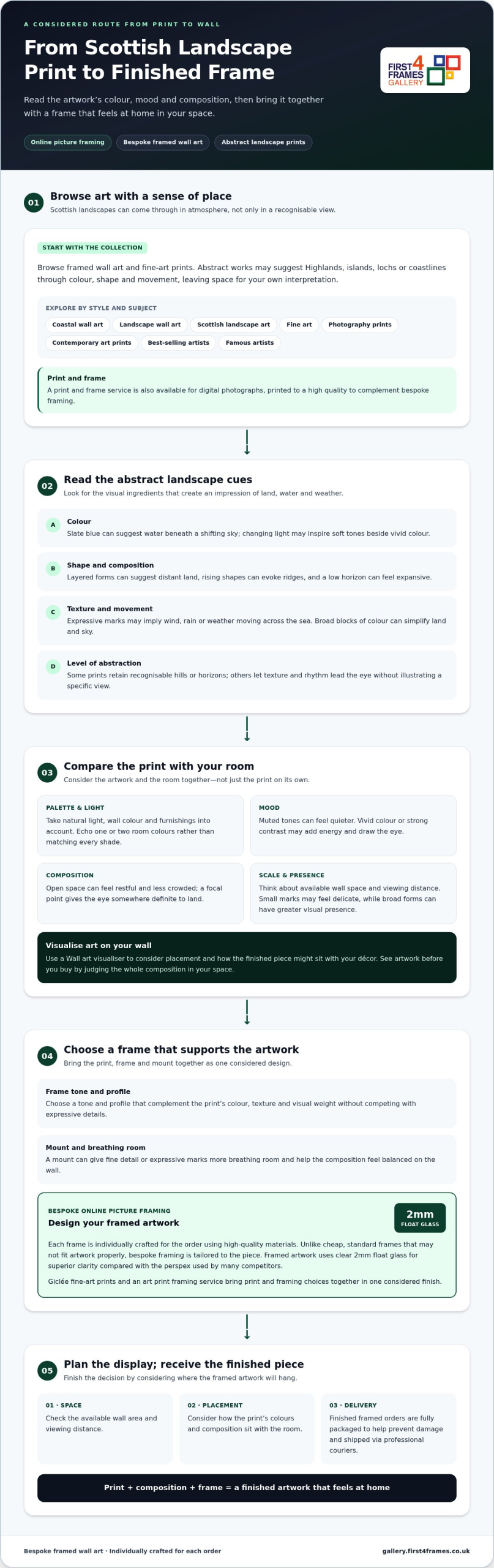
  • Abstract landscape prints scotland can suggest a strong sense of place through colour, texture and movement, even without depicting a recognisable view.
  • Compare a print’s palette, composition and level of abstraction with the mood you want to create in your room.
  • Choose a frame colour, profile and mount that give the artwork presence without competing with its expressive details.
  • Explore framed wall art, Scottish landscape art, fine art and contemporary prints to find a piece that feels personal to your home.

Abstract Landscape Prints in Scotland: How Art Suggests a Sense of Place

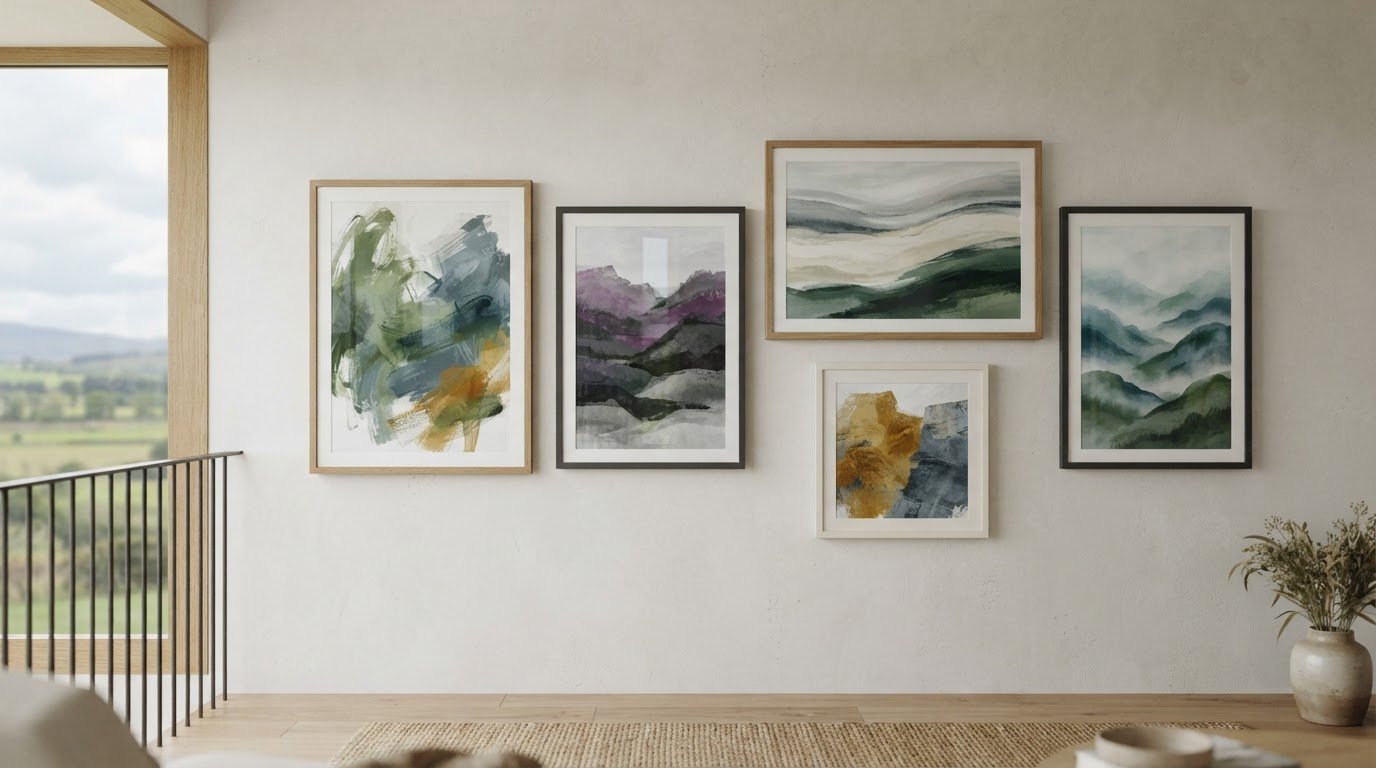
A landscape can feel unmistakably Scottish without showing a named mountain, loch or shoreline. In abstract art, colour, shape, texture and movement do the describing: a band of slate blue might suggest water beneath a shifting sky, while broken, rising forms can call to mind Highland ridges. The artwork invites you to recognise a place through atmosphere rather than an exact view.

A useful way to understand abstract landscape prints scotland is to look for visual cues that evoke Scottish terrain and mood, while leaving room for your own interpretation. Unlike a photograph or strictly representational painting, an abstract work doesn’t aim to record every detail. For background on the tradition, explore this history of landscape painting in Scotland.

Watch an expressive watercolour approach to a Scottish landscape in this tutorial:

What makes a landscape print abstract?

Look for simplification and interpretation rather than one fixed style. An artist might reduce land and sky to broad blocks of colour, use expressive marks to imply wind or rain, or shift natural colours to heighten a feeling. Some compositions retain recognisable horizons and hills; others are more open-ended, letting texture and rhythm lead the eye. Both can suggest landscape without illustrating it literally.

How Scottish places can inspire abstract art

Highlands, islands, lochs and coastlines offer starting points for mood and composition, but they don’t necessarily identify a specific location. A low horizon can feel expansive, layered shapes can suggest distant land, and restless marks might evoke weather moving across the sea. Changing light can inspire contrasts between soft tones and vivid colour. These visual cues let Scottish landscape art feel rooted in place while remaining personal and imaginative.

Choose Abstract Scottish Landscape Art by Colour, Mood and Composition

Choosing between abstract landscape prints Scotland has inspired is easier when you compare four things: palette, composition, level of abstraction and the mood you want in the room. Abstract art uses form, colour and line in many ways; the Tate’s guide to what is abstract art is a helpful starting point for looking beyond literal subject matter.

Match the print’s mood to the room

Consider how natural light, wall colour and furnishings affect the artwork’s presence. Muted tones can create a quieter feel, while vivid colour or strong contrasts may add energy and draw the eye. An open composition can feel restful; bolder marks may suit a room that already has a lively character.

Selection tip: Let the artwork echo one or two colours already in the room rather than matching every shade exactly. This creates a connection without making the print disappear into the décor.

Compare categories by atmosphere, too. Coastal wall art may feel open and airy, while broader landscape wall art can create a more grounded impression. Contemporary art prints range from restrained arrangements to striking colour relationships. Before choosing a size and position, visualise art on your wall by considering the available space and viewing distance. To see artwork before you buy, assess how the whole composition might sit in your room, not just how it looks on its own.

Read the composition before choosing

An open composition with generous negative space can make a wall feel less crowded. A concentrated focal point gives the eye somewhere definite to land, while balanced shapes can create a steadier impression. Consider scale as well: small, scattered marks may feel delicate, whereas broad forms can have greater visual presence. If you’re comparing abstract landscape prints Scotland offers, browse the fine-art print gallery with your room’s colours, proportions and light in mind.

Frame and Display Abstract Landscape Prints for a Finished Look

A frame should support an abstract print’s colour, texture and movement without competing for attention. Consider its tone and profile alongside the artwork’s visual weight and your room’s décor. A mount can create breathing room around expressive marks or fine detail, helping the composition feel balanced on the wall.

Choose a frame that complements the print

Design your framed artwork by considering the print, frame and mount together. First4Frames Gallery individually crafts each frame for the order using high-quality materials. Unlike cheap, standard frames that may not fit artwork properly, bespoke framing is tailored to the piece. This creates custom framed art prints with a considered finish. An art print framing service should bring the artwork and framing choices together as one coherent presentation.

Consider print quality and glazing together

First4Frames Gallery offers Giclée fine-art prints, and framed artwork uses 2mm float glass for superior clarity compared with the perspex used by many competitors. Use a Wall art visualiser to consider how the finished piece might sit in your room, and assess the artwork’s colours and placement against your décor.

Finished framed orders are fully packaged to help prevent damage and shipped via professional couriers. Explore framed art and fine-art prints to find a piece and frame that feel right for your space.

Find Abstract Landscape Prints in Scotland and Make Them Your Own

Make your choice in a few considered steps: browse the artwork, compare its mood with your room, explore frame options, then plan where the finished piece will hang. A large online selection of artwork and frames gives you room to compare different looks. Treating the print and frame as one design decision helps the artwork feel at home in your space.

From choosing a print to choosing your frame online

Explore Scottish landscape art, fine art, contemporary art prints and photography prints, alongside framed wall art by best-selling and famous artists. Once you’ve found a print you love, use online picture framing to choose a frame that suits its colours and composition. First4Frames’ custom picture framing brings your preferred choices together in a finished piece, with the frame crafted for the artwork.

Before deciding, consider the wall’s available space, nearby furnishings and viewing distance. Mark out the proposed position with removable paper to help judge scale and placement. This practical step makes it easier to picture how the finished artwork will sit in the room.

A personal print-and-frame option

A digital photograph offers another way to make a wall personal. First4Frames’ print-and-frame service produces photographs to the highest quality to match bespoke framing. It’s a distinct option from choosing an abstract landscape print, but the same thoughtful approach applies: consider the image’s colours, where it will hang and how its frame can bring the presentation together.

Explore the online photo printing and framing service to create a professionally finished piece from a digital photograph.

Bring a Sense of Scotland to Your Walls

Abstract landscape art can evoke Scotland through colour, form and atmosphere without reproducing a particular view. As you choose abstract landscape prints scotland has inspired, consider how the palette and composition will feel in your room, then select a frame and mount that support the artwork rather than distract from it.

First4Frames offers fine-art Giclée prints from a range of artists, primarily from Scotland. Each frame is individually crafted for the order using high-quality materials, and framed artwork uses clear 2mm float glass rather than the perspex used by many competitors. Finished frames are fully packaged to help prevent damage and shipped via professional couriers, ready to become part of your home.

Take time to find a piece that feels right, whether it brings a familiar landscape to mind or creates the mood you want. Explore abstract and Scottish landscape prints in the gallery and discover framed wall art for your space.

Frequently Asked Questions

What are abstract landscape prints?

Abstract landscape prints suggest scenery through colour, shape, texture or movement rather than depicting every feature literally. Some retain recognisable horizons or landforms, while others focus mainly on atmosphere. In Scottish landscape art, layered forms or shifting tones may bring coast, loch, island or Highland environments to mind without mapping a precise location or serving as a photographic record.

How can abstract art represent Scotland without showing a recognisable place?

Abstract art can suggest Scotland through visual cues such as changing light, weather, landforms, colour and movement. Abstract landscape prints Scotland has inspired may convey a sense of place without identifying a particular view. Notice the mood the composition creates, then consider whether it suits your room. A named location isn’t necessary for the artwork to feel meaningful or connected to Scotland.

How do I choose an abstract landscape print for my home?

Start with the room where you plan to display the print, then compare its palette, scale, composition and mood with the space. Decide whether you’d like a calm focal point or a more energetic accent. Consider the wall colour, light and furnishings, then think about the frame and mount alongside the artwork so the finished piece feels balanced and thoughtfully placed.

Should abstract landscape art be framed?

Framing can give a print a finished look and help it sit comfortably within a room. Choose a frame and mount that complement the artwork’s colours and composition without distracting from them. First4Frames Gallery individually crafts each frame for the order using high-quality materials. Framed artwork uses clear 2mm float glass, rather than the perspex used by many competitors.

Can I have a digital photograph printed and framed?

Yes, First4Frames Gallery offers a print-and-frame service for digital photographs, with printing produced to a high quality to complement the bespoke framing. This is a separate option from choosing an abstract landscape print, but similar considerations apply. Think about the image’s colours, the room where it will hang and how the frame can bring the finished artwork together.

Posted on

Understanding Art Print Edition Numbers: A Clear, Practical Guide

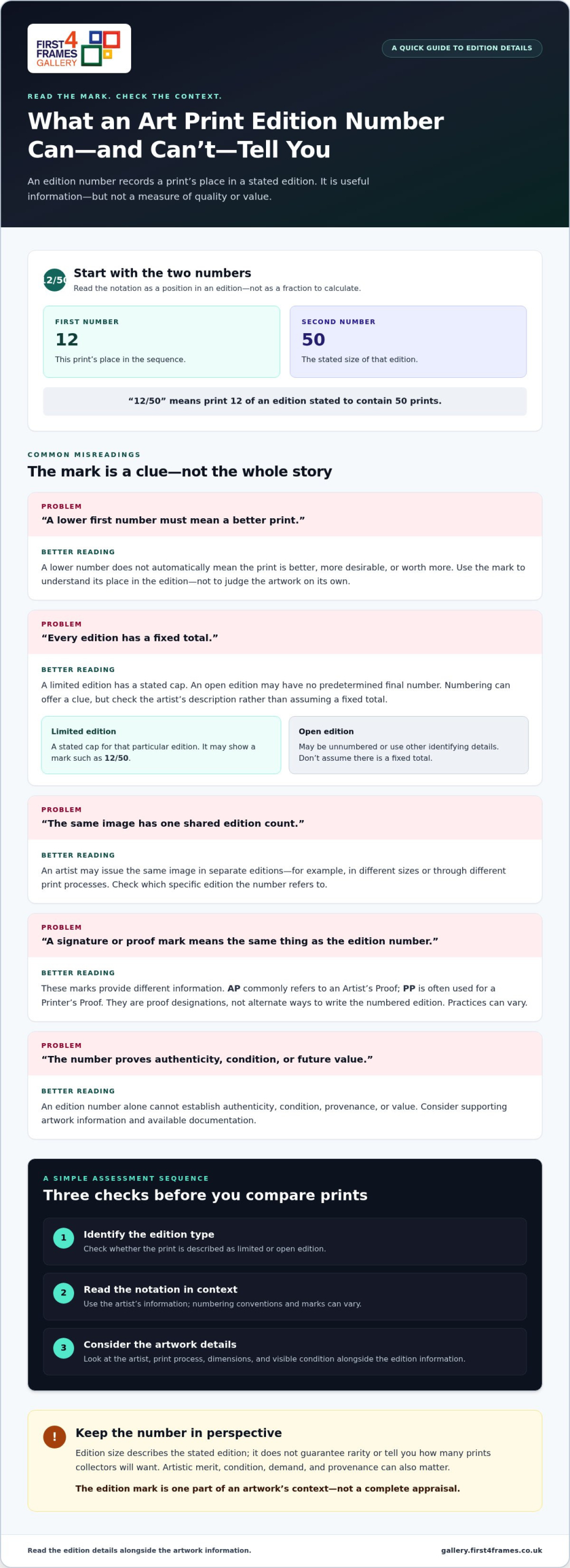
A lower number on an art print doesn’t automatically make it better or more valuable. If you’ve looked at a mark such as 7/50 and wondered what the two numbers mean, you’re not alone. Understanding art print edition numbers starts with separating what the mark records from what it can’t tell you: the first number usually identifies the print’s place in the edition, while the second gives the edition’s stated size. Practices vary, so the surrounding artwork information matters too.

This guide explains how to read the numerator and denominator, what edition size tells you, and how limited editions differ from open editions. You’ll also learn why a number alone can’t establish a print’s quality or value, and which other details to consider when choosing artwork. With a clearer picture of the edition, you can explore fine art prints with more confidence and plan how the artwork will look in your home.

Key Takeaways

  • Understanding art print edition numbers helps you interpret edition details, but the number isn’t a measure of quality or value.
  • Distinguish limited editions from open editions, and remember that different sizes or print processes may have separate edition counts.
  • Read edition numbers alongside other artwork details. Signatures and proof marks provide different information, and conventions can vary.
  • Choose artwork that speaks to you, then use edition details as context while exploring themes such as Scottish landscape art, coastal wall art and contemporary art prints.

What Do Art Print Edition Numbers Mean? Read the Mark at a Glance

Edition numbers identify a print’s position within a stated edition. A mark such as 12/50 commonly means that the print is number 12 in an edition of 50. The first number identifies its place in the sequence; the second gives the stated edition size.

Edition size is the total number of prints stated as belonging to a particular edition. It describes the edition, but doesn’t guarantee rarity or tell you how many prints collectors will want. A lower first number doesn’t automatically mean the print is better, more desirable or worth more. Understanding art print edition numbers helps you read the notation, not judge the artwork by the mark alone.

How to read a number such as 12/50

If a print is numbered 12/50, read it as “print 12 of an edition stated to contain 50 prints”, not as a fraction to calculate. The artist’s information provides the best context for interpreting the number. If the mark is unclear or uses a different format, look for the accompanying artwork details rather than assuming the usual convention applies.

Where edition details may appear

Numbering is often written in the print’s margin, the unprinted border around the image. Edition information may also appear on an accompanying label, certificate or artwork description. Signatures and other marks are separate details. For example, an Artist’s Proof is a distinct printmaking designation, not another way of writing the edition fraction.

Artists and printmaking practices vary, so the placement, wording and marks aren’t universal. Read the number alongside the artist’s description to understand what the stated edition covers. This provides useful context, while print quality and personal appeal should be considered on their own merits.

Limited Edition vs Open Edition Prints: What the Number Tells You

A limited edition has a stated cap for that particular edition. An open edition may have no predetermined final number, so it can be produced without the same declared limit. Numbering can offer a clue, but the artist’s description is important because practices and ways of presenting edition details vary.

Edition type
Numbering clue
Sensible interpretation
Limited edition
May show a fraction such as 12/50
The stated edition has a defined cap
Open edition
May be unnumbered, or use other identifying details
Don’t assume there’s a fixed total

Does a smaller edition mean a more valuable print?

Not by itself. A smaller edition may mean fewer prints were made in that particular run, but scarcity is only one part of a print’s context. Artistic merit, condition, demand and provenance can all matter. No edition number guarantees authenticity or future resale value. Christie’s collecting guide offers further context on prints and multiples, including the idea of an original print. Treat the edition mark as useful information, not a promise of price.

Can one artwork have more than one edition?

Yes. An artist may issue the same image in separate editions, for example in different sizes or through different print processes. Don’t assume that the numbers belong to one shared count. Check the details for the specific print to see which edition its number refers to.

Once you understand what an edition label can tell you, explore artwork that suits your space and taste in the online art print gallery.

How to Assess Art Print Edition Details Before You Choose

Use this sequence to assess edition information without reading too much into the number:

  • Identify the edition type. Check whether the print is described as limited or open edition.
  • Read the notation. Interpret the number using the artist’s information, rather than assuming every mark follows the same convention.
  • Check the artwork details. Consider the artist, print process, dimensions and visible condition alongside the edition information.

Signatures, proof marks and edition numbers are different details. A signature may identify or be attributed to the artist, while a proof mark describes a print’s relationship to the edition or production process. Their use can vary between artists and printmaking practices. Christie’s collecting guide offers further background on limited editions and how prints are made.

What do AP, PP or other proof marks mean?

AP commonly refers to an Artist’s Proof, while PP is often used for a Printer’s Proof. These are proof designations, not alternative ways of writing the numbered edition. Interpret them alongside the specific artwork information. Their meanings, use and numbering practices can differ, so don’t assume a universal quantity or significance from the letters alone.

What edition numbers cannot prove on their own

An edition number by itself doesn’t establish authenticity, condition, provenance or value. It tells you something about a print’s place in a stated edition, but it can’t provide a complete account of the artwork. Look for supporting information that identifies the artist, process and edition, and consider any available documentation. This broader context makes understanding art print edition numbers more useful when comparing prints.

An edition number is one part of an artwork’s context, not a complete appraisal. Keep that in mind as you browse the art print and framed art gallery, weighing the edition details alongside the image that feels right for your space.

Choose and Display an Art Print with Confidence

Choose a print because you enjoy looking at it, then use its edition details as context. Understanding the number can inform your decision, but it needn’t outweigh the image or how it will look in your home. Explore fine art, Scottish landscape art, coastal wall art, photography prints and contemporary art prints. A wall art visualiser can help you visualise art on your wall and see artwork before you buy.

Pair a print with a considered frame

A well-chosen frame completes an artwork’s presentation without changing what its edition number means. First4Frames Gallery creates bespoke framed wall art, with each frame individually crafted to order from high-quality materials. Unlike cheap, standard frames that may not fit artwork properly, a bespoke frame is made for the individual order. With Online picture framing, you can Choose your frame online and Design your framed artwork to suit the print and your space. The Art print framing service uses 2mm float glass, offering superior clarity to the perspex used by many competitors.

Explore artwork and plan the finished display

Browse an extensive online selection of artwork and frames, including framed wall art featuring works by best-selling artists and famous artists. Find Custom framed art prints and consider how the frame will complement the image. For digital photographs, the online photo printing and framing service combines high-quality printing with bespoke framing. Finished framed orders are fully packaged to help prevent damage and shipped via professional couriers.

Explore the framed art and print gallery to find an image that feels right for your space.

Choose a Print That Feels Right for Your Space

Understanding art print edition numbers gives you a useful starting point: the first figure commonly shows a print’s position, while the second indicates the stated edition size. The mark alone doesn’t prove a print’s quality, authenticity or future value. Read it alongside the artwork information, and remember that edition practices can vary.

Use those details as context, then let the image, artist and the way it will look in your home guide your choice. First4Frames Gallery offers Giclée fine art prints from a range of artists, primarily from Scotland, with bespoke frames individually crafted for each order using high-quality materials. Thoughtful framing helps the chosen artwork feel at home on your wall.

Ready to find an image that speaks to you? Explore framed art prints in the gallery and discover artwork you’ll be glad to display.

Frequently Asked Questions

What does 12/50 mean on an art print?

12/50 commonly means print number 12 in a stated edition of 50. The first number identifies the print’s place in the edition, and the second gives the edition size. Read the notation alongside the artist’s description because numbering practices can vary. The mark provides edition context, but it doesn’t by itself tell you about the print’s quality or value.

Is a lower-numbered art print more valuable?

No. A lower number doesn’t automatically make a print more valuable. A number such as 2/50 records its position in the edition, not its quality or desirability compared with 28/50. Value can depend on factors such as the artist, demand, condition and provenance. Treat the number as one piece of information, not a guarantee of a particular price or future resale value.

What is the difference between a limited edition and an open edition print?

A limited edition has a stated cap for that particular edition. An open edition may not have a predetermined total, so it can be produced without the same declared limit. The artwork’s description should clarify which type it is. Artists may also issue separate editions for different sizes or print processes, so don’t assume all versions share one edition count.

Do all art prints have edition numbers?

No, not all art prints are numbered. Open editions may be unnumbered, and artists or printmaking practices can use different ways to identify a work. You may find information in an artwork description or accompanying documentation instead. If a print has no edition number, that alone doesn’t establish its quality, authenticity or value. Consider the artwork details as a whole.

What does AP mean beside an art print edition number?

AP commonly stands for Artist’s Proof, a proof designation associated with the artist and distinct from the numbered edition. It may appear beside a print rather than as a fraction such as 12/50. Proof practices and meanings can vary by artist and print process, so interpret the mark using the accompanying artwork information. An AP mark alone doesn’t prove greater quality or value.

Posted on

12 x 8 Picture Frames: How to Choose the Right Fit

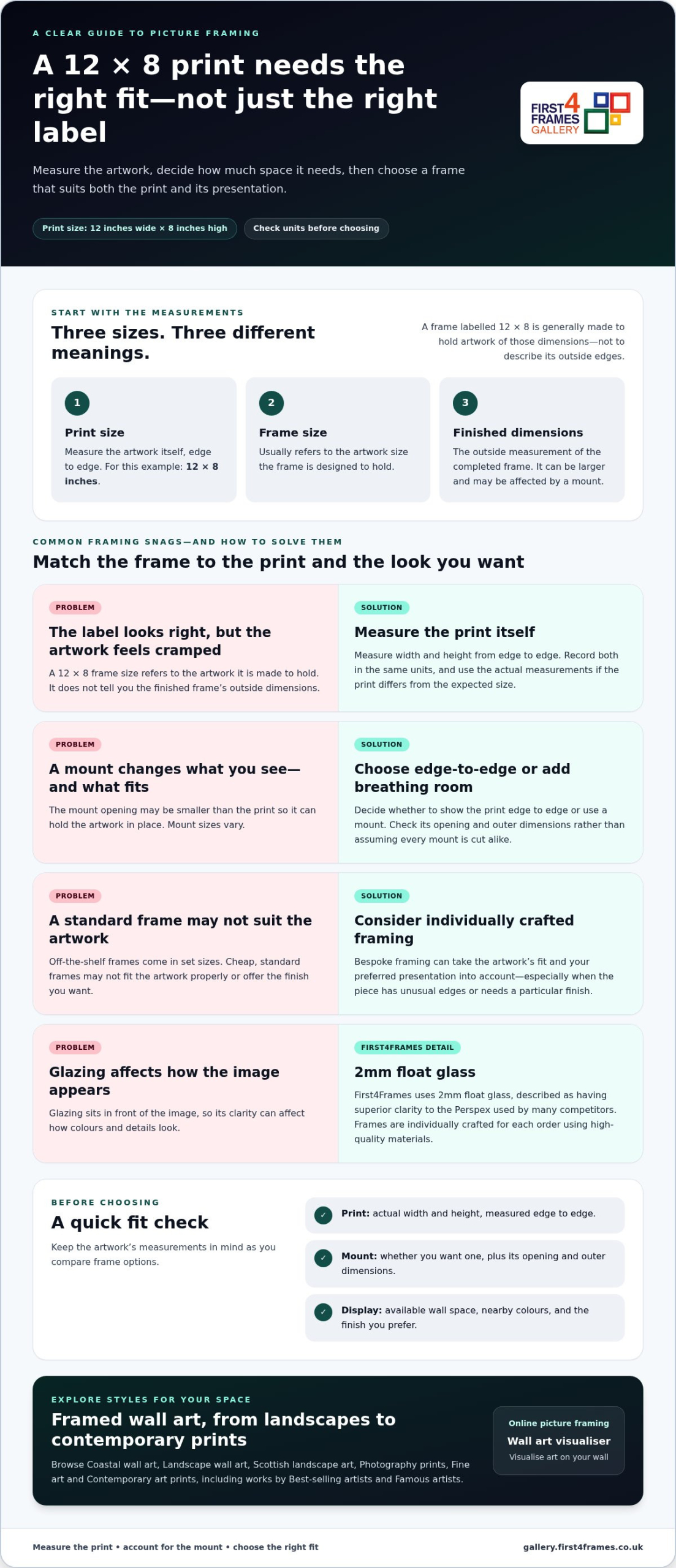
A 12 x 8 picture frame can look right but still leave your print cramped or poorly centred if you have not checked the measurements. A 12 x 8 print measures 12 inches by 8 inches, and a frame labelled 12 x 8 is generally designed to hold artwork of those dimensions.

Once you have measured the print, decide whether to show it edge to edge or add a mount. A mount’s opening is usually smaller than the artwork, allowing it to hold the print in place. This guide explains how to check dimensions, account for a mount and choose between a ready-to-hang frame and bespoke picture framing. At First4Frames Gallery, every frame is individually crafted for each order using high-quality materials, including 2mm float glass. Whether you are framing a photograph or choosing framed art, the right measurements and finish help give your picture the space and care it deserves.

Key Takeaways

  • For picture framing, 12 x 8 usually refers to the artwork’s dimensions in inches. Check the units before choosing a frame.
  • Measure the print, then account for any mount. Its opening and the finished frame dimensions can vary.
  • Compare standard frames with individually crafted options to find a suitable fit and finish for your artwork.
  • Explore framed wall art online and picture how your choice will look in your space before deciding.

What Does 12 x 8 Mean for a Picture Frame?

Search results can use the same numbers for very different things, from picture frames to garden sheds. The units make all the difference. For picture framing, 12 x 8 usually describes artwork measuring 12 inches wide by 8 inches high. It does not mean the finished frame will measure 12 by 8 inches on the outside.

Print size is the artwork’s edge-to-edge measurement. Frame size usually refers to the artwork size the frame is designed to hold. Finished framed dimensions are the outside measurements of the completed frame. These can be larger and may also be affected by a mount.

For a visual guide to common dimensions, explore standard photo and picture sizes. You can also read about standard photographic print sizes and how print dimensions are commonly described.

This video offers a practical look at framing an 8 x 12 print:

How to Measure a 12 x 8 Print

Measure the artwork itself from edge to edge, not the outer edge of the paper, a border you plan to trim, or an existing frame. Record the width and height in the same units, and note which measurement is which. Consistent units make it easier to compare your print with frame details. If the print differs slightly from the expected size, use its actual measurements when choosing a frame.

Why Search Results May Show 12 x 8 Feet

A shed listing may use 12 x 8 to describe a footprint of 12 feet by 8 feet. That is a garden structure’s floor area, not a picture dimension. For a frame, the same numbers usually refer to inches. Check the product category and stated units before buying, particularly when search results show sheds and picture frames side by side. A quick unit check helps you choose a frame for your artwork rather than a garden plot.

How to Choose a Frame for 12 x 8 Artwork

Use these steps to match the frame to your print and the way you want it to look on the wall:

  • Measure: Check the artwork’s width and height, including any border you want to keep visible. Compare those measurements with the frame’s stated picture size.
  • Decide on a mount: A mount adds space around the image. Its opening may be smaller than the print so it can hold the edges in place. Check the stated opening and outer dimensions, as mount sizes vary.
  • Choose a frame: A standard frame can be convenient when its intended artwork size suits your print. Cheap, standard frames may not fit the artwork properly or offer the finish you want. A bespoke frame, individually crafted for your order, can be made with the artwork’s fit and your preferred presentation in mind.
  • Consider the display: Measure the wall space and consider nearby colours. Decide whether you want the artwork to stand out or sit comfortably within the room.

The print size describes the artwork, the mount opening determines how much of it is visible, and the external frame size is the overall measurement of the finished piece. A 12 x 8 print with a mount will not necessarily suit a frame whose external dimensions are 12 x 8.

Should You Add a Mount to a 12 x 8 Picture?

A mount can give artwork breathing room and create a considered transition between image and frame. Its opening affects both the visible area and how the print is held, so do not assume every mount is cut to the same size. If colour is part of your decision, read this guide to choosing a mount colour. For broader guidance on caring for paper, see the Library of Congress’s paper preservation advice.

When Bespoke Framing Makes Sense

Custom framing is useful when your artwork has unusual edges, needs a particular finish or calls for a specific presentation. First4Frames Gallery crafts each frame individually for the order, with the artwork’s fit and your display preferences in mind. Once you know what matters most, explore framed artwork for inspiration.

What Quality Details Matter in a 12 x 8 Framed Picture?

A ready-made frame is convenient when its dimensions and finish suit your print. However, standard off-the-shelf frames are made to set sizes, leaving less flexibility over fit and presentation. First4Frames frames are individually crafted for each order using high-quality materials. Instead of relying on a cheap, one-size-fits-all frame that may not suit the artwork, you can choose a finish designed around the piece.

Float Glass and Perspex: What Is the Difference?

First4Frames uses 2mm float glass for clear, traditional glazing with superior clarity to the Perspex used by many competitors. Glazing sits in front of the image, so its clarity can affect how colours and details appear. The frame’s tone and profile matter too: they can complement the artwork or create a more defined border. Together, the glazing and frame shape the presentation without changing the artwork itself.

Choosing Artwork That Suits Your Space

Choose an image that feels at home in the room, then consider how its colours and subject will work with your décor. Framed wall art includes many styles and subjects, from Coastal wall art and Landscape wall art to Scottish landscape art, Photography prints, Fine art and Contemporary art prints. You can also explore works by Best-selling artists and Famous artists.

For a tailored presentation, explore the framing options and consider how the frame can support the artwork’s character. Browse framed wall art to find a piece that feels right for your space.

How to Choose and Order 12 x 8 Framed Wall Art Online

Online picture framing brings artwork and framing choices together in one place. Start by browsing framed wall art, then select a piece or framing option that suits your space. For a 12 x 8 print, keep the artwork’s measurements in mind as you choose a frame. Decide too whether you want a mount to add space around the image.

From Online Picture Framing to Ready-to-Hang Art

Explore the gallery’s artwork and frame options, then choose a style that complements the image and your room. A wall art visualiser can help you visualise art on your wall and see artwork before you buy. Choose your frame online and design your framed artwork around the look you want, whether you are selecting custom framed art prints or bespoke framed wall art. Ready-to-hang framed art gives you a simple way to go from choosing a piece to displaying it. For inspiration, browse framed artwork and discover the available choices.

Printing and Framing a Digital Photograph

Have a digital photograph you would like to display? First4Frames’ print and frame service brings the image and frame together as one considered piece. Your photograph is printed to the highest quality to complement the bespoke framing. Explore online photo printing and framing to turn your photograph into wall art.

Each frame is individually crafted for its order, then fully packaged to help prevent damage in transit and shipped via professional couriers. This careful process makes online ordering a straightforward way to bring a framed image from selection to your home.

Find the Right Frame for Your Artwork

Choosing a 12 x 8 frame starts with measuring the print and checking whether the stated frame size refers to the artwork or the finished piece. If you add a mount, its opening affects how much of the image shows and the space around it. Consider the look you want as well as the fit.

For a finish made with care, First4Frames frames are individually crafted for each order using high-quality materials. The 2mm float glass glazing gives a clear view of the artwork. Finished frames are fully packaged to help prevent damage and shipped via professional couriers, so your chosen piece can make its journey from gallery to home.

Ready to find artwork that feels at home in your space? Browse framed artwork and find a piece for your space. Explore the choices, picture your favourite on the wall and choose a frame that lets it shine.

Frequently Asked Questions

Is 12 x 8 the right frame size for a 12 x 8 inch print?

Usually, yes. A frame labelled 12 x 8 is generally intended to hold artwork measuring 12 inches by 8 inches. Check whether the listing gives the size of the print it fits or the frame’s external dimensions. If you plan to add a mount, make sure the frame can accommodate the artwork and mount together. The mount changes the visible opening and the overall fit.

What does 12 x 8 mean when buying a picture frame?

For picture framing, 12 x 8 usually means the artwork measures 12 inches wide by 8 inches high. The same numbers can describe other products in different units, so check the product category and measurement units. For example, a shed listed as 12 x 8 may be measured in feet. Frame listings generally use the artwork dimensions, not the outside measurement of the finished frame.

Can I put a 12 x 8 print in a larger frame?

Yes. A larger frame can display a smaller print with a mount, creating space around the artwork and a different presentation. Check that the frame’s internal dimensions can accommodate the print and mount, and remember that mount openings vary. If you want a specific border or fit, custom framing can be tailored to the print and the look you have in mind.

How do I choose a frame for a 12 x 8 photograph?

Measure the photograph edge to edge, then choose a frame designed for those dimensions or a larger one with a suitable mount. Consider whether you want the image displayed edge to edge or surrounded by a border, and how the frame’s finish will work with the photograph and room. First4Frames Gallery crafts each frame for the order using high-quality materials.

Is glass or Perspex better for a 12 x 8 picture frame?

It depends on your priorities, but First4Frames Gallery uses 2mm float glass for clear, traditional glazing. Its clarity is superior to Perspex, which is used by many competitors. Glazing affects how the artwork appears behind the frame, so consider the visual finish you prefer and the setting where the picture will be displayed. The glazing is part of creating a frame that suits the artwork.

Posted on

Can I Get My Existing Frame Re-Glazed with UV Glass?

What if your frame can stay, but its glazing needs to change? If you’re asking, “can I get my existing frame re-glazed with UV glass”, the answer may be yes. A framer first needs to check whether the frame can safely accommodate the new glazing and whether it is suitable for the artwork.

It makes sense to check before replacing a frame you already love. UV protection varies between glazing options, and filtering UV light is not the same as reducing reflections or improving clarity. First4Frames Gallery specifies 2mm float glass for its framing, but standard float glass should not be mistaken for UV-protective glazing. Whether First4Frames Gallery offers UV-glass reglazing is not confirmed, so check directly before making plans.

This guide explains what a framer needs to assess, what to ask about UV performance, and how glass and acrylic differ. You’ll also learn when bespoke reframing may be a better fit, so you can make an informed choice for your artwork.

Key Takeaways

  • Wondering “can I get my existing frame re-glazed with UV glass”? A framer needs to assess the frame and artwork before confirming whether they’re suitable.
  • Compare glazing by its documented UV specification, clarity, reflections and handling needs. Don’t rely on the label “UV glass” alone.
  • Photograph your frame and describe the artwork, then ask about glazing availability, fit and whether the mount needs review.
  • If the frame is unsuitable, bespoke picture framing may provide a better fit, with each frame individually crafted for the artwork.

Can an Existing Picture Frame Be Re-Glazed with UV Glass?

Yes, an existing frame may be suitable for UV-protective glass, but a framer needs to check the frame and artwork before confirming. The glazing must fit securely without pressing against the artwork or mount. The frame’s condition, internal depth, rebate (the channel that holds the glazing and artwork) and fixing method all affect whether it can be reused. There is no universal fit.

If you’re asking, “can I get my existing frame re-glazed with UV glass”, treat UV protection as a specification to verify, not an automatic feature of replacement glass. Ask which product is proposed and request its documented UV performance. This is separate from whether the glass is anti-reflective or offers a clear view. UV filtering can help reduce one source of deterioration, but it cannot prevent every cause of fading or damage.

What needs checking before replacing the glazing?

Ask a framer to inspect the frame, rebate depth, fixings and existing glazing. They should also check how the artwork and mount sit inside the frame. If the replacement glazing is thicker than the original, or the frame is worn or unusually constructed, it may not fit securely. An assessment can establish whether reglazing is practical or bespoke reframing would be more suitable.

What does UV-protective glass mean for framed art?

The term “UV glass” alone does not tell you how much UV the product filters. Check the manufacturer’s documented specification and ask the framer to explain what it means for your artwork. A picture frame brings together several components, including protective glazing, but glazing cannot preserve artwork on its own. Light exposure, the artwork’s materials and its surroundings matter too.

UV filtering and anti-reflective treatment are different features. One concerns UV performance, while the other reduces reflections. Ordinary glass clarity is another consideration. First4Frames specifies 2mm float glass and describes its clarity as superior to perspex used by many competitors, but this is not a claim of UV protection. Its available information confirms bespoke framing, not UV-glass reglazing, so check availability directly.

UV Glass, Standard Glass, and Perspex: What Should You Compare?

The label “UV glass” is not enough to judge whether glazing suits your artwork or frame. Compare the documented UV specification alongside appearance, handling and fit. UV filtering, anti-reflective treatment and glass clarity are separate considerations.

Glazing UV specification Clarity and reflections Handling and compatibility
Standard glass Check the product details. Don’t assume it has a UV-protective specification. Appearance and reflections depend on the glass and any coatings. Heavier than acrylic and can break. Confirm that its thickness and weight suit the frame and fixings.
UV-specified glass Ask for the manufacturer’s documented UV performance. UV filtering does not necessarily reduce reflections. Ask whether the glazing has an anti-reflective treatment. Check the chosen product’s thickness and weight against the frame’s rebate and construction.
Perspex or acrylic UV performance varies by product, so request its specification. Check the product’s appearance against your artwork and lighting. Lighter and shatter-resistant compared with glass, but more prone to scratching and static. Confirm it can be fitted securely.

First4Frames specifies 2mm float glass and describes it as clearer than perspex used by many competitors. This detail concerns clarity, not UV protection, and should not be treated as a UV specification.

Which glazing questions should you ask a framer?

Ask what UV performance is documented for the proposed glazing, whether its thickness and weight suit your frame, and how it may affect reflections and the artwork’s appearance. Check any handling or cleaning requirements as well. If you’re considering whether can I get my existing frame re-glazed with UV glass is practical, these details will help the framer assess your specific frame.

Does UV glass protect artwork from all fading?

No glazing can prevent every kind of fading or damage. Tell the framer where the piece will hang, particularly if it may receive direct sunlight, and seek advice tailored to valuable or delicate work. If reframing is a better fit, you can browse framed artwork for inspiration.

How to Decide Whether to Re-Glaze or Reframe Your Artwork

A careful assessment helps protect both the artwork and the frame. Before approving new glazing, give a framer enough information to check the frame’s condition, construction and fit.
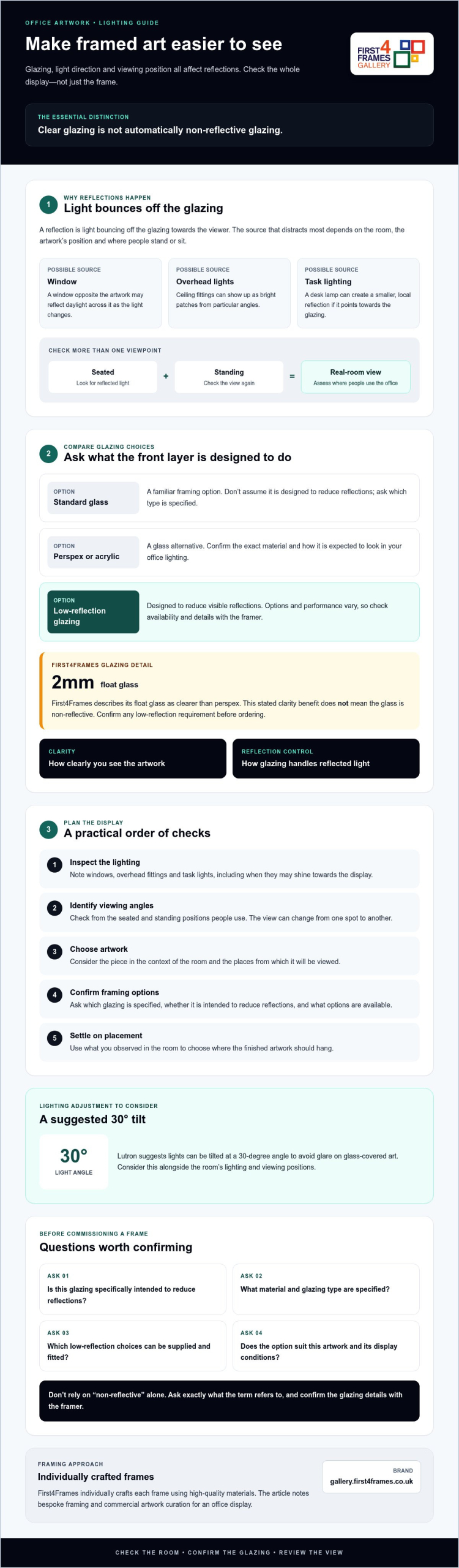
  1. Photograph the frame. Share clear images of the front, back, corners and fixings. Include a side view so the framer can see the frame’s depth.
  2. Describe the artwork. Explain what it is made from, whether it has a mount and where it is displayed. Mention any concerns about its condition or sensitivity.
  3. Ask for an assessment. Confirm whether the requested glazing is available, whether it will fit securely and what handling it needs. Ask whether removing and refitting the artwork could affect the mount or frame construction.
  4. Agree the next step. Proceed with reglazing only after a professional confirms that the frame can safely accommodate the chosen material.

When might keeping the existing frame make sense?

Reusing a frame may be practical if it is in good condition and the framer confirms that the replacement glazing fits the rebate and fixings. Even then, changing the glazing means taking the frame apart. Ask whether removing and refitting the artwork could affect it or the mount. The answer depends on the individual frame, so don’t assume it will be a straightforward swap.

When should you consider bespoke reframing?

If the frame cannot safely hold your preferred glazing, a new frame made for the artwork may be more suitable. First4Frames offers bespoke picture framing, with each frame individually crafted for the order using quality materials. Its available information does not confirm whether it accepts reglazing jobs, so check service availability before making arrangements.

For more on framing decisions, read a custom picture framing guide and a picture frame selection guide. If a new piece is the right direction, explore framed artwork for inspiration.

Your Next Step: Get the Right Framing Advice for Your Artwork

Before authorising work, ask a framer to confirm the UV specification, check that the glazing fits your frame and establish whether it is suitable for the artwork. Preparing clear details will help them assess your options.

What information should you prepare for a framing enquiry?

Gather these details before speaking to a framer:

  • Measurements: Record the outside frame dimensions and, if accessible, the artwork and rebate dimensions.
  • Photographs: Take clear pictures of the front, back and edges, including any visible damage.
  • Artwork and glazing: Describe the artwork, current glazing, display location and the UV-protection outcome you want. If you have a digital photograph, ask about print and frame options. First4Frames sells Giclée fine art prints that customers can pair with a custom frame.

First4Frames offers bespoke framing, but whether it provides UV-glass reglazing is not confirmed. If a new piece better suits your needs, explore its selection of fine art prints and ready-to-hang framed art, with a choice of frames. You can also consider bespoke framed art for your home or commercial space. Browse the framed art gallery for inspiration.

Choose the Right Next Step for Your Artwork

The answer to “can I get my existing frame re-glazed with UV glass” depends on the frame’s construction, the glazing available and what suits the artwork. Before authorising a change, ask a framer to confirm the UV specification, check the frame’s fit and consider how the artwork and mount will sit behind the replacement glazing.

Clear details make that conversation easier. Share the frame’s measurements and photographs, describe the artwork and its display location, and explain what you want UV protection to achieve. First4Frames specifies 2mm float glass for its clarity compared with perspex, but this is not a UV-protection claim. If a new frame is a better solution, First4Frames offers bespoke picture framing, with each frame individually crafted for the order.

Looking for a fresh piece instead? Explore framed art in the First4Frames Gallery for inspiration. Ask a framer to assess your existing frame, or browse the gallery to find artwork that you can pair with a frame.

Frequently Asked Questions

Can I replace the glass in my existing picture frame with UV glass?

Possibly, but a framer needs to inspect the frame and confirm that the required glazing is available. The frame’s depth, condition and fixings must suit the replacement, and the artwork must sit safely behind it. If you’re asking, “can I get my existing frame re-glazed with UV glass”, request the product’s documented UV specification and a fit assessment before approving any work.

Will UV glass fit any existing picture frame?

No, there is no universal fit. A framer needs to check the frame’s depth and rebate, its condition, and whether the fixings can hold the new glazing securely. They should also make sure the artwork and mount have enough clearance and will not press against the glass. The answer depends on the specific frame and glazing, so arrange an assessment before choosing a replacement.

Does UV glass stop artwork from fading completely?

No. UV-filtering glazing can help reduce exposure to UV radiation, but it cannot prevent every cause of fading or damage. Other light and environmental conditions matter too, including display location and direct sunlight. Ask a framer how the proposed glazing’s documented specification relates to your artwork and where it will hang. For valuable or delicate work, seek advice tailored to the piece.

Is UV glass better than perspex for picture framing?

Neither is automatically better for every artwork or frame. Compare the specific product’s documented UV performance, appearance, thickness and handling needs. Glass is generally more scratch-resistant but can break. Acrylic, often called perspex, is lighter and shatter-resistant but can scratch and attract dust through static. First4Frames specifies 2mm float glass and highlights its clarity compared with perspex, but this is not a UV-protection claim.

Can a picture framer reglaze a frame without replacing the artwork or mount?

It may be possible, but the framer should inspect the specific frame construction first. They need to consider how the glazing is held in place and whether the artwork and mount can be removed and refitted safely. The mount may need review if the replacement affects the available clearance. Don’t assume the artwork can remain untouched or that the mount will suit the new glazing.

Posted on

Large Framed Art for Commercial Spaces: Buying Guide

The most impressive artwork for a commercial space is not always the largest piece available. Choosing large framed art for commercial spaces means balancing visual impact with the room’s purpose, wall dimensions and existing interior. The right choice should feel considered in its setting, not oversized for the sake of it.

When you are planning artwork for several rooms, it can be difficult to make the selection feel cohesive while still giving each space its own character. You may also need to decide whether a standard frame will suit each piece. This guide covers practical ways to assess artwork, framing and project requirements before you order.

Explore how commercial artwork curation can bring a scheme together, from fine art and photography prints to coastal wall art, Scottish landscape art and contemporary art prints. You’ll also learn how to use a wall art visualiser to preview art on your wall before you buy. First4Frames Gallery’s frames are individually crafted using high-quality materials, with 2mm float glass for clarity. We’ll look at how online selection, bespoke framing and professional courier delivery can support the process from choosing artwork to receiving finished framed wall art.

Key Takeaways

  • Learn how large framed art for commercial spaces can support a room’s atmosphere and identity, without relying on a fixed definition of “large”.
  • Compare artwork subject, colour and mood with framing options to find a considered fit for each piece and setting.
  • Use a practical planning sequence: start with the project brief and wall measurements, then coordinate artwork, framing and delivery.
  • Discover how commercial artwork curation, online selection and custom framing can help property developers, hoteliers and estate agents create a cohesive scheme.

Why Large Framed Art Can Work in Commercial Spaces

“Large” has no single size threshold in a business interior. It means artwork with enough presence to relate to its surroundings, whether it anchors a reception wall or adds character to a meeting room. To judge whether a piece will work, consider the available wall area, how far away people will view it, the room’s function and the atmosphere you want visitors or staff to experience.

Well-chosen framed art can create a focal point, contribute to a business’s identity and help an interior feel complete. Artwork displayed in a shared setting also relates to the broader idea of public art, although a framed work selected for a commercial interior is not necessarily a site-specific commission.

For a visual example of oversized wall art, watch this short video:

Which commercial spaces might benefit from framed artwork?

In an office, artwork can help distinguish a reception area from a quieter meeting room. Hotels can use considered choices to create a welcoming impression, while art in a staged property can help visitors picture the space as finished and lived in. Galleries may select framed works to complement their wider presentation. Start by defining what each room needs to do and the experience you want people to have. Then consider which subjects and moods support that brief.

When is framed art different from an art installation?

Curated framed works are finished pieces, paired with framing suited to the artwork and setting. A site-specific installation, by contrast, may involve a design developed for a particular building or location. Large framed art for commercial spaces can make a strong visual statement without becoming a construction project. First4Frames provides commercial artwork curation and framing, but not on-site installation. Confirm installation arrangements separately if your project requires them.

How to Compare Large Framed Art and Framing Options

Start with the artwork, then consider the frame. Compare each option with the project brief: its subject, palette and mood should suit the room’s purpose and the impression you want to create. A calm landscape might complement a restful guest space, while a more expressive contemporary print could bring energy to a shared area. The best fit depends on the setting, not on a presumed trend.

What should a commercial buyer compare before choosing artwork?

Consider coastal wall art, landscape wall art and Scottish landscape art alongside fine art, photography prints and contemporary art prints. Check how each work’s colours and visual character relate to the interior, and whether it supports the brief. A selection may include pieces by best-selling and famous artists. For a multi-room project, compare the works as a group too. Related colours or subject matter can create continuity without making every room look identical.

Why does bespoke framing matter for large framed art?

A standard frame may not suit the dimensions or presentation of a particular work. First4Frames individually crafts each frame to order using high-quality materials, so the frame can be matched to the chosen piece rather than relying on a standard option. The specified glazing is 2mm float glass, selected for clarity. For more guidance on choosing a frame to complement a work, see Mastering Custom Picture Framing: The Expert Guide to Bespoke Art Display.

Consider the artwork and framing together before deciding. For large framed art for commercial spaces, this helps the finished piece feel intentional, with the frame supporting rather than distracting from the image. You can browse the framed art gallery to explore options for your brief.

How to Plan Large Framed Art for Your Commercial Project

A clear plan makes it easier to coordinate artwork across a commercial space. Work through the decisions in order and keep a record of the details a provider will need to give project-specific guidance.

  1. Define the brief. Note each room’s purpose, the atmosphere you want to create and any visual themes to carry between spaces.
  2. Assess the walls. Record the available wall measurements and where people are likely to view the artwork from. Note the viewing conditions, including natural and artificial light.
  3. Shortlist artwork. Group rooms by function, then choose works that feel related without requiring every space to look the same.
  4. Choose the framing. Confirm the artwork and frame combination, including the finished dimensions and any custom framing requirements.
  5. Coordinate delivery. Confirm project quantities, delivery arrangements and how finished frames will be packaged and shipped.

How can you shortlist art for several rooms?

Begin with the experience each area should offer. A reception space and a quiet meeting room may call for different subjects or moods. A shared colour palette can help the wider scheme feel coherent. Use a wall art visualiser to Visualise art on your wall and See artwork before you buy, so you can consider a work in context. The “Art in the Frame” resource can also help you think about sourcing and framing as connected choices.

What should you confirm before ordering framed works?

Before placing an order, check the artwork dimensions, frame choice and quantities with the provider. Ask how finished frames are protected for transit and how delivery is coordinated. First4Frames packages finished frames to help prevent damage and ships them via professional couriers. Confirm project-specific dimensions, framing suitability and delivery arrangements before ordering.

Ready to explore options for your brief? Browse the framed art gallery as you shape your shortlist.

How First4Frames Helps Source Large Framed Art for Business

Choosing large framed art for commercial spaces involves more than finding a striking image. First4Frames Gallery supports property developers, hoteliers and estate agents with commercial artwork curation, connecting artwork selection with bespoke framing. Its online gallery includes Giclée prints and works by artists primarily from Scotland, alongside a selection of frames. Explore landscape, coastal, fine art, photography and contemporary styles to find options that suit your project.

What can buyers explore through the online art and framing service?

Browse Custom framed art prints and Bespoke framed wall art, or consider the Art print framing service for a digital photograph you’d like printed and framed. First4Frames prints supplied photographs to complement the bespoke frame. This is a print-and-frame option, not a photography service. Frames are individually crafted for each order using high-quality materials, with 2mm float glass for clarity.

The Online picture framing journey is straightforward: choose artwork, Choose your frame online, then Design your framed artwork by reviewing the combination. Online visualisation can help you picture a work in its intended setting before deciding. For more framing guidance, explore the article Picture Frames: The Ultimate Guide to Choosing, Hanging, and Displaying Art.

How can a commercial buyer take the next step?

Browse the gallery and shortlist pieces that suit the rooms, visual brief and framing needs of your project. Then contact First4Frames Gallery to discuss commercial curation or bespoke framing requirements. Before ordering, confirm project-specific dimensions, framing suitability, quantities and delivery arrangements. Finished frames are fully packaged to help prevent damage and shipped via professional couriers.

Contact First4Frames about commercial framing to discuss your requirements, then Browse framed artwork for your commercial space.

Bring Your Commercial Art Brief to Life

Choosing large framed art for commercial spaces starts with the setting. Consider each room’s purpose, the artwork’s subject and mood, and how the frame completes the presentation. For a project spanning several rooms, a clear brief and recorded wall measurements help you build a cohesive selection and check the practical details before ordering.

First4Frames Gallery supports property developers, hoteliers and estate agents with commercial artwork curation, Giclée prints and works by artists primarily from Scotland. Each frame is individually crafted for its order using high-quality materials, so it can be matched to the chosen artwork rather than relying on a standard frame that may not fit. This offers a considered route from selecting artwork to choosing finished framed art.

Ready to shape a distinctive scheme for your space? Browse the gallery and find framed art for your project. A thoughtful selection can help bring the whole interior together.

Frequently Asked Questions

Can large framed art work in an office or other commercial space?

Yes. Framed artwork can suit offices, hotels, staged properties and galleries when it supports the room’s purpose and visitor experience. Consider the wall around it, how people will view the work and the atmosphere you want to create. For large framed art for commercial spaces, the subject, colour and framing should suit the interior rather than being selected by size alone.

How do I choose the right size framed art for a commercial wall?

Measure the available wall area first, then consider viewing distance, furniture and the room’s layout. A work that feels prominent in a reception area may have a different impact in a corridor or meeting room. There is no universal size rule for every commercial setting. Share your measurements and viewing context with the provider, and confirm the finished artwork and frame dimensions before ordering.

Is bespoke framing better than a standard frame for commercial artwork?

Bespoke framing can be a better fit when the frame needs to suit a particular artwork. A standard frame may not fit the piece properly or complement its presentation. First4Frames individually crafts each frame to order using high-quality materials, rather than relying on a one-size-fits-all option. Its specified glazing is 2mm float glass, selected for clarity.

Can I preview framed artwork on my wall before ordering?

A wall art visualiser can help you preview a work in context and consider how its subject, colour and scale may sit within your interior. It is a useful selection aid, but it does not replace checking the actual artwork and frame details. Before ordering, confirm how the preview represents the finished piece, including the chosen frame, dimensions and appearance, with the provider.

How is large framed art packaged and delivered?

First4Frames fully packages finished framed orders to help prevent damage and ships them via professional couriers. Before placing a commercial order, confirm the artwork dimensions, framing suitability, quantities and delivery arrangements with the provider. Ask how the finished pieces will be packaged for transit, particularly if your project includes several works. No delivery time is specified, so check the arrangements for your order directly.

Posted on

Non-Reflective Office Lighting Frames: Buying Guide

A beautifully framed print can still be difficult to enjoy when bright reflections compete with the image. Choosing non-reflective frames for office lighting involves more than the frame itself: glazing, light direction and artwork placement all play a part. Glazing terms can also be confusing when you’re comparing options for a professional-looking display.

First4Frames Gallery individually crafts each frame using high-quality materials. Its framing service uses 2mm float glass, which it describes as clearer than perspex. That should not be mistaken for non-reflective glazing. If reflections are a concern, check directly with your framer which specialist glazing choices are available before ordering.

This guide explains what causes reflections and how glazing, lighting and placement can work together to make office artwork easier to see. Learn how anti-glare and anti-reflective glazing differ, what to consider when choosing framed wall art, and which questions to ask before commissioning custom picture framing.

Key Takeaways

  • Check how windows, overhead lights and viewing angles affect the display, then assess the lighting around the wall you’re considering.
  • Compare glazing choices when considering non-reflective frames for office lighting. Clear 2mm float glass is not necessarily glazing designed to reduce reflections.
  • Use a practical order of checks: inspect the lighting, identify viewing angles, choose artwork, confirm framing options, then settle on placement.
  • Explore bespoke framing and commercial artwork curation for an office display. First4Frames individually crafts each frame using high-quality materials.

Why office lighting creates reflections on framed artwork

A reflection is light bouncing off the glazing towards the viewer, not a feature of the frame itself. A window opposite the artwork may reflect across it as daylight changes. Ceiling lights can appear as bright patches, while a desk lamp may cause a smaller, local reflection. The most distracting source depends on the room and the artwork’s position.

Viewing angle matters too. A framed print may look clear from one spot and mirror a light source from another. Check it from the seated and standing positions people typically use in the office. For an overview of picture framing glass or acrylic, see the different glazing materials used in framing.

This short video demonstrates acrylic described as non-glare:

Which office lights and positions create the most glare?

Assess the artwork in the lighting conditions it will actually face. A window opposite the frame may reflect daylight directly, while overhead fittings can show up from particular angles. Task lighting can cause glare if it points towards the glazing. No single light source always dominates, so check from the usual seated and standing positions before deciding where the piece should hang.

Does a non-reflective frame mean non-reflective glass?

The frame surrounds and supports the artwork; glazing is the transparent front layer. The phrase “non-reflective frame” may refer loosely to the glazing or the finished display, so ask the seller exactly what it means and which glazing is specified. The frame shapes the presentation; the glazing determines how its surface handles light. First4Frames specifies 2mm float glass and describes it as clearer than perspex, but does not describe it as non-reflective. Confirm any low-reflection requirement before ordering.

Compare glazing choices for clearer framed art in an office

Glazing affects how clearly artwork can be seen and how reflections appear, but these are separate considerations. When choosing non-reflective frames for office lighting, compare the glazing itself rather than assuming the frame material controls glare.

Glazing choice What to consider
Standard glass A familiar framing option, but don’t assume it’s designed to reduce reflections. Ask what type is specified.
Perspex or acrylic A glass alternative. Confirm the exact material and how it is expected to look in your office lighting.
Low-reflection glazing Designed to reduce visible reflections, but options and performance vary. Check availability and details with the framer.

First4Frames specifies 2mm float glass and describes its clarity as superior to perspex. That stated clarity benefit doesn’t mean the glass is non-reflective. Clarity describes how clearly you see the artwork; reflection control describes how glazing handles reflected light. Availability depends on the framer.

What should you ask about anti-reflective glazing?

Ask whether the quoted glazing is specifically intended to reduce reflections, how the provider describes its performance, and whether it suits your artwork and display conditions. Confirm which options can be supplied and fitted, and ask for any relevant care guidance. Don’t rely on “non-reflective” alone; find out exactly what the term refers to.

How do clarity and reflection control differ?

Glazing can offer a clear view without being designed to minimise reflections. Consider both needs, then ask the framer to explain the available choices. Lighting placement may also help: Lutron suggests lights can be tilted at a 30-degree angle to avoid glare on glass-covered art.

To find artwork for your office, browse the framed artwork gallery, then confirm your glazing requirements directly before ordering.

Non-Reflective Office Lighting Frames: Buying Guide

How to choose and position framed artwork under office lighting

A practical plan helps you choose artwork that suits the office and stays visible from the places people use most. Before ordering non-reflective frames for office lighting, work through these steps:

  • Inspect the lighting. Note windows, overhead fittings and task lights, including when they’re likely to shine towards the display.
  • Identify viewing angles. Check sightlines from desks, meeting areas and circulation routes, from both seated and standing positions.
  • Choose the artwork. Consider the room’s purpose, existing colours and the atmosphere you want the art to create.
  • Confirm framing options. Ask the framer about suitable frame and glazing choices before placing your order.

How should you assess artwork placement before ordering?

Use a temporary paper outline or hold a sample print against the wall in a few possible positions. This helps you visualise the scale and placement before you buy. A wall art visualiser may also help if you have access to one, but don’t assume it’s provided by the seller. Check sightlines from desks and meeting areas. If reflections distract from the image, try moving the planned position or adjusting nearby lighting.

Which artwork styles suit a professional office?

Choose imagery that supports the space without overwhelming it. Coastal wall art can suggest an open, restful mood; landscape wall art offers a broad range of natural scenes, while Scottish landscape art brings a more specific sense of place. Fine art, photography prints and contemporary art prints offer further options. If considering work by best-selling artists or famous artists, compare the image, scale and palette with the room before choosing a frame.

For broader frame-selection advice, consult Picture Frames: The Ultimate Guide. To explore artwork options for your office, browse the framed art gallery.

Choose bespoke framed wall art for a polished office finish

A well-chosen frame brings artwork into the room’s design, while suitable glazing and placement help keep it comfortable to view. First4Frames individually crafts each frame to order using high-quality materials. Bespoke framing lets you discuss how the frame should present the artwork and fit the space. Businesses planning a coordinated display can also consider commercial artwork curation.

First4Frames offers a selection of frames and artwork online. Choose a frame, then plan the finished piece around the print, office palette and intended position. If reflections are a concern, ask which glazing options are available rather than assuming a bespoke frame includes non-reflective glass.

What can an office ask a bespoke framer to tailor?

Discuss the artwork’s size and presentation, frame selection and any glazing requirements. First4Frames specifies 2mm float glass and describes its clarity as superior to perspex; this doesn’t mean it has anti-reflective performance. Confirm any low-reflection requirement directly with the framing service. These choices can help shape custom framed art prints through an art print framing service, creating bespoke framed wall art suited to the workplace.

How can businesses source office artwork and framed photographs?

Commercial artwork curation can help businesses furnish office spaces. First4Frames offers bespoke framing for prints, fine art, paintings and photographs. Businesses can discuss the artwork and framing requirements for their space, including the glazing and presentation they have in mind.

Explore framed wall art for your office and consider how each piece will work with its lighting, position and frame.

Make your office artwork clear and considered

Choosing non-reflective frames for office lighting means looking beyond the frame: glazing, light direction and viewing position all influence how easily artwork can be seen. Check the display from everyday desk and meeting-room sightlines, and confirm exactly what a framer means by “non-reflective” before ordering.

First4Frames individually crafts each frame to order using high-quality materials. Its framing uses 2mm float glass, described as clearer than perspex, but that clarity should not be mistaken for verified anti-reflective performance. Ask about glazing requirements directly. Businesses can also consider commercial artwork curation for a cohesive office display.

Thoughtful artwork choices and bespoke framing can help create a polished space that feels welcoming and reflects your workplace. Explore framed wall art for your office and find pieces to help bring your vision to life.

Frequently Asked Questions

Are non-reflective frames the same as anti-reflective glass?

No. “Non-reflective frame” doesn’t necessarily mean the frame includes anti-reflective glass. The frame is the structure surrounding the artwork, while glazing is the transparent front layer. Sellers may use the phrase informally, so ask what glazing is included and whether it’s specifically intended to reduce reflections. Don’t assume ordinary glass or a particular frame finish will control glare.

Does 2mm float glass stop reflections from office lights?

No. First4Frames specifies 2mm float glass and describes its clarity as superior to perspex, but clarity and reflection reduction are different qualities. Float glass can still show reflections from office lights, depending partly on light direction and viewing angle. Ask the framer whether lower-reflection glazing is available for your chosen artwork and frame before ordering.

How can I reduce glare on framed pictures in an office?

Start by checking the artwork from the places people usually sit or stand. Reflections can change with the sightline, so view the piece from desks and meeting areas, then try adjusting its position or nearby lighting. Before ordering non-reflective frames for office lighting, ask the framer about glazing options. The best approach depends on your room, windows, light sources and viewing angles.

Is perspex clearer than glass for picture framing?

Not necessarily. Performance depends on the specific glazing and your priorities. First4Frames describes its 2mm float glass as clearer than perspex, but this doesn’t establish that every type of glass is clearer than every acrylic. Ask the framer to explain the materials available and compare how they suit your artwork, office lighting and handling needs.

Can I order custom framed art prints for an office?

Yes. First4Frames offers bespoke picture framing, fine art prints and commercial artwork curation, so businesses can discuss artwork and framing requirements for their space. Frames are individually crafted for each order using high-quality materials. Confirm glazing choices directly, especially if reducing reflections under office lighting is important to your project.