Posted on

How to Hang Pictures on Plasterboard Walls: A Practical Guide

How to Hang Pictures on Plasterboard Walls: A Practical Guide

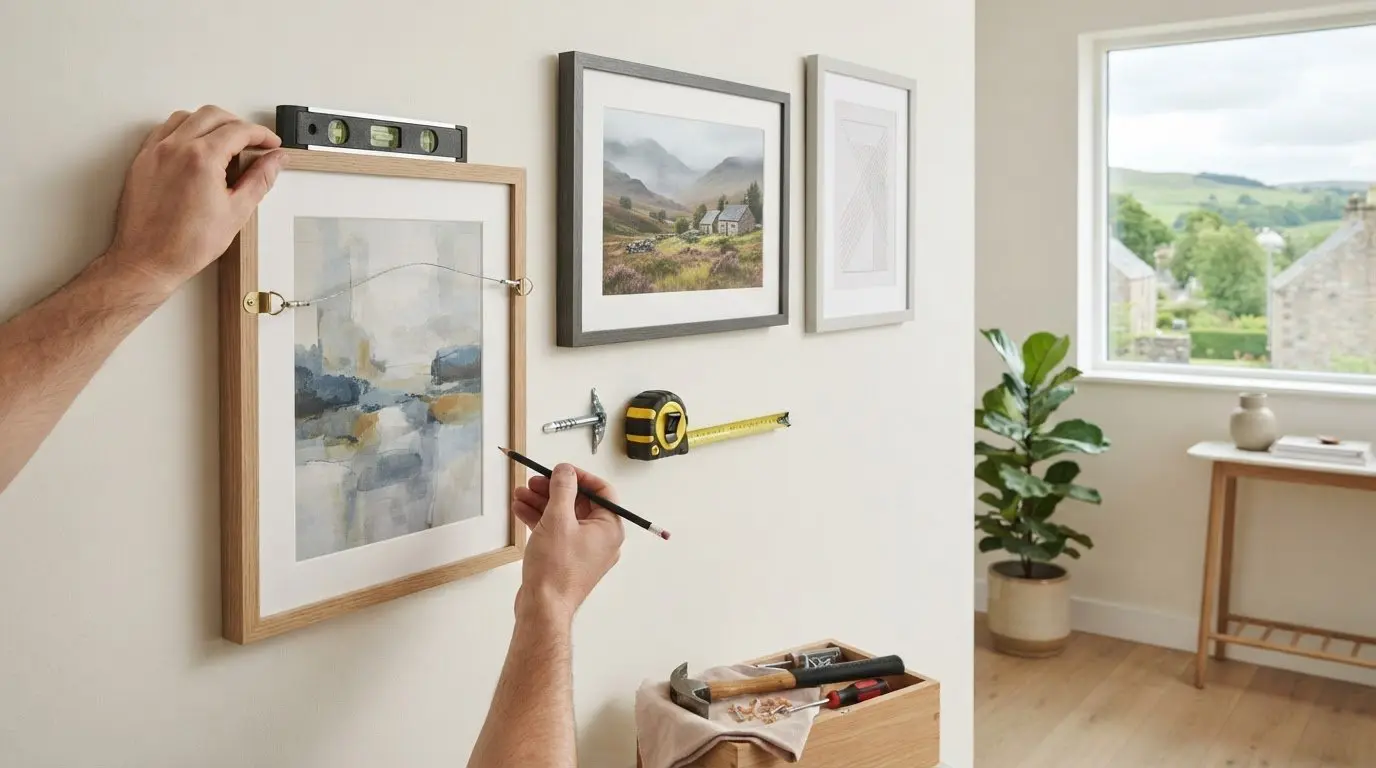
What if the right fixing matters more than the hook itself? If you’re unsure what’s behind your plasterboard, conflicting advice can make a simple job feel risky. Learning how to hang pictures on plasterboard walls starts with the wall structure and the frame’s weight, not guesswork.

This guide explains how to choose a suitable hanging position, check for a stud and match a fixing to your picture. You’ll also learn how to hang the frame neatly and check that it feels secure. Before drilling, take care around hidden pipes and wiring. Once the wall fixing is in place, the right frame hardware makes hanging simpler: First4Frames Gallery professionally framed artwork comes ready to hang with D-rings and high-quality framing wire attached.

Key Takeaways

  • When working out how to hang pictures on plasterboard walls, assess the wall structure and the framed picture before choosing a fixing.
  • Compare fixings by their intended use and support method. A stated load capacity isn’t a guarantee for every wall or installation.
  • Mark the hanging position carefully, then follow the fixing manufacturer’s fitting directions and tool requirements.
  • Match the wall fixing to the frame’s hanging hardware, then check that the finished picture is straight and secure.

How to Hang Pictures on Plasterboard Walls Without Guesswork

Identify both the wall and the frame before choosing a fixing. Plasterboard is a sheet material, as explained in this overview of Drywall (Plasterboard) Composition and History, but the space behind it can vary. Your intended fixing point may open onto a hollow cavity, meet a timber stud or be affected by another part of the wall structure.

That difference matters. A fixing designed to grip behind a hollow board works differently from a screw secured into a stud. The right option also depends on the framed picture’s weight, its attached hanging hardware and the fixing manufacturer’s instructions. Assess the whole setup instead of choosing a hook based only on its advertised capacity.

What should you check before hanging a picture?

Weigh the complete framed picture, not just the artwork, and check the back to see what hanging hardware is fitted and where it sits. Then inspect the planned position. Cracks, crumbling plaster, damp patches or a board that feels loose are reasons to choose another spot or address the wall before hanging anything.

How can you tell what is behind the plasterboard?

A hollow section has an open space behind the board; a stud is a supporting timber member. Use an appropriate wall detector to locate support and check for hidden services, following the device’s instructions carefully. Detector results can help you assess the position, but don’t assume that every point on a wall has the same structure.

Before making a hole, establish:

  • The framed picture’s total weight and the location of its hanging hardware.
  • Whether the chosen spot is sound, and whether a stud or hollow section is behind it.
  • Whether the position needs checking for concealed pipes or wiring.
  • Which fixing suits the wall and frame, and what its manufacturer specifies for fitting.

This quick assessment helps you choose a fixing that matches the wall and frame, rather than relying on guesswork.

Choose a Plasterboard Picture Fixing for the Wall and Frame

Once you know what is behind the board, match the fixing to that support, the frame’s weight and the hardware on its back. The fixing must suit both the wall and the way the frame hangs. For example, a hook that works with a sawtooth hanger may not suit picture wire. Check that the fixing and frame hardware connect securely, without forcing or bending either part.

The right picture fixing depends on the wall, the frame and the installation. Keep this in mind when deciding how to hang pictures on plasterboard walls, especially if the frame is heavy or valuable. If you can’t establish that the fixing is suitable for the wall and load, don’t guess.

When does a plasterboard fixing need extra support?

A fixing made for hollow walls may suit a position without a stud, provided its instructions cover your board and the frame’s weight. These fixings grip or spread their support behind the board instead of relying only on the surface. If you locate a suitable timber stud, a compatible screw secured into it provides another support option. Use the detector’s directions and the fixing manufacturer’s guidance to choose the approach.

How should you interpret a fixing’s weight rating?

Read the rating and fitting instructions for the exact fixing you’re using. A stated capacity applies to the product under the conditions described by its manufacturer, not automatically to every plasterboard wall, frame or installation. Ratings from different fixings aren’t interchangeable. Board condition, fixing position and correct installation can all affect whether the setup is appropriate, so don’t treat a product figure as a universal guarantee.

For a ready-to-hang framed picture, check how its attached hardware engages with the chosen fixing before lifting it into place. First4Frames frames have D-rings and high-quality framing wire attached for straight wall mounting. If you’re choosing artwork for a wall you’re preparing, browse the framed art gallery and include the finished frame in your hanging plan.

How to Fit a Picture Fixing and Hang the Frame Step by Step

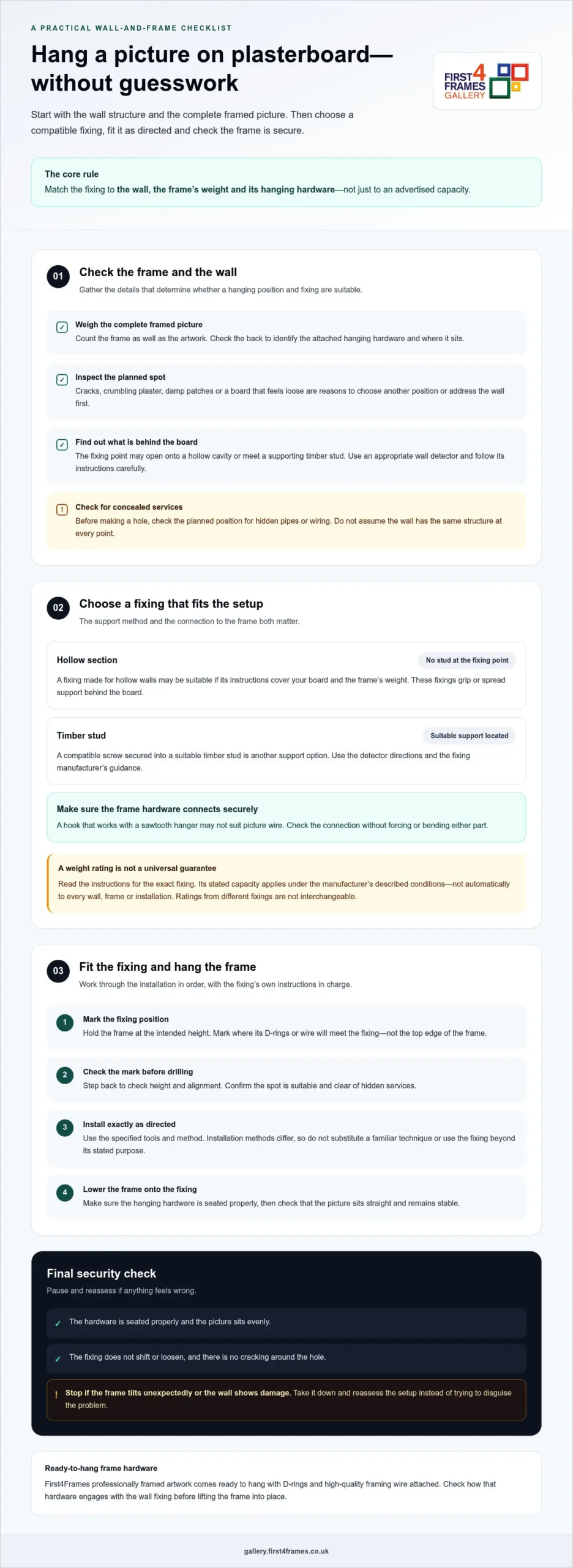
Careful marking and patient fitting help protect both the wall and your frame. Follow the selected fixing’s own instructions, including its tool requirements. Installation methods differ, so don’t substitute a familiar technique or use the fixing beyond its stated purpose. If you’re unsure about the position or support, pause before making a hole.

How do you position and fit the fixing?

Hold the frame at the intended height and mark where its hanging hardware will meet the fixing. Account for the position of the D-rings or wire instead of marking the frame’s top edge as the fixing point. Step back to check the height and alignment, then confirm the spot is clear of hidden services before drilling. Fit the fixing exactly as directed.

How do you check the picture is hanging securely?

Lower the frame gently onto its intended hanging point and make sure the hardware is seated properly. Check that the picture sits straight and that the fixing doesn’t shift, loosen or cause cracking around the hole. If the frame tilts unexpectedly or the wall shows damage, take it down and reassess the setup rather than trying to disguise the problem.

  1. Mark the fixing position, taking the frame’s hanging hardware and desired height into account.
  2. Check the mark for alignment and confirm it’s a suitable, clear location.
  3. Install the fixing with the specified tools and method, following its instructions throughout.
  4. Lift the frame onto the fixing, then check that it sits evenly and remains stable.

Stop if the wall or fixing doesn’t feel secure. A neat finish matters, but a frame should only stay in place if its support feels sound. This step-by-step approach makes how to hang pictures on plasterboard walls clearer while leaving the fixing’s instructions in charge of the installation details.

Once your hanging point is ready, explore framed art for your wall and choose a finish that suits your space.

Make Plasterboard Walls Ready for Framed Art

A finished display brings together the wall fixing, frame and artwork. Once you’ve chosen a fixing that suits your wall and frame, think about the look you want in the room. Bespoke framing gives the artwork a considered fit, while a standard frame may not suit its proportions. First4Frames individually crafts each frame to order using high-quality materials.

What hanging hardware comes with First4Frames framed art?

The frame’s attached hardware and the wall fixing have separate roles: one connects the picture to the fixing, while the other supports it in the wall. First4Frames frames are fitted with 2mm float glass, selected for its clarity compared with the perspex used by many competitors. The glazing is part of the finished frame, but it doesn’t change the need to choose a suitable wall fixing for the frame’s weight.

First4Frames can print and frame your digital photographs, with print quality chosen to complement the bespoke frame. Finished frames are fully packaged to help prevent damage and shipped via professional couriers. The ready-to-hang finish makes it easier to plan how your artwork will sit in your home.

How can a framed print complete a room?

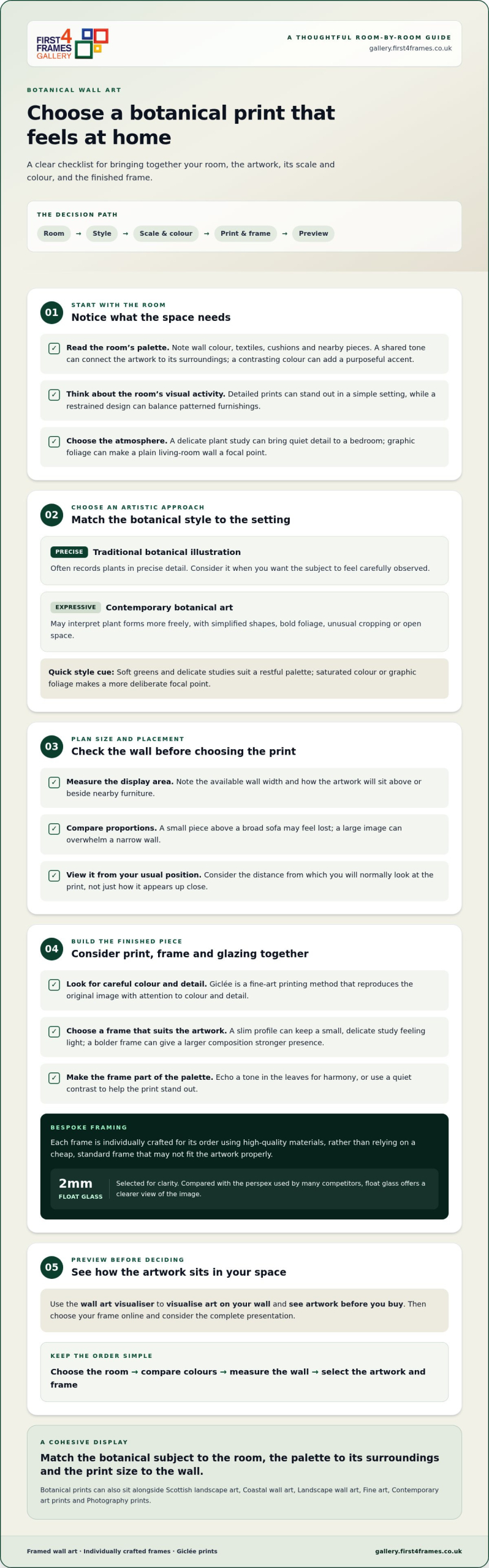
Choose a print to suit the room’s character and the display you have in mind. A landscape can create a calming focal point in a living room, while a carefully chosen photograph may bring a more personal feel to a hallway or reading nook. Bespoke framing brings the image and its presentation together, helping your chosen piece feel at home in the space.

With your display planned, explore ready-to-hang framed art and find artwork to suit your room.

Choose Artwork That Feels at Home on Your Wall

Choose artwork to suit the room’s mood, from Coastal wall art and Scottish landscape art to Photography prints and Contemporary art prints. Explore Fine art by best-selling artists and famous artists, then consider how the image and frame will work together as Bespoke framed wall art.

Online picture framing lets you choose your frame online and design your framed artwork around the piece. A wall art visualiser can help you visualise art on your wall and see artwork before you buy. Custom framed art prints give a favourite image a considered finish, while an art print framing service brings the print and presentation together.

Explore ready-to-hang framed art and find a piece that feels right for your wall.

Frequently Asked Questions

Can you hang a heavy picture on a plasterboard wall?

Yes, but the fixing needs to suit the picture’s full weight and the wall behind it. For a heavier frame, securing a compatible screw into a timber stud can provide support without relying on the board alone. If you can’t locate suitable support or aren’t sure the fixing is appropriate, don’t guess. To hang pictures on plasterboard walls safely, consider the weight and wall support together.

Do you need to find a stud to hang a picture on plasterboard?

No, a stud isn’t essential for every picture. A fixing designed for hollow walls may suit a lighter frame when used exactly as directed. A stud can be a useful support point for heavier pieces, but first confirm its position with an appropriate detector and check for hidden services. If the frame has two hanging points, make sure the layout supports both sides as intended.

Can you hang a picture on plasterboard without drilling?

Sometimes, adhesive picture strips or hooks can be used, but only if their manufacturer says they’re suitable for your wall surface and the frame’s weight. Surface condition matters: dust, loose paint or damaged paper facing can affect how well an adhesive holds. Follow the product’s preparation, application and waiting instructions, and don’t use adhesive as a substitute for a mechanical fixing if the frame exceeds its stated limits.

How do you stop a picture frame from leaning forward on plasterboard?

Check that the frame’s hanging points are correctly engaged and that its back sits evenly against the wall. If picture wire allows the frame to tip, suitable frame bumpers near the lower corners can help steady it, provided they fit without marking the wall. Don’t change the wall fixing to correct a frame-balance issue. For a large or valuable piece, get help lifting and positioning it.

What should you do if a plasterboard picture fixing feels loose?

Take the frame down straight away and don’t keep tightening the fixing in the same opening. Check whether the hole has widened or the board is cracked or crumbling. A damaged spot may no longer provide reliable support; choose a sound position and a fixing suited to that location, or secure it to a suitable stud. Repair the old hole separately before rehanging the picture.

Browse First4Frames’ ready-to-hang framed art to find a print and frame for your wall.
Posted on

Bespoke Picture Framing in Glasgow: How to Choose the Right Service

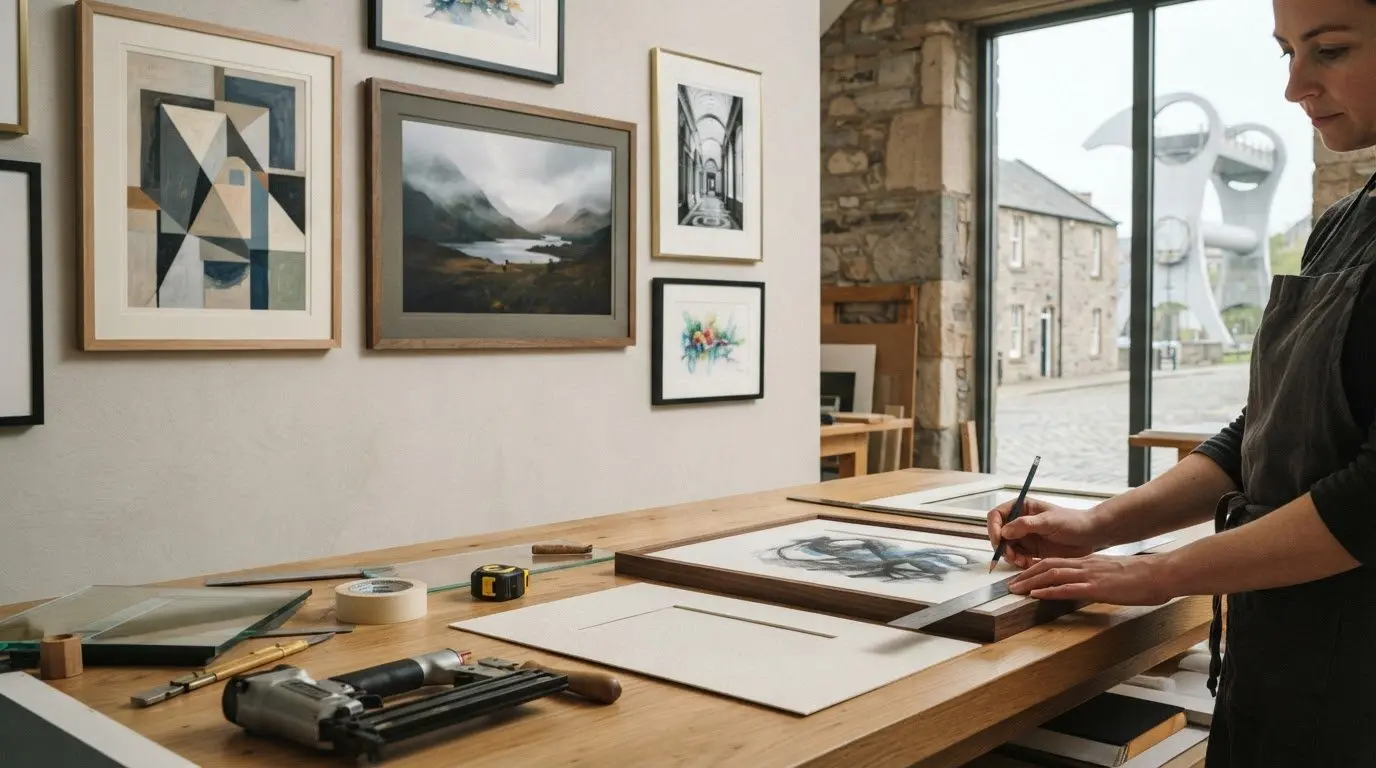
The frame that looks right on screen may not fit your artwork or your room once it arrives. Choosing bespoke picture framing glasgow means weighing more than colour: the frame and mount should suit the piece, while the materials and finish help protect and present it beautifully. A standard frame can leave an artwork looking generic or poorly fitted.

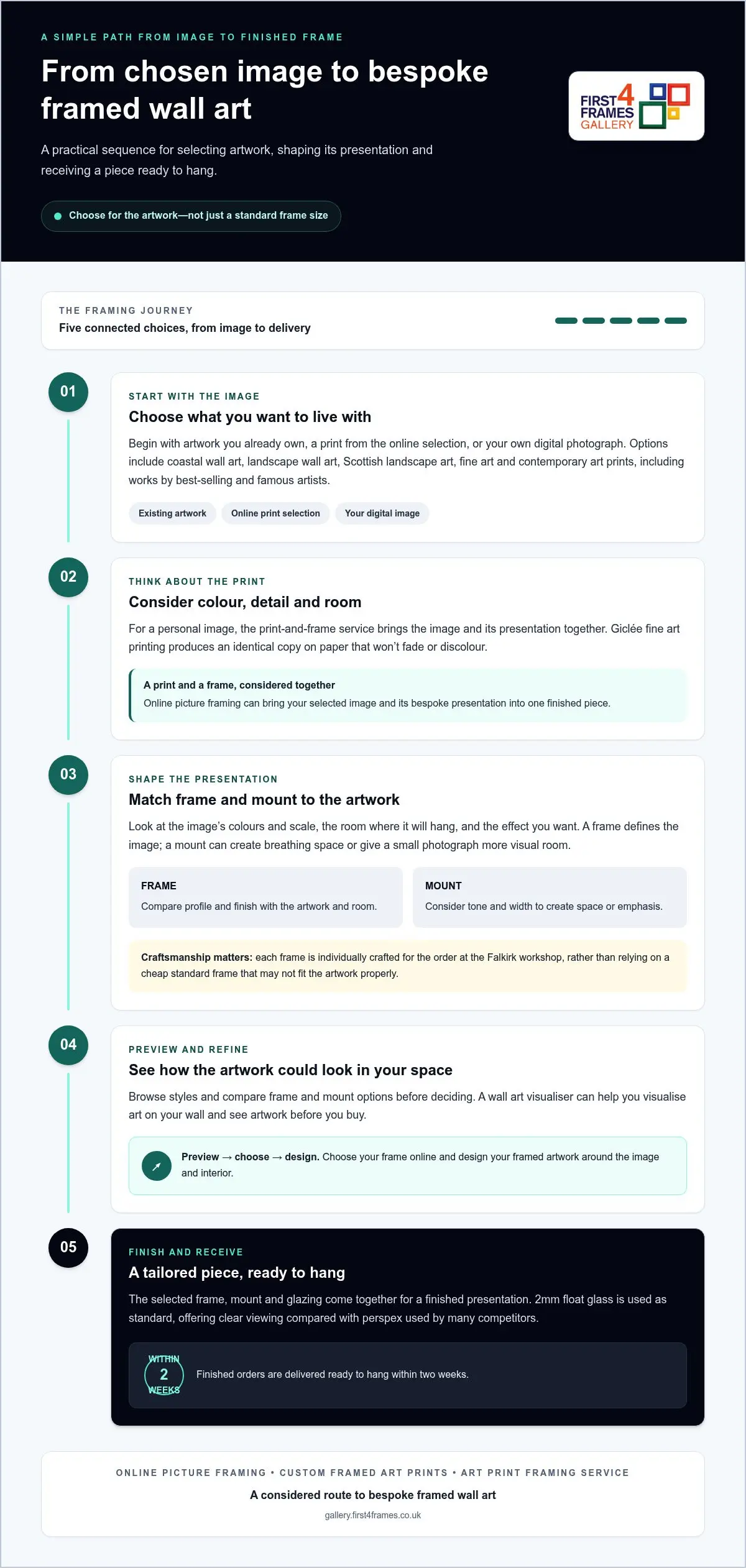
This guide explains what to compare, from individual craftsmanship and 2mm float-glass glazing to artwork choices and delivery. Whether you’re framing a piece you already own or choosing a print and frame together, the right fit starts with the artwork. First4Frames Gallery creates each frame for the specific piece at its Falkirk workshop, with online frame and mount choices to help shape a tailored result. Explore framed wall art or have a digital photograph printed and framed. We’ll look at how to match a frame to artwork, what professional framing brings, and how finished orders reach you ready to hang within two weeks.

Key Takeaways

  • With bespoke picture framing glasgow, choose a frame and mount to suit the artwork rather than relying on a standard size.
  • Compare craftsmanship and glazing to understand how the frame can enhance the artwork’s presentation.
  • Decide whether to frame a piece you own, select a print, or pair a digital image with a print-and-frame service.
  • Follow a simple path from artwork and frame selection to a finished piece delivered ready to hang within two weeks.

Bespoke Picture Framing in Glasgow: What Should You Look For?

Start with what you want to display: an existing painting or photograph, a print chosen for your room, or a customer-supplied digital image to be printed and framed. Bespoke picture framing Glasgow customers choose should begin with the artwork, not a standard frame size. First4Frames Gallery offers custom framing for prints, fine art, paintings and photographs, with frame and mount choices to suit the piece.

Bespoke picture framing means selecting and making a frame and mount to suit an individual piece. The practical benefit is a considered fit and presentation. The frame gives the image a visual boundary, while a mount can create breathing space without competing with it. For an overview of the history and components of picture frames, see this general reference. First4Frames Gallery creates bespoke frames at its Falkirk workshop and hand-delivers orders in the Central Belt.

How do you know whether bespoke framing suits your artwork?

A one-off piece, unusual dimensions or a photograph with personal meaning may suit a tailored frame better than a ready-made option. Standard-size frames can work well when the artwork matches their dimensions and the style suits your space. For an individual piece, consider how the frame’s width and finish relate to the image’s colours and subject. A mount can separate the image from the frame and give it room to stand out. A restrained choice helps keep attention on the artwork.

What can Glasgow customers have framed?

Choose from framed wall art, fine art prints, or bring a painting or photograph for custom framing. The selection includes styles such as Scottish landscape art and photography prints, so you can find a piece that feels connected to home or reflects your taste. If your image is digital, the print-and-frame service brings the image and its finished presentation together. Explore photo printing and framing online to turn a personal image into framed wall art.

How Frame Craftsmanship, Mounts and Glazing Shape the Finished Picture

A frame’s finish, proportions and fit all affect how an artwork looks on the wall. First4Frames individually crafts each frame for the order, rather than using a cheap, standard frame that may not fit the artwork properly. In-house precision cutting and expert mounting bring the selected components together for a polished finish.

How should you choose a frame and mount for a picture?

Consider the artwork’s colours and scale, the room where it will hang, and the effect you want. A slim profile can keep attention on a detailed image; a wider mount can give a small photograph more visual space. Choose a mount tone that sits comfortably alongside the artwork, then compare frame finishes with the room’s décor. The online frame and mount catalogue gives you options for designing framed artwork around these details.

Use this comparison to focus your decision:

Choice Consider Visual role
Frame Artwork colours, scale and room setting Defines the image and complements its surroundings
Mount Colour and width Creates space around the image or adds emphasis
Glazing How the artwork looks behind a clear surface Completes the presentation

For paper-based works, the Library of Congress shares guidance on mats and glazing for art preservation, a useful reference when thinking about presentation and care. First4Frames uses 2mm float glass as standard. Float glass offers clear viewing compared with the perspex used by many competitors.

Why does professional in-house framing matter?

Careful cutting and mounting help keep the artwork and its surrounding elements aligned, so the finished piece looks balanced rather than assembled from off-the-shelf parts. Browse the framed art gallery to explore artwork and consider how different frame and mount choices could shape its presentation.

Choosing Between Custom Framed Art Prints and Your Own Photograph

Begin with the image you want to live with: a personal photograph, artwork you already own, or a print chosen from the online selection. Online picture framing makes it straightforward to bring the image and its presentation together, creating bespoke framed wall art that feels at home in your space.

Can you have your own digital photograph printed and framed?

Yes, you can upload your own photograph or artwork to be printed and framed. This is a practical option for a favourite holiday photograph, a family image or artwork you have in digital form. First4Frames’ Giclée fine art printing produces an identical copy on paper that won’t fade or discolour. The online photo printing and framing service brings high-quality printing and bespoke framing together.

How can you choose artwork before committing to a frame?

Follow a simple sequence:

  1. Choose the image. Browse coastal wall art, landscape wall art, fine art and contemporary art prints, including works by best-selling and famous artists, or start with your own digital photograph.
  2. Consider the print. Think about the image’s detail, colour and how you’d like it to sit in your room.
  3. Select the frame and mount. Choose options that complement the image and your interior.

Browse online to compare styles before deciding. A wall art visualiser can help you visualise art on your wall and see artwork before you buy. Then choose your frame online and design your framed artwork, creating custom framed art prints with an art print framing service tailored to your chosen image.

Ready to find an image for your space? Browse the framed art gallery and explore ideas for your display.

Ordering Bespoke Picture Framing for Glasgow: From Selection to Hanging

Ordering bespoke picture framing Glasgow customers can feel confident about is a clear journey, from choosing the artwork to receiving a finished piece. First4Frames works from its Falkirk workshop and serves the Central Belt, including Glasgow. You can select existing artwork, choose a print or have your own image printed and framed.

  1. Choose the artwork. Decide which print, photograph or original piece you want to display.
  2. Set the look. Select frame and mount options that suit the artwork and the room.
  3. Receive the finished frame. Your professionally framed, premium quality print will be delivered ready to hang within two weeks.

Central Belt orders may be hand-delivered. Orders elsewhere in the UK are sent by courier. Finished frames are fully packaged to help prevent damage during transit and shipped via professional couriers.

What arrives with a ready-to-hang framed picture?

The frame arrives ready for straightforward wall mounting, with D-rings and high-quality framing wire attached. The hanging fittings are already in place, so you can plan where the artwork will sit and hang it as part of your room.

How can businesses plan a framed-art project?

For developers, hoteliers and estate agents, artwork can help create a coherent feel across a property or business space. First4Frames offers commercial artwork curation, bringing together artwork choices and framing for a considered overall display. Advice and ongoing relationships can support projects as they develop, whether you’re selecting pieces for one setting or shaping a consistent look across spaces.

Explore the framed art gallery to find artwork for your home or business.

Make Your Next Artwork Feel at Home

The right piece can do more than fill an empty wall. It can bring a favourite place, a meaningful memory or a fresh point of colour into your everyday surroundings. Think about the feeling you want the room to hold, then choose artwork and framing that help express it. That personal connection is at the heart of bespoke picture framing glasgow.

With more than 20 years of professional framing experience, First4Frames can help turn an image you love into a finished feature for your home or business. Whether you’re drawn to a striking print or want to give a personal photograph a place of its own, start with what speaks to you. The frame and mount choices can shape a piece that feels considered and distinctly yours.

Browse framed art and print options in the gallery to find inspiration and take the next step towards artwork you’ll be glad to see on your wall.

Frequently Asked Questions

Can I upload my own photograph for printing and bespoke framing?

Yes, you can upload your own photograph or artwork to be printed and framed. This brings the printed image and its bespoke frame together as one finished piece, rather than leaving you to coordinate a print from one source and framing from another. It’s a practical option for a favourite holiday photograph, a family image or artwork you already have in digital form.

Can First4Frames source a print that isn’t shown in the gallery?

Yes, you can request a print that isn’t shown in the gallery by email. Include details that identify the piece, such as its title or artist, to help First4Frames understand what you’re looking for.

How are framed pictures delivered to Glasgow?

Framed orders can be hand-delivered in the Central Belt, including Glasgow, or sent by courier anywhere in the UK. General orders are delivered ready to hang within two weeks. Finished frames are packaged to help protect them during transit. For bespoke picture framing Glasgow customers can order without needing to visit the Falkirk workshop.

Can I choose the frame and mount for my artwork online?

Yes, frame and mount selections are available through drop-down lists on each product page. Review the options shown for the specific artwork you’re considering, as choices can differ between products. This lets you shape the finished look around your image, whether you want a quieter border or a frame that adds more visual presence.

Does First4Frames provide artwork for businesses as well as homes?

Yes, First4Frames provides commercial artwork curation for property developers, hoteliers, estate agents and other businesses. The service combines curated art solutions with advice and ongoing relationships, supporting projects that need artwork across a commercial space. You can consider how selected pieces work together across different areas to create a coherent feel for the setting.

Posted on

Glasgow West End Prints: How to Choose Art That Feels Like Home

What makes a Glasgow West End print feel like home: a familiar street, a favourite local landmark, or a memory attached to a place? With so many styles and finishes to choose from, it’s easy to find an attractive image and still wonder whether it feels personal or how it will look once framed. The right choice brings both together.

This guide explains how to compare subjects, print quality and framing options so you can choose art that connects with your favourite part of the West End and suits your space. Explore Park Circus by Falkirk-based artist Nikki Monaghan, available as a 500 × 500 mm print, or have your own Glasgow photograph printed and framed. Each frame is individually crafted for the artwork, rather than relying on a generic standard size, and glazed with float glass. With professional in-house framing, your professionally framed, premium quality print will be delivered ready to hang within two weeks.

Key Takeaways

  • Choose glasgow west end prints for the place or memory they bring to mind, whether that’s familiar architecture, greenery or a cultural landmark.
  • Learn what Giclée printing means and how print quality and a made-to-order frame shape the finished artwork.
  • Use a four-step checklist to match the subject and style, from Scottish landscape art to photography prints, to your wall and preferred presentation.
  • Explore ready-to-hang framed art from First4Frames Gallery in Falkirk, or have your own Glasgow photograph printed and framed.

How to choose Glasgow West End prints with a real local connection

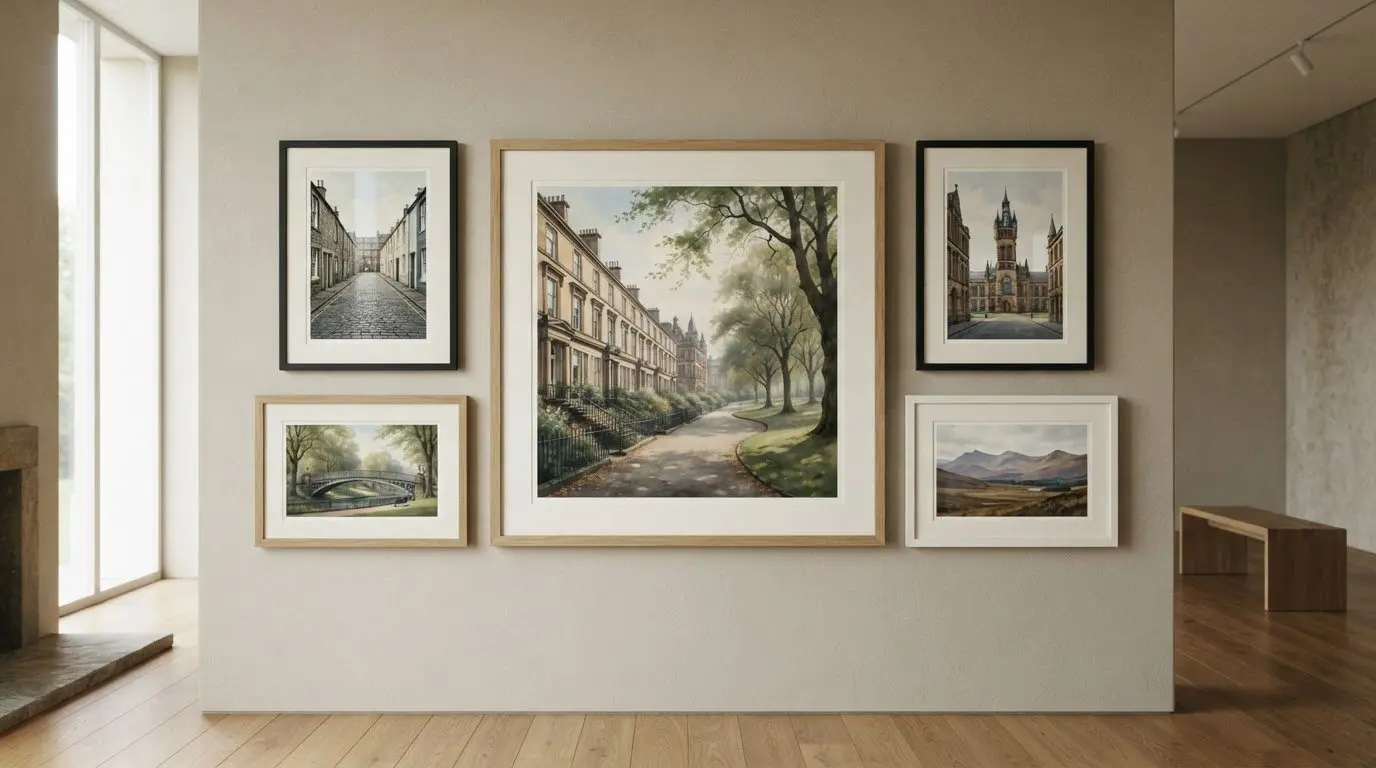
A local print can hold more than a view. It might bring back a walk you love, a familiar corner or the feeling of belonging to Glasgow. Before comparing styles, decide what you want your glasgow west end prints to connect you with. The Glasgow West End has a rich mix of architecture, cultural landmarks and everyday streets to inspire your choice.

Start with a subject, not a trend. Ashton Lane, the University of Glasgow, Kelvingrove Park and the River Kelvin are ideas to explore, not promises of specific artwork imagery. Think about the place you’d most enjoy seeing every day, and whether you’re drawn to architecture, a familiar street, greenery or a cultural landmark.

For a glimpse of a Glasgow West End resident’s visit to an antique shop in Paisley, watch this short video:

Which Glasgow West End subject feels most like yours?

Ask yourself what you’d choose without considering what’s currently popular: a recognisable landmark, a street scene, striking architecture or a quieter view? Your personal link could be where you meet friends, a route you walk often or a place that reminds you of a particular time. That connection can make a print feel considered rather than simply decorative.

Match the print’s mood to its place in your home

Consider colour and detail alongside the room’s existing palette. A busy, detailed scene may draw the eye in a simple space, while a softer or more restrained image can sit comfortably among patterned furnishings and other artwork. Decide whether the print should be the room’s focal point or complement what’s already there. Then picture how its tones will look beside your walls and furniture.

The strongest choice connects a specific place with the mood you want the room to hold.

What makes a framed Glasgow West End print feel well finished?

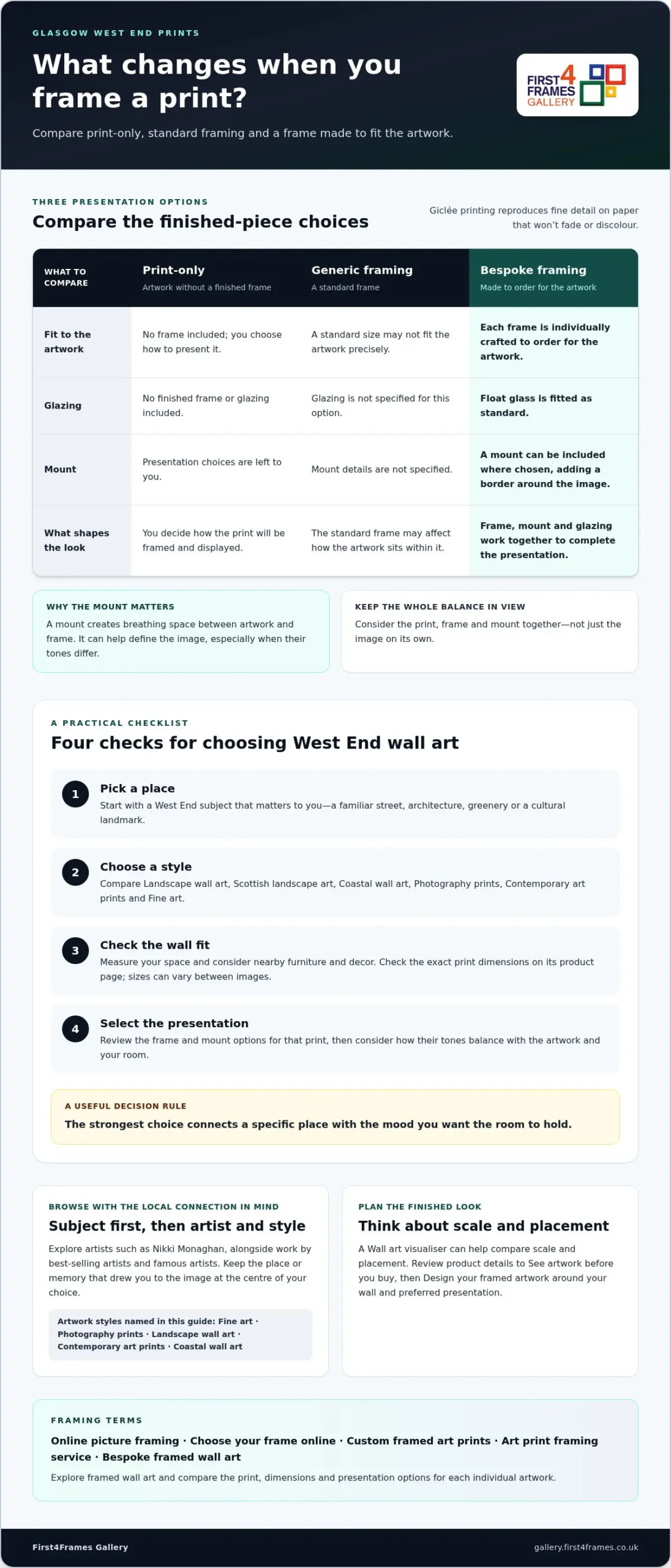
A striking image is only part of the finished piece. Giclée printing reproduces artwork in fine detail on paper that won’t fade or discolour. The frame, mount and glazing then shape how the image is presented and protected.

Unlike a generic standard frame that may not fit the artwork properly, each First4Frames frame is individually crafted to order using high-quality materials. Float glass is fitted as standard. The bespoke frame and considered presentation help glasgow west end prints feel complete, rather than like an image simply placed behind glass.

  • Print-only: Offers the artwork without a finished frame, leaving presentation choices to you.
  • Generic framing: Uses a standard frame that may not fit the artwork as precisely.
  • Bespoke framed presentation: Pairs the print with a frame made for that order, float glass and, where chosen, a mount.

How glazing and a mount shape the finished artwork

Float glass is fitted as standard, providing a protective layer over the framed print while keeping the image clearly visible. A mount creates a border between the artwork and frame. That breathing space can help define the image, particularly if the frame and artwork have different tones. Consider how both details affect the overall balance, not just the print itself.

Design your framed artwork online

On each product page, review the frame and mount choices shown for that print, then consider which combination suits its colours and your room. The custom picture framing guide can help you think through framing decisions, while the University’s history of the University of Glasgow offers context for artwork connected with this landmark. Explore the framed art gallery to compare available prints and presentation options.

A practical checklist for choosing Glasgow West End wall art

Use this four-step checklist to narrow your choices and find glasgow west end prints that feel local and work in your room.

  1. Pick a place. Begin with a West End subject that matters to you, rather than choosing an image just because it’s popular.
  2. Choose a style. Compare Landscape wall art, Scottish landscape art, Coastal wall art, Photography prints and Contemporary art prints. Fine art and photographs each offer a distinct way to connect with a familiar place.
  3. Assess the wall fit. Measure the space and consider nearby furniture and other decor before choosing a print.
  4. Select the presentation. Review the dimensions and frame and mount options on the individual product page. Online picture framing lets you Choose your frame online as part of planning the finished look.

Check scale and placement before choosing a print

Compare the exact print dimensions on its product page with your measured wall space. Don’t assume every image is available in the same sizes. Think about whether the piece will hang alone or alongside existing decor, and use a standard UK picture sizes guide as a reference when considering proportions. Print dimensions and frame choices together determine the artwork’s presence on your wall.

Compare art styles and artists without losing the local connection

Browse artists such as Nikki Monaghan, as well as work by best-selling and famous artists. Keep the place or memory that drew you to the image at the centre of your decision. To Visualise art on your wall, try a Wall art visualiser to compare scale and placement; look at the product details to See artwork before you buy. Explore Custom framed art prints and the Art print framing service as you Design your framed artwork, including options for Bespoke framed wall art.

Browse Glasgow West End prints and framed art to compare artwork and presentation choices.

Where to buy Glasgow West End prints ready to hang

First4Frames Gallery is based in Falkirk, where its workshop provides professional in-house framing for customers across the UK. The gallery includes Park Circus by Falkirk-based artist Nikki Monaghan, available as a 500 × 500 mm print. Product pages show the artwork details and presentation options for each print.

Choose a gallery print or have your own image framed

If you have a particular Glasgow subject in mind that isn’t shown in the gallery, First4Frames can source prints on request by email. You can also provide your own Glasgow photograph or artwork to be printed and framed, bringing your chosen image together with bespoke framing. Find out more about the online photo printing and framing service.

Browse framed fine-art prints to explore the available artwork.

Order a finished print with confidence

Each frame is professionally made in-house for the artwork, with precision cutting and expert mounting. D-rings and high-quality framing wire are attached for straight wall mounting. Finished frames are fully packaged to help prevent damage and shipped via professional couriers. Your professionally framed, premium quality print will be delivered ready to hang within two weeks.

From selecting a gallery print to framing an image of your own, professional presentation brings your chosen artwork together. Explore framed artwork and find a piece for your space.

Let a favourite West End place find its place at home

The right artwork can make a room feel more distinctly yours. Let the place behind the image guide your choice, then imagine living with it: what might it bring to mind as you pass by each day, and how could it become part of the stories your home holds?

For a personal touch, consider whether a gallery print or an image of your own would mean more. First4Frames brings over 20 years of professional framing experience to its Falkirk workshop, helping turn an image into a considered piece for your wall. A meaningful print doesn’t need to follow a trend. It needs to feel right to you.

Explore the selection, notice which glasgow west end prints draw you in, and choose a piece that feels connected to your life as well as your room. Browse framed fine-art prints to find artwork for your space.

Frequently Asked Questions

Where can I buy Glasgow West End prints online?

You can buy framed fine-art prints through the First4Frames Gallery online collection. Browse the artwork, then open an individual product page to see its details and available presentation options. Use the subject or artist as a starting point, then consider which image you’d be pleased to live with every day.

Can I request a Glasgow West End print that is not shown in the gallery?

Yes. First4Frames can source prints that aren’t shown in the gallery when you request them by email. If you know the artist or title, include those details; otherwise, describe the place or subject you have in mind. A recognisable landmark or street can help explain what you’re looking for.

What is the difference between a framed print and an unframed poster?

A framed print arrives as a complete presentation, while an unframed poster is an image without its frame and must be displayed or framed separately. First4Frames professionally frames prints in-house, with each frame made for the artwork rather than chosen as a generic standard size. The product page shows the frame and mount choices for that print.

How long does it take to receive a framed print from First4Frames?

Your professionally framed, premium quality print will be delivered ready to hang within two weeks. For a Park Circus order, the process typically takes between one and two weeks. If you’re planning around a particular occasion or room refresh, keep the relevant timeframe in mind as you choose your print and presentation.

Can I have my own Glasgow West End photograph printed and framed?

Yes. You can provide your own Glasgow photograph or artwork to be printed and framed by First4Frames. Before submitting an image, view it at full size and consider the crop you want, especially if important details sit close to the edges. This helps you choose an image that suits the finished print and the place you have in mind for it.

Posted on

How to Frame a Silk Painting: A Careful Step-by-Step Guide

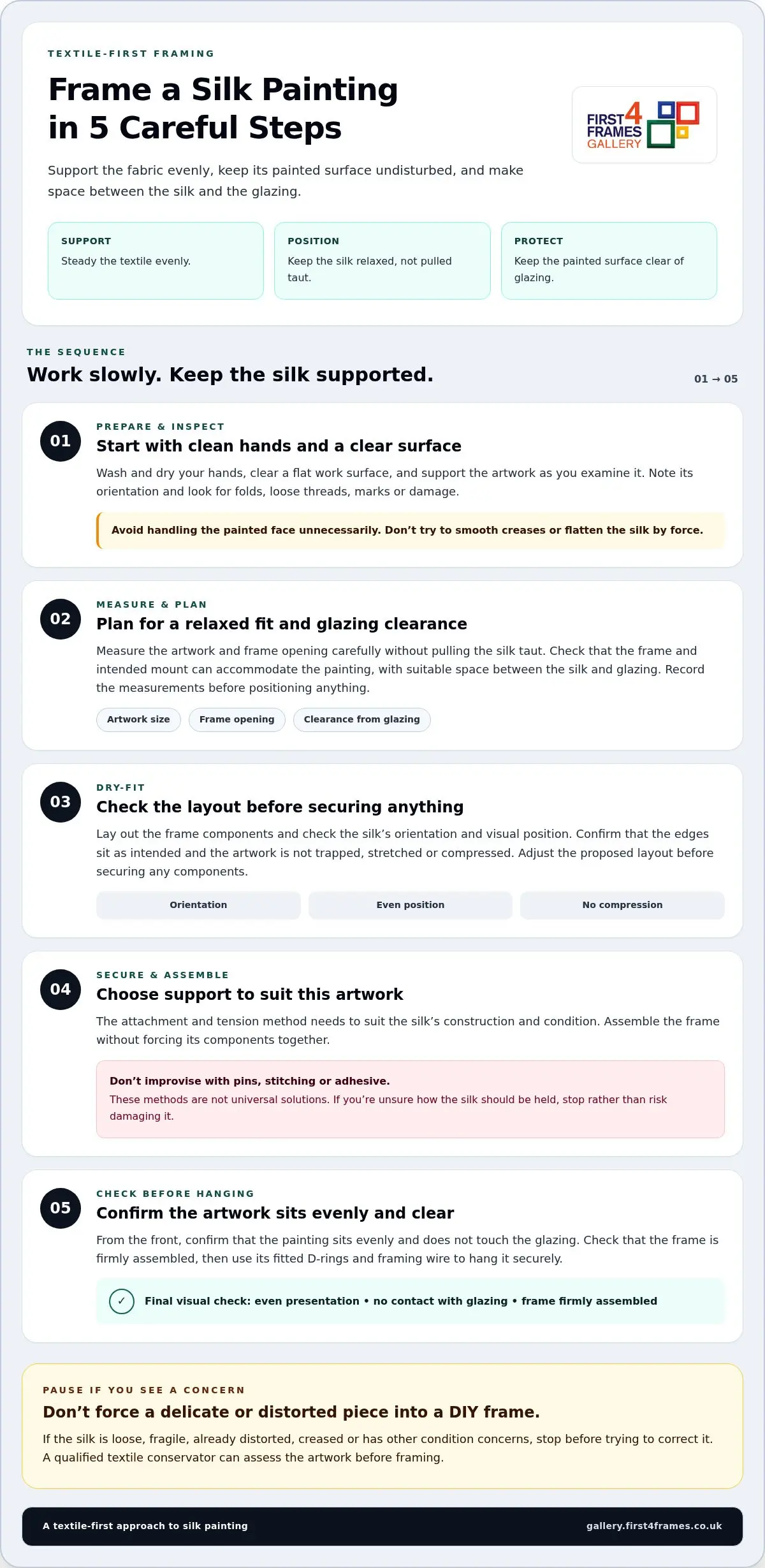
A silk painting needs to be treated as a textile before it’s treated as a picture. If you’re wondering how to frame a silk painting without pulling the fabric unevenly or letting glazing press against its surface, start by considering how the silk is supported. A thoughtful presentation can also help the piece sit beautifully alongside other framed art in your home.

It’s natural to feel cautious: silk is delicate, and a frame that works for a paper print may not suit a textile. As you plan the display, consider the artwork’s colours, scale and surroundings, whether you’re pairing it with Coastal wall art, Scottish landscape art, Fine art or Contemporary art prints. A Wall art visualiser can help you Visualise art on your wall before deciding on an arrangement.

This guide explains how to support and frame silk carefully, and when bespoke framing may be a sensible choice. If you’re exploring Online picture framing, comparing Custom framed art prints or looking to Choose your frame online, keep the artwork’s individual needs in mind. The same thoughtful approach can help you Design your framed artwork and find a place for Photography prints or Bespoke framed wall art, too.

Key Takeaways

  • Think of silk as a delicate textile: plan how to support it without disturbing its painted surface.
  • When considering how to frame a silk painting, choose a setup that holds the fabric evenly and keeps it clear of the glazing.
  • Follow a careful sequence, beginning with clean hands and a clear work surface, then inspect the artwork before framing.
  • If the piece needs an individually considered fit or presentation, bespoke framing offers another route. First4Frames Gallery professionally frames customer-supplied artwork in-house.

Why framing a silk painting calls for a textile-first approach

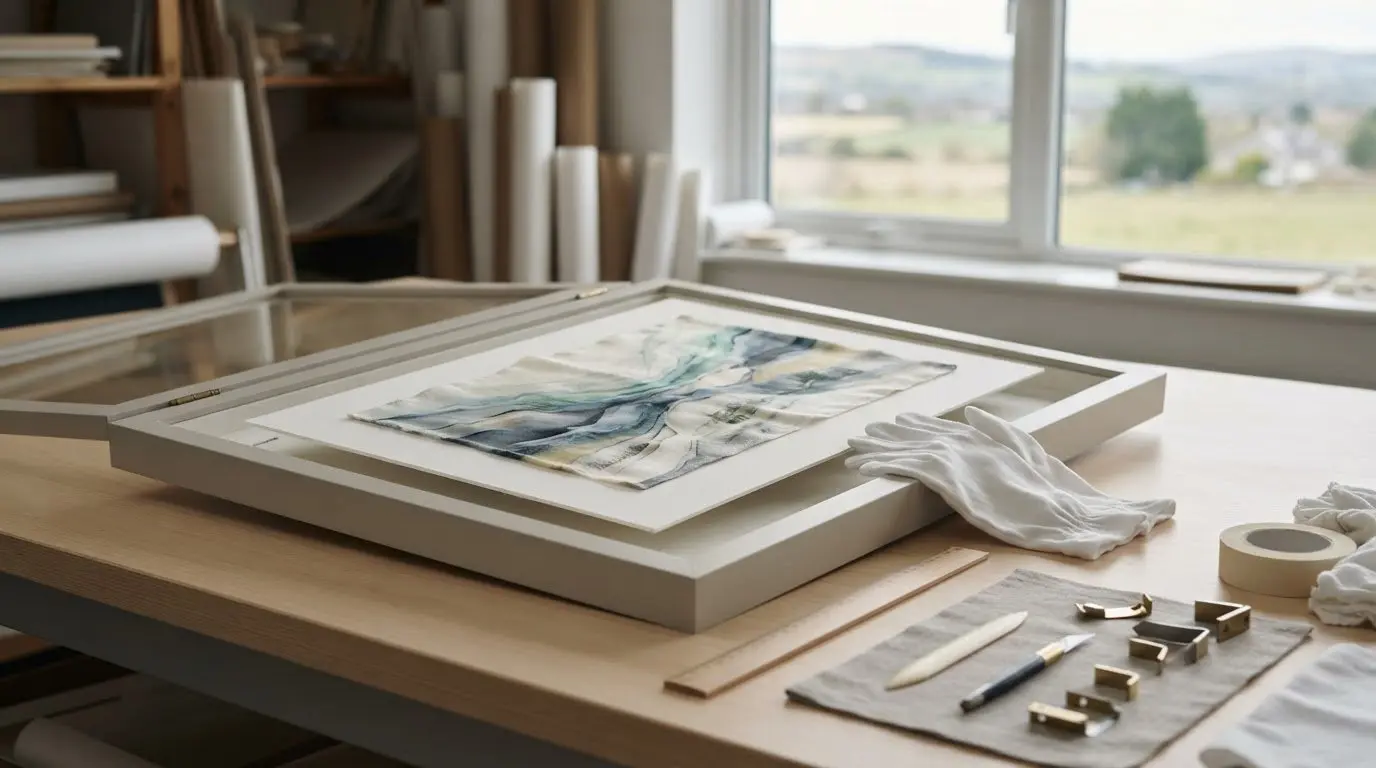
A silk painting may look like a flat picture, but its support behaves differently from paper. Silk is flexible, so it can shift, sag or crease if it isn’t supported evenly. The painted surface also needs space: pressure from a mount or contact with glazing can affect how the work sits and looks.

Textile-first framing means supporting the fabric evenly while keeping its painted surface undisturbed. That principle is central to how to frame a silk painting. The aim is to give the material a stable presentation without pulling it taut, trapping folds or allowing the glazing to rest against it.

What makes a silk painting different from a paper artwork?

Paper usually holds its shape as a sheet; silk can move with handling and gravity. A small fold may become more noticeable once the work is displayed, while uneven support can leave one area slack and another under tension. Touching the painted face may also leave handling marks. Handle the artwork gently, and don’t try to smooth, stretch or flatten it by force.

What should you consider before choosing a frame?

First, establish whether the silk is already mounted or remains loose. A mounted piece may have a support that affects the frame depth and how it can be presented. With loose silk, the support and fitting need particular thought so the fabric can sit evenly without being compressed.

Consider the painting’s overall size, visible condition and intended display position. A larger piece may need a different support approach from a small one, while the available wall space can help determine a suitable frame proportion and orientation. Plan for clearance between the silk and glazing, too: the painted surface shouldn’t rest against the glass.

If you notice existing creases, distortion, fragile areas or other condition concerns, pause rather than trying to correct them as part of a DIY framing project. A qualified textile conservator can assess the artwork before framing. Careful assessment helps you choose an approach that respects the piece instead of forcing it to fit a standard frame.

Choose suitable support, mount and glazing for a silk painting

Support, mount and glazing work together, but each has a different job. The support steadies the textile, the mount helps position it within the frame, and the glazing provides a front barrier. Base these decisions on the silk’s construction and condition, not a one-size-fits-all method. This is an important part of how to frame a silk painting without pulling or compressing it.

How should the silk be supported?

Aim for even, stable support that holds the artwork in position without stretching it excessively. The right attachment and tension method depends on whether the silk is loose, already mounted or has areas that need particular care. Don’t treat adhesives, pins or stitching through the artwork as universal solutions. Any of these may be unsuitable for a particular piece, so avoid choosing a method without considering the textile’s construction and condition. The American Institute for Conservation’s Textile Conservation Catalog offers further reference on textile conservation methods and material considerations.

Should glazing touch a silk painting?

Don’t assume the painted surface can safely rest against glass or acrylic. Contact may press against the textile, so consider a mount or frame spacing that creates a clear gap where appropriate. The amount of clearance and the framing arrangement should suit the artwork, not just the frame’s appearance.

First4Frames Gallery uses float glass as standard. The glazing choice should still be considered alongside the silk’s support and the space needed between the artwork and the glass. Float glass is not specialist conservation glazing, and no UV-filtering or conservation properties are claimed for it. For more on framing options, read the custom picture framing guide. You can also browse framed artwork for presentation ideas.

How to frame a silk painting step by step

Work slowly and keep the silk supported throughout. If the fabric is loose, fragile or already distorted, don’t try to correct it by pulling or pressing. Pause before proceeding with a DIY frame.

  1. Prepare and inspect. Wash and dry your hands, clear a flat work surface, and support the artwork as you examine it. Look for folds, loose threads, marks or damage, and note the painting’s orientation. Avoid trying to smooth creases or handling the painted face unnecessarily.
  2. Measure and plan. Measure the artwork and frame opening carefully, keeping the silk relaxed rather than pulling it taut. Check that the frame and intended mount can accommodate the painting and allow suitable clearance from the glazing. Record the measurements before positioning anything.
  3. Dry-fit before securing. Lay out the frame components and check the orientation and visual position of the silk. Confirm that the edges sit as intended and that the artwork isn’t trapped, stretched or compressed. Adjust the proposed layout before securing any components.
  4. Secure and assemble with care. Any attachment and tension method needs to suit the artwork’s construction and condition. Don’t improvise with pins, stitching or adhesive. If you’re unsure how the silk should be held, stop rather than risk damaging it. Assemble the frame without forcing its components together.
  5. Check before hanging. From the front, confirm that the painting sits evenly and doesn’t touch the glazing. Check that the frame is firmly assembled, then use its fitted D-rings and framing wire to hang it securely and verify that it sits straight.

In short: inspect, measure, dry-fit, secure appropriately, then check clearance and hanging alignment. These are the essential stages in how to frame a silk painting, but the right attachment method depends on the piece itself. For inspiration on framing and presentation, explore framed artwork.

When bespoke framing is the better route for a silk painting

A standard frame may not suit silk that is loose, unusually sized or already mounted in a way that affects how it fits. Bespoke framing is worth considering if the artwork needs a particular frame depth, a carefully chosen proportion or a presentation that works around its existing support. Unlike cheap, standard frames that may not fit the artwork properly, each First4Frames Gallery frame is individually crafted for the order using high-quality materials.

If you’re unsure how to frame a silk painting or feel uneasy handling the piece, a professionally framed, individually considered fit may be a more comfortable route. Address any condition concerns before framing.

What can a bespoke framer contribute?

First4Frames Gallery professionally frames customer-supplied artwork in-house, with precision cutting and expert mounting. Customers can choose from extensive frame and mount selections on product pages, helping shape a finish that complements the artwork rather than overwhelming it. Frames use float glass as standard. Finished frames are prepared for display with D-rings and high-quality framing wire for straight wall mounting.

How to take the next step

Consider whether you’re comfortable assessing and handling the silk yourself. If it’s difficult to support evenly or you’re uncertain about its presentation, custom framing offers a professional alternative. First4Frames Gallery brings over 20 years of professional framing experience in Falkirk to customer-supplied pieces, with a wide choice of frame and mount options.

Explore frame styles and presentation ideas, then browse the gallery to find artwork that inspires your next display.

Give your silk painting a considered place to shine

Choosing how to frame a silk painting is also a chance to think about how the artwork will live in your home. Consider the wall, the light in the room and the feeling you want the finished piece to bring to the space. A thoughtfully chosen frame can give the painting a clear visual setting without asking it to fit a standard format.

If you’re still weighing up a DIY approach, decide whether you feel comfortable handling and positioning the silk. Bespoke framing offers an alternative for artwork that needs an individual fit, with frame and mount options to shape its presentation. Let the painting guide the next decision, from a quiet, understated finish to a frame that makes it a focal point.

Explore framed artwork in the gallery for ideas and inspiration. Your silk painting deserves a setting that feels right for both the artwork and the room. Browse First4Frames Gallery’s framed artwork to plan your next display.

Frequently Asked Questions

Can you frame a silk painting without glass touching it?

Yes. A frame can be arranged so the silk is separated from the glazing, but suitable spacing depends on the artwork’s construction and condition. A painting with a raised or uneven surface, for example, may need a different arrangement from a flat, securely mounted piece. Don’t assume direct contact is safe. If the painted surface or its support seems fragile, pause and have the piece assessed before framing.

Should a silk painting be stretched before framing?

Not necessarily. Stretching isn’t right for every silk painting, and pulling the fabric too tightly may alter how it looks. The decision depends on the textile’s construction, condition and any support it already has. Avoid experimenting on valuable or delicate work, particularly if it has existing folds or distortion. If you’re uncertain, have the piece assessed before changing its tension.

Can I frame a silk painting myself?

Possibly, if the painting is securely mounted and a simple, sturdy frame suits its size. If you’re learning how to frame a silk painting, consider whether you can position it without handling the painted face or straining its support. Don’t use adhesives or fasteners through the painted silk. For delicate, valuable or unusually sized pieces, bespoke framing can offer a more considered fit.

What is the best frame for a silk painting?

There isn’t one frame that’s best for every silk painting. Choose a proportion and finish that complement the artwork’s dimensions and colours without crowding it, and consider how its condition and display setting affect the support and glazing arrangement. A narrow mount may suit a small work, while a larger piece may need a different visual balance. Pause before framing if the silk is fragile or damaged.

Can a picture framer frame artwork supplied by a customer?

Yes. First4Frames Gallery offers custom framing for customer-supplied artwork, with in-house precision cutting and expert mounting. Customers can select from frame and mount options to tailor the presentation to the piece. Because silk paintings vary in construction and condition, consider the framing approach individually rather than applying one mounting method to every artwork. Note the dimensions and current support when planning the frame.

Posted on

Prints of the Isle of Skye: A Guide to Choosing Your Perfect Landscape

What if the Skye print that feels most at home in your room isn’t the island’s most famous view? It’s easy for landscape images to blur together at first glance, but prints of the isle of skye capture very different moods, from the dramatic shape of the Old Man of Storr to the softer colours of the Fairy Pools. The right choice is the scene that means something to you and sits naturally within your space.

This guide will help you compare Skye’s distinctive landscapes, match a print’s subject and scale to your room, and choose a frame with confidence. At First4Frames Gallery, every frame is individually crafted for each order using high-quality materials. We use 2mm float glass for its clarity, rather than the perspex used by many competitors. Consider how the landscape, print size and frame work together to create a personal, professionally presented piece that’s ready to display.

Key Takeaways

  • Compare prints of the isle of skye by subject and mood, not just by recognisable landmark, to find a landscape that feels personal.
  • Match the artwork’s orientation and composition to your available wall space for a balanced display.
  • Consider how a Giclée print and a carefully chosen frame work together to create a finished piece for your room.
  • Explore framing options that turn your chosen artwork into a considered focal point at home.

Why choose prints of the Isle of Skye for your walls?

Dramatic ridgelines meet rugged coast on Skye, where waterfalls, sea views and shifting light make each scene feel different. A landscape print can bring that sense of place indoors, adding colour and atmosphere while giving the room a natural point of focus. This guide compares Skye subjects, so you can choose the scene and composition that best suit your space.

Skye landscapes bring rugged landforms, open water and changeable light together in distinctive combinations. That contrast gives the artwork character, whether you’re drawn to a dramatic mountain view or a quieter coastal mood.

What makes Skye landscapes visually distinctive?

The Cuillin’s strong mountain silhouettes and the sculptural ridges of the Quiraing are useful visual references when comparing compositions. Some scenes centre on bold rock forms; others give more space to sea and sky. Mist can soften distant contours, while changing light brings different tones to the landscape. For wider geographical and cultural context, see the Isle of Skye overview.

Which rooms suit Isle of Skye wall art?

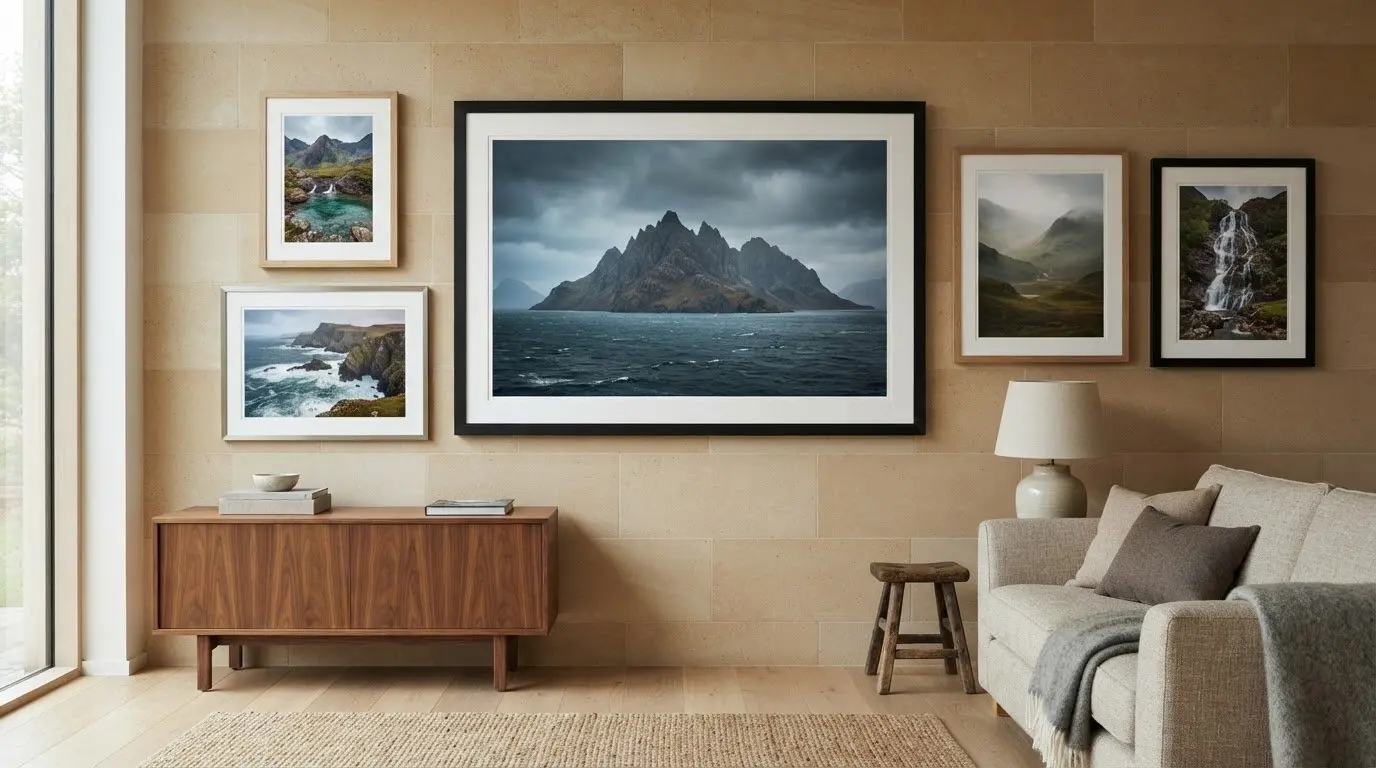
Start with the atmosphere you want. A broad coastal view can create an open, airy focal point in a living space, while a mountain silhouette can bring a calm, grounded presence to a bedroom. In a hallway, a clear composition makes a welcoming first impression. For a home office, consider a scene with layered land and sky that gives the eye somewhere to rest. Before choosing a size, measure the wall and note the furniture or shelving nearby so the print feels in proportion.

If you’re considering Skye alongside landscapes from elsewhere in Scotland, our broader guide to Scottish landscape art can help you explore the wider subject. Here, the focus is on Skye’s distinctive contrasts and finding a scene that feels at home in your room.

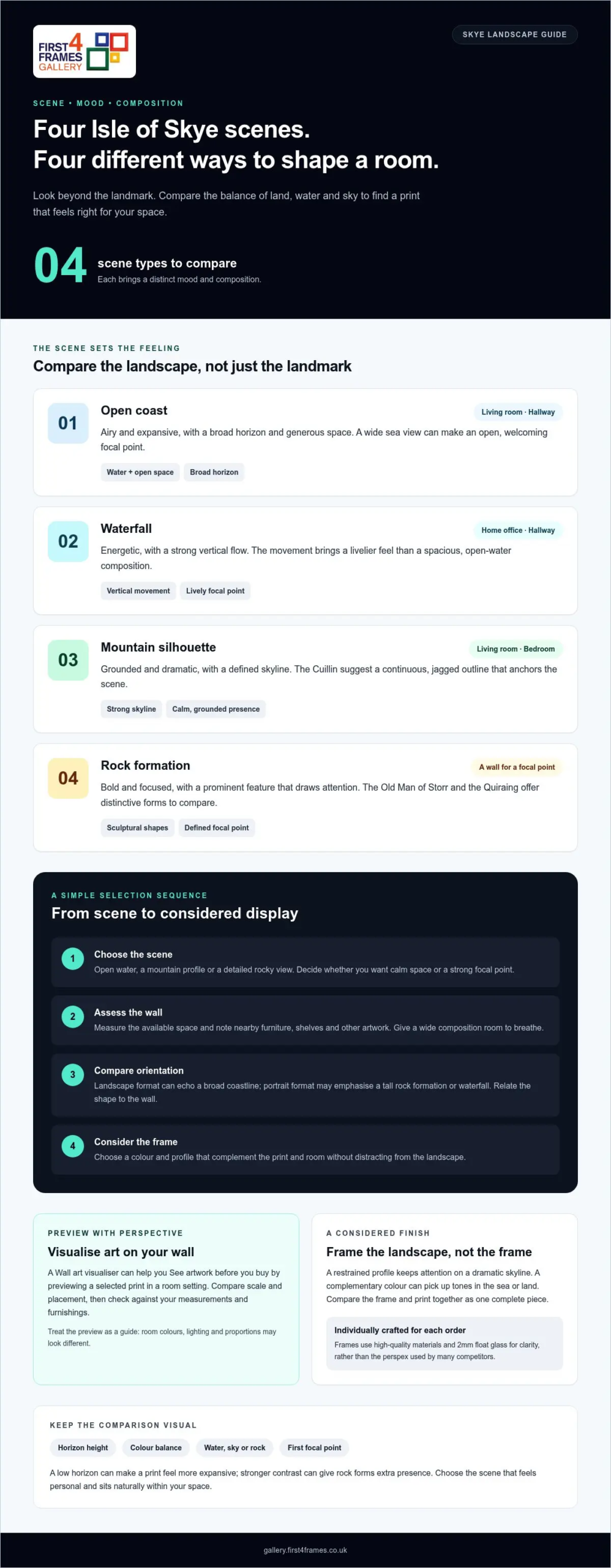
Compare Isle of Skye print subjects by scene, mood, and composition

Two prints can show equally rugged scenery yet create very different impressions. As you compare prints of the isle of skye, look beyond the landmark. Notice how much space the artwork gives to water, sky or rock, and where your eye lands first. These details help you choose for both subject and mood.

Coastal and water scenes for an open, airy feel

A broad sea view can feel expansive, especially when the composition gives the water plenty of room. A closer shoreline brings more texture and detail. Waterfalls create a different effect: their vertical movement can make a composition feel lively rather than spacious. Compare the balance of colour, movement and open space, rather than choosing simply because water appears in the image.

Mountain and rock formations for dramatic impact

Mountain silhouettes tend to anchor a scene, while striking rock formations create a more focused focal point. The Cuillin suggest a continuous, jagged skyline; the Old Man of Storr and the Quiraing offer distinctive forms that can command attention. Use these landmarks as visual references when comparing artwork, rather than assuming they appear in a particular print. For a broader view beyond Skye, explore the Scottish landscape print guide.

Scene Typical mood and composition Room to consider
Open coast Airy, with a broad horizon and generous space Living room or hallway
Waterfall Energetic, with a strong vertical flow Home office or hallway
Mountain silhouette Grounded and dramatic, with a defined skyline Living room or bedroom
Rock formation Bold and focused, with a prominent focal point A wall where the artwork can draw attention

As you browse the framed art gallery, compare horizon height and colour balance as well as the subject. A low horizon can make a print feel more expansive, while stronger contrast can give rock forms extra presence. Think about which parts of the image you want to notice first from across the room.

How to choose and visualise an Isle of Skye print for your space

Use a simple sequence to move from inspiration to a confident choice. The scene sets the mood; the wall, orientation and frame determine how naturally the print sits in your room.

  1. Choose the scene. Decide whether you’re drawn to open water, a mountain profile or a detailed rocky view. Consider whether you want a calm, spacious feel or a strong focal point.
  2. Assess the wall. Measure the available space and note nearby furniture, shelves and other artwork. A wide composition needs room to breathe, while a strong central feature can suit a more contained space.
  3. Compare orientation. A landscape format can echo a broad coastline, while a portrait format may emphasise a tall rock formation or waterfall. Relate the artwork’s shape to the wall, not just to the image itself.
  4. Consider the frame. Choose a colour and profile that complement the print and your room without distracting from the landscape.

See artwork before you buy

A Wall art visualiser can help you Visualise art on your wall by previewing a selected print in a room setting. Use it to compare scale and placement, then check the result against your measurements and furnishings. It’s a useful way to See artwork before you buy, but treat the preview as a guide: your room’s colours, lighting and proportions may look different.

Choose a frame that supports the landscape

A frame should give the image a considered finish, not compete with its subject. A restrained profile keeps attention on a dramatic skyline, while a complementary colour can pick up tones in the sea or land. With Bespoke framed wall art and Online picture framing, you can shape the display around the artwork and your space. Use a picture-frame guide to consider proportions and display options, then compare the frame with the print as a complete piece.

Explore the framed artwork selection to compare landscape prints and begin picturing the right one in your home.

Create bespoke framed wall art with a professional finish

A considered frame helps an artwork feel complete. Pair a Giclée fine art print with a frame that complements its proportions and palette to create Custom framed art prints with a personal finish. Every First4Frames frame is individually crafted for its order using high-quality materials. Unlike cheap, standard frames that may not fit the artwork properly, a bespoke frame is made for the piece. First4Frames uses 2mm float glass for glazing, offering superior clarity compared with perspex used by many competitors.

From print choice to a framed finish

Choosing artwork and framing online makes it straightforward to shape a display around your taste and room. Browse framed wall art, including Fine art, Coastal wall art, Landscape wall art, Scottish landscape art, Photography prints and Contemporary art prints, with works by Best-selling artists and Famous artists. Choose your frame online and Design your framed artwork as one considered choice. Each finished frame is fully packaged to help prevent damage and shipped via professional couriers.

A print-and-frame option for personal photographs

Your own digital photograph can also become framed wall art. With First4Frames’ print-and-frame service, photographs are printed to the highest quality to match the bespoke framing. Choose an image with personal meaning, consider how it will work as wall art, then select a frame suited to your space. The Art print framing service brings those choices together. Explore the photo printing and framing service for your own photographs.

Browse the framed art gallery to explore the artwork and find a landscape that feels at home in your space.

Choose a landscape that feels like yours

The right artwork can become more than a finishing touch. It can hold a memory of a visit, reflect a place you hope to see, or bring a landscape you love into everyday life. Let that personal connection guide your choice of prints of the isle of skye. Take time to find an image you’ll enjoy living with, rather than choosing only to match a colour scheme.

Think of your chosen print as the beginning of a lasting story in your home. The view may draw your eye at first, then become part of familiar routines and changing seasons. Choosing art with care helps it feel at home because it speaks to you.

Browse Isle of Skye prints and framed artwork to find a landscape that resonates with you. Explore the collection and choose a print to complete with a bespoke frame.

Frequently Asked Questions

Can I preview an Isle of Skye print on my wall before buying?

Yes, a wall art visualiser can show how an artwork might look in your space and help you judge its scale and overall feel. Compare a print above a sofa with one on a smaller, open wall to see how placement changes its presence. Treat the preview as a guide: your room’s lighting, wall colour and nearby furnishings also affect how the artwork appears.

How do I choose the right size for an Isle of Skye print?

Measure the wall area you want to fill, then consider the furniture below it and how far away you’ll usually view the print. A wide landscape image may sit comfortably above a sofa, while a portrait composition can work in a narrower space. Compare the print’s proportions with the wall before choosing a frame; a thumbnail alone can make prints of the isle of skye seem larger or smaller than they’ll feel at home.

What is the difference between a Giclée print and a standard art print?

Giclée describes a fine-art printing approach used to reproduce detailed artwork. It’s a useful term to know as you browse, but the best choice still depends on the image and how you want it to look on your wall. Consider the subject, print finish and frame together. For example, a detailed coastal scene may call for a frame that keeps attention on the artwork rather than drawing the eye away.
Is 2mm float glass a good choice for framed landscape prints?

First4Frames uses 2mm float glass to glaze framed landscape prints. Consider where the finished artwork will hang in relation to windows and other light sources when deciding on its presentation. Glazing is one part of the finished piece, alongside the print and frame, so assess the artwork as a whole when choosing a display that suits your space.

Can I have my own photograph printed and framed?

Yes, First4Frames offers a print-and-frame service for your digital photographs, with printing chosen to complement bespoke framing. Start with a personal image, think about how its subject and orientation will work as wall art, then choose a frame that suits the room. Explore the photo printing and framing service to create a finished display from your own photograph.

Posted on

Contract Framing for New Developments: A Buying Guide

A development’s artwork can bring its interiors together or leave each space feeling disconnected. Contract framing for new property developments starts with a cohesive art scheme, then gives every piece a frame suited to its artwork and setting. The aim is not to make every room identical, but to create a considered visual thread throughout the property.

Coordinating choices across rooms or multiple properties takes planning. You need a clear picture of the finished scheme and confidence in the framing quality. First4Frames combines commercial artwork curation with bespoke picture framing, bringing together artwork selection and made-to-order frames. Each frame is individually crafted for its order using high-quality materials. The 2mm float glass offers clarity compared with the perspex used by many competitors.

This guide explains how to create a consistent scheme while choosing artwork and frame details that work in each space. It also covers practical ways to plan specifications and coordinate decisions, from selecting artwork to receiving professionally finished, carefully packaged pieces.

Key Takeaways

  • Contract framing for new property developments means planning and supplying framed artwork for a commercial project, not building contracts or public procurement.
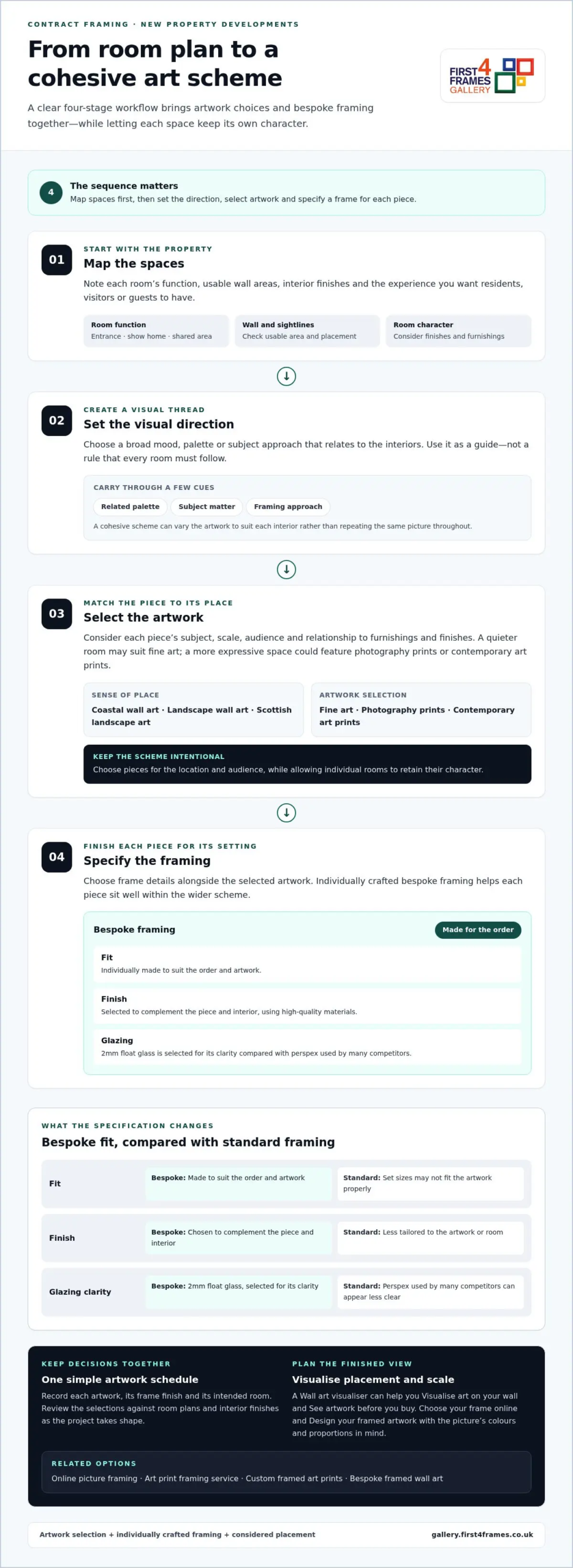
  • Map room functions, wall areas and interior finishes first to shape an art scheme that feels cohesive and suits each space.
  • Choose artwork before specifying frames, so each frame complements the individual piece and the development’s visual direction.
  • Commercial artwork curation and a broad online selection of artwork and frames can help bring a project from initial choices to a finished scheme.

What Contract Framing for New Property Developments Involves

Contract framing for new property developments means planning and supplying framed artwork for a commercial project. It brings art selection and presentation into the wider interior design, helping entrances, show homes and shared spaces feel considered and welcoming. In this context, “contract framing” is about presenting artwork, not building contracts or public procurement.

The distinction matters because “framing” can describe different kinds of work. Framing (construction) concerns a building’s structural framework; artwork framing is about presenting pictures for interior spaces. A well-planned art scheme considers where each piece will hang, how it relates to the room and the impression it creates.

Where framed artwork can shape a development

Begin with the spaces people encounter and use. An entrance may need a clear visual welcome, while artwork in a show home can complement the furnishings and help visitors imagine the space as lived in. In shared areas, consider the room’s purpose and character before selecting pieces. Check usable wall area, sightlines, finishes and the scale of the artwork. These details help each piece feel purposeful rather than added as an afterthought.

A cohesive scheme without a one-size-fits-all look

Consistency does not mean hanging the same picture in every room or property. Carry a few visual cues through the scheme, such as a related palette, subject matter or framing approach, then vary the artwork to suit each interior. A quieter room might suit fine art, while a more expressive space could feature photography prints or contemporary art prints. Explore a broad choice of framed wall art to find pieces that support the overall direction while allowing individual rooms to retain their character.

How Bespoke Framing Builds a Consistent Art Specification

A useful art specification covers the picture and its presentation together. Each frame is individually crafted for its order using high-quality materials, with proportions and finishes selected to suit the artwork. Cheap, standard frames may not fit a piece properly, leaving an awkward border or an unbalanced result. Bespoke framed wall art gives each piece a considered finish while helping maintain a consistent scheme across the development.

Consideration Bespoke framing Standard framing
Fit Individually made to suit the order and artwork Set sizes may not fit the artwork properly
Finish Chosen to complement the piece and interior Less tailored to the artwork or room
Glazing clarity 2mm float glass, selected for its clarity Perspex used by many competitors can appear less clear

Choose artwork and finishes as one specification

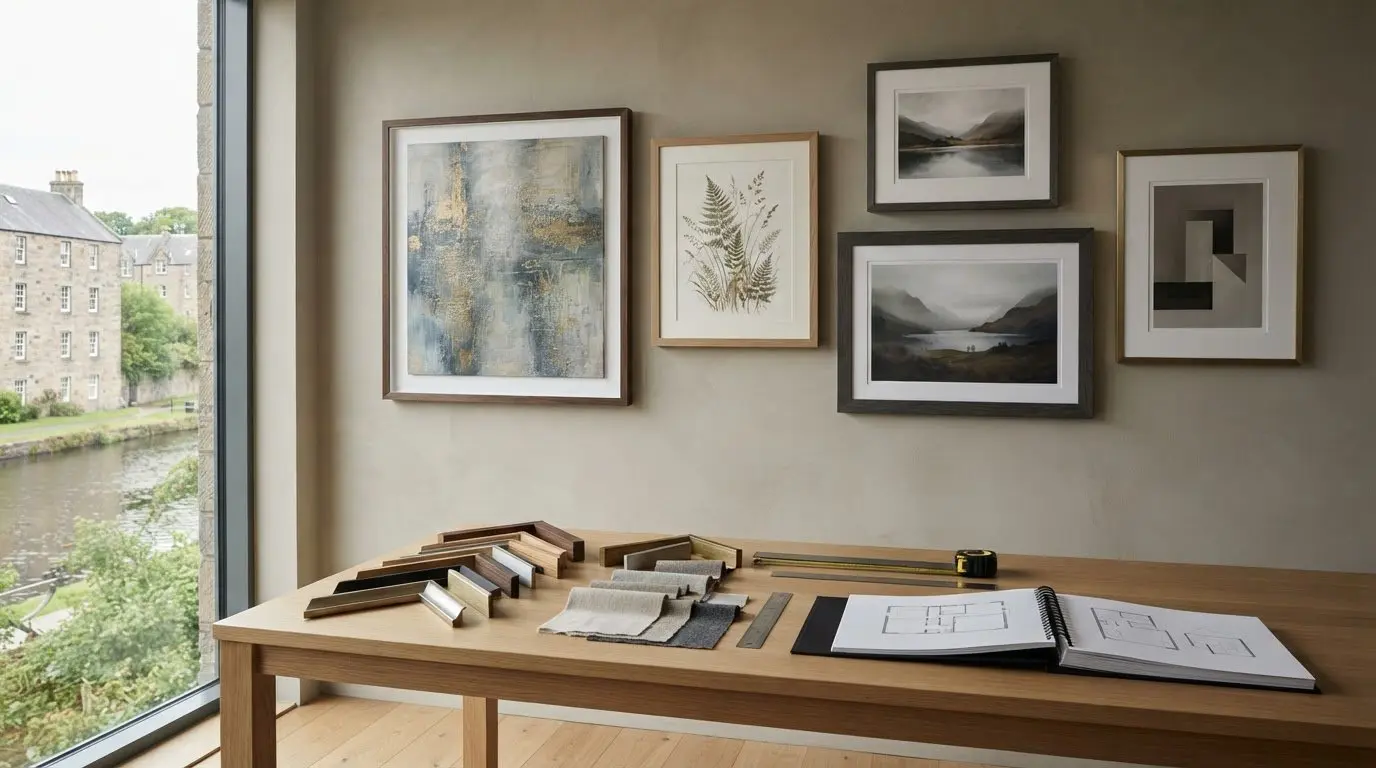
Coordinate frame finishes with the artwork, room palette and development’s interior direction. Coastal wall art may suit a light, relaxed setting, while Landscape wall art or Scottish landscape art can bring a stronger sense of place. Photography prints offer another route to a personal or contemporary feel. Keep a simple schedule listing each artwork, its frame finish and its intended room. This makes it easier to review the scheme as a whole without making every piece identical.

From online selection to visualising the finished piece

Choose your frame online and Design your framed artwork with the picture’s colours and proportions in mind. A Wall art visualiser can help you Visualise art on your wall and See artwork before you buy, making it easier to assess scale and placement within the wider scheme. For further inspiration, browse the gallery’s framed artwork selection and compare options for each space.

How to Plan Contract Framing for a New Development

A clear workflow makes decisions easier to manage and helps the finished artwork feel intentional throughout the property. For contract framing for new property developments, record choices as the project takes shape. Keep the artwork and framing details together so the team can review selections against room plans and interior finishes.

  1. Map the spaces. Note each room’s function, usable wall areas, interior finishes and the experience you want residents, visitors or guests to have. This gives you a practical starting point for selecting artwork.
  2. Set the visual direction. Choose a broad mood, palette or subject approach that relates to the interiors. Treat it as a guide, not a rule that every space must follow.
  3. Select the artwork. Match each piece to its location and audience. Consider its subject, scale and relationship to furnishings and finishes.
  4. Specify the framing. Choose frame details alongside the selected artwork, so the presentation suits each piece and contributes to the overall scheme.

Selecting art that suits the property and its audience

A coordinated scheme can include framed wall art, fine art and works by best-selling or famous artists while still giving each room its own character. Consider whether a shared space needs a calm focal point or whether a show home would benefit from a more personal touch. A guide to choosing picture frames can help you assess how a frame supports the artwork and its display.

Preparing digital photographs for a framed scheme

Digital photographs can become finished display pieces through a print-and-frame service. High-quality printing helps the image sit well with its bespoke frame, making personal or place-related photographs a considered part of the interior rather than an afterthought. Custom framed art prints can form part of the scheme, with an art print framing service or online picture framing bringing selection and presentation together.

Start exploring artwork options for your project in the online art gallery.

Bring a New Development’s Art Scheme Together with First4Frames

Commercial artwork curation and bespoke framing work best as connected parts of a project. First4Frames Gallery brings artwork selection and made-to-order framing together, with a broad online choice of artwork and frames to help shape a scheme for development interiors. This joined-up service supports contract framing for new property developments, from discussing the spaces and selecting artwork to creating finished framed pieces.

What to bring to an initial art-scheme discussion

Start with a clear picture of the development and the experience you want its interiors to create. Share the interior direction, room uses, artwork preferences and project information. Plans, room lists or notes on finishes can help focus the discussion. You do not need every decision settled: a clear sense of priorities gives the curation and framing process a practical foundation and helps guide the next choices.

Choosing framed artwork for the finished spaces

Explore framed wall art across landscape, coastal and contemporary styles, considering how each piece relates to its intended room and the broader interior. A striking landscape might provide a focal point, while coastal imagery could reinforce a lighter atmosphere. For more guidance on selecting artwork and its presentation, explore this fine art sourcing and framing guide.

Once selected, finished frames are fully packaged to help prevent damage and shipped via professional couriers. This supports a straightforward handover from framing to project coordination. Explore framed artwork and prints to begin shaping an art scheme for your development.

Give Your Development a Distinctive Art Direction

A new development’s art scheme can do more than fill walls. It can give each interior a sense of place and make the whole project feel thoughtfully considered. Start with a clear idea of how you want residents and visitors to experience the property. Let artwork express that character, with enough variety for each room to feel individual. That balance is at the heart of contract framing for new property developments: creating a distinctive identity through considered choices rather than repetition. Keep a shortlist of artwork and styles that suit the project to make later decisions easier and more focused.

Explore the gallery at your own pace, noting which subjects and moods feel right for the development. A well-chosen piece can become a memorable detail, welcoming people into a space and giving its interior personality. Explore framed artwork and prints to start shaping an art direction for your project.

Frequently Asked Questions

What does contract framing mean for a new property development?

It means including framed artwork in the planning of a commercial development’s interiors. Treat it as part of the interior-finish process by connecting art decisions to room schedules, design intent and handover priorities. This keeps artwork visible alongside other interior selections instead of leaving it until rooms are otherwise complete. The scope is artwork presentation, not construction work or public procurement.

Can framed artwork be coordinated across multiple properties or rooms?

Yes. For a multi-property project, create a simple reference system that identifies each location and its artwork decisions. This makes it easier to compare selections across the development and see where a shared visual cue is working, while still allowing local variations. Keep the references with the project’s interior documentation so the team can follow the scheme as decisions progress.

What is the difference between bespoke framing and a standard frame?

Bespoke framing allows the frame specification to be tailored to an individual artwork, while standard frames follow set formats. Before approving a piece, compare its overall framed dimensions with the available wall area and nearby furnishings. Record the selected finish alongside the artwork reference so project notes show which framing choice is intended for each location.

Can digital photographs be printed and framed for a development?

Yes. Digital photographs can be considered alongside other artwork in a development’s scheme. Select images that support the property’s character, then review their orientation, colours and intended placement before deciding how to present them. For instance, a place-focused image might help tell a local story, while a more abstract photograph could complement a contemporary interior without dominating it.

How are framed artworks protected during delivery?

Finished frames are fully packaged to help prevent damage and shipped via professional couriers. For site handling, plan a designated receiving point and identify who will log each piece on arrival. Match artwork references to room or location labels, then store the frames appropriately until they are needed. This gives the project team a clear handover process and makes it easier to locate each work.

Posted on

Colourful Abstract Art for Neutral Decor: Buying Guide

What if colourful abstract art could make a neutral room feel more considered, not less calm? The right piece adds warmth and personality to pared-back surroundings, but bold colour can feel risky if it clashes with warm or cool finishes, dominates the space or looks different once framed. Colourful abstract art for neutral decor works best when you consider colour, scale and framing together.

This guide explains how to connect artwork with existing accents, judge its size and compare framing choices. First4Frames Gallery offers a wide selection of framed wall art, including Contemporary art prints, with bespoke frames individually crafted for each order. Unlike cheap standard frames that may not fit the artwork properly, a custom frame is made to suit the piece. Artwork is finished with 2mm float glass, chosen for its superior clarity compared with the perspex used by many competitors. Use the Wall art visualiser to visualise art on your wall and see artwork before you buy, so you can assess your choice in context.

Key Takeaways

  • Use colourful abstract art for neutral decor as a deliberate accent that adds energy while preserving the room’s calm foundation.
  • Match artwork to warm, cool or mixed neutrals. Complementary or neighbouring shades on the colour wheel can guide your choice, but they are not rules.
  • Measure the wall, consider nearby furniture and compare proportions to find artwork that suits the space.
  • Compare Giclée prints, Fine art, Photography prints and framed artwork by palette, print style, dimensions and frame choices.

Why colourful abstract art works in neutral decor

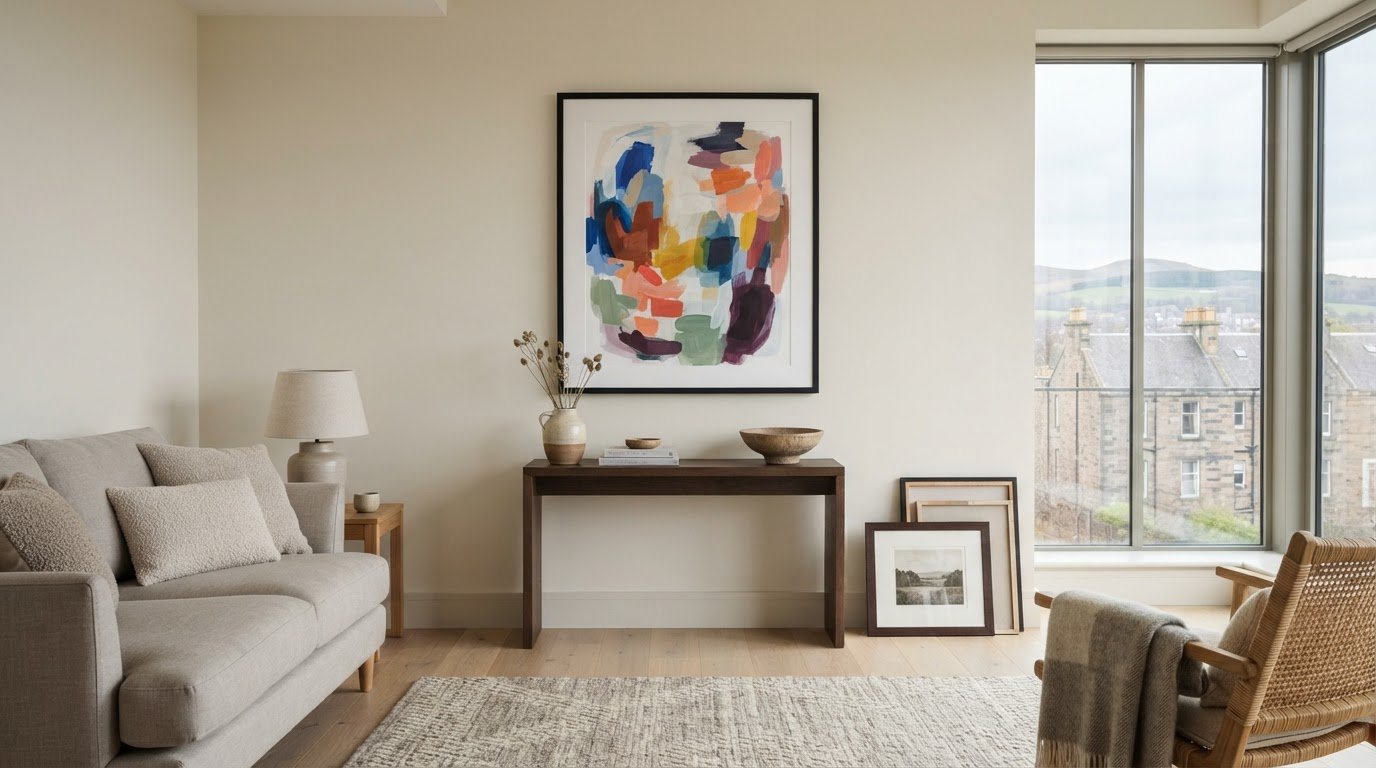
Colourful abstract art creates a deliberate focal point against restrained walls, floors or furnishings. It can bring energy to a room without asking you to change its neutral foundation. Contrast makes a neutral interior feel more personal by giving the eye a vivid detail to return to, while the surrounding calm keeps the artwork in balance.

Start by identifying the room’s undertones. Cream, beige and warm stone tend to feel softer and more sunlit; grey and many off-whites tend to feel cooler. This distinction can guide your palette. Warm neutrals often sit comfortably with earthy reds, ochres or greens, while cooler ones can complement blues and cleaner, sharper accents. Treat these as starting points, not strict rules.

What makes abstract art a natural fit for neutral rooms?

Non-representational shapes and colour bring character without tying the room to a specific subject or decor theme. A flowing composition can add movement, while blocks of colour create a more structured focal point. If you’re curious about the history and forms of abstract art, exploring its variety can help you identify the kinds of compositions you’re drawn to.

Abstract prints are one option among other styles, including Coastal wall art, Landscape wall art and Scottish landscape art. Choose based on the mood you want, rather than assuming a neutral room needs artwork that blends in.

Choose a colour mood before choosing the print

Look around the room first. Echo a shade already present in a cushion, rug or vase to connect the artwork with its surroundings. Or introduce one purposeful accent colour and let the print become the room’s main point of contrast. Repeating a small detail of that colour elsewhere can make the choice feel deliberate.

For a quieter effect, choose tonal artwork with colours close to the room’s existing palette. Higher-contrast Contemporary art prints make a bolder statement, particularly against plain walls. Neither approach is inherently better. Consider how much visual energy you want, then choose a print that complements the room rather than competing with it.

How to match colourful abstract art to your neutral palette

Before choosing a print, look at the undertones in the room’s largest surfaces, such as the sofa, flooring and walls. Undertones influence how artwork colours appear: a shade can look warmer or cooler depending on the neutral colours and light around it. Use the guide below to narrow your palette, then treat it as inspiration rather than a formula.

Warm neutrals: Cream, beige and warm stone pair naturally with related warm accents. A measured cool contrast can add definition.

Cool neutrals: Grey and cool off-white can support vivid colour, gentle tonal combinations or a mix of warm and cool shades.

Mixed palettes: If warm and cool finishes sit together, look for artwork with a colour note that connects both sides.

The colour wheel can help refine your choice. Complementary colours sit opposite each other and create stronger contrast; analogous colours sit beside each other and tend to feel more harmonious. Neither approach is a rule. For more on how colour shapes interiors, explore this overview of color theory in interior design. Look for one or two colours already present in the room to create a visual link. Exact matches aren’t necessary: a similar tone can help the composition feel at home without repeating every accessory.

Compare colour intensity before committing

A print with one vivid focal colour makes a clear statement, while several softer colours spread interest across the composition. Consider which effect suits the room’s existing visual activity. Daylight and artificial lighting can change how colours appear, so compare artwork in the space where it will hang, at different times if possible.

Use the Wall art visualiser to Visualise art on your wall and See artwork before you buy. Previewing the work in context can help you judge its palette more practically than viewing it on a screen alone. For more ideas on selecting artwork and its presentation, browse this gallery of framed art as you consider colourful abstract art for neutral decor.

Colourful Abstract Art for Neutral Decor: Buying Guide

How to choose the right size and frame for colourful abstract art

Good proportions help colourful abstract art feel intentional rather than crowded or lost. Work through these steps before settling on a print:

  1. Measure the wall area. Note the available width and height, leaving space around the artwork so it doesn’t feel squeezed against corners or nearby features.
  2. Consider nearby furniture. Above a sofa or sideboard, compare the artwork’s width with the furniture and the wall space around it. A larger print can anchor a broad wall; a smaller piece may suit a compact display.
  3. Compare proportions. Check whether a landscape, portrait or square composition suits the space. Preview it in its intended position rather than judging the image alone.
  4. Choose a frame. Consider the print’s colours, the room’s finishes and whether the frame should blend in or add definition.

Make artwork scale feel balanced above furniture

Stand back and assess the whole arrangement, including the furniture beneath it and any surrounding objects. A print can look generous on screen but feel undersized above a wide sofa, or overwhelm a narrow wall. The picture frames guide offers further help with display choices. A Wall art visualiser can also help you preview the work in its intended position and judge the overall balance.

Use framing to connect art with the room

A frame in a quiet, complementary colour can support the artwork without competing for attention. A darker or more defined profile can sharpen its contrast against pale walls. With Online picture framing, you can Design your framed artwork by comparing frame choices. Every First4Frames frame is individually crafted for the order using high-quality materials, unlike cheap standard frames that may not fit the artwork properly. The framed work uses 2mm float glass for superior clarity compared with the perspex used by many competitors. For a tailored finish, explore framed art and bespoke options, including Bespoke framed wall art.

Where to find colourful abstract art for neutral decor

Compare artwork by more than its dominant colour. Consider palette, print style, dimensions and frame choices together, since each affects how the finished piece will sit in your room. The selection includes Giclée prints, Fine art, Photography prints and Contemporary art prints, as well as work by Best-selling artists and Famous artists. Custom framed art prints bring your chosen image and frame together as one considered piece.

Browse and visualise framed abstract artwork

Online picture framing makes it easier to compare print and frame combinations. As you browse, consider how the artwork’s colours and dimensions work with different frame options. Choose your frame online and use the Wall art visualiser to picture the combination in your room. Explore colourful framed wall art to compare abstract prints and other styles in context.

An Art print framing service brings a selected print and frame together. First4Frames also offers a print-and-frame option for digital photographs, with high-quality printing chosen to complement the bespoke framing.

Turn a considered choice into framed art

The gallery brings together work from its artist selection, Giclée fine art prints, ready-to-hang framed art and bespoke framing. This joined-up approach lets you explore artwork and consider its finished presentation as part of the same decision. Finished frames are fully packaged to help prevent damage and shipped via professional couriers.

A considered print, a well-fitted frame and protective delivery bring colour to your room with care from selection to arrival. Explore the gallery’s framed art and prints to find a piece that feels right for your space.

Let your artwork make the room your own

A neutral room can be a living backdrop, ready to evolve as your taste changes. Rather than aiming for a perfectly coordinated finish, choose a piece you’ll enjoy seeing each day. The most lasting choice may be the one that makes you pause, sparks a memory or brings a little of your personality into the space.

Give yourself room to explore before deciding. Compare different compositions and colour moods, then picture how each might feel in your home over time. The right colourful abstract art for neutral decor doesn’t simply fill an empty wall; it can become part of how you experience the room, whether you’re settling in for a quiet evening or welcoming friends.

Explore colourful abstract prints and framed art to find a piece that speaks to you. Trust your eye, compare the options and choose the artwork you’ll love living with.

Frequently Asked Questions

Can colourful abstract art work in a small neutral room?

Yes, colourful abstract art can suit a small neutral room. Consider the clear wall area and how much visual activity already comes from furniture, rugs and fittings. A compact print can provide a focused accent, while a larger statement piece may become the room’s main feature. Compare both at the intended height and position, leaving enough surrounding wall space for the artwork to breathe.

How do I choose abstract art for a beige or grey room?

For colourful abstract art for neutral decor, first check whether the beige or grey feels warm, cool or balanced in your room. Then choose colours that harmonise with that undertone or create a deliberate contrast. Pick out one existing shade, perhaps from a cushion or rug, as a visual bridge. View the print under your room’s lighting. Exact colour matches aren’t needed for a cohesive effect.

Will colourful abstract art go out of style?

Art doesn’t have to follow a trend to feel current. Its staying power depends more on whether you enjoy looking at it and whether it sits comfortably with the room. Consider how you might feel about the piece if you changed cushions, throws or other accessories. Choosing artwork for a colour combination you genuinely love gives you more freedom than buying solely to keep pace with a passing style.

Should the frame match the colours in abstract artwork?

No. A frame can pick up one colour in the artwork, recede into the room’s finishes or create a crisp outline that strengthens contrast. Rather than matching every shade, compare the complete framed piece with the wall and nearby furniture. Use the visualiser to test how the frame’s tone and profile affect the composition in place, especially if the artwork has several competing colours.

Can I have a digital photograph printed and framed to suit neutral decor?

Yes. A personal digital photograph can be printed and framed as wall art, with its colours considered alongside your neutral decor. First4Frames’ print-and-frame service pairs high-quality printing with bespoke framing, so the image and its presentation are considered together. For example, a photograph with a small accent of colour can tie in with cushions or ceramics. Choose a frame that supports both the image and its surroundings.

Posted on

Minimalist Line Art Prints for Sale: How to Choose the Right Print and Frame

What if the frame is just as important as the drawing? Minimalist line art prints for sale can look deceptively similar online, yet the subject, scale and finish all affect how a piece feels in a room. Choosing the print and frame together helps the artwork sit comfortably on your wall, with a considered look that doesn’t overwhelm the space.

It’s natural to wonder how a design will look at home, or whether a standard frame will fit and do it justice. This guide explains how to compare line art styles, measure for the right print size and choose a frame to suit your space. You’ll also find practical ways to visualise art on your wall before you buy, plus what to look for in bespoke framing. At First4Frames Gallery, each frame is individually made for the order using high-quality materials, with 2mm float glass for clear viewing. Finished frames are fully packaged to help prevent damage in transit and shipped via professional couriers.

Key Takeaways

  • Compare abstract faces, figurative sketches, botanical lines and geometric designs to find minimalist line art prints for sale that suit your room’s mood.
  • Match print size and frame width to the wall and nearby furniture, allowing negative space to keep a simple composition balanced.
  • Before buying online, choose a subject, measure the display area and review the artwork presentation and product details.
  • Decide whether framed or unframed art suits your plans, and consider how bespoke framing can complete the artwork.

How to Choose Minimalist Line Art Prints for Sale That Suit Your Space

Pared-back drawings can bring a sense of calm, but a simple image still changes a room’s mood. A fine, flowing line may feel gentle and intimate, while bold black strokes create a stronger focal point. Contrast affects how clearly the artwork stands out from its surroundings; negative space gives the eye room to rest and keeps a composition feeling light. In minimalist line art, deliberate lines and open space do much of the work.

For a broader introduction to the form, explore What is Line Art?. Then consider how the drawing relates to the room. It might echo existing shapes and tones, or provide a deliberate point of contrast.

Which minimalist line art style fits your room?

Abstract faces and figurative sketches often feel expressive and personal. Their gestures and varied contours draw attention, making them a good choice when you want the print to become a conversation piece. Botanical lines tend to feel quieter, with leaves and stems bringing an organic note. Geometric compositions, built from repeated shapes or precise curves, add structure.

These are starting points, not rules about which interior style can accommodate each design. Contemporary art prints and fine art offer broader contexts for line-based work, from playful modern interpretations to restrained drawings. Black-and-white art can connect with dark accents or pale walls; a small area of colour can pick up a tone already present in cushions, ceramics or furnishings. Let the room guide your choice without trying to make every element match.

How can you visualise art on your wall before buying?

Measure the area you’re considering, then mark the intended artwork dimensions on the wall with removable tape or paper. This outline helps you judge the scale beside furniture, switches and nearby pictures. Stand back to assess it from the room’s entrance and from the place where you’ll usually sit.

A wall art visualiser can help you visualise art on your wall and see artwork before you buy by previewing a design in your space. Use the preview as a guide, then compare the stated artwork dimensions with your measurements before choosing a print.

Choose the Right Size, Print Finish, and Framing for Line Art

Judge print size against both the wall and the furniture beneath it, not in isolation. A design that looks generous on a product page may feel lost above a broad sofa, while a large print can crowd a narrow wall. Check the artwork’s full dimensions, including the frame, and leave breathing room around the image so its open space remains part of the composition.

Small accent

Use a smaller print to add a quiet detail to a compact wall or an existing arrangement. A slim frame can preserve the drawing’s light feel.

Single focal point

Choose a size that holds its own above furniture without overwhelming it. A broader frame adds visual presence, while a fine profile keeps attention on the lines.

Gallery wall

Plan the group as a whole. Consistent spacing or a shared frame finish can bring different prints together without making each image feel cramped.

When comparing minimalist line art prints for sale, check the artwork dimensions as well as the image preview. Review the print-finish details and consider how the surface will look in the room’s light. Keep the frame colour and profile in proportion to the linework: strong contrast can emphasise a spare drawing, while a quieter edge lets delicate marks lead.

What should you consider when choosing a frame online?

Choose your frame online with the drawing’s character and intended position in mind. Bespoke framing brings print and frame together, with each frame individually made for the order using high-quality materials. Unlike cheap, standard frames, which may not fit the artwork properly, a made-to-measure frame is selected to suit the piece. Design your framed artwork as one considered whole rather than choosing a frame as an afterthought.

Why does glazing matter for minimalist artwork?

Clear glazing helps fine marks remain crisp. First4Frames uses 2mm float glass, which offers clearer viewing than the perspex used by many competitors. For more on frame choices and display, see Picture Frames: The Ultimate Guide to Choosing, Hanging, and Displaying Art.

Explore the online art gallery with your measurements in mind, so you can consider the artwork and its eventual presentation together.

Minimalist Line Art Prints for Sale: How to Choose the Right Print and Frame

How to Buy Minimalist Line Art Prints Online With Confidence

A clear order of decisions makes choosing minimalist line art prints for sale more straightforward. Work through these steps before placing an order:

  1. Choose the subject. Decide whether you want a face, figure, botanical detail or abstract design, and consider how its mood will suit the room.
  2. Measure the wall. Note the available width and height, including space around nearby furniture, so you can compare the artwork’s dimensions with its intended position.
  3. Compare the presentation. Review product imagery from different views and read the details for print dimensions, finish and whether a frame is included. Look closely at line weight, contrast and open space, not just the thumbnail.
  4. Select framing. Decide whether you want a finished framed piece or prefer to arrange a frame separately. Consider how its profile and colour will complement the drawing.

Online picture framing and an art print framing service bring these decisions into one process, helping you weigh the artwork and its presentation together. Check whether the stated dimensions refer to the complete framed piece or the print alone, as this affects how much space it will occupy.

How do you compare framed and unframed art prints?

Ready-to-hang framed wall art offers convenience: the print arrives as a complete piece, so you don’t need to source and fit a separate frame. An unframed print gives you flexibility to choose framing later, but you’ll need to consider fit and finish yourself. Custom framed art prints are made to suit the artwork rather than relying on a standard frame that may not fit its dimensions.

What should buyers know about packaging and delivery?

Finished frames are fully packaged to help prevent damage in transit and shipped via professional couriers. This is useful reassurance when ordering framed artwork online. You can also make a more confident choice by reviewing the print’s details and presentation before buying.

Ready to compare artwork options? Browse the gallery’s framed art and prints and consider which designs fit your measurements and framing preference.

Find Bespoke Framed Minimalist Line Art That Feels Finished

The final choice depends on how you want the artwork to arrive and fit into your plans. An unframed print leaves you free to arrange the presentation later; ready-to-hang framed art brings print and frame together as a finished piece. Bespoke framing lets you consider the artwork and its setting as one, with choices tailored to the individual piece.

What makes bespoke framed wall art a considered choice?

First4Frames offers a wide online selection of artwork and frames, alongside custom picture framing for a tailored result. Browse coastal wall art, landscape wall art, Scottish landscape art, photography prints and contemporary art prints, as well as works by best-selling artists and famous artists. With a broad choice of frame styles, you can choose an understated finish that lets delicate linework lead or a more defined profile that gives it presence.

Can you print and frame a digital photograph?

Yes. First4Frames’ print-and-frame service turns a digital photograph into finished wall art, with high-quality printing to complement its bespoke framing. Explore the online photo printing and framing service to create a framed piece from your own image.

Choose artwork that feels right for your room, then explore framing options to complete the look. Explore the gallery and choose artwork for your space.

Let the Right Line Drawing Find Its Place

A well-chosen piece can become a quiet part of your everyday routine, catching your eye as you pass or bringing calm to a busy corner. As you browse minimalist line art prints for sale, picture the feeling you want the room to hold, not just the colours or shapes that match it. A graceful outline might soften a space, while a more expressive drawing can add personality without filling the wall with visual noise.

Give yourself time to notice which artwork you keep returning to. The strongest choice often feels natural in the room and meaningful to you, rather than simply following a trend. Once a design has caught your attention, explore the gallery’s selection of artwork and framed prints.

Explore minimalist art and framed prints in the gallery, and find a piece that feels at home in your space.

Frequently Asked Questions

What is minimalist line art?

Minimalist line art uses a pared-back visual approach, often relying on a small number of marks rather than detailed shading or colour. A single continuous outline might suggest a face, while a few curved strokes can evoke a leaf or figure. The viewer’s eye fills in what’s left unsaid, making the artwork feel simple but expressive.

How do I choose the right size for a minimalist line art print?

Compare the print’s stated dimensions with the clear wall space, then consider nearby furniture and how far away you’ll usually view it. A small design above a narrow side table can feel deliberate, while the same print may look undersized over a broad sofa. Include the frame in your measurements when comparing finished minimalist line art prints for sale.

Are minimalist line art prints suitable for a gallery wall?

Yes. Their clean compositions can sit comfortably alongside photography, abstract work or other illustrations. To make a group feel connected, repeat one feature, such as a frame colour, while varying image shapes or subject matter for interest. Lay out paper templates on the floor first, then adjust spacing and order before marking positions on the wall.

Is framed line art better than an unframed print?

Neither option is automatically better; it depends on how much choice and preparation you want. A framed print gives you a complete presentation, while an unframed one lets you select a frame later to suit a changing room or an existing collection. If choosing separately, check that the frame opening and print dimensions are compatible before purchasing.

What glazing does First4Frames use for framed art prints?

First4Frames uses 2mm float glass for framed art prints. It offers clearer viewing than the perspex used by many competitors. When deciding where to hang a print, consider daylight and room lighting, and choose a position where reflections are less likely to distract from the artwork.

Posted on

Architectural Prints of Glasgow and Edinburgh: A Guide to Choosing Art

What if the print that feels most like your favourite city isn’t the one with its best-known landmark? Choosing architectural prints of Glasgow and Edinburgh means weighing two distinct moods: Glasgow’s expressive Mackintosh lines and Edinburgh’s close-packed stone streets, stairways and closes. Both make compelling wall art, but it can be difficult to judge online how a particular image or artistic treatment will look in your room.

A detailed monochrome drawing can feel calm and timeless, while a colourful or graphic interpretation makes a stronger contemporary statement. The right choice depends on the architecture you love, the atmosphere you want and the colours already in your space.

In this guide, compare the cities’ visual character, consider how artistic style changes a print’s impact, and use practical checks to choose a size and frame. You’ll also find ways to visualise art on your wall and see how individually crafted framing, made with high-quality materials, brings your chosen architectural print together as ready-to-display framed wall art.

Key Takeaways

  • Choose between architectural prints of glasgow and edinburgh by the city and streetscape you feel most connected to, not by a “right” answer.
  • Compare illustration, photography and contemporary treatments to find the colour, contrast and level of detail you enjoy.
  • Start with the wall, then consider the print’s subject, scale and visual weight alongside your room’s colours and furniture.
  • Pair your chosen print with a considered frame through online picture framing. Each First4Frames Gallery frame is individually crafted for its order using high-quality materials.

What Makes Glasgow and Edinburgh Architectural Prints Feel Different?

Choosing between two much-loved Scottish cities isn’t a test with one right answer. The appeal of architectural prints of glasgow and edinburgh often comes down to personal connection: a familiar street, a building you admire or the atmosphere you want to bring into a room.

Architectural art turns the shape of a street or the character of a façade into a daily reminder of a place.

City Possible mood and subjects May suit
Glasgow Varied, energetic; street scenes, cultural buildings and changing urban details Rooms that welcome expressive, characterful imagery
Edinburgh Historic and layered; stone streets, closes and rooflines Spaces that call for depth, texture or a sense of history

Which Glasgow architectural details might draw your eye?

Glasgow city prints can bring together contrasting façades, busy streets and cultural buildings, so even a restrained palette may feel lively. The Architecture of Glasgow offers context on the city’s Victorian buildings and Glasgow Style. Ashton Lane, Oran Mor and Glasgow Film Theatre are examples of subjects that could focus a print on a street’s atmosphere, a distinctive façade or a cultural landmark. As you browse, notice which details connect with your own experience of the city.

What gives Edinburgh architecture prints their distinctive appeal?

Edinburgh’s historic streetscape has a different visual rhythm. Closely set stone buildings, layered rooflines, narrow closes and stairways can create depth, with details unfolding as your eye moves through the scene. A familiar setting might bring back a visit or favourite walk; a broader street view can convey a quieter, timeless mood. Choose the image for the memory or atmosphere it holds for you, rather than to declare one city better than the other.

How Artistic Style Changes the Look of Glasgow and Edinburgh Prints

The same building can feel quiet, dramatic or full of movement depending on how an artist interprets it. In architectural prints of glasgow and edinburgh, the medium and composition shape the mood as much as the subject. Artistic treatment transforms a building’s lines, light and surroundings into the atmosphere a print brings to a room.

Illustration or photography: which architectural treatment suits you?

Illustrative linework can reduce a scene to outlines, shadows and selected details, directing attention to a doorway, window pattern or roofline. Photography prints capture a particular view, including its light, perspective and surrounding activity. Compare how clearly you can see the details, whether darker tones feel rich or heavy, and how the image is composed. Fine lines and open space often feel measured; strong tonal contrast can make the same subject more striking.

How do contemporary and fine art prints differ in feel?

Contemporary art prints may use cropped viewpoints, simplified shapes or unexpected colour to make familiar architecture feel fresh. Fine art prints can place more emphasis on texture, careful detail and the artist’s interpretation. When comparing them, notice how colour guides your eye, how much of the setting is included, and whether the composition feels balanced or deliberately energetic.

Scottish landscape art can include architectural elements, but for this choice, look for buildings that remain central to the image. Browsing works by best-selling artists and famous artists can introduce you to different approaches to fine art, photography prints and contemporary art prints.

As you compare, picture each print’s contrast and colour alongside your room’s existing palette. To explore possible subjects and treatments, browse architectural and city-inspired prints.

Architectural Prints of Glasgow and Edinburgh: A Guide to Choosing Art

How to Choose Architectural Prints for Your Room

Choosing architectural prints of glasgow and edinburgh for a particular room is easier when you work from the space outward. Use this sequence to narrow your options:

  • 1. Identify the wall. Note its usable width, nearby furniture and the distance from which you’ll usually view the artwork.
  • 2. Choose a city and subject. Pick the place that feels meaningful, then decide whether you prefer a street scene, landmark or architectural detail.
  • 3. Consider scale and visual weight. A detailed image needs room to breathe, while a bold composition can hold its own above substantial furniture. Decide whether one print or a coordinated pair will balance the wall.

Use your room’s existing colours to guide the finish. Monochrome can work well among varied furnishings; restrained colour can echo a cushion or wall tone, while stronger contrast can create a focal point in a neutral space. If you’re also browsing Coastal wall art or Landscape wall art, look for a clear architectural feature to keep the city’s buildings at the heart of your choice. A wall art visualiser can help you visualise art on your wall and see artwork before you buy. For broader display planning, consult Picture Frames: The Ultimate Guide to Choosing, Hanging, and Displaying Art.

How can print size and placement shape the result?

Compare the artwork’s proportions with the available wall space, allowing nearby shelves, lamps and furniture to remain part of the composition. From across the room, check whether the subject still reads clearly. Up close, consider whether the finer details invite a longer look. For practical UK size context, see Standard Photo & Picture Sizes: The Complete UK Guide for Framing.

How should the frame and glazing complement architecture prints?

A simple profile can define the print’s edges without competing with windows, masonry or fine linework. Each First4Frames frame is individually crafted for its order using high-quality materials, unlike cheap, standard frames that may not fit the artwork properly. First4Frames uses 2mm float glass for glazing, offering superior clarity to the perspex used by many competitors. For more bespoke framing guidance, explore Mastering Custom Picture Framing: The Expert Guide to Bespoke Art Display.

Ready to compare artwork for your space? Explore architectural and city-inspired prints.

From City Print to Bespoke Framed Wall Art

A city print becomes part of your room when its presentation feels as considered as the image. Online picture framing lets you pair a chosen architectural print with a frame that suits its lines and tones. With architectural prints of glasgow and edinburgh, a subtle frame can let fine details speak, while a stronger profile gives the artwork more presence.

What does the print-and-frame experience involve?

Browse a large online selection of artwork and frames, choose a print, then Choose your frame online to complement it. Design your framed artwork as bespoke framed wall art, with custom framed art prints individually framed for your order. This bespoke approach avoids the compromises of a standard frame that may not fit the artwork properly. Every frame is crafted using high-quality materials, so its proportions and finish are considered for the piece it holds.

An art print framing service brings the presentation choices together in one place. Select a finish that supports the artwork without overwhelming its architectural features, and consider how the completed piece will sit with your room. The print and frame work together as ready-to-hang framed art.

Can a digital photograph become a framed architectural keepsake?

Yes. The print-and-frame service can turn your own digital photograph of a Glasgow or Edinburgh building into a finished piece. Your photograph is printed to a high quality suited to bespoke framing, then paired with a frame you choose. It’s a way to keep a personal architectural view on display, whether it captures a memorable visit or a detail you pass every day.

Finished frames are fully packaged to help prevent damage and shipped via professional couriers. Explore framed architectural and city prints and find a piece that feels at home on your wall.

Make a Favourite City Part of Your Everyday

A well-chosen architectural print can do more than fill an empty wall. It can bring a place you love into your daily surroundings, whether that connection comes from a memorable visit, a familiar street or an appreciation of the buildings themselves. Let that personal response guide your choice. The most successful architectural prints of glasgow and edinburgh are the ones you’ll enjoy living with, not simply the ones that make the strongest first impression.

Before deciding, picture where your eye will meet the artwork during an ordinary day. A quiet corner might suit a detailed view; a prominent wall may welcome a composition with greater presence. Trust your sense of what belongs in the room, and give the print space to become part of its character.

Browse the gallery and find architectural prints for your space. Your chosen view of Glasgow or Edinburgh could be the detail that makes a room feel unmistakably yours.

Frequently Asked Questions

Can Glasgow and Edinburgh architectural prints work together on one wall?

Yes, prints from both cities can make a cohesive display when they share a visual point of connection. For example, align their centres and use the same frame finish, while choosing one broad street view and one closer façade. Before hanging, arrange the pieces on the floor to test their order and spacing against the wall.

What should I look for in an architectural print?

Choose a subject that matters to you, then check how clearly the image conveys its sense of place. Notice whether the viewpoint includes enough of the building to make it recognisable, and whether surrounding details add context or distract. For architectural prints of Glasgow and Edinburgh, a familiar doorway, roofline or street corner can make the artwork personal without requiring a panoramic city view.

Is float glass clearer than perspex for framed prints?

First4Frames uses 2mm float glass for glazing, which offers superior clarity to the perspex used by many competitors. Its clear presentation lets you appreciate the print’s fine lines, tonal changes and surface detail. The frame, artwork and surrounding light all contribute to how the finished piece looks on your wall.

How can I see artwork on my wall before buying?

Use a wall art visualiser to preview a chosen print in your room before making a decision. Compare its apparent size with nearby furniture, then check whether the image feels balanced beside shelves, windows or other wall features. If possible, view the preview in the room’s usual lighting as well as in daylight, so you can judge how the artwork fits your everyday space.

Posted on

Modern Botanical Prints UK: Find Art That Feels at Home

The right botanical print can make a room feel more like yours, rather than simply following a trend. Choosing among modern botanical prints for sale uk homes can feel tricky when style, scale and colour all need to work together, and an online image doesn’t always show how a piece will look on your wall.

Start with the room: consider its colours, the available wall space and whether you’re drawn to delicate leaves, bold forms or atmospheric florals. This guide will help you choose botanical wall art that feels personal, compare print and frame options, and preview the artwork at home with a wall art visualiser. First4Frames Gallery offers a large online selection of artwork and frames, bespoke framing, and Giclée prints that can be ordered ready to hang. Each frame is individually crafted for the order using high-quality materials, with 2mm float glass for a clear view of the artwork.

Key Takeaways

  • Explore modern botanical prints for sale uk and compare contemporary interpretations with traditional botanical illustration to find a style that suits your home.
  • Use your room’s palette and available wall space to narrow down artwork and choose a print size that feels balanced.
  • Giclée printing reproduces artwork with attention to colour and detail, while a frame crafted for your order completes its presentation.
  • Preview your selection with the wall art visualiser, then use the online process to create framed art ready to display.

Modern botanical prints for sale in the UK: choose a style that suits your space

Botanical art brings natural forms, colour and a sense of life into everyday spaces. Modern prints range from carefully observed leaves to simplified shapes and expressive compositions. Traditional botanical illustration often records plants in precise detail, while contemporary work may interpret them more freely. Both approaches have their own appeal: choose according to the room and the atmosphere you want to create. For background, explore the history and purpose of Botanical illustration.

When looking at modern botanical prints for sale uk, begin with the room rather than a passing trend. A delicate plant study can bring quiet detail to a bedroom, while graphic foliage can turn a plain living-room wall into a focal point. Think about how much visual activity the room already has. A detailed print may stand out in a simple setting, while a restrained design can balance patterned furnishings.

For creative inspiration, watch this watercolour and linework demonstration.

Which botanical print style works in your room?

Delicate plant studies and soft greens work well with an existing restful palette. Bold foliage or saturated colours make a more deliberate focal point, especially against simpler décor. Contemporary compositions may use unusual cropping or open space to keep the image feeling light. Botanical prints can also complement modern framed wall art, including works by best-selling artists and famous artists, alongside Coastal wall art or Landscape wall art.

How can you judge scale and colour before buying?

Measure the available wall width and consider the distance from which you’ll usually view the print. Compare its proportions with nearby furniture: a small piece above a broad sofa may feel lost, while a large image can overwhelm a narrow wall. Notice whether the artwork’s colours echo or contrast with cushions, paint and other nearby pieces. Use the wall art visualiser to visualise art on your wall and see artwork before you buy.

For a cohesive display, match the botanical subject to the room, the palette to its surroundings and the print size to the wall.

What makes a quality modern botanical print and frame?

A botanical image’s fine lines, layered greens and subtle changes in tone deserve a print that reproduces the artwork faithfully. Giclée is a fine-art printing method that captures the original image with careful attention to colour and detail. It offers a considered way to enjoy botanical work alongside other gallery categories, including Fine art, Contemporary art prints and Photography prints.

When comparing modern botanical prints for sale uk, look beyond the image alone. With online picture framing, you can consider how a frame will sit with the print. A slim profile can keep a small, delicate study feeling light, while a bolder frame may give a larger composition a stronger presence. Colour matters too: a frame that picks up a tone in the leaves or provides a quiet contrast can help the print feel at home in its setting.

How does bespoke framing change the finished print?

Each frame is individually crafted for its order using high-quality materials, rather than relying on a cheap, standard frame that may not fit the artwork properly. This bespoke approach lets the frame complement the print’s scale, palette and presentation. For an overview of available framed artwork, explore the online art gallery and its custom framed art prints.

Framed artwork uses 2mm float glass, selected for its clarity. Compared with the perspex used by many competitors, float glass offers a clearer view of the image, so fine details and colours are easy to appreciate. The glazing is an important part of the finished presentation, not just a final detail.

The print carries the image, the frame shapes its presentation, and the glazing provides a clear view. Together, these choices turn a botanical print into a finished piece of framed art, thoughtfully suited to its subject and setting.

How to choose modern botanical wall art for your home

A thoughtful choice starts with the room, not the frame. Decide where the artwork will hang, then note the wall colour, textiles and nearby furniture. A print that picks up a quiet green in your cushions can bring the room together; a contrasting leaf or flower colour can add a purposeful accent.

How do you match botanical art to colour and interior style?

Compare the artwork’s dominant colours with the tones already around it. Soft botanical hues can sit easily in calm, traditional rooms, while graphic foliage can bring energy to a modern interior. In a mixed space, use one shared colour to connect different styles. Botanical subjects can also sit alongside Scottish landscape art or Coastal wall art, creating a varied display without making every piece match.

How should you plan the frame and wall placement?

Measure the available display area and consider how the artwork will relate to a sofa, sideboard or other nearby furniture. Check the space from your usual viewing position, not just up close. Then choose your frame online: a frame that echoes a furnishing can create harmony, while a gentle contrast can help the print stand out. Use the option to design your framed artwork and consider the complete presentation. If you’re comparing modern botanical prints for sale uk, a wall art visualiser can help you preview the artwork in your room and visualise art on your wall before deciding.

Keep the process simple: choose the room, compare colours, measure the wall, then select the artwork and frame. Explore framed art in the gallery to find a piece that suits your space.

Buy framed modern botanical prints online with confidence

Buying framed art online can feel uncertain if you can’t picture the finished piece in your room. A straightforward process helps: browse the artwork, use the wall art visualiser to preview your choice, select a frame and complete your framed-art design. Seeing the print and frame together makes it easier to judge the whole composition, rather than choosing a print and hoping the frame suits it later.

What should you expect from online picture framing?

With a wide online selection of artwork and frames, you can choose your frame online and design your framed artwork around the print’s subject, colour and scale. Bespoke framed wall art comes from these choices working together. Each frame is individually crafted for its order using high-quality materials, giving the artwork a considered fit and finish instead of a cheap, standard frame that may not suit it. Custom framing options let the presentation be tailored to the piece.

An art print framing service brings the print and frame together as one considered order. Finished frames are fully packaged to help prevent damage and shipped via professional couriers, so your artwork is prepared for its journey to your home.

Can you frame your own digital botanical photograph?

Yes. A print-and-frame service for digital photographs offers a straightforward route from your own image to finished wall art. The photograph is printed to a high quality to match its bespoke framing. Explore online photo printing and framing to turn a botanical image of your own into a framed piece.

Whether you’re choosing a gallery print or framing a personal photograph, the process brings artwork, presentation and practical delivery together. Browse modern botanical and framed wall art to find a piece that feels right for your home.

Bring botanical art home with confidence

The right botanical print is more than a pleasing image. Consider how its subject, colours and scale will sit in your room, then use the wall art visualiser to preview the finished look before choosing your frame. As you explore modern botanical prints for sale uk, remember that thoughtful framing is part of the artwork’s overall character.

Each frame is individually crafted for its order using high-quality materials. The 2mm float glass provides a clear view compared with the perspex used by many competitors, while finished frames are fully packaged to help prevent damage and shipped via professional couriers. Together, these details carry your choice from screen to wall with care.

Ready to find a piece that feels at home in your space? Browse the gallery and design your framed artwork, choosing artwork and framing that work beautifully together.

Frequently Asked Questions

How do I choose a modern botanical print for my living room?

Start with the room’s colour palette and the wall space available. Compare the print’s dominant tones with your walls, textiles and nearby furniture, then consider how its size will look above a sofa or sideboard. Delicate plant studies can add quiet detail, while bold foliage can create a focal point. A wall art visualiser can help you preview the effect before choosing a frame.

Are botanical prints still in style in 2026?

Botanical prints remain a versatile choice because natural forms can suit many interior styles. Choose soft colours for a calmer feel, or expressive foliage to bring colour and energy to a wall. The key is finding a print that feels right in your room rather than following a trend. Modern botanical prints for sale uk range from delicate studies to contemporary, graphic interpretations.

What is the difference between a Giclée print and a standard art print?

Giclée is a fine-art printing method used to reproduce artwork with attention to its original detail and colour. “Standard art print” is a broader term and doesn’t describe one specific printing method, so production and finish can vary. First4Frames Gallery offers Giclée fine art prints from a range of artists, primarily from Scotland, which can be paired with a selected frame.

Can I choose a frame online for a botanical print?

Yes, you can browse artwork and frames online, then choose a frame to suit your print and room. A wall art visualiser lets you preview the artwork in your space, helping you consider the overall presentation before completing your framed design. Each frame is individually crafted for its order using high-quality materials, bringing a considered fit and finish to the artwork.

How are framed art prints packaged and delivered in the UK?

Finished frames are fully packaged to help prevent damage during their journey and shipped via professional couriers. Framed artwork uses 2mm float glass for clarity, rather than the perspex used by many competitors. These practical details support a carefully finished piece from framing through delivery.