A Scottish gift for an architecture graduate can mark years of study without defaulting to drawing tools, novelty plans, or another object for a crowded desk. Dundee: V&A by Stewart Bremner connects the occasion to a distinctive piece of Scottish architecture. Its bold graphic treatment also reflects the graduate’s trained eye for silhouette, proportion, and the relationship between a building and its setting.
Why a Scottish gift for an architecture graduate should feel specific
Graduation presents are most memorable when they acknowledge what the recipient has learned. An image of a recognised contemporary building does this without turning their degree into a slogan. The V&A Dundee provides a strong subject because the structure is immediately defined by its form and riverside position.
The Scottish setting adds another layer. It may connect with a graduate who studied in Dundee, grew up nearby, visited the museum during their course, or simply values ambitious public architecture. Those personal links make the gift easier to remember than a broadly architectural poster chosen without reference to place.
Match the gift to the graduate, not only the degree
For a Dundee connection: the landmark can hold memories of study, work placements, exhibitions, or the waterfront.
For a design-led home: the travel-poster influence sits naturally with clean furniture and strong colour.
For a first professional office: the subject signals architectural interest without looking like course material.
For a move after graduation: a framed image provides a portable connection to Scotland and a familiar city.
Think about the recipient’s taste before selecting a size or frame. Someone who prefers minimal rooms may want a restrained moulding and plenty of wall space. A graduate with a more colourful interior may enjoy a stronger frame edge. The aim is to support the graphic image rather than compete with it.
Choose a size for where life goes next
The available print sizes are 594 by 420 and 840 by 594 millimetres before framing. The smaller option is easier to place in a rented flat, study, or compact office. The larger version can become a substantial focal point in a living room or studio. If you do not know the graduate’s future wall space, the more adaptable size is often the considerate choice.
A ready-to-hang framed print also reduces practical work during a busy transition. First 4 Frames uses colour-managed Giclée production and completes bespoke framing by hand at its Falkirk workshop. The result feels properly finished for a milestone while remaining useful long after the ceremony.
Add a message without marking the artwork
Write a separate card that records the qualification, date, and why you chose the building. This keeps the print versatile if it later moves from a home to a workplace. It also gives the recipient a personal note to keep without adding a plaque or inscription that may not suit every future room.
As a Scottish gift for an architecture graduate, this image recognises both achievement and an enduring interest in the built environment. View the framed Dundee: V&A print for a landmark-led present with bold design and lasting craftsmanship.
blue wall art for an industrial home office should earn its place by answering a real question about the room or recipient. Clifton Suspension Bridge (Blue) is a useful starting point because Peter McDermott’s treatment of a great engineering landmark can relate to steel, timber and functional furniture while giving the workspace a measured field of colour.
Place blue wall art for an industrial home office with structure
An industrial interior already contains strong lines. Align the finished frame with a desk, low cabinet or shelving bay, but do not force every edge into rigid symmetry. The bridge can provide direction while the room retains the practical irregularity of a working space.
Clear temporary papers from the proposed sightline.
Mark the complete framed outline above low furniture.
Check it from the seated desk position and doorway.
Move monitor glare and task lights away from the glass.
Keep cable routes clear of the lower frame.
Blue need not make the office cold. Natural timber, warm lamp light and one tactile fabric can balance the image. Avoid repeating its hue across every storage box and chair; the artwork should remain the intentional colour statement.
Why choose a bridge instead of office typography?
Engineering conveys span, connection and purpose through the subject itself. It can suggest ambition without instructing the viewer through a printed slogan.
Let engineering and craftsmanship share a precise edge
Architectural subjects reveal weak alignment quickly. Colour-managed Giclée production supports clean distinctions in the blue treatment, while accurate mounting and a bespoke frame made in-house give the bridge enough definition alongside metal and timber furniture.
Blue wall art for an industrial home office can provide both order and personality. Clifton Suspension Bridge contributes a recognisable structure, while restrained colour repetition keeps the workspace warm and usable.
bronze Cockapoo gift for a dog lover should earn its place by answering a real question about the room or recipient. Cockapoo Standing is a useful starting point because Michael Simpson’s miniature sculpture records the breed’s alert, friendly presence in solid foundry bronze, making the recipient’s genuine connection with the dog more important than a generic pet slogan.
Choose a bronze Cockapoo gift for a dog lover personally
First confirm that the breed matters. The strongest recipient may share life with a Cockapoo, remember one fondly or appreciate small animal sculpture. Breed recognition gives the gift its meaning; a handwritten note can carry the personal story without engraving a stock message onto the object.
Scale
At 5.3 cm high, 6.2 cm wide and 2.4 cm deep, it rewards a close-view shelf or cabinet.
Making
Lost-wax casting, hand-applied patination and protective wax give the small form material depth.
The sculpture weighs 105 g, so choose a stable surface beyond wagging tails, curious children and the edge of a desk. Gentle side light will describe the coat and silhouette better than a dark shelf crowded by larger ornaments.
Limited edition of 250
Engraved sculptor’s signature and edition number
Matching signed certificate of authenticity
Printed presentation box
Look closely at the lost-wax craft and collector details
Cockapoo Standing is cast in solid foundry bronze using the ancient lost-wax method. Acids and heat create its rich brown patina before protective wax is applied. Those processes, together with the matching certificate, make this a small collector sculpture rather than a novelty ornament.
A bronze Cockapoo gift for a dog lover feels lasting when the breed connection is real. Cockapoo Standing combines recognisable character, secure miniature scale and documented foundry craftsmanship in an object made to keep.
colourful wall art for a music room should earn its place by answering a real question about the room or recipient. Disco Inferno is a useful starting point because David Short’s playful contemporary image can supply rhythm and personality, leaving instruments and listening equipment to remain useful rather than turning them into decorative props.
Scale colourful wall art for a music room around the equipment
Start with the room in use. Open the piano lid, place guitars on their safe stands and sit in the normal listening position. The available wall may become smaller once cables, speakers and acoustic treatment are considered, so mark the finished artwork only after those essentials are settled.
Print size
Potential role
265 mm square
A compact beat above a record unit or narrow return.
500 mm square
A clear focal point visible across a modest practice room.
800 mm square
A room anchor where the wall and listening distance support it.
Repeat one colour in a chair, cable tidy or storage box, then allow the remaining equipment to stay visually quiet. The title already carries a musical association. It does not need a neon lyric, mirrored ball and a gallery of album covers beside it.
Rhythm in a room can come from spacing, scale and colour; it does not require every object to announce music.
Give joyful colour the discipline of a square frame
David Short’s work draws on colour, pattern and memory. At the larger square sizes, consistent reproduction and accurate mounting become especially important. Colour-managed Giclée output and bespoke framing completed in-house keep the lively image coherent.
Colourful wall art for a music room should contribute energy without distracting from playing or listening. Disco Inferno supplies a joyful visual rhythm, while deliberate sizing keeps the practical room organised.
landscape wall art for a traditional dining room should earn its place by answering a real question about the room or recipient. Dunkeld Bridge is a useful starting point because Joseph Maxwell Stuart’s direct response to Scottish landscape can sit naturally with timber and familiar architectural detail without making the room feel like a staged period interior.
View landscape wall art for a traditional dining room across the table
Test the wall from every regular seat. A bridge scene gains meaning when its route remains visible beyond glassware, chair backs and a pendant fitting. The strongest position may be opposite a sideboard rather than directly above it.
Connect
Let one timber tone or muted textile acknowledge the landscape’s warmth.
Separate
Use the mount and frame to stop brown furniture merging into the picture.
Simplify
Remove extra maps, tartan objects and souvenir views from the same wall.
Traditional does not have to mean dark. Joseph Maxwell Stuart paints outdoors in oils and watercolours, responding directly to light and place. A restrained frame can respect established furniture while letting that freshness remain visible.
Extend the dining table before measuring.
Mark the finished frame at seated eye level.
Switch on the evening lights and check reflections.
Leave clear wall around the complete presentation.
Balance heritage, light and a hand-finished presentation
Plein-air landscape rewards faithful tonal reproduction. Colour-managed Giclée production supports the original sense of light, while one-to-one frame choices and in-house craftsmanship can relate the finished work to existing timber without making it visually heavy.
Landscape wall art for a traditional dining room can bring history into everyday use without becoming formal. Dunkeld Bridge offers Scottish place, an active route and enough light to keep a timber-rich room welcoming.
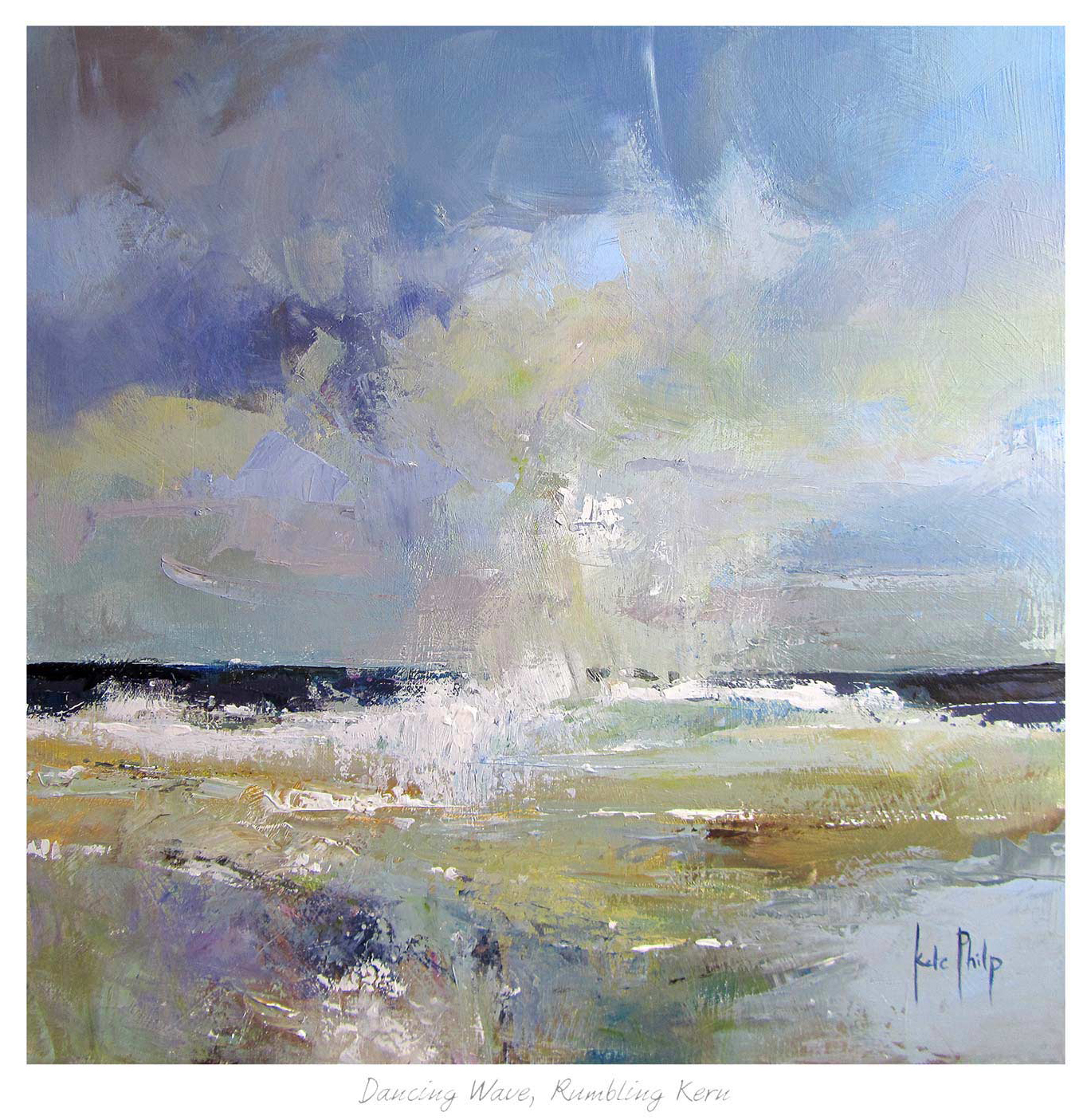
coastal wall art for a bathroom should earn its place by answering a real question about the room or recipient. Dancing Wave, Rumbling Kern is a useful starting point because Kate Philp’s Northumberland subject contributes real movement and place, while sensible positioning can keep the picture beyond direct splashes and persistent condensation.
Choose coastal wall art for a bathroom by conditions first
Begin with ventilation rather than colour. A bathroom that stays damp after use is not the right place for framed paper artwork. In a well-ventilated room, choose a wall away from the shower, bath edge and basin, then check that towels and doors cannot brush the frame.
Display check
Reason
Direct splash route
Keep the artwork well outside it.
Extractor performance
Confirm steam clears promptly after bathing.
Mirror reflection
Use it to extend the wave only if glare stays controlled.
Viewing point
Test the image from the doorway, not from inside the bath.
The wave supplies enough coastal identity on its own. Plain towels, clean fittings and one quiet wall colour will support it better than shells, rope and written bathroom signs. Its active water also provides a useful counterpoint to tile, glass and other hard, static surfaces.
What if the room remains humid?
Choose another location. A nearby landing or dressing area can retain the bathing connection while giving the framed work a more stable environment.
Let genuine coastal movement replace a themed scheme
Kate Philp draws on the contrasting beaches and rugged cliffs of North Northumberland. Colour-managed Giclée production preserves that movement and tonal separation, while bespoke framing completed in-house gives the image a clean boundary against reflective bathroom finishes.
Coastal wall art for a bathroom should be chosen with the room’s conditions in mind. Dancing Wave can bring energy and a specific shoreline connection without asking the rest of the interior to imitate the coast.
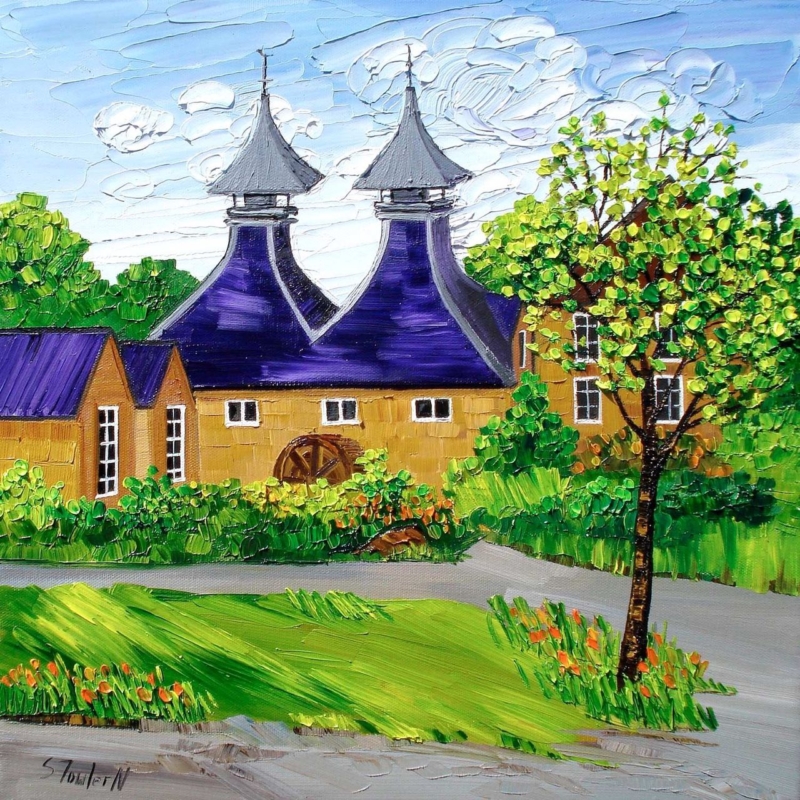
wall art for a home whisky room should add atmosphere and a sense of provenance without making the space resemble a themed pub. Strathisla Whisky Distillery by Sheila Fowler offers a more considered starting point. The historic Scottish subject gives the room identity, while the square composition can sit comfortably with bottle storage, timber furniture, and the smaller scale of many dedicated tasting spaces.
Why wall art for a home whisky room needs more than a logo
A whisky room is usually built around materials and rituals. Glass, wood, labels, and warm pools of light already provide detail. Large advertising graphics can compete with that collection and may make the room feel commercial. Artwork showing a real distillery introduces the subject in a quieter way. It connects the contents of the cabinet to landscape, buildings, and craft.
Strathisla Whisky Distillery is especially useful because its architecture gives the eye a clear destination. It can support conversation without requiring every visitor to recognise a particular bottle. The picture therefore suits both an enthusiastic collector’s room and a compact corner used for occasional tastings.
Choose a position clear of bottles and glass
Start with a wall that can be seen while people are seated. Above a low cabinet may work, provided the finished frame has space above the tallest bottle. A short wall beside the tasting table is another good option. Avoid hanging the print directly behind open shelves, where reflections and labels will interrupt the image.
Placement check
What to look for
Viewing distance
The distillery should remain clear from the main tasting seats
Cabinet clearance
Doors, decanters, and bottle tops must not overlap the frame
Task lighting
Downlights should illuminate the table without causing glare on the glass
Heat and moisture
Keep the artwork away from radiators, sinks, and changing humidity
Work with the room’s warm materials
Whisky rooms often include oak, walnut, leather, brass, or deep paint colours. The frame does not need to copy those finishes. Instead, choose one that creates a clear edge between the artwork and the wall. A dark moulding can feel crisp against lighter plaster. A carefully selected timber may connect with cabinetry, but it should not look like an almost-match.
The print is available in 265 by 265 and 500 by 500 millimetre sizes before framing. The smaller option can define a tasting nook or narrow wall. The larger version gives a dedicated room a stronger anchor. Mark out the complete framed dimensions with low-tack tape before ordering, then check them from every seat.
Let the print supply colour without over-dressing the theme
Pick up one restrained colour from the artwork in a chair, tray, or textile if the room needs connection. Stop there. Barrels, tartan, maps, and whisky slogans used together can turn a calm room into a display set. One specific image, professionally framed, leaves the bottles and the experience of tasting to provide the remaining story.
First 4 Frames produces its Giclée prints through a colour-managed process and completes bespoke framing in-house in Falkirk. That hand-finished presentation gives the architectural detail a lasting, ready-to-hang finish. You can explore more landscape, coastal, and floral work on Sheila Fowler’s official website or browse the Sheila Fowler collection at First 4 Frames.
Well-chosen wall art for a home whisky room can celebrate the craft behind a collection while keeping the room personal and composed. View the framed Strathisla Whisky Distillery print and compare both available square sizes for your tasting space.
abstract wall art for a narrow hallway should earn its place by answering a real question about the room or recipient. Echoes of Form is a useful starting point because its 400 × 560 mm portrait format, bold colour and geometric character can make one controlled pause without narrowing the route with a long run of small frames.
Position abstract wall art for a narrow hallway from the approach
Stand in the room that leads into the hall. The best wall is often the one revealed gradually as you approach, not the surface nearest the front door. A portrait composition can occupy that view while leaving useful wall space around its frame.
Check the route before marking the wall
Open every nearby door to its full arc.
Allow for coats, bags and passing shoulders.
Mark the complete frame, not only the 400 × 560 mm print.
Walk towards the paper outline from both directions.
View it under the lamps normally used after dark.
Echoes of Form already supplies visual activity. Keep the runner, paint and storage disciplined, and avoid answering every shape with another patterned object. One repeated colour in a small practical detail is enough to connect the picture with the space.
A passage feels larger when the eye has one destination and the walking line remains physically clear.
Use the frame to contain energy rather than add more pattern
Fred Carson’s practice spans painting, ceramics and architectural work, so form and colour are central to the image. Colour-managed Giclée production and a precisely mounted, hand-finished frame give that energy a dependable edge in a busy route through the home.
Abstract wall art for a narrow hallway works when it creates a deliberate stop without becoming an obstacle. Echoes of Form brings colour and structure, while measured placement preserves the hall’s practical flow.
What if the right fixing matters more than the hook itself? If you’re unsure what’s behind your plasterboard, conflicting advice can make a simple job feel risky. Learning how to hang pictures on plasterboard walls starts with the wall structure and the frame’s weight, not guesswork.
This guide explains how to choose a suitable hanging position, check for a stud and match a fixing to your picture. You’ll also learn how to hang the frame neatly and check that it feels secure. Before drilling, take care around hidden pipes and wiring. Once the wall fixing is in place, the right frame hardware makes hanging simpler: First4Frames Gallery professionally framed artwork comes ready to hang with D-rings and high-quality framing wire attached.
Key Takeaways
When working out how to hang pictures on plasterboard walls, assess the wall structure and the framed picture before choosing a fixing.
Compare fixings by their intended use and support method. A stated load capacity isn’t a guarantee for every wall or installation.
Mark the hanging position carefully, then follow the fixing manufacturer’s fitting directions and tool requirements.
Match the wall fixing to the frame’s hanging hardware, then check that the finished picture is straight and secure.
How to Hang Pictures on Plasterboard Walls Without Guesswork
Identify both the wall and the frame before choosing a fixing. Plasterboard is a sheet material, as explained in this overview of Drywall (Plasterboard) Composition and History, but the space behind it can vary. Your intended fixing point may open onto a hollow cavity, meet a timber stud or be affected by another part of the wall structure.
That difference matters. A fixing designed to grip behind a hollow board works differently from a screw secured into a stud. The right option also depends on the framed picture’s weight, its attached hanging hardware and the fixing manufacturer’s instructions. Assess the whole setup instead of choosing a hook based only on its advertised capacity.
What should you check before hanging a picture?
Weigh the complete framed picture, not just the artwork, and check the back to see what hanging hardware is fitted and where it sits. Then inspect the planned position. Cracks, crumbling plaster, damp patches or a board that feels loose are reasons to choose another spot or address the wall before hanging anything.
How can you tell what is behind the plasterboard?
A hollow section has an open space behind the board; a stud is a supporting timber member. Use an appropriate wall detector to locate support and check for hidden services, following the device’s instructions carefully. Detector results can help you assess the position, but don’t assume that every point on a wall has the same structure.
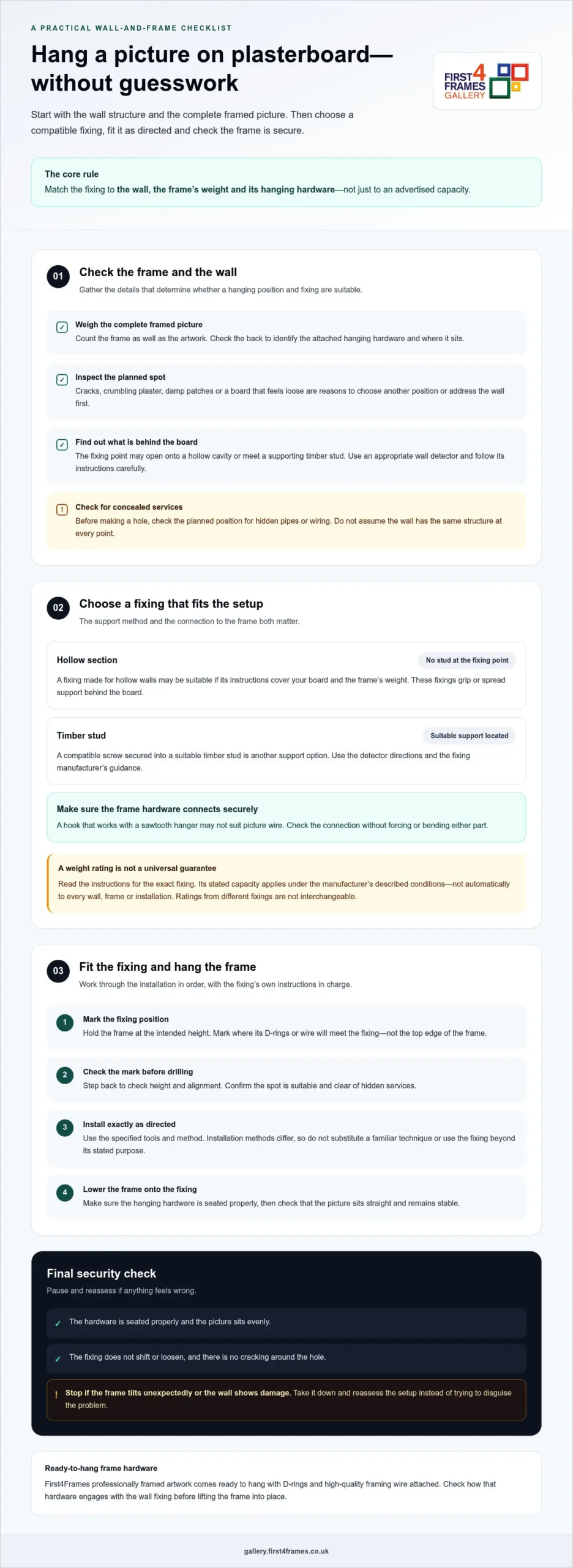
Before making a hole, establish:
The framed picture’s total weight and the location of its hanging hardware.
Whether the chosen spot is sound, and whether a stud or hollow section is behind it.
Whether the position needs checking for concealed pipes or wiring.
Which fixing suits the wall and frame, and what its manufacturer specifies for fitting.
This quick assessment helps you choose a fixing that matches the wall and frame, rather than relying on guesswork.
Choose a Plasterboard Picture Fixing for the Wall and Frame
Once you know what is behind the board, match the fixing to that support, the frame’s weight and the hardware on its back. The fixing must suit both the wall and the way the frame hangs. For example, a hook that works with a sawtooth hanger may not suit picture wire. Check that the fixing and frame hardware connect securely, without forcing or bending either part.
The right picture fixing depends on the wall, the frame and the installation. Keep this in mind when deciding how to hang pictures on plasterboard walls, especially if the frame is heavy or valuable. If you can’t establish that the fixing is suitable for the wall and load, don’t guess.
When does a plasterboard fixing need extra support?
A fixing made for hollow walls may suit a position without a stud, provided its instructions cover your board and the frame’s weight. These fixings grip or spread their support behind the board instead of relying only on the surface. If you locate a suitable timber stud, a compatible screw secured into it provides another support option. Use the detector’s directions and the fixing manufacturer’s guidance to choose the approach.
How should you interpret a fixing’s weight rating?
Read the rating and fitting instructions for the exact fixing you’re using. A stated capacity applies to the product under the conditions described by its manufacturer, not automatically to every plasterboard wall, frame or installation. Ratings from different fixings aren’t interchangeable. Board condition, fixing position and correct installation can all affect whether the setup is appropriate, so don’t treat a product figure as a universal guarantee.
For a ready-to-hang framed picture, check how its attached hardware engages with the chosen fixing before lifting it into place. First4Frames frames have D-rings and high-quality framing wire attached for straight wall mounting. If you’re choosing artwork for a wall you’re preparing, browse the framed art gallery and include the finished frame in your hanging plan.
How to Fit a Picture Fixing and Hang the Frame Step by Step
Careful marking and patient fitting help protect both the wall and your frame. Follow the selected fixing’s own instructions, including its tool requirements. Installation methods differ, so don’t substitute a familiar technique or use the fixing beyond its stated purpose. If you’re unsure about the position or support, pause before making a hole.
How do you position and fit the fixing?
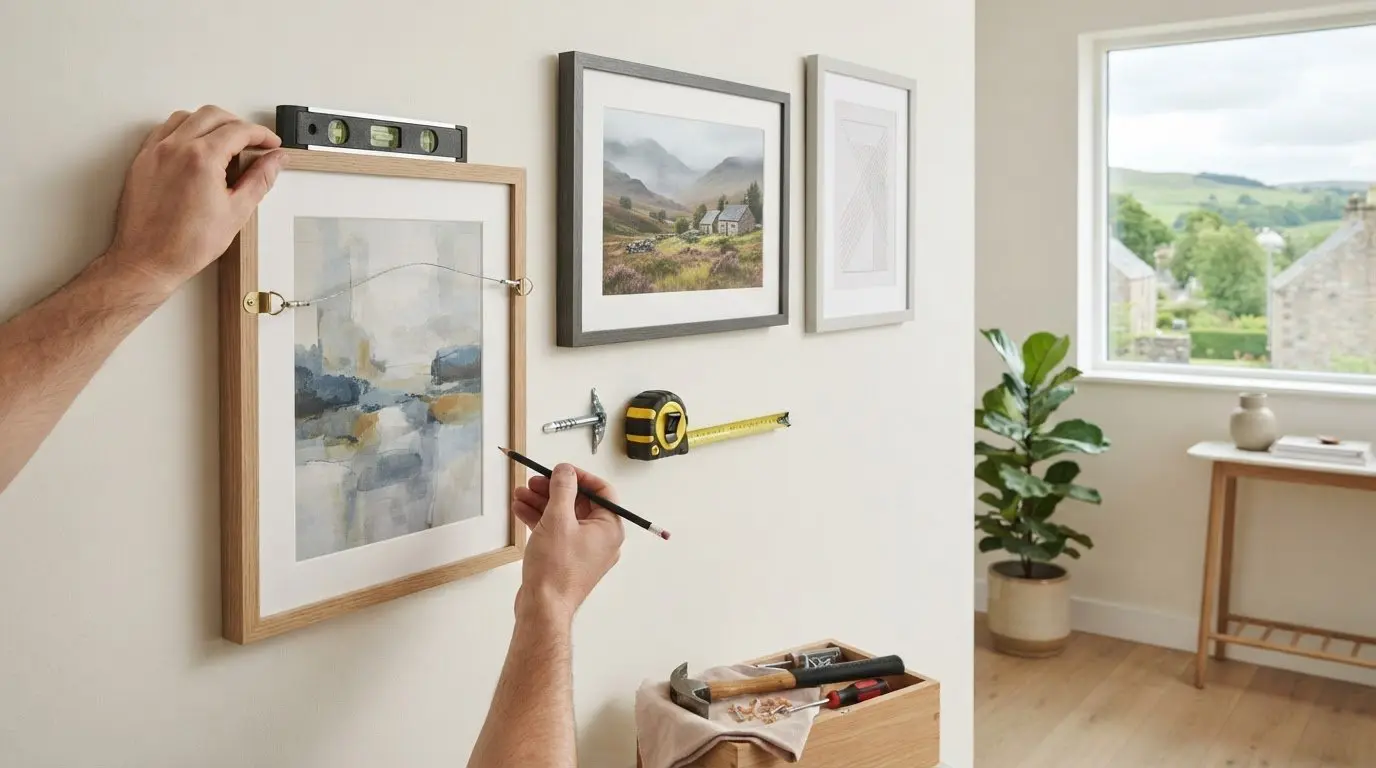
Hold the frame at the intended height and mark where its hanging hardware will meet the fixing. Account for the position of the D-rings or wire instead of marking the frame’s top edge as the fixing point. Step back to check the height and alignment, then confirm the spot is clear of hidden services before drilling. Fit the fixing exactly as directed.
How do you check the picture is hanging securely?
Lower the frame gently onto its intended hanging point and make sure the hardware is seated properly. Check that the picture sits straight and that the fixing doesn’t shift, loosen or cause cracking around the hole. If the frame tilts unexpectedly or the wall shows damage, take it down and reassess the setup rather than trying to disguise the problem.
Mark the fixing position, taking the frame’s hanging hardware and desired height into account.
Check the mark for alignment and confirm it’s a suitable, clear location.
Install the fixing with the specified tools and method, following its instructions throughout.
Lift the frame onto the fixing, then check that it sits evenly and remains stable.
Stop if the wall or fixing doesn’t feel secure. A neat finish matters, but a frame should only stay in place if its support feels sound. This step-by-step approach makes how to hang pictures on plasterboard walls clearer while leaving the fixing’s instructions in charge of the installation details.
A finished display brings together the wall fixing, frame and artwork. Once you’ve chosen a fixing that suits your wall and frame, think about the look you want in the room. Bespoke framing gives the artwork a considered fit, while a standard frame may not suit its proportions. First4Frames individually crafts each frame to order using high-quality materials.
What hanging hardware comes with First4Frames framed art?
The frame’s attached hardware and the wall fixing have separate roles: one connects the picture to the fixing, while the other supports it in the wall. First4Frames frames are fitted with 2mm float glass, selected for its clarity compared with the perspex used by many competitors. The glazing is part of the finished frame, but it doesn’t change the need to choose a suitable wall fixing for the frame’s weight.
First4Frames can print and frame your digital photographs, with print quality chosen to complement the bespoke frame. Finished frames are fully packaged to help prevent damage and shipped via professional couriers. The ready-to-hang finish makes it easier to plan how your artwork will sit in your home.
How can a framed print complete a room?
Choose a print to suit the room’s character and the display you have in mind. A landscape can create a calming focal point in a living room, while a carefully chosen photograph may bring a more personal feel to a hallway or reading nook. Bespoke framing brings the image and its presentation together, helping your chosen piece feel at home in the space.
Choose artwork to suit the room’s mood, from Coastal wall art and Scottish landscape art to Photography prints and Contemporary art prints. Explore Fine art by best-selling artists and famous artists, then consider how the image and frame will work together as Bespoke framed wall art.
Online picture framing lets you choose your frame online and design your framed artwork around the piece. A wall art visualiser can help you visualise art on your wall and see artwork before you buy. Custom framed art prints give a favourite image a considered finish, while an art print framing service brings the print and presentation together.
Can you hang a heavy picture on a plasterboard wall?
Yes, but the fixing needs to suit the picture’s full weight and the wall behind it. For a heavier frame, securing a compatible screw into a timber stud can provide support without relying on the board alone. If you can’t locate suitable support or aren’t sure the fixing is appropriate, don’t guess. To hang pictures on plasterboard walls safely, consider the weight and wall support together.
Do you need to find a stud to hang a picture on plasterboard?
No, a stud isn’t essential for every picture. A fixing designed for hollow walls may suit a lighter frame when used exactly as directed. A stud can be a useful support point for heavier pieces, but first confirm its position with an appropriate detector and check for hidden services. If the frame has two hanging points, make sure the layout supports both sides as intended.
Can you hang a picture on plasterboard without drilling?
Sometimes, adhesive picture strips or hooks can be used, but only if their manufacturer says they’re suitable for your wall surface and the frame’s weight. Surface condition matters: dust, loose paint or damaged paper facing can affect how well an adhesive holds. Follow the product’s preparation, application and waiting instructions, and don’t use adhesive as a substitute for a mechanical fixing if the frame exceeds its stated limits.
How do you stop a picture frame from leaning forward on plasterboard?
Check that the frame’s hanging points are correctly engaged and that its back sits evenly against the wall. If picture wire allows the frame to tip, suitable frame bumpers near the lower corners can help steady it, provided they fit without marking the wall. Don’t change the wall fixing to correct a frame-balance issue. For a large or valuable piece, get help lifting and positioning it.
What should you do if a plasterboard picture fixing feels loose?
Take the frame down straight away and don’t keep tightening the fixing in the same opening. Check whether the hole has widened or the board is cracked or crumbling. A damaged spot may no longer provide reliable support; choose a sound position and a fixing suited to that location, or secure it to a suitable stud. Repair the old hole separately before rehanging the picture.
local Scottish art for an Edinburgh new home should earn its place by answering a real question about the room or recipient. Cramond Kirk is a useful starting point because its recognisable subject offers a specific connection to the city, while Joseph Maxwell Stuart’s painted interpretation remains artwork first rather than a generic housewarming message.
Make local Scottish art for an Edinburgh new home feel specific
A place-led gift is strongest when the location has a genuine link. Cramond Kirk may suit someone moving nearby, returning to Edinburgh, or building a home around familiar walks and landmarks. Ask whether that connection will be understood before choosing it.
Consider the recipient’s relationship with Cramond.
Look at the materials already present in the new home.
Measure a likely wall only as guidance.
Keep the frame choice flexible while the room evolves.
Explain the place connection in a handwritten card.
Joseph Maxwell Stuart studied at the Ruskin School and Edinburgh College of Art. His practice includes work made directly from landscape. That viewpoint distinguishes this from a souvenir image and brings an artist’s treatment of local place into the room.
If you do not know the final wall
Choose a versatile presentation and include the product details. The recipient can discuss mount, moulding and scale with First 4 Frames instead of being committed to a frame selected for an unsettled room.
Avoid surrounding the work with tartan, maps and several Edinburgh motifs. One local scene has more authority when it stands on its own among the recipient’s possessions.
Use bespoke framing to connect the gift with the actual home
A housewarming artwork is easier to live with when its presentation responds to the destination. First 4 Frames combines colour-managed Giclée production with one-to-one framing guidance and hand-finished work completed in-house at the Falkirk workshop.
Local Scottish art for an Edinburgh new home can create belonging without spelling out the occasion. Cramond Kirk offers a specific place and an established artist’s view, while bespoke framing lets it belong to the recipient’s interior.