
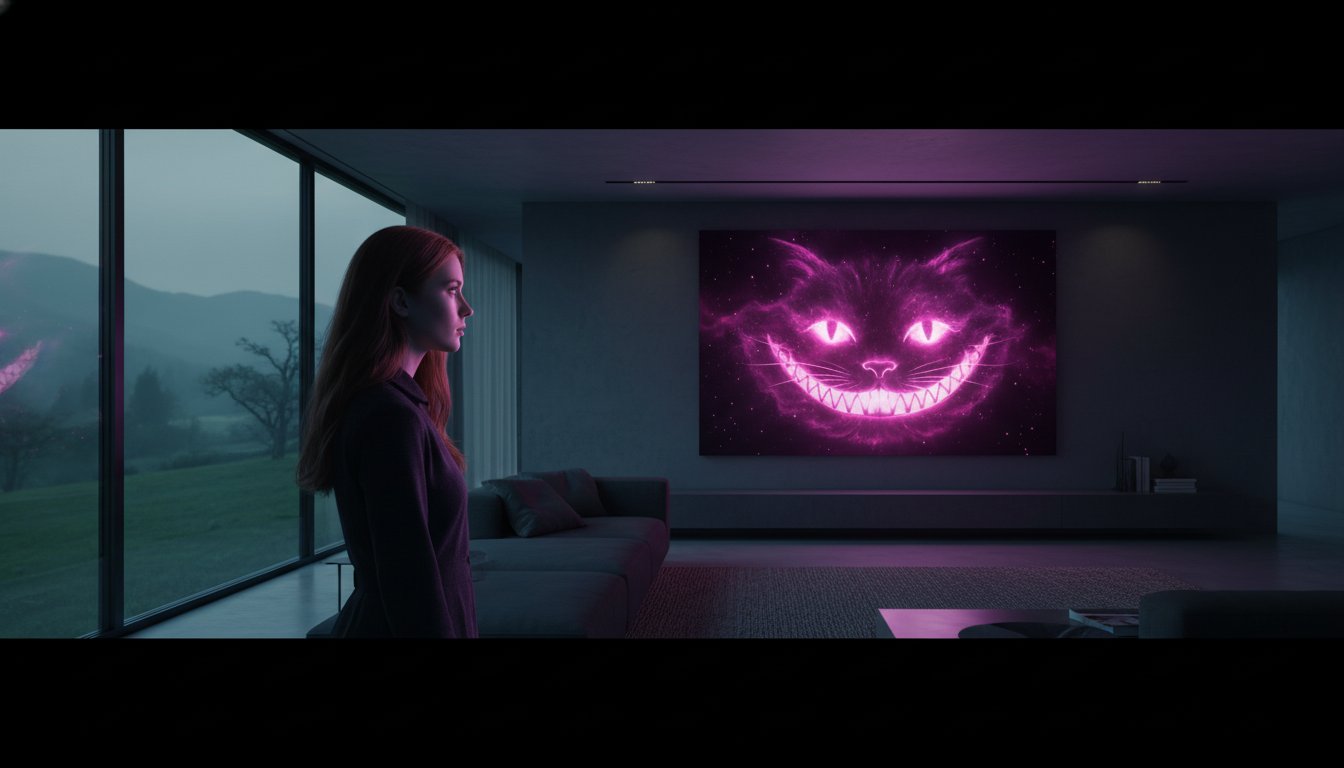
He materialises from thin air, offers riddles wrapped in wisdom, and vanishes leaving only that famous, floating grin. Few characters in literature are as enchanting and enigmatic as the cheshire cat from alice‘s adventures in Wonderland. But is the mischievous feline from the Disney classic the same as the one on Lewis Carroll’s page? What is the true meaning behind his philosophical musings and that iconic, knowing smile? If you’ve ever felt puzzled by this grinning guide, you’ve come to the right place.
Embark on a journey with us down the rabbit hole as we provide a clear guide to this beloved character. We will explore his surprising origins, decode the wisdom in his most famous quotes, and unravel the deep symbolism that has captivated audiences for generations. By the end, you’ll have a newfound appreciation for his role in literature and discover how his timeless charm is captured in beautiful fine art, providing perfect inspiration for bringing a touch of Wonderland’s magic into your home.
Key Takeaways
- Uncover the Cheshire Cat’s literary origins in Lewis Carroll’s 1865 novel and understand his original, enigmatic role as a guide for Alice.
- Learn how the character’s iconic look has evolved, from the first illustrations by John Tenniel to unforgettable screen adaptations.
- Go beyond the grin to explore the rich symbolism of the cheshire cat from alice and what he reveals about the illogical nature of Wonderland.
- Discover why this mysterious character makes such a compelling art subject and get practical tips for choosing a beautiful print for your home.
The Origins of the Grin: Who is the Cheshire Cat?
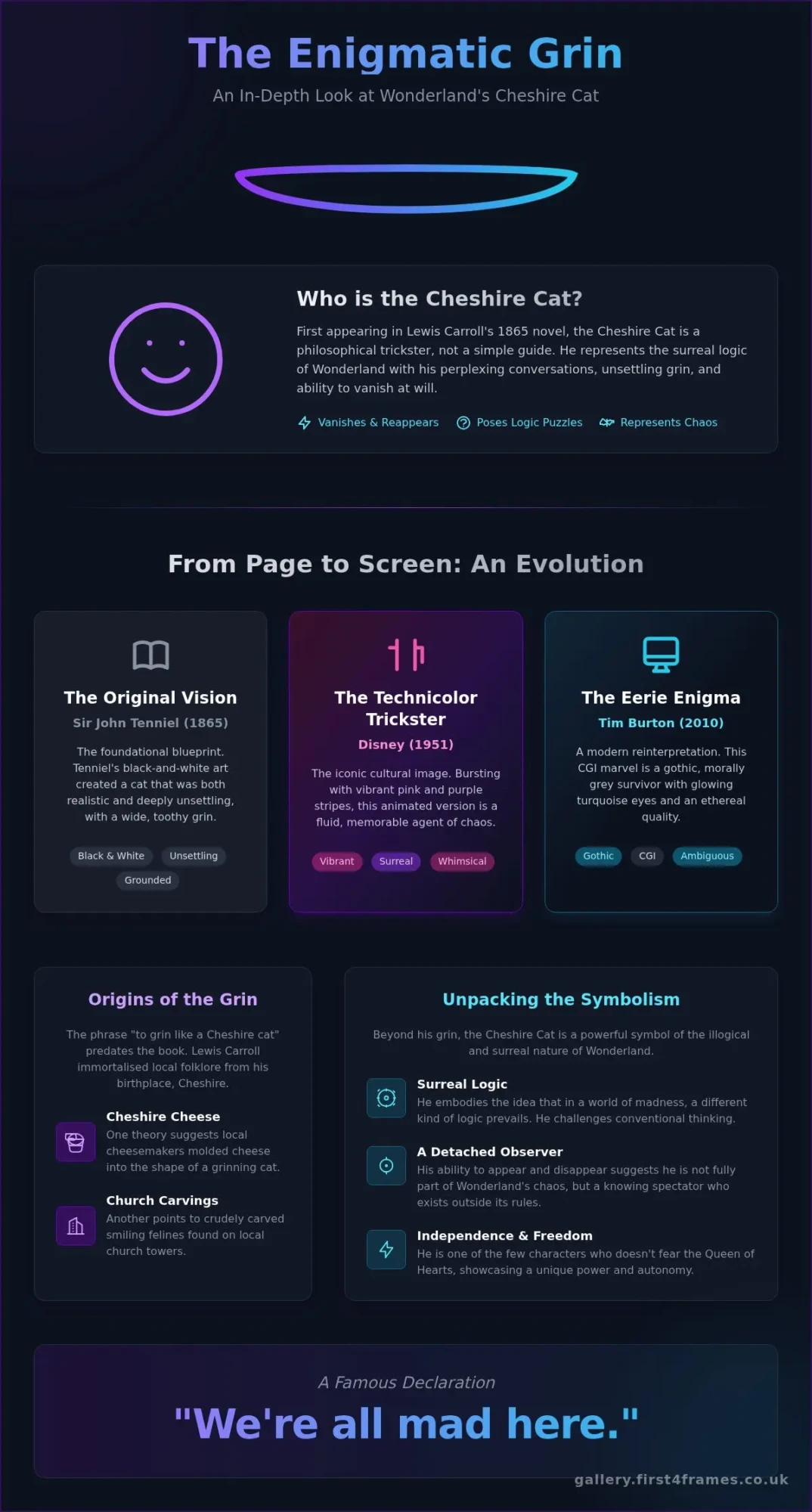
First appearing in Lewis Carroll’s 1865 masterpiece, Alice’s Adventures in Wonderland, the Cheshire Cat is one of literature’s most enigmatic and enduring characters. He is not a simple guide but a philosophical trickster, engaging Alice in perplexing conversations that are equal parts frustrating and profound. With his iconic, lingering grin and the ability to vanish at will, he represents the surreal logic of Wonderland, a constant, knowing presence in a world of beautiful chaos.
To see one of his most famous screen appearances, watch this classic clip:
A Character in the Book
Alice first encounters the Cheshire Cat in the Duchess’s chaotic kitchen, where he sits serenely, grinning amidst the madness. Unlike the more whimsical and mischievous personality seen in many film adaptations, the literary cheshire cat from alice is a more complex figure. He challenges Alice’s understanding of reality with logic puzzles, such as his famous declaration, “We’re all mad here.” His unique power to appear and disappear, often leaving just his grin behind, gives him a special status; he is one of the few characters who seems to operate outside the tyrannical rule of the Queen of Hearts, respected and perhaps even feared by all.
The History Behind the Phrase
Lewis Carroll didn’t invent the concept of a grinning cat. The phrase “to grin like a Cheshire cat” was a common saying in 19th-century Britain, long before Alice fell down the rabbit hole. Its origins are debated, but two popular theories connect it to the county of Cheshire, Carroll’s birthplace. One suggests that local cheesemakers once molded their Cheshire cheese into the shape of a grinning cat. Another points to crudely carved smiling felines found on church towers in the region, a testament to local craftsmanship. For a more comprehensive overview of the Cheshire Cat and these fascinating origins, Wikipedia offers an excellent resource. Through his spectacular character, Carroll immortalised a piece of local folklore, giving it a permanent home in our collective imagination.
From Page to Screen: The Cheshire Cat’s Most Famous Portrayals
The Cheshire Cat’s journey from a literary enigma to a global icon is a spectacular tale of artistic evolution. While Lewis Carroll’s words gave him his paradoxical personality, it was the visual interpretations that cemented his image in our collective consciousness. Each artist and director brought their unique vision to the character, transforming him for new generations and ensuring his place in popular culture.
Sir John Tenniel’s Original Vision
The first face we ever put to the name was crafted by Sir John Tenniel for the original 1865 publication. His masterful black-and-white sketch style created a cat that was both realistic and deeply unsettling. Tenniel’s art, which you can explore further in this excellent Cheshire Cat overview, established the character’s wide, toothy grin and a subtly mischievous glint in his eye. This grounded, yet uncanny, portrayal became the foundational blueprint, influencing every artist who dared to draw the grinning feline thereafter.
Disney’s Technicolor Trickster (1951)
For millions, the definitive cheshire cat from alice is Disney’s 1951 creation. Bursting onto the screen in vibrant pink and purple stripes, this version was a triumph of surreal animation. His ability to disappear and reappear in pieces, his fluid movements, and his memorable song made him an unforgettable agent of chaos. The studio’s bold artistic choices-moving far from Tenniel’s realism-transformed him into a whimsical, slightly mad guide, cementing his place as a beloved cultural icon.
Tim Burton’s Eerie Enigma (2010)
Tim Burton’s 2010 live-action adaptation offered a striking reinterpretation for a modern audience. This Cheshire Cat was a gothic, CGI-driven marvel, with glowing turquoise eyes, an unnervingly oversized grin, and an ethereal, almost ghostly, ability to float and shapeshift. His personality became more ambiguous and morally grey-a sly survivor in a dark and twisted Wonderland. This design, with its darker aesthetic, perfectly captured the uncanny nature of the character, appealing to those who appreciate a touch of the macabre in their fantasy.
‘We’re All Mad Here’: Unpacking the Cheshire Cat’s Symbolism
The iconic, disembodied grin of the cheshire cat from alice is one of literature’s most enduring images. But beyond his whimsical appearance, he serves as a profound symbol, representing the very essence of Wonderland’s chaotic logic. He challenges our perceptions of reality, sanity, and purpose, acting not just as a character but as a philosophical puzzle box waiting to be explored.
A Symbol of Absurd Logic
Unlike other inhabitants, the Cheshire Cat understands and embodies the fluid, nonsensical rules of Wonderland. He appears and vanishes at will, a physical manifestation of the world’s absurdity. While everyone else is frantic, he observes with a detached amusement, a commentator on the chaos. His famous grin, which has literary origins of the Cheshire Cat’s grin predating Lewis Carroll’s work, is the perfect symbol of his enigmatic nature-he is both present and absent, sane and mad, all at once.
The Philosophical Guide
Where characters like the White Rabbit or the Queen of Hearts give Alice confusing orders, the Cheshire Cat offers something far more valuable: perspective. He doesn’t tell her what to do; instead, his riddles force her to confront her own assumptions. By explaining that the path she takes “depends a good deal on where you want to get to,” he teaches her a crucial lesson in self-reliance. He is the only guide who empowers Alice to navigate Wonderland on her own terms.
Famous Quotes and Their Meanings
The dialogue of the cheshire cat from alice contains the story’s most pivotal themes, wrapped in beautifully crafted statements that question everything.
- ‘We’re all mad here. I’m mad. You’re mad.’ – This isn’t a judgment but a declaration of fact within Wonderland. It redefines ‘madness’ not as an illness, but as an alternative state of being, inviting Alice to abandon conventional notions of sanity.
- ‘…it doesn’t much matter which way you go.’ – Spoken when Alice admits she has no destination, this highlights the importance of purpose. Without a goal, any direction is as valid as another-a profound commentary on choice and intention.
- ‘I’m not crazy; my reality is just different from yours.’ – Though a famous adaptation line, it perfectly captures his spirit. It champions the idea of subjective reality, suggesting that sanity is merely a matter of perspective.
This complex blend of logic and lunacy is what makes the character such a spectacular and timeless icon. His enigmatic smile serves as a beautiful reminder that sometimes, the most logical path is to simply embrace the absurd.
Bringing Wonderland Home: Choosing Your Cheshire Cat Art
Beyond his riddles and philosophical musings, the Cheshire Cat is a visual icon. His enigmatic grin and vibrant stripes have inspired artists for generations, making the cheshire cat from alice a spectacular subject for fine art. But how do you choose a piece that captures his magic and perfectly complements your home?
Finding the Right Artistic Style
Your home’s decor is unique, and your art should be too. Consider which style best captures the mischievous spirit you love:
- Classic Illustration: Perfect for a timeless, literary feel in a study or library, honouring the original storybook charm.
- Modern Pop Art: Uses bright, bold colours to make a spectacular statement in a contemporary living space.
- Abstract & Surrealist: A unique, thought-provoking piece that delves into the dreamlike nature of Wonderland.
- Minimalist Line Art: A subtle and sophisticated nod to the character, ideal for a clean, modern aesthetic.
Why Quality Matters: Giclée Prints
A beautiful image deserves a printing process that does it justice. That’s where Giclée (pronounced “zhee-clay”) printing comes in. Using specialist, archival-quality inks on premium fine art paper, this method produces a print with superior colour accuracy and depth, capturing every nuance of the artist’s original work. It offers exceptional fade resistance, ensuring your chosen artwork remains a vibrant centrepiece for decades.
The Perfect Frame: A Bridge to Your Decor
A frame is more than just a border; it’s the bridge that connects the artwork to your room’s decor. It completes the piece and seamlessly integrates it into your space. A sleek black frame offers a modern touch, ornate gold adds vintage luxury, and natural wood brings warmth. The mount is also crucial, giving the artwork breathing space and drawing the eye inward. For a truly professional finish, a bespoke framing service ensures your art is presented beautifully.
The right piece of art doesn’t just decorate a wall-it brings a story and a touch of Wonderland into your home. Ready to find your perfect piece? Explore our gallery of fine art prints.
More Than Just a Grin: The Enduring Magic of the Cheshire Cat
From his mysterious origins in English folklore to his iconic portrayals on screen, the Cheshire Cat is far more than just a floating smile. He is a symbol of absurdity, a whimsical guide through the chaos of Wonderland, and a profound reminder that a touch of madness can be enlightening. This enduring legacy makes the cheshire cat from alice a captivating subject for art, capable of adding a spark of philosophical wit and enchanting mystery to any space.
Are you ready to bring that spectacular charm into your home? As a passionate, one-stop-shop for beautiful framed art, First4Frames Gallery is here to help. With over 20 years of bespoke framing experience, we pair stunning illustrations with premium, long-lasting Giclée art prints that are built to last. Embark on a journey of artistic discovery and find the perfect framed print for your home. Let your walls tell a story as captivating as the cat himself.
Frequently Asked Questions
What are the Cheshire Cat’s most famous quotes from the book?
The Cheshire Cat offers some of Wonderland’s most profound and perplexing advice. His most famous lines include, “We’re all mad here. I’m mad. You’re mad,” which perfectly captures the essence of Wonderland. Another iconic quote, delivered to a lost Alice, is, “If you don’t know where you are going, any road will get you there.” These philosophical tidbits highlight his role as a mysterious and enigmatic guide throughout Alice’s spectacular journey.
Is the Cheshire Cat considered good or evil?
The cheshire cat from alice defies simple labels like ‘good’ or ‘evil’. He operates on his own logic, serving as a neutral yet chaotic guide. While he occasionally helps Alice navigate Wonderland, his advice is often cryptic and his motives are unclear. He represents the inherent absurdity and unpredictability of the world Alice has entered. Rather than being malicious, he is simply an agent of delightful chaos, observing the madness with an all-knowing grin.
What does the phrase ‘grinning like a Cheshire cat’ actually mean?
The phrase ‘grinning like a Cheshire cat’ describes a person with a very broad, constant, and often mysterious smile. It implies that the person knows something that others do not. The origin of the phrase predates Lewis Carroll’s book, with one theory linking it to an old sign painter in Cheshire who painted grinning lions. Carroll masterfully personified this idiom, creating a character whose iconic, lingering smile has become a beautiful and enduring image in literature.
What colour is the Cheshire Cat in the original book?
In Lewis Carroll’s original 1865 book, *Alice’s Adventures in Wonderland*, the Cheshire Cat has no specified colour. The beautiful first-edition illustrations were created by Sir John Tenniel as black and white line drawings. This left the cat’s appearance open to interpretation for decades. It wasn’t until later adaptations, most famously Disney’s animated film, that the cat was given his distinctive pink and purple stripes, which have now become his most recognised look.
Why can the Cheshire Cat disappear?
The Cheshire Cat’s ability to disappear and reappear at will is one of his defining magical traits. Within the nonsensical rules of Wonderland, this power isn’t given a logical explanation; it simply *is*. This ability symbolises his elusive and mysterious nature, as he is a character who transcends the normal laws of physics and reality. His gradual fade, leaving only his grin behind, is a perfect visual representation of his enigmatic and finely crafted personality.
Which Disney movie does the Cheshire Cat appear in?
The most famous screen appearance of the Cheshire Cat is in Disney’s classic 1951 animated feature film, *Alice in Wonderland*. In this beloved movie, he is depicted with his now-iconic pink and purple stripes and is voiced by Sterling Holloway. This version of the character cemented his place in popular culture as a mischievous, singing, and philosophising feline who both confuses and occasionally assists Alice on her spectacular journey through Wonderland.