
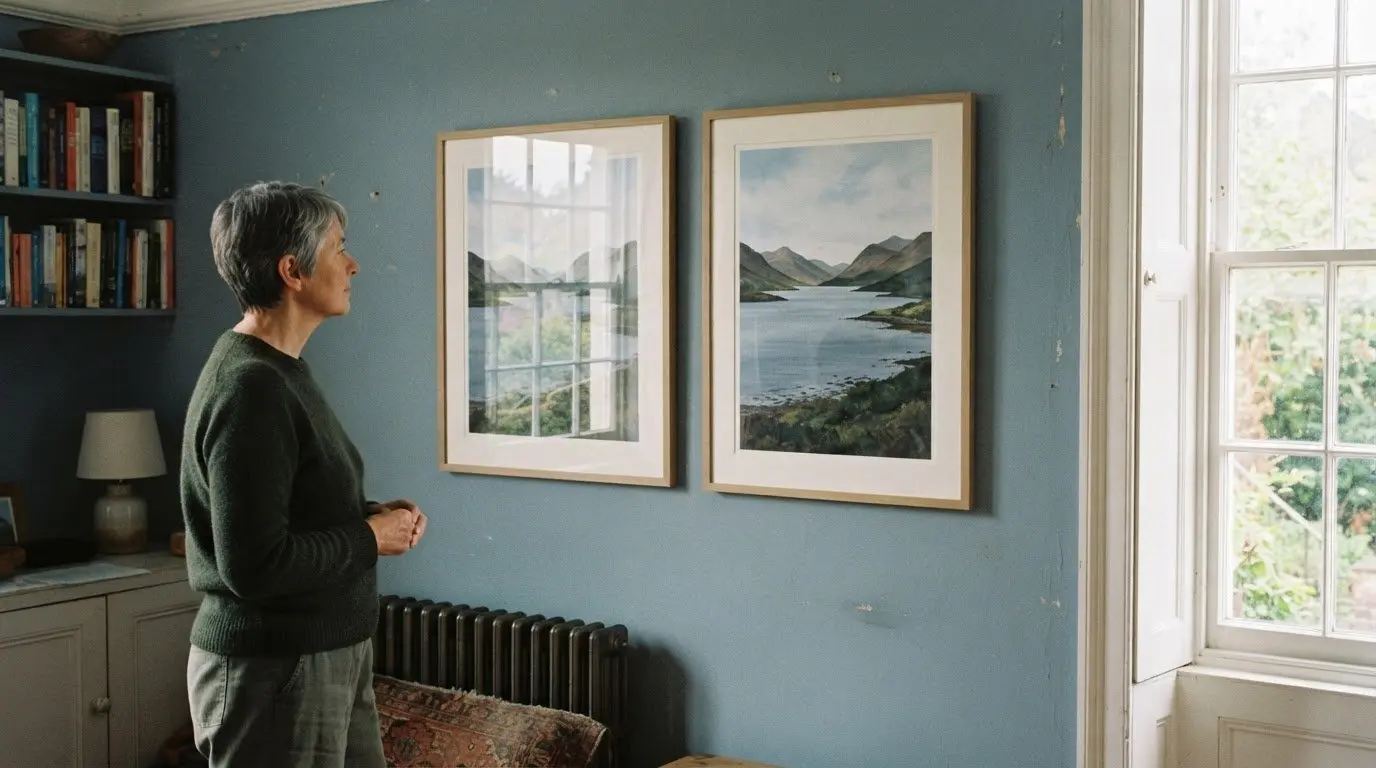
The clearest-looking choice isn’t always the one that handles reflections best. Choosing between standard and low-reflection glass depends on the artwork, the room and the finish you want: standard clear glass gives a straightforward view, while anti-reflective glass reduces reflections. Non-glare glass works differently, scattering incoming light across its surface.
It’s easy to assume all low-reflection glass does the same job. This guide explains the differences and how air gaps can affect perceived haze. As you consider Online picture framing, use a Wall art visualiser to Visualise art on your wall and See artwork before you buy. You can Choose your frame online and Design your framed artwork, whether you’re considering Bespoke framed wall art, Custom framed art prints or an Art print framing service. Explore Coastal wall art, Landscape wall art, Scottish landscape art, Photography prints and Contemporary art prints, alongside work by Best-selling artists and Famous artists. These choices can help you find Framed wall art that feels at home in your space.
Key Takeaways
- Choose glazing with the artwork and display setting in mind: clear, non-glare and anti-reflective glass each affect the view differently.
- Non-glare glass scatters incoming light, while anti-reflective glass reduces reflections without working in the same way.
- An air gap between the glass and artwork can influence perceived haze, so the glass surface may not be the only factor.
- Compare light transmission as well as reflection to decide how clearly you want the artwork to show through.
What are the different types of glass used in picture framing?
Picture-frame glazing ranges from standard clear float glass to non-glare and anti-reflective options. The right choice depends on the artwork, its setting and the protection it needs.
Matching Glass to Artwork and Frames
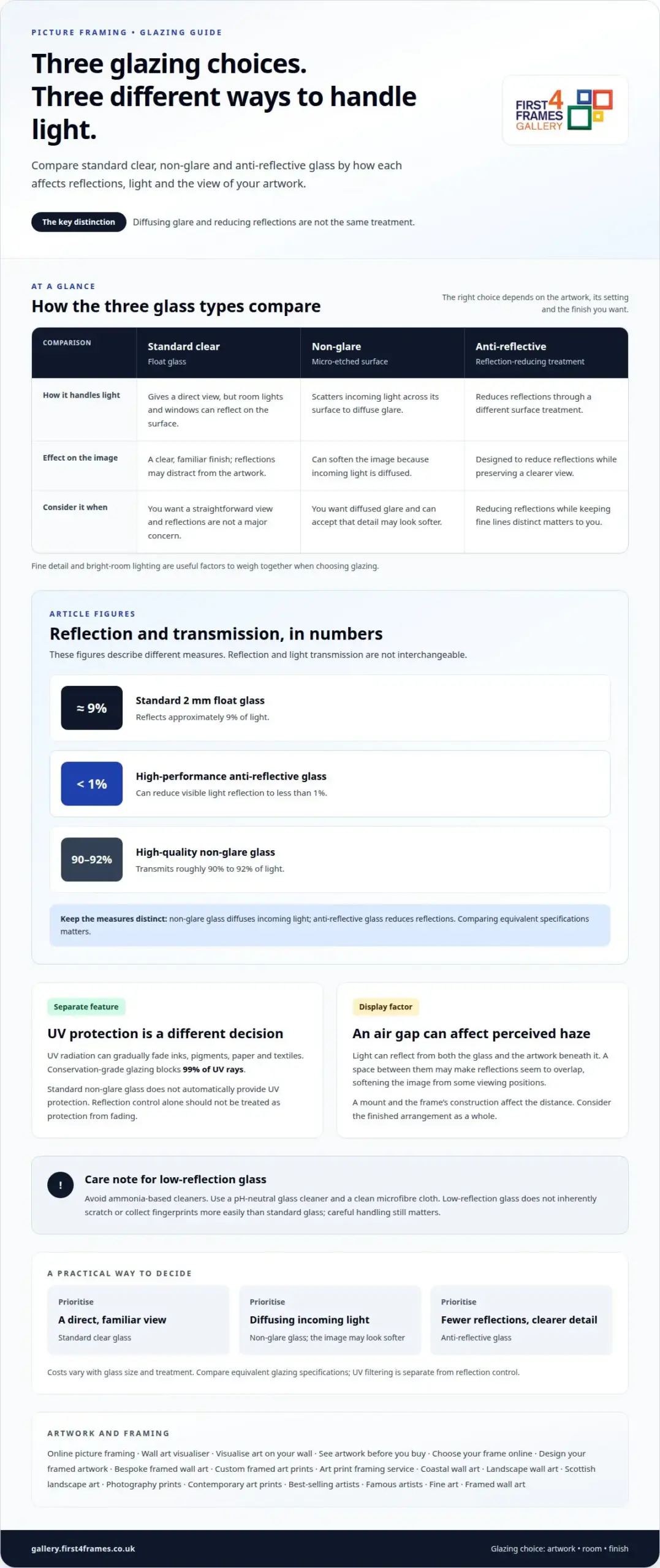
Matching glass to artwork and frames means balancing the image’s appearance with the frame’s style and display setting. Standard float glass, usually 2 mm thick, offers a clear, familiar finish that suits many framed prints. Non-glare glass has a micro-etched surface that scatters incoming light, while anti-reflective glazing reduces reflections through a different surface treatment. Consider the artwork’s detail and the room’s lighting together: a finely detailed print may benefit from a clearer view, while a bright room can make reflections more noticeable.
Glazing for Valuable Artwork
For valuable artwork, glazing should be chosen with both visibility and protection in mind. UV radiation gradually fades inks, pigments, paper and textiles, so long-term exposure can alter an original, photograph or collectible print. Conservation-grade glazing blocks 99% of UV rays, making it a consideration for pieces whose condition matters. Standard non-glare glass does not automatically provide UV protection, so reduced reflections alone shouldn’t be treated as protection from fading. Keep the artwork’s value and display conditions central to the decision.
Reflection and Artwork Clarity
Reflection affects how clearly you see an image by placing the room’s light and shapes across its surface. Standard clear glass can show reflections, while non-glare glass scatters incoming light and may soften the image. Anti-reflective glass is designed to reduce reflections while preserving a clearer view. To clean low-reflection glass without damaging its surface, avoid ammonia-based cleaners. Use a pH-neutral glass cleaner and a clean microfibre cloth instead.
UV protection and reflection control are separate features, so assess them independently. UV filtering can help limit fading, while the surface treatment determines how reflections affect viewing. This distinction helps you choose glazing that suits the artwork’s preservation needs and the frame’s intended appearance.
Standard clear, non-glare and anti-reflective glass
Glazing choices handle light differently, affecting how framed artwork appears in its setting. Knowing their strengths makes choosing between standard and low-reflection glass more straightforward.
Comparing Glass Types
Standard clear glass gives a direct view but can reflect room lights and windows. Non-glare glass diffuses incoming light, while anti-reflective glass reduces reflections to preserve a clearer view. This difference matters for framed photographs and artwork displayed in bright rooms. Low-reflection glass does not inherently scratch or collect fingerprints more easily than standard glass; careful handling still matters. Picture frames are its common use, though similar glazing may suit display cases or windows when the specification fits.
Light Transmission
Light transmission describes how much visible light passes through glazing towards the artwork. Standard 2 mm float glass reflects approximately 9% of light, while high-performance anti-reflective glass can reduce visible light reflection to less than 1%. High-quality non-glare glass transmits roughly 90% to 92% of light. These figures show why treatments aren’t interchangeable: diffusing glare can soften detail, while reducing reflection can keep fine lines distinct.
Relative Glass Costs
There is no single UK price difference for all low-reflection glass, because specifications vary. Glass size and the chosen treatment affect the comparison, while UV filtering is a separate feature from reflection control. An anti-reflective option with added UV protection is not directly comparable with standard glass lacking that feature. For a fair comparison, weigh equivalent glazing specifications against the artwork’s needs rather than treating every low-reflection product as the same.
Advantages and Disadvantages
Low-reflection glazing can make artwork and photographs easier to see where reflections would otherwise distract. This is useful for detailed images and rooms with strong light. The trade-offs are that non-glare surfaces may soften the image and higher-specification glazing can cost more than standard options. A practical way to choose is to decide whether reducing reflections or keeping a simple, direct view matters more.
Browse framed artwork to explore how presentation shapes the finished piece.
Air gaps and perceived haze
A framed image can look hazy even when its glass is clean and clear. The space between glazing and artwork affects how light reaches the image and returns to the viewer. For example, a visible gap may make reflections appear to sit over a print rather than on the glass. This can be mistaken for a flaw in the glazing itself.
Light can reflect from the glass surface and from the artwork beneath it. When there is an air space between them, these reflections may be perceived together, softening the image or creating a misty appearance from certain viewing positions. A bright window opposite a framed landscape can make this more noticeable. The apparent haze may change as the viewer moves around the room.
Keeping the gap between glass and artwork controlled during framing helps manage perceived haze. The frame’s construction and any mount can affect the distance between the glazing and the image. A mount also creates separation around the artwork, so consider the finished arrangement as a whole. The aim is a neat fit that keeps the artwork and glazing appropriately positioned.
Do not assume every cloudy-looking area comes from an air gap. Fingerprints, dust on either surface and reflections from a nearby lamp can all affect the view. Compare the appearance from another angle, then inspect the glass and artwork separately. If the haze shifts as you move, reflected light may be contributing; if it stays in one place, surface marks may be involved.
Low-reflection glass can reduce distracting reflections, but installation still shapes the final impression. Anti-reflective glazing fitted with an unsuitable gap, for example, may not give the crisp view expected. A close, even fit helps the glass work as intended and keeps attention on the artwork. Spacing should suit the frame, any mount and the artwork’s position, rather than being treated as an afterthought.
How much more light does low-reflection glass transmit than standard glass?
A glazing specification can help you compare how a framed image will appear, but transmission figures need context. The most popular standard anti-reflective Artglass option has 70% UV protection and around 99% light transmission. That example shows that a product can combine strong light transmission with some UV filtering. It doesn’t mean every low-reflection option has the same balance.
Read light-transmission and UV figures as separate details. Light transmission describes visible light passing through the glazing; UV protection refers to filtering a different part of the light spectrum. A high visible-light figure alone does not show how much UV the glass filters. For an original, photograph or print, consider the protection specification alongside the desired appearance.
The image itself also shapes perceived brightness. A pale print with open areas may appear luminous, while deep tones or a matte surface can look more subdued through the same glazing. Room lighting and where the frame hangs affect the viewing experience too. A specification is a useful comparison, not a complete prediction of how every artwork will look.
Compare products using the same type of measurement, then consider the artwork and its intended setting. If a vivid, clear presentation is the priority, pay attention to visible-light transmission. If limiting UV exposure matters too, assess that feature separately rather than assuming one specification covers both needs. The right balance helps glazing support the image instead of drawing attention to itself.
Explore framed artwork and picture how different images might suit your space.
First4Frames Gallery
First4Frames Gallery helps bring artwork and framing together through Ready-to-Hang Framed Art, Custom Picture Framing and Giclée Fine Art Prints. If you’re weighing how reflections affect a particular print or photograph, consider its display setting alongside the frame’s finish. Each frame is made bespoke for its individual order, using high-quality materials and 2 mm float glass.
For artwork that needs a considered fit and finish, Custom Picture Framing offers a tailored framing route. The aim is to let the image sit comfortably within its frame, with glazing as part of the finished presentation. This can help you make a practical choice based on the artwork and the look you want on your wall.
Contact First4Frames Gallery to discuss your framing requirements.
Let your artwork set the direction
Choosing between standard and low-reflection glass is one part of creating a display that feels right for your space. Start with how you want the artwork to look in the room, then consider how its frame will complement your colours and furnishings. A considered presentation gives the image room to feel at home.
Take a moment to picture where the piece will hang and what you’d most like to notice when you look at it. That simple decision can guide your choice of artwork and framing style, making the finished display feel personal rather than purely practical.
Explore the gallery and find a piece that inspires your next step. Let your chosen artwork bring a little more character to your walls.
Frequently Asked Questions
What Is Anti-Reflective Glass?
Anti-reflective glass has a surface treatment designed to reduce reflected light and keep the artwork more visible. For example, it can help a framed print remain clear when displayed opposite a bright window. It is not intended to make the image look dark or tinted; the aim is to limit distracting reflections so attention stays on the artwork.
What is Non-Glare Picture Frame Glass?
Non-glare picture-frame glass uses a micro-etched surface to scatter incoming light rather than reflect it directly. This can make a framed image easier to view under some lighting, though the softened light may also soften fine detail. A highly detailed drawing, for example, may look less crisp than it would through clear glazing.
Which Type of Glass Should You Choose?
Choose glazing according to the artwork’s value, detail and display conditions. Standard clear glass can suit a print in a room with gentle, indirect light. Anti-reflective glazing can be a stronger fit where a window or lamp creates distracting reflections. For an original or collectible piece, consider UV protection separately from reflection control, since these are distinct glazing features.
What is the difference between standard glass and low-reflection glass?
Standard glass gives a direct view but can reflect objects and light in the room. Low-reflection glazing is treated to reduce or diffuse those reflections, depending on the type. Against a bright background, the difference becomes clear: standard glass may mirror the room, while low-reflection options can keep the artwork more prominent.
How do standard and low-reflection glass compare for glare, reflections and colour accuracy?
Standard glass can place visible reflections over colours and fine detail, making artwork harder to assess from some angles. Anti-reflective glazing reduces that distraction, helping the image appear clearer. Non-glare glass diffuses incoming light instead, which can soften details. To judge a print’s tones, view it under the lighting where it will hang.
Does low-reflection glass provide UV protection, and how does it compare with UV-filtering glass?
Low-reflection glass does not necessarily provide UV protection; reflection control and UV filtration are separate properties. Standard non-glare glass, for instance, does not automatically filter UV. If limiting fading matters, look for a glazing specification that states its UV protection level. UV-filtering glass is chosen for that protective property, while low-reflection glass is chosen to improve the viewing experience.