
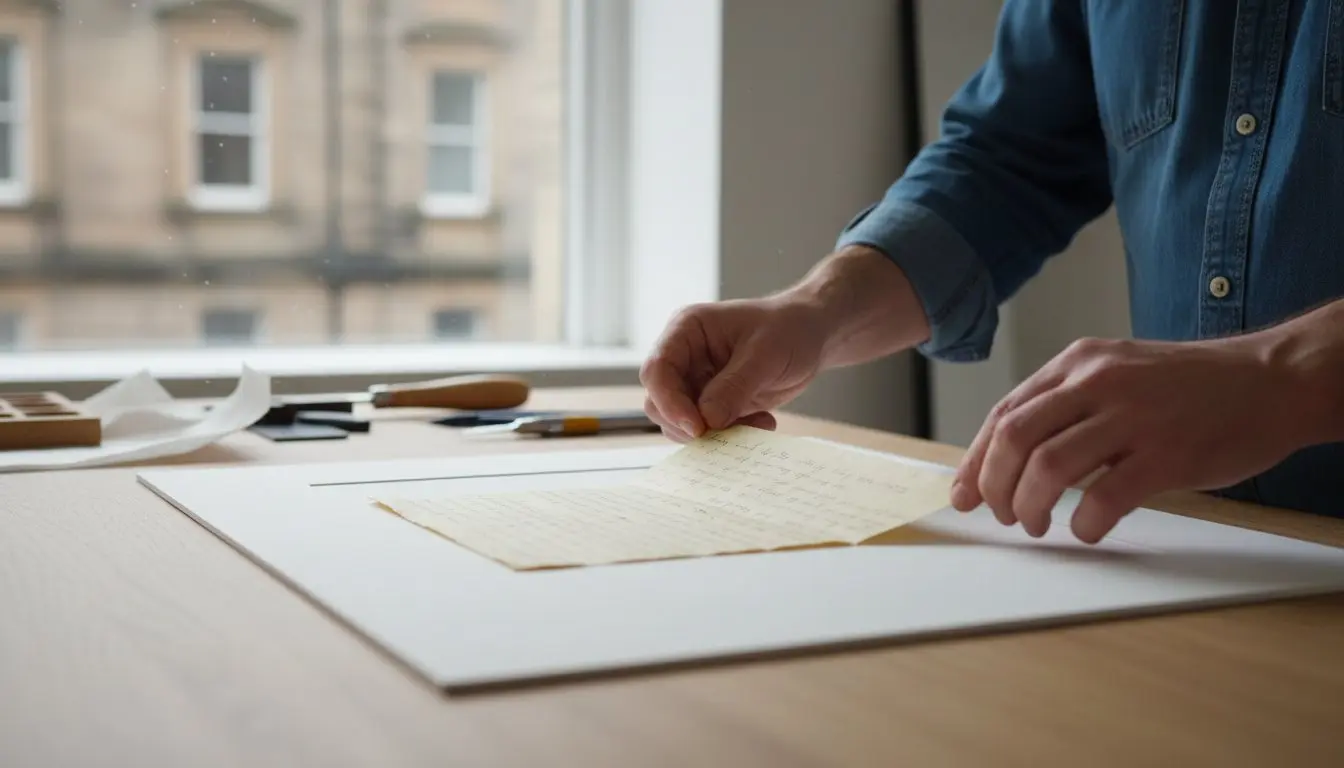
Last Tuesday, a visitor to our First4frames gallery stood before a vibrant Giclée print by one of our featured artists, clutching a 1945 handwritten letter they hoped to display alongside it. It’s a common sight for our artisans, yet the fear of damaging a fragile heirloom is always present. You want to showcase your history, but you’re terrified that a single piece of standard tape or a splash of sunlight will erase it forever. Learning how to frame a delicate document isn’t just about aesthetics; it’s about acting as a guardian for your most precious memories.
We understand that terms like archival and acid-free often feel like a foreign language when you just want your certificate to look beautiful on the wall. With over 20 years of experience and a 4.9-star rating on Google Reviews, we’ve seen how the wrong materials can cause irreversible yellowing within just 24 months. This guide promises to demystify the conservation process so you can protect your papers for a lifetime. You’ll learn the specific techniques our bespoke framing service uses, from UV-protective glazing to reversible mounting methods, ensuring your document remains a perfect bridge between your room décor and your personal history.
Key Takeaways
- Understand why professional conservation framing is a protective system where every step must be completely reversible to safeguard your document’s long-term integrity.
- Discover how to shield irreplaceable signatures and paper fibres from UV light and acidity using specialist “sunscreen” glazing and acid-free mountboards.
- Learn the expert steps for how to frame a delicate document, from working in a dust-free environment to using “no-glue” mounting techniques like Japanese tissue hinges.
- See how our bespoke framing standards mirror the premium quality of our gallery Giclée prints to offer your family heirlooms museum-level protection.
- Explore the benefits of choosing a trusted one-stop-shop with over twenty years of craftsmanship to ensure your historical papers are displayed beautifully and safely.
What is Conservation Document Framing and Why Does it Matter?
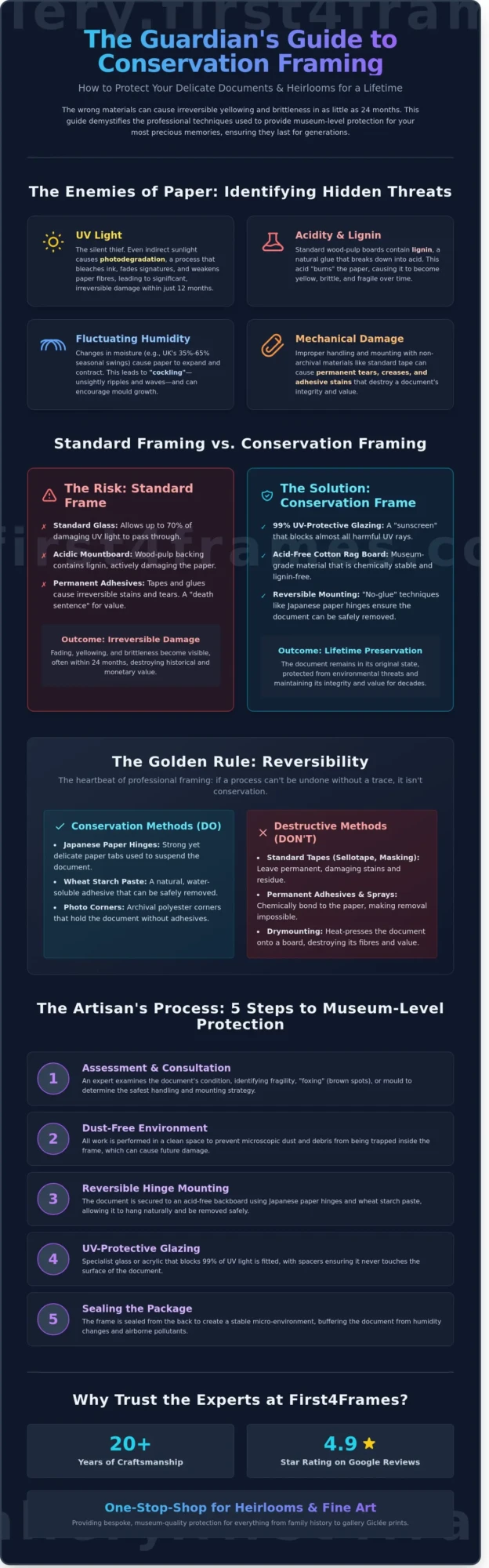
Framing a delicate document is a task that goes far beyond simply choosing a style that matches your living room. At First4Frames, we view a frame as a protective system designed to preserve history. While the beautiful works in our gallery showcase local talent, the technical side of our business focuses on the science of preservation. Understanding how to frame a delicate document starts with the realization that the frame is a bridge between your room décor and the artwork. It acts as a controlled environment, shielding paper from the three main enemies of longevity: fluctuating humidity, acidic migration, and ultraviolet light.
To better understand this concept, watch this helpful video:
Documents like 19th-century maps, handwritten letters, or vellum certificates are significantly more vulnerable than the modern Giclée prints we offer in our print-and-frame service. These older papers often contain high levels of lignin, which causes them to turn yellow and brittle when exposed to standard materials. A bespoke preservation package differs from a £15 high-street frame by using 99% UV-protective glass and museum-grade cotton rag boards. This level of craftsmanship ensures that your document doesn’t just look spectacular today, but remains intact for decades to come.
The Golden Rule: Reversibility in Framing
Reversibility is the heartbeat of professional framing. If a process can’t be undone without leaving a trace, it isn’t conservation. Permanent adhesives or drymounting are a “death sentence” for fragile paper; they destroy the item’s historical integrity and its future market value. You can ensure you’re receiving true archival or conservation picture framing by confirming the use of Japanese paper hinges and reversible wheat starch pastes. This allows a document to be safely removed for future research or sale. We’ve built a 4.9-star rating on review platforms by sticking to these strict preservation standards for every customer.
When to Seek a Professional Artisan
Identifying when a document is too fragile for DIY methods is vital. If you notice “brittle” edges that flake at a touch, active foxing (brown spots), or signs of mould, it’s time to consult an expert. At First4Frames, we use over 20 years of experience to handle unique paper challenges that standard shops won’t touch. We’re a one-stop-shop that understands the emotional and financial value of your items. Whether it’s a family heirloom or a piece of investment art from a gallery, our bespoke service provides the expertise needed to keep delicate fibres stable and secure. Our three-step process makes this professional care accessible to everyone in the UK.
Identifying the Threats: What Damages Delicate Paper?
Preserving a rare map or a family heirloom requires more than just a standard shop-bought frame. At the First4frames gallery, we often showcase intricate works by local artists that demand museum-grade protection. Understanding the environmental enemies of paper is vital when learning how to frame a delicate document. Paper is an organic material; it reacts to its surroundings in ways that can lead to irreversible decay if left unprotected. Our team has spent over 20 years perfecting the balance between aesthetic beauty and long-term safety.
- UV Light: This is a silent thief. It bleaches ink and weakens paper fibres through a process called photodegradation. Even indirect sunlight can cause significant fading within 12 months.
- Acidity: Standard wood-pulp boards contain lignin. This substance creates an acidic environment that “burns” the paper, leaving it yellowed and fragile.
- Fluctuating Humidity: In the UK, indoor humidity often swings between 35% and 65% depending on the season. This causes “cockling,” which is the unsightly rippling seen in poorly mounted documents.
- Mechanical Damage: Tearing or creasing usually happens during improper handling or mounting. Our 4.9-star customer rating reflects our commitment to handling every item with the precision of a master artisan.
The Chemistry of “Paper Burn”
Lignin is the natural glue that holds wood fibres together. In cheap framing materials, it breaks down into acids that turn certificates brown and brittle. To prevent this, we use materials that offer total protection. High-end framing relies on preservation, technical analysis, and research to ensure longevity. We only recommend mountboards made from 100% cotton rag or alpha-cellulose. These materials are naturally acid-free. They act as a chemical buffer, neutralising any pollutants that might drift toward your document and keeping the paper pristine for a lifetime.
Environmental Control Within the Frame
Paper should never touch the glass. When you’re considering how to frame a delicate document, creating an air-space is essential. Without it, condensation can form on the inside of the glass. This leads to mould growth or the document sticking to the glazing. UK homes often have external walls that get damp or radiators that create sudden heat spikes. We suggest hanging your pieces away from these hazards. If you’re looking for inspiration, you can explore our gallery collection to see how we display professional works safely. Our bespoke framing service ensures your document is suspended in a stable micro-environment, protecting it for decades to come.
Essential Materials for Preserving Fragile Documents
Choosing the right components is the most critical step when learning how to frame a delicate document properly. At First4Frames, we draw on over 20 years of expertise to ensure your heirlooms receive museum-standard care. We source only the best materials to create a protective environment that stops the clock on ageing. Every material that touches your document must be chemically inert to prevent yellowing or “acid burn” over time.
- UV-Filtering Glazing: This acts as a high-performance sunscreen for irreplaceable signatures and inks.
- Conservation Grade Mountboard: This creates a safe, acid-free nest that supports the paper without leaching harmful chemicals.
- Archival Hinges or Mylar Corners: These professional mounting methods secure the piece without using destructive sticky tapes.
- Sealed Backing: A robust barrier that protects the document from dust, wood-boring insects, and UK humidity levels.
Glazing Options: Beyond Standard Glass
Standard 2mm float glass offers almost no protection against light damage. For delicate items, we recommend UV-filter acrylic or specialist conservation glass. UV-filtering glass acts as a barrier that blocks 99% of harmful rays. This is vital because light damage is cumulative and irreversible. Anti-reflective coatings are another premium addition. These coatings reduce reflections to less than 1%, allowing you to see the fine detail of old handwriting or faint pencil marks without the distraction of glare. Our customers frequently highlight the clarity of these finishes in our 5-star ratings, noting how the document appears almost touchable.
The Anatomy of an Archival Mount
A “window mount” is essential for keeping the document away from the glazing. If the paper touches the glass, trapped moisture can cause “cockling” or lead to the document sticking to the surface. At First4Frames, we see the mount as the bridge between your room décor and the document. We often suggest choosing mount colours like soft creams or “antique white” that complement old parchment. This avoids the harsh contrast of modern bright whites. As a one-stop-shop for framing, we ensure the mountboard is at least 1,400 microns thick to provide a deep, professional bevel that adds a sense of importance to the piece.
How you attach the document to the mountboard depends on its condition. Archival hinges, made from Japanese tissue and wheat starch paste, are the gold standard because they are strong yet completely reversible. If the edges of your document are too brittle for hinges, clear Mylar corners are the perfect alternative. These allow the document to “float” in the frame without any adhesive touching the paper. This level of care is why the First4Frames gallery is a trusted professional for local historians and collectors across the UK.
The Professional Process: How to Frame a Delicate Document
Preserving a rare manuscript or a vintage map requires a level of precision that matches the curation found in the First4Frames gallery. When you learn how to frame a delicate document, the first rule is absolute cleanliness. Our technicians work in a strictly controlled, dust-free environment. We always wear white, lint-free cotton gloves. This isn’t just for show; skin oils contain acids that can cause permanent “fingerprint” staining on 18th-century vellum or thin 1920s newsprint within just a few years.
The mounting process focuses on a “no-glue” philosophy. We use Japanese Kozo tissue hinges paired with acidified wheat starch paste. This method is favoured by museum conservators because it’s entirely reversible. If the document needs to be removed in 50 years, a tiny amount of moisture releases the bond without tearing the fibres. For items that are printed on both sides or are too brittle for hinges, we employ clear polyester (Mylar) photo-corners. These provide a secure hold using friction and tension rather than adhesives.
Proper spacing is the next critical step. A document should never touch the glazing. We maintain a consistent air gap of at least 3mm using acid-free spacers or deep-window mounts. This gap prevents “ferrotyping,” where moisture traps the paper against the glass, potentially causing the ink to lift or mould to grow. We then seal the entire package into a micro-environment. This creates a buffer against the UK’s fluctuating humidity levels, which can swing by 20 percent between seasons.
Step-by-Step Mounting Techniques
The wheat starch paste method is our primary choice for traditional documents. It provides a strong yet flexible hold that moves with the paper. If a document is extremely fragile, we recommend Mylar encapsulation. This sandwiches the piece between two inert sheets, providing 360-degree support. Regarding old folds; we generally advise against aggressive flattening. Forcing a 100-year-old crease to lie flat can snap the cellulose fibres. We prefer “gentle relaxation” in a humidity-controlled chamber before the framing begins.
Final Assembly and Inspection
Before the final fit, we check all materials for “out-gassing.” Cheap wood pulps and certain plastics release acidic vapours that yellow paper over time. We only use inert, conservation-grade boards. Every frame receives a bespoke dust-seal on the back to prevent debris and insects from entering. Our attention to these hidden details is why First4Frames maintains a 4.9 out of 5-star rating on independent review platforms. We don’t just provide a border; we build a protective vault for your history.
Ready to see how professional presentation transforms a piece? Explore the First4Frames gallery to see our craftsmanship in action.
From Family Heirlooms to Fine Art: Trusting the Experts
Your most precious papers deserve the same reverence as a gallery masterpiece. At First4frames gallery, we treat every item with the same meticulous care we apply to the high-value works that pass through our doors. Whether you possess a centuries-old land deed or a rare first-edition programme, we understand that these items are irreplaceable. Our approach to how to frame a delicate document mirrors the archival standards we use for our premium Giclée prints, ensuring your history remains vibrant for decades.
We operate as a true one-stop-shop for art and preservation. This means you benefit from a seamless journey where consultation, curation, and bespoke framing happen under one roof. Our Falkirk workshop handles everything on-site, providing a level of security that online-only retailers simply cannot match. You aren’t just buying a frame; you’re investing in 20 years of technical expertise and a passion for craftsmanship that has earned us a 4.9-star rating across independent review platforms.
The Gallery Standard
Our daily work with acclaimed artists like Jolomo and Jack Vettriano informs every preservation project we undertake. We use the same museum-grade materials for your family tree as we do for a £5,000 fine art original. A professionally framed document does more than just sit on a wall; it becomes a spectacular focal point that tells a story. We help you choose the perfect mount and moulding to act as a bridge between your room décor and your personal history. By applying gallery-level techniques, we ensure your document is protected from the acidic degradation and UV light that often ruin unprotected papers. We don’t take shortcuts with your memories.
Getting Your Bespoke Quote
Starting your preservation journey is straightforward and inspiring. We invite you to bring your treasures to our Falkirk centre for a personal assessment. Our team will examine the condition of your item and suggest the best conservation methods to suit your budget and style. We pride ourselves on offering a hassle-free, speedy service that never compromises on the quality of our craftsmanship. Most consultations take less than 20 minutes, giving you clear options and a transparent price immediately. Don’t leave your history in a drawer where it can fade or tear.
Ready to transform your archive into art? Request a bespoke framing quote for your delicate document today and let our experts show you how to frame a delicate document with the care it deserves.
Protect Your Heritage with Professional Conservation
Your most precious papers deserve more than a standard shop-bought frame. Protecting fragile heirlooms requires a deep understanding of UV-filtering glass and acid-free mounting to prevent irreversible yellowing or brittle edges. At First4frames gallery, we treat every piece of paper as a work of art, whether it’s a rare print from our featured artists or a century-old family birth certificate. We believe a frame should do the heavy lifting, acting as a beautiful bridge between your room décor and your history.
Learning how to frame a delicate document involves balancing aesthetic beauty with scientific preservation. Our team brings over 20 years of expert framing experience to every project, ensuring your items remain in pristine condition for decades. We specialise in conservation-grade materials that safeguard against environmental threats like humidity and light damage. Our excellent customer ratings on review platforms reflect our commitment to premium craftsmanship and reliable, bespoke service. You don’t have to risk the integrity of your collection when you have a trusted professional partner by your side.
Preserve your history with our bespoke framing service and ensure your stories stay vivid for the next generation. We’re ready to help you transform your fragile archives into spectacular displays.
Frequently Asked Questions
Can I use regular sticky tape to mount my document if it is on the back?
No, you shouldn’t use regular sticky tape on any part of a delicate document. Standard adhesive tapes contain acidic glues that yellow paper within 24 months and leave permanent oily residues. At First 4 Frames, our craftsmen use reversible, acid-free T-hinges or starch-based adhesives. These methods ensure your precious items, like the limited edition prints by our featured gallery artists, remain pristine and can be removed safely without damage.
Will framing my document stop it from fading completely?
Framing won’t stop fading 100%, but using the right glass makes a massive difference. Standard glass only blocks about 45% of UV rays, whereas our specialist museum glass blocks up to 99%. Even with this protection, we recommend hanging your piece away from direct sunlight. This is especially important for delicate items or Giclée prints from our gallery, which are designed to last over 75 years when protected from harsh light.
Is it safe to frame an original birth certificate or should I use a copy?
It’s usually better to frame a high-quality copy and keep the original in a fireproof safe. Original birth certificates are vital legal documents that you might need to present for passport applications or legal matters. We offer a professional print-and-frame service where we create a 1200dpi Giclée scan of your document. This allows you to display a beautiful, identical replica while the authentic original remains protected and accessible for official use.
What is the difference between “acid-free” and “archival” materials?
Acid-free materials are pH neutral during manufacture, but archival materials are made from naturally stable fibres like 100% cotton rag. While acid-free products might eventually become acidic over 20 years, archival materials are designed to last for centuries. When you’re learning how to frame a delicate document, choosing archival-grade mountboard is essential. Our bespoke framing service uses these premium materials to act as a protective bridge between your room’s environment and your artwork.
How much does it cost to professionally frame a delicate document?
Professional framing for a small delicate document typically starts from £45 at First 4 Frames. For a standard A4 certificate with UV-protective glass and archival mounting, prices usually range between £65 and £120 depending on your choice of bespoke wood moulding. Our customers frequently rate our value as “Excellent” on Trustpilot; they often note that our 20 years of expertise ensures your investment protects your document’s financial and sentimental value for decades.
Can I frame a document that is already torn or has holes?
Yes, you can certainly frame a document that shows signs of age like tears or holes. We often frame vintage maps or aged sketches from our gallery artists that have characterful imperfections. A professional framer uses a Japanese tissue repair method to stabilise the area without using harsh chemicals. This approach highlights the history of the piece while ensuring the damage doesn’t spread. It’s a key step in how to frame a delicate document properly.
Should I have my document professionally cleaned or restored before framing?
You should consider professional restoration if the document has heavy foxing, mould, or significant staining. Framing a “dirty” document can sometimes trap moisture or acidic particles against the paper, accelerating decay. We recommend consulting a specialist conservator if your item is over 100 years old or shows brown spotting. Once cleaned, our one-stop-shop can then provide the perfect bespoke frame to showcase the restored beauty of your historical piece or fine art print.