
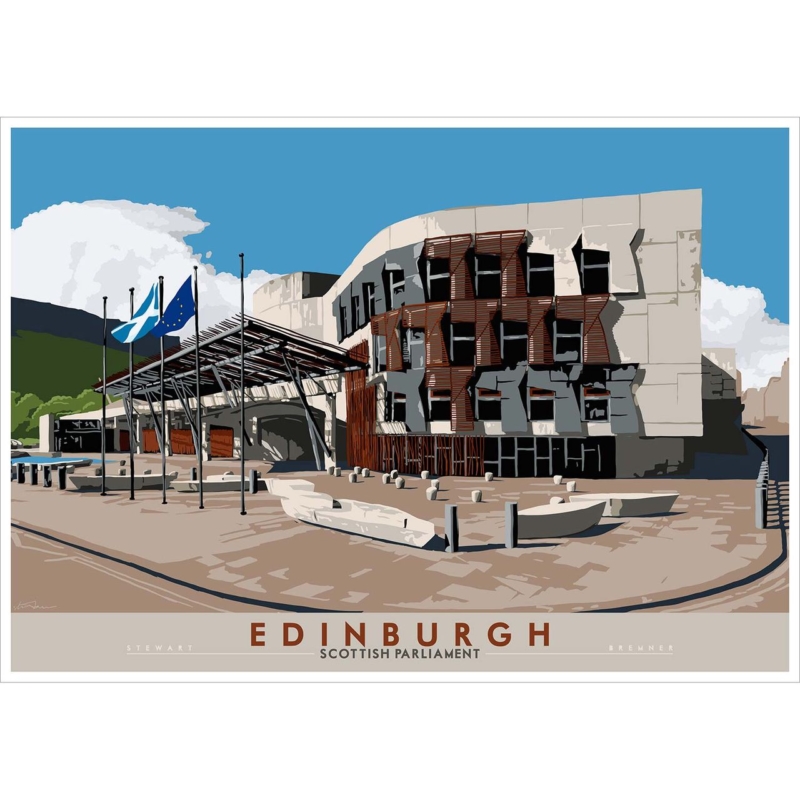
civic office wall art should tell visitors something about a workplace before a meeting begins. Edinburgh: Scottish Parliament by Stewart Bremner uses the Scottish Parliament’s recognisable forms, flags and open forecourt to create that immediate connection. The building is modern, public and unmistakably Edinburgh. Its clean graphic treatment can give a reception, consultation room or shared office a strong sense of place without falling back on a generic city skyline.
Why civic office wall art needs a clear purpose
Artwork in a civic setting is seen by many audiences. Staff pass it every day. Visitors may see it while waiting, asking for help or preparing for an appointment. A picture therefore needs to be interesting without becoming distracting, locally relevant without looking like a souvenir, and professional without feeling impersonal.
This print answers that brief through architecture. The Parliament’s pale stone, dark window openings and warm timber details create a disciplined palette. Strong shadows give the building depth, while the open blue sky stops the scene from feeling severe. The Saltire and European flag add movement near the entrance, but they do not dominate the composition.
Start with the visitor journey
Choose the wall by following the route a visitor actually takes. Begin at the entrance, pause at the reception point and then sit in the waiting area. The best position is often the first uninterrupted wall seen from two of those places. It lets the picture act as an orientation point rather than a decoration added after the furniture plan was finished.
- Check the entrance view. The building and the Edinburgh caption should remain legible from the doorway.
- Check the seated view. Avoid placing the centre of the image so high that waiting visitors look up sharply.
- Check the service point. Screens, leaflet holders and signs should not cut across the lower part of the frame.
- Check circulation. Keep the finished frame clear of door swings, queue barriers and the busiest shoulder-height route.
The available print proportions suit a wall above low seating, a credenza or a bank of visitor chairs. Mark the full framed dimensions with paper or low-tack tape. This test reveals whether the artwork is large enough to hold the wall without making a public area feel crowded.
Use modern architecture to signal local confidence
A traditional landmark can communicate heritage. The Scottish Parliament says something different. Its asymmetric windows, projecting timber elements and broad canopy speak about contemporary public life and ambitious design. That makes the image relevant to organisations working in policy, community services, planning, education or the built environment.
There is no need to turn the whole office into an Edinburgh theme. One specific architectural subject is more confident than a collection of unrelated postcards. Keep nearby signage functional and give the artwork a defined area of wall. Local identity then feels deliberate rather than promotional.
Build a calm workplace palette around the print
| Existing office finish | Connection in the artwork | Practical approach |
|---|---|---|
| Blue seating | The clear sky and flags provide a natural link | Keep other blue accessories limited |
| Pale walls | The stone facade keeps the picture light | Use a mount edge if the print needs more separation |
| Timber reception desk | Warm brown louvres repeat the material gently | Avoid forcing the frame to match the desk exactly |
| Dark metal details | Window shadows add crisp contrast | Choose a slim moulding rather than a heavy black border |
The graphic style is especially useful where an office already contains screens, wayfinding and printed information. Large, simplified shapes remain readable among those practical elements. They also keep the building clear from a distance, while smaller details reward a closer look.
Plan lighting and presentation for daily use
Public offices often combine ceiling panels, window light and task lighting. Check the proposed wall at different times of day. A bright reflection across the Parliament caption or the dark windows can interrupt the design. Moving the frame slightly, adjusting a spotlight or choosing a wall at right angles to glazing may improve visibility.
First 4 Frames uses colour-managed Giclée production and completes bespoke framing in-house at its Falkirk workshop. That process helps preserve the flat blue sky, pale masonry, fine flag details and deep architectural shadows. A well-chosen frame also protects the print in a busy shared environment and gives it a suitably finished edge.
Stewart Bremner is an Edinburgh-based artist, illustrator and graphic designer whose work draws on travel-poster and mid-century influences. See more of his approach at Stewart Bremner’s official website, or browse the wider Stewart Bremner collection at First 4 Frames.
Purposeful civic office wall art can make a workplace feel rooted, approachable and contemporary before a conversation starts. View the framed Edinburgh: Scottish Parliament print for a strong architectural image that connects public space with a distinctive part of modern Edinburgh.