
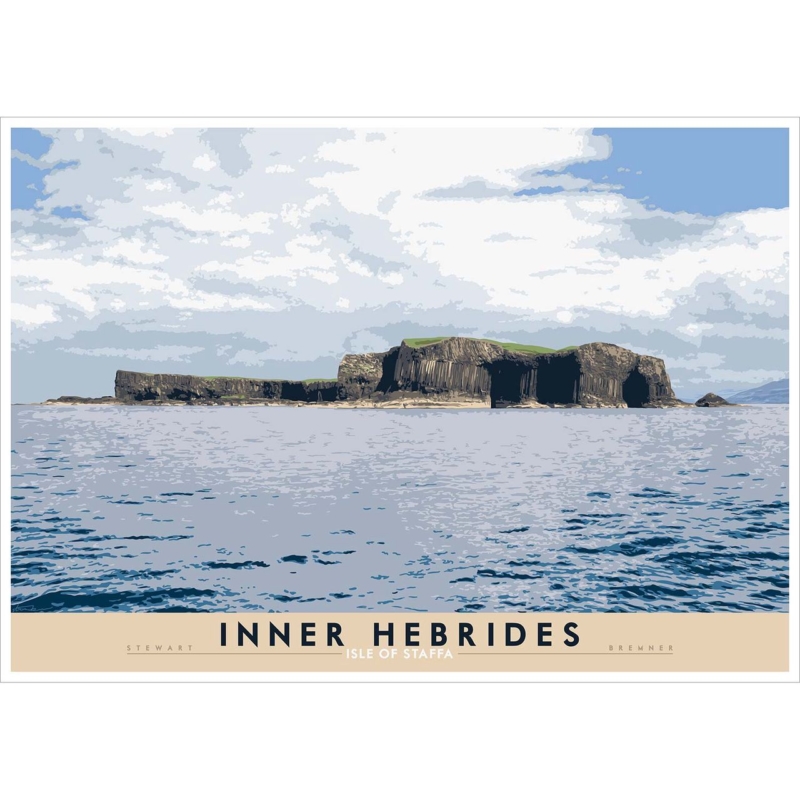
wall art for tongue and groove walls works best when the picture introduces a clear counter-direction and enough separation from the repeated lines of the panelling. Inner Hebrides: Isle of Staffa provides a real subject, scale and finished product for the decision.
Let wall art for tongue and groove walls cross the vertical rhythm
Use the island as a horizon
Staffa’s long profile gives the eye a horizontal pause. Centre the complete frame across several boards instead of matching every edge to a groove.
Create visible separation
A frame needs enough tonal difference from painted timber to read clearly. An exact colour match can disappear into the wall pattern.
Resolve fixings before height
Identify the construction behind the boards and use suitable fixings for the wall and finished weight. A convenient groove is not a structural plan.
The print is available at 594 × 420 mm and 840 × 594 mm before framing. Compare the whole outer frame. The larger format can suit broad panelling, while the smaller one can hold a dining nook or bedroom wall.
- Check board direction and spacing.
- Mark a horizontal outer frame.
- Confirm the wall construction.
- Keep furniture visually simple.
- Avoid shells, rope and nautical signs.
Frame wall art for tongue and groove walls with clear contrast
Staffa’s rock, sea and sky need controlled distinction beside a strongly lined surface. Colour-managed Giclée production preserves those divisions. A bespoke frame, hand-finished in-house, provides the visual break.
For the island’s geology, wildlife and visiting guidance, read National Trust for Scotland information about Staffa. Explore the Stewart Bremner collection, or view the exact product, sizes and framing choices.
Wall art for tongue and groove walls can work with the panelling. Staffa supplies a calm horizontal counterpoint, while exact scale and a distinct frame keep both wall and artwork legible.