
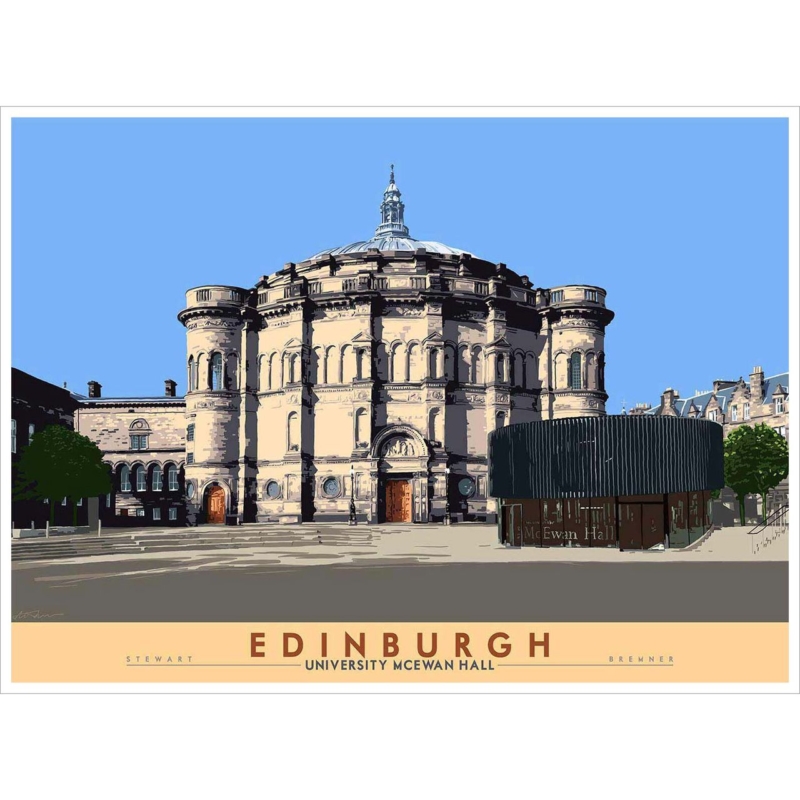
Edinburgh university alumni office wall art can carry a personal history into a professional room without making the workspace feel nostalgic. Edinburgh: University McEwan Hall by Stewart Bremner centres one of the university’s most recognisable ceremonial buildings. Its strong circular facade, pale stone and open blue sky make a confident architectural image. For someone who studied, graduated or worked in Edinburgh, the connection is specific. For colleagues and visitors, it remains a clear, accomplished piece of city art.
Why Edinburgh university alumni office wall art can feel professional
Alumni pieces often rely on crests, dates or novelty slogans. Those details may be meaningful, but they can look more like memorabilia than lasting office art. Architecture offers a quieter connection. McEwan Hall has an immediate link to university life and graduation, yet the building also stands on its own as a substantial Edinburgh subject.
The image is structured rather than sentimental. The domed roof, rounded towers and deep window shadows give it visual authority. A low modern entrance balances the ornate stonework, while the broad sky keeps the square composition open. That combination works well in a study, consulting room, professional practice or home office where the owner wants one personal reference without filling the room with academic symbols.
Let the building tell the story
A useful alumni display does not need to explain every connection on the wall. The printed Edinburgh caption and the recognisable building provide enough context. Keep certificates, graduation photographs and smaller keepsakes on a different surface or in a more private part of the office. Giving the artwork its own clear area makes the connection feel assured rather than over-stated.
- For a client-facing office, use the print as the main personal element and keep signs functional.
- For a home office, position it where it can be enjoyed from the desk, not only used as a video-call backdrop.
- For a shared practice, choose a wall connected to the alumnus rather than implying a link for the whole organisation.
- For a graduation gift, confirm that the recipient has room for the finished framed size before choosing the larger option.
Use the architecture to organise the office
The hall is almost symmetrical, so it can bring order to a workspace containing screens, shelves and paperwork. Its central dome creates a natural axis. Centre that axis over a desk, credenza or meeting table rather than automatically using the middle of the entire wall. The relationship to the furniture will matter more during everyday use.
The artwork is available in landscape print sizes, although the product image includes a generous poster border within its square presentation. Make a paper template for the full framed dimensions. Check it from the doorway, from the main chair and from the opposite side of any meeting table. The word Edinburgh should remain readable, but the frame should not compete with a monitor or presentation screen.
| Office feature | Detail to connect | What to avoid |
|---|---|---|
| Warm timber desk | The sandstone and brown poster lettering | A frame that almost, but not quite, matches the desk |
| Blue seating | The broad clear sky | Repeating blue across every accessory |
| Dark shelving | The deep architectural shadows and entrance | A heavy moulding that closes in the image |
| Pale neutral walls | The light facade and printed border | Hanging the work without enough edge definition |
Balance heritage and modern working life
McEwan Hall combines historic stone architecture with a dark, contemporary entrance structure. That contrast is useful in offices where traditional professional furniture sits beside modern technology. The print can connect both without forcing the room into a period style. Its travel-poster influence simplifies the building, so ornate details remain legible without becoming fussy.
Keep surrounding objects selective. One small stack of books or a ceramic piece can support the scholarly association. A collection of university mugs, scarves and branded stationery would turn the wall into a display of affiliation. The framed picture is stronger when it suggests experience and memory through place rather than repeating a logo.
Check light, reflections and viewing distance
Office windows and overhead panels can create strong reflections. Test the wall through a full working day before fixing the frame. A position at right angles to the main glazing often gives a clearer view than the wall directly opposite it. Also check the seated sightline. Fine architectural details and the small lower caption should be visible without placing the picture uncomfortably low.
First 4 Frames uses colour-managed Giclée production and completes bespoke framing in-house at its Falkirk workshop. This process helps retain the difference between cream stone, grey paving, dark shadow and the flat blue sky. A well-judged mount and moulding give the poster-style border a professional finish suited to a working environment.
Stewart Bremner is an Edinburgh-based artist, illustrator and graphic designer whose work draws on travel-poster and mid-century design. Explore his wider approach at Stewart Bremner’s official website, or browse the Stewart Bremner collection at First 4 Frames.
Thoughtful Edinburgh university alumni office wall art can mark an important connection while still serving the room as accomplished architectural art. View the framed Edinburgh: University McEwan Hall print for a distinctive Edinburgh landmark that brings memory, structure and a confident sense of place into the working day.