
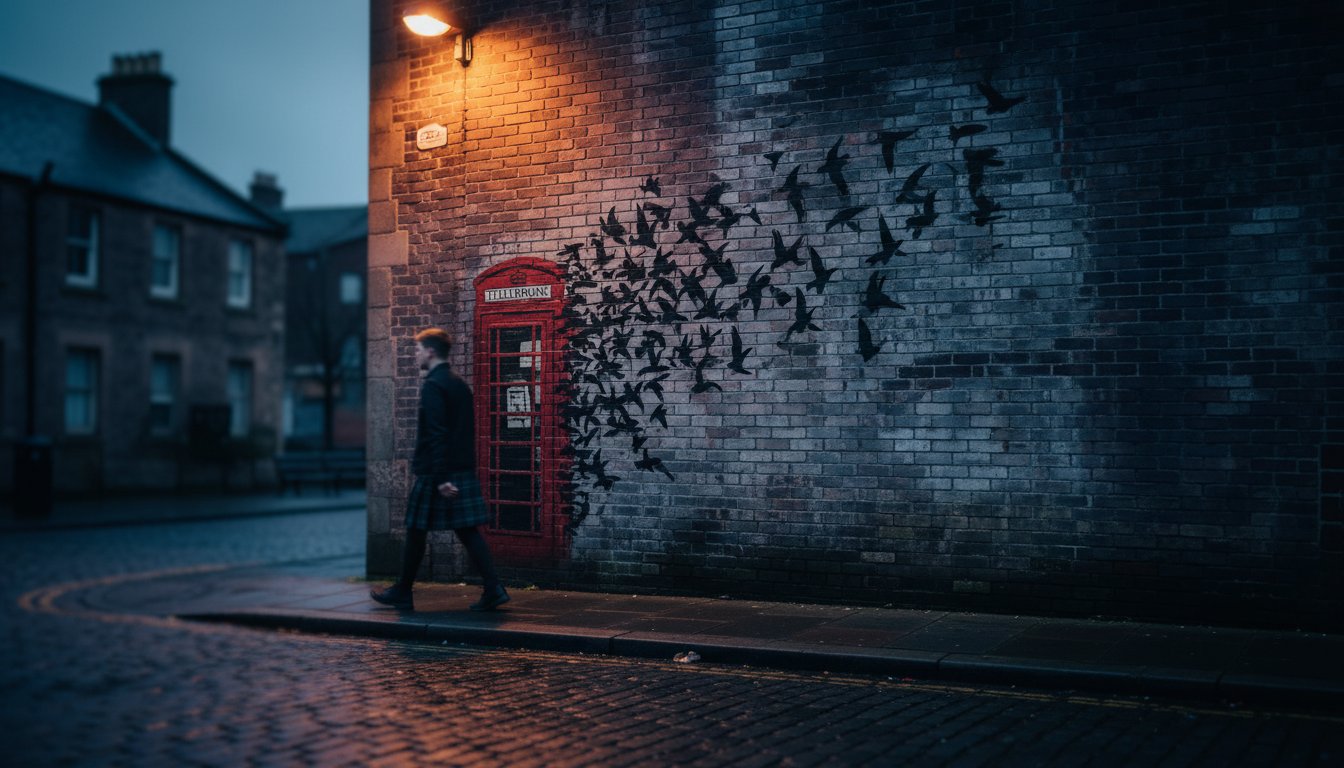
Have you ever walked past a stencilled image on a wall-a rat in a suit, perhaps, or a girl reaching for a red balloon-and felt like you were missing a piece of the story? For decades, the world has been captivated by the work of Banksy, the anonymous street artist whose name is more famous than his face. But with so many myths and whispers surrounding his identity, it can be difficult to know where the art ends and the legend begins, or what the powerful messages in his pieces truly mean.
At First4Frames Gallery, we believe beautiful art should be accessible to everyone, and that starts with understanding the story behind the masterpiece. Join us as we journey into the world of this cultural phenomenon. We’ll explore his most spectacular pieces, decode the commentary woven into his stencils, and separate the facts from the myths. By the end, you’ll not only recognise his iconic work but also appreciate the profound impact he’s had on art and culture, feeling more knowledgeable and connected to the conversation.
Who is Banksy? The Enduring Mystery of an Anonymous Icon
In the world of contemporary art, no figure is more famous, yet more unknown, than the artist known only as Banksy. For over two decades, this anonymous street artist has captivated the globe with provocative, witty, and politically charged works that appear overnight on city walls, bridges, and even in major museums. The central paradox of Banksy is that while his art is instantly recognisable, his true identity remains one of the most closely guarded secrets of our time, a mystery that only amplifies the power of his message.
To explore the enduring allure of this mystery, this short documentary offers a perfect starting point:
The Bristol Connection and Early Career
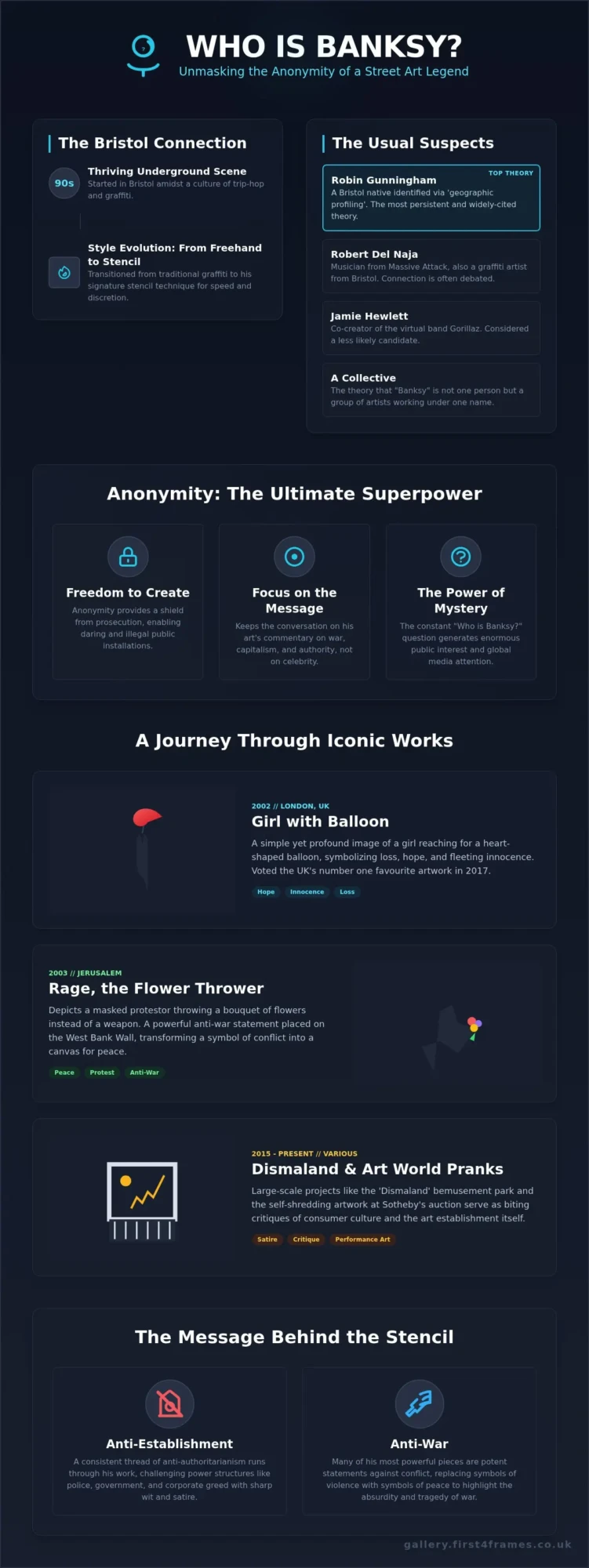
The story begins in the vibrant, multicultural city of Bristol during the 1990s. Immersed in a thriving underground scene of trip-hop music and graffiti art, the artist started out as part of the DryBreadZ Crew (DBZ). Initially a freehand graffiti artist, he soon adopted his signature stencil technique. This was a practical evolution, allowing for complex images to be executed quickly and discreetly, reducing the risk of being caught by the authorities.
Popular Identity Theories: From Robin Gunningham to Jamie Hewlett
The speculation surrounding Banksy’s identity is relentless. The most persistent theory, supported by a ‘geographic profiling’ study from 2008, points to a Bristol native named Robin Gunningham. Others suggest that Banksy is not one person but a collective of artists. Other names frequently mentioned include Robert Del Naja of the band Massive Attack and Jamie Hewlett, co-creator of the band Gorillaz, though these are often considered less likely. For a comprehensive overview of Banksy and the various theories, Wikipedia offers an excellent resource.
Why Anonymity is His Superpower
Far from being a simple gimmick, the artist’s anonymity is fundamental to his work and impact. It serves several crucial purposes that have cemented his iconic status:
- Freedom to Create: Graffiti is illegal. Anonymity provides a shield from prosecution, allowing him to create ambitious and daring public installations without fear of legal repercussions.
- Focus on the Message: By remaining faceless, Banksy ensures the conversation stays centred on the art itself-its commentary on war, capitalism, and authority-rather than on the personality or celebrity of the artist.
- The Power of Mystery: The secrecy generates enormous public interest and debate. The constant “who is Banksy?” question keeps him in the headlines, turning every new piece into a global media event.
Iconic Artworks: A Journey Through Banksy’s Most Famous Pieces
To truly understand the phenomenon of Banksy, one must look at the work itself. From simple stencils loaded with emotional weight to elaborate, headline-grabbing stunts, his art has consistently captured the public imagination. These pieces are not just images on a wall; they are cultural moments that tell the story of an artist’s spectacular rise from the streets to global infamy.
Girl with Balloon (2002)
First appearing on a wall on London’s South Bank, this beautiful and deceptively simple stencil shows a young girl reaching for a red, heart-shaped balloon as it drifts away. Its message is both hopeful and melancholic, capturing a universal sense of loss and the fleeting nature of innocence. The image resonated so deeply with the public that a 2017 poll named it the UK’s number one favourite artwork, cementing its iconic status.
Rage, the Flower Thrower (2003)
Located in Jerusalem on the West Bank Wall, this powerful piece depicts a masked protestor in the act of throwing not a petrol bomb, but a vibrant bouquet of flowers. By replacing an act of violence with a symbol of peace, Banksy created a potent anti-war statement. Its placement in a region of intense conflict gives the artwork profound political and social significance, turning a wall of separation into a canvas for peace.
Kissing Coppers (2004)
Stencilled on the side of a pub in Brighton, Kissing Coppers featured two male police officers in a passionate embrace. The work was a bold commentary on authority and homophobia, challenging stereotypes by humanising the figures in a way that was both tender and subversive. After repeated vandalism, the original wall section was removed and eventually sold at auction, highlighting the difficult relationship between street art and commercial value.
Dismaland and Other ‘Pranks’ (2015-Present)
Banksy’s work evolved from walls to large-scale performance art. In 2015, he opened Dismaland, a satirical ‘bemusement park’ in Weston-super-Mare that served as a grim parody of consumer culture. His most audacious stunt came in 2018 when a framed Girl with Balloon print self-destructed via a hidden shredder moments after being sold for over £1 million at Sotheby’s. These events are critiques of the art establishment itself, exploring how value is created and questioning his own role within it. The journey from anonymous graffiti artist to art-world disruptor is a core part of The Story Behind Banksy.
The Message Behind the Stencil: Unpacking Banksy’s Core Themes
Beyond the immediate visual punch, Banksy’s work is a masterclass in communication. Using the stark simplicity of stencils, often paired with dark humour and satire, he crafts powerful commentaries that resonate globally. His art is not just decoration; it is a direct conversation about the state of our world. By examining his recurring themes, we can move beyond individual pieces to understand the consistent, passionate message at the heart of his craft.
Anti-Establishment and Anti-War Statements
A powerful thread of anti-authoritarianism runs through much of Banksy’s portfolio. He consistently challenges power structures, from the police in Kissing Coppers to the military. His work often juxtaposes symbols of innocence, like children, with figures of authority to highlight the absurdity and brutality of conflict. This is most poignantly seen in his pieces created in conflict zones, such as Rage, the Flower Thrower on the West Bank wall, which transforms an act of violence into a plea for peace.
A Critique of Consumerism and Capitalism
The artist frequently turns his spray can on corporate culture and the relentless drive of consumerism. Works like Napalm, which features Mickey Mouse and Ronald McDonald callously holding the hand of a terrified child from a famous Vietnam War photo, are a shocking indictment of corporate indifference. The ultimate irony, of course, is that his anti-capitalist art has become a multi-million-pound commodity. This paradox is a core part of The Story Behind Banksy, where his rebellious stance only serves to increase his market value.
Hope, Innocence, and Humanity
Despite his cynical eye, an undercurrent of hope is rarely far from the surface. This is often channelled through his most famous recurring motifs. The rat, a symbol of the downtrodden yet resilient survivor, populates his cityscapes. Monkeys serve as a satirical mirror to society’s follies. But it is the child who represents his most enduring message of hope and innocence. The iconic Girl with Balloon, with its simple caption “There is always hope,” perfectly captures the beautiful, fragile optimism that makes his work so profoundly human.
Technique and Controversy: Is It Art or Vandalism?
Beyond the anonymity and the powerful messages, the work of Banksy is defined by its unique execution and the heated debate it inspires. The artist’s methods are intrinsically linked to his message, creating a fascinating tension between breathtaking artistry and the letter of the law. This duality forces us to ask a fundamental question: where does vandalism end and art begin?
The Power and Practicality of the Stencil
Banksy’s primary tool is the multi-layered stencil. Unlike traditional freehand graffiti, which can be time-consuming, stencils are prepared meticulously in advance. This allows for incredibly detailed and complex images to be applied to a surface in a matter of minutes-a crucial advantage when secrecy and speed are essential. This technique results in a sharp, graphic style that is instantly recognisable, cementing the ‘Banksy’ look as a global phenomenon.
The Art vs. Vandalism Debate
The central controversy surrounding Banksy’s work is its legality. From one perspective, it is unauthorised graffiti and therefore an act of criminal damage. Property owners may face removal costs, and councils are often caught between legislation and public opinion. However, the opposing view is compelling:
- A Gift to the Public: Many see the artworks as free, thought-provoking pieces that enrich the urban landscape.
- Cultural and Financial Value: A genuine Banksy can increase a property’s value exponentially. Works have been protected by Perspex screens, and entire communities have rallied to save them. The fate of a piece in UK towns from Bristol to Port Talbot often reveals more about our own values than the artist’s.
Challenging the Art World from Within
Banksy doesn’t just challenge authority on the streets; he takes the fight directly to the art establishment. He famously smuggled his own subversive works into major institutions like the Tate Britain and the British Museum. His most spectacular critique came in 2018 when Girl with Balloon shredded itself moments after being sold at Sotheby’s for over £1 million. Renamed Love is in the Bin, the stunt was a stunning commentary on the commodification of art, forcing the elite art world to question its own rules and validating his status as a master provocateur.
While the debate continues, the powerful imagery of Banksy captivates audiences worldwide. To bring a piece of this revolutionary spirit into your own space, you can explore our collection of beautifully framed prints.
The Banksy Effect: From Street to Auction House
Perhaps the greatest paradox of the Banksy phenomenon is its incredible economic impact. An artist who built a reputation on anti-capitalist and anti-establishment themes has become a blue-chip investment, with his work commanding spectacular prices in the world’s most exclusive auction houses. This journey from illicit street art to a multi-million-pound market is a testament to his unique cultural position, blurring the lines between activism, art, and high-value commerce.
The Booming Market for Banksy’s Work
The financial figures are staggering. Canvases like Love is in the Bin-the piece that famously shredded itself after being sold-was later resold for a record-breaking £18.5 million. Even his limited edition prints, once sold for a few hundred pounds, now regularly fetch six-figure sums. This has also created a controversial market for authenticated street pieces, which are physically removed from public walls and sold to private collectors, raising complex ethical questions about ownership and preservation.
Pest Control: Authenticating the Unauthorised
To navigate this high-stakes market, Banksy established an official handling service named Pest Control. It is the sole body authorised to verify and issue a Certificate of Authenticity for his work. For any serious collector, this certificate is non-negotiable, guaranteeing the piece is genuine and protecting its value. The irony is palpable: an anonymous artist, famous for unauthorised installations, now has a formal, bureaucratic body to legitimise his output for the very establishment he critiques.
Banksy’s Legacy and Influence
Beyond the auction prices, the true legacy of Banksy lies in how he catapulted street art into the mainstream cultural conversation. He proved that a stencil on a wall could carry as much weight as a painting in a gallery, inspiring a new generation of artists to use public spaces for powerful social commentary. His work continues to challenge perceptions, provoke debate, and demonstrate that art can be truly accessible, immediate, and profoundly impactful.
The powerful statements made by street art have reshaped modern aesthetics. If you’re inspired by this bold artistic movement, why not bring a piece of it into your own space? Explore our collection of modern art prints and discover the perfect piece to start your own conversation.
The Enduring Legacy of a Modern Art Enigma
Ultimately, the mystery of who Banksy is may be the least interesting part of the story. What truly endures is the impact of the art itself: its sharp wit, its political audacity, and its ability to turn a simple brick wall into a global headline. From the streets of Bristol to the hallowed halls of auction houses, his work consistently challenges our perceptions of value, authority, and the very definition of art. This is the true legacy-a conversation that continues long after the paint has dried.
This power to provoke thought and transform a space is the essence of great art. If you’re inspired to bring that same energy into your own home, you need a partner who understands craftsmanship. At First4Frames, we are passionate about making beautiful art accessible. As trusted experts in fine art Giclée prints and with a bespoke framing service honed over 20 years, we help you find and display the perfect piece. Discover spectacular prints and professional framing at First4Frames. Let us help you create a space that truly inspires.
Frequently Asked Questions About Banksy
What is Banksy’s most famous artwork?
While many of his pieces are iconic, “Girl with Balloon” is arguably Banksy’s most famous work. Its spectacular fame was cemented in 2018 when a print of the artwork famously self-destructed by shredding itself moments after being sold at auction for over £1 million. Renamed “Love is in the Bin,” it has become a legendary piece of performance art. Other globally recognised works include “Flower Thrower” and “Kissing Coppers.”
Has Banksy’s real identity ever been confirmed?
No, Banksy’s real identity has never been officially confirmed. This anonymity is a core part of the artist’s mystique and public persona. While investigative journalists and researchers have put forward several theories over the years, naming individuals like Robin Gunningham or Robert Del Naja, none have been proven. The mystery allows the focus to remain on the art and its powerful, often political, message rather than the artist themselves.
How much is an original Banksy artwork worth?
The value of an original Banksy varies dramatically, from thousands to millions of pounds. While his public street art isn’t technically for sale, his original canvases and limited-edition prints are highly sought after. At auction, major works command spectacular prices. For instance, the shredded “Love is in the Bin” later resold for a staggering £18.58 million in 2021, demonstrating the premium value placed on his most unique pieces in the fine art market.
Where can I see Banksy’s art in person?
You can see Banksy’s art both on the streets and in galleries. For his public stencil work, his home city of Bristol is a key location, along with several sites across London. However, many of these pieces are subject to weathering or removal. For preserved works, you must look to museums or galleries that feature his art in exhibitions. These are often temporary, so it’s best to check with major UK art institutions for current or upcoming displays.
Is it legal to buy and sell Banksy’s prints and artwork?
Yes, it is perfectly legal to buy and sell authentic Banksy prints and original artworks. The market is very active, but it is absolutely crucial to ensure the piece is genuine. The only way to do this is to acquire a work that comes with a Certificate of Authenticity from Pest Control, the official handling service for the artist. Buying without this official verification carries a significant risk of purchasing a forgery, so professional due diligence is essential.
What is Pest Control and why is it important for Banksy’s art?
Pest Control is the only official body authorised to authenticate the artwork of Banksy. It acts as a point of sale for new pieces and, more importantly for the secondary market, issues Certificates of Authenticity for genuine works. This service is vital for collectors as it protects them from the widespread issue of fakes. Owning a certificate from Pest Control is the only surefire way to prove a piece is legitimate, ensuring its value and provenance.