
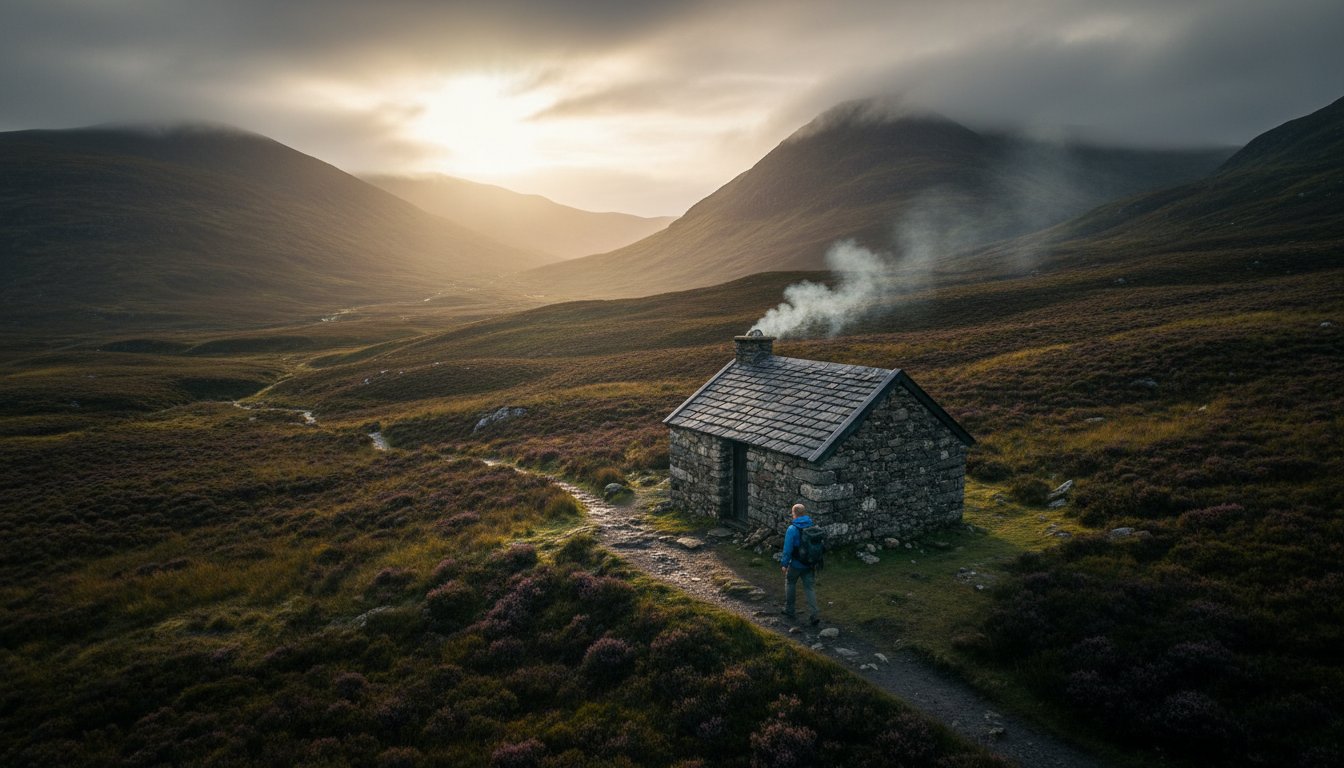
Imagine hiking through a spectacular Scottish glen, the wind on your face, as a simple stone shelter appears through the mist. It’s not a cottage, and it’s far more than a hut-it’s a sanctuary. But what exactly is a Scottish Bothy, and what are the unwritten rules that govern these wild, open-door havens? For many, they are a beautiful mystery, a symbol of Highland hospitality that feels both inviting and intimidating, sparking questions of etiquette and preparation.
This guide is your key. We unlock the rich history and soul of these iconic structures, demystifying the essential ‘Bothy Code’ and equipping you with the practical knowledge to step inside with confidence. Embark on a journey with us from their humble origins to their place in modern art, and discover how you can responsibly experience the simple, profound magic of Scotland’s most treasured wild shelters.
Key Takeaways
- Understand what a Scottish Bothy truly is: a simple, free-to-use shelter offering a unique connection to Scotland’s wild places.
- Learn how to prepare for your adventure by packing the essential gear needed for a completely self-sufficient stay.
- Master the essential Bothy Code, the golden rules of respect that ensure these beautiful shelters remain open for everyone.
- Discover why these humble stone huts have become such an iconic and powerful subject in Scottish landscape art.
The Soul of the Scottish Bothy: More Than Just a Stone Hut
Imagine hiking through the vast, mist-shrouded glens of the Scottish Highlands. The wind whispers through the heather, the mountains stand as silent, ancient sentinels, and as daylight fades, you spot a plume of smoke rising from a simple stone structure. This is the heart-warming promise of a Scottish Bothy—a humble sanctuary offering refuge from the elements in the wildest corners of the country.
At its core, a bothy is a simple, unlocked shelter left open for anyone to use, completely free of charge. It’s an idea built on a foundation of mutual trust and respect for the landscape. To get a real sense of this unique experience, this short film offers a beautiful glimpse into a night spent in a remote bothy.
A Brief History of Bothies
Originally, these structures were not for adventurers. They were basic accommodation on large estates for farmhands, shepherds, gamekeepers, and other workers who needed to be close to their remote duties. As land use changed and these buildings fell into disuse, the rise of recreational hiking in the 20th century gave them a new purpose. The Mountain Bothies Association (MBA), a charity founded in 1965, has been instrumental in preserving and maintaining these buildings for all to enjoy.
Bothy vs. Hut vs. Holiday Cottage
It’s crucial to understand what a bothy is—and what it isn’t. Unlike commercial mountain huts or holiday cottages, bothies are defined by their beautiful simplicity and lack of modern conveniences.
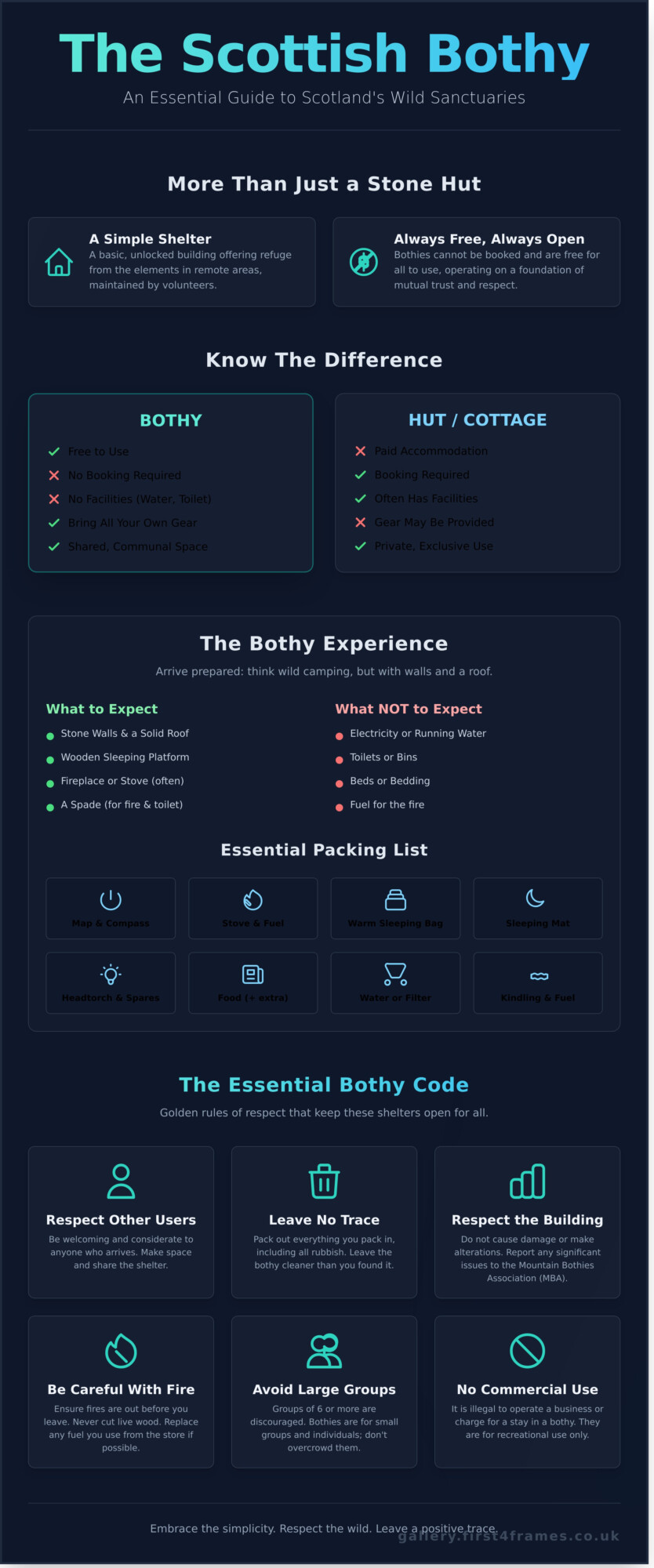
- Bothies: Always free, cannot be booked, and offer basic shelter (walls and a roof), often with a sleeping platform and fireplace. You must bring all your own gear.
- Huts & Cottages: Must be booked and paid for, often have facilities like beds, toilets, and kitchens, and are managed commercially.
The Philosophy of the Open Door
The bothy system operates on an incredible, unwritten code of conduct. The door is always unlocked, a powerful symbol of trust and communal spirit. This philosophy extends to how you use the space; visitors are expected to leave it cleaner than they found it, replace any firewood they use, and be welcoming to others who arrive. This shared responsibility is a cornerstone of the experience and a beautiful reflection of a wider Scottish tradition of hospitality, offering warmth and shelter to any weary traveller who needs it. For a detailed exploration of this concept, you can learn more about What is a Bothy? and its cultural roots.
The Bothy Experience: What to Expect and How to Prepare
Stepping into a Scottish bothy for the first time is an unforgettable experience. It’s a return to simplicity, a shelter earned through effort. But to truly appreciate it, you must arrive prepared. These remote mountain huts are not hotels; they are simple, free-to-use refuges that rely entirely on the self-sufficiency and respect of their visitors. Your adventure begins long before you reach the door, with careful planning and packing.
A Look Inside: Facilities (or Lack Thereof)
Forget luxury. A bothy’s interior is spartan and functional. You can typically expect stone walls, a roof that keeps the worst of the weather out, and a wooden sleeping platform. Many have a fireplace or stove and a spade for managing the fire and for toilet duties (which must be conducted far from the bothy and any water sources). What you will not find is electricity, running water, beds, or toilets. You must carry in everything you need and, crucially, carry out all of your rubbish. This ‘leave no trace’ philosophy is a cornerstone of the unwritten rules detailed in The Bothy Code.
Your Essential Bothy Packing List
Being self-sufficient is key. Your pack should contain everything required for a safe and comfortable night in the wild. Think of it as wild camping, but with solid walls around you.
- Sleeping Gear: A warm, four-season sleeping bag is essential, along with a sleeping mat for insulation and a small pillow for comfort.
- Cooking & Hydration: A reliable stove and fuel, lightweight pots, utensils, and enough food for your stay plus extra for emergencies. Carry all the water you need or bring a filter/purification tablets.
- Warmth & Light: A powerful headtorch with spare batteries is non-negotiable. Candles can create a welcoming atmosphere, and if you plan to use the fireplace, bring dry kindling and fuel like coal or peat. Never rely on finding wood nearby.
- Navigation: A physical map and compass are vital. A GPS device or phone app should only be used as a backup.
Safety in the Wild
The remote location of most bothies means that safety is your own responsibility. This extends beyond your gear to your physical fitness; ensuring you are prepared for the demands of the hike is paramount. For those seeking structured support on their health journey, the medical weight loss programs offered by foundry can help build the strength and stamina needed for such adventures. Always tell someone your intended route and your expected return time. Check the mountain weather forecast meticulously before you leave, as conditions can change in an instant. Finally, be prepared to camp outside. Bothies operate on a first-come, first-served basis and can be full, so carrying a lightweight tent or bivvy bag is a wise precaution. Before setting off, always check the Mountain Bothies Association website for any temporary closures or important updates.
The Hiker’s Etiquette: Mastering the Essential Bothy Code
A Scottish Bothy operates on a beautiful foundation of trust and mutual respect. There are no wardens or booking systems; instead, there is the Bothy Code. This isn’t a formal set of rules, but a shared understanding that ensures these precious shelters remain open and welcoming for all. Mastering this etiquette is as crucial as packing a good map. At its heart, the code is simple: respect the building, respect other users, and respect the environment. For detailed guidance on specific locations, a resource like The Scottish Bothy Bible is an invaluable companion on your journey.
Respect for the Building
These simple structures are your shield against the elements, often maintained by dedicated volunteers. Treat them with the care they deserve. Your primary goal should always be to leave the bothy in a better state than you found it.
- Do not cut live wood. Never damage the building or surrounding trees for firewood. Use the provided saw to cut deadfall or fuel you’ve carried in.
- Leave dry kindling for the next visitor. Imagine arriving cold and wet; finding a small supply of tinder by the hearth is a simple act of kindness that defines the bothy spirit.
- Report any damage. If you notice a leaking roof or a broken window, make a note and report it to the Mountain Bothies Association (MBA) when you return.
- Ensure the fire is out. Before you sleep or leave, make certain any fire is safely and completely extinguished.
Respect for Other Users
You will likely share the bothy with strangers who quickly become friends. This communal aspect is part of the magic, and a little consideration goes a long way. Always be prepared to share the space.
- Keep it clean and tidy. Sweep the floor, wipe down surfaces, and leave the space ready for the next occupants.
- Welcome others. If you arrive first, offer a warm welcome to those who come after you. Make room and share the warmth of the fire.
- Keep groups small. Bothies are not designed for large, organised groups. If your party is more than six, consider camping nearby to leave space for others.
- Be considerate with noise. Share stories, but be mindful that others may want to rest after a long day’s hike.
Respect for the Environment
A bothy’s remote location is its greatest charm. To preserve this wildness, it’s essential to leave no trace of your visit. Adhering to the principles of the Scottish Outdoor Access Code is non-negotiable.
- Bury human waste properly. Toilets are a rarity. Go to the toilet at least 30-50 metres away from the bothy and any water source. Dig a hole and bury all waste.
- Pack out everything you pack in. This includes all food scraps, wrappers, and rubbish. Do not burn plastic or leave anything behind in the fireplace.
A Journey Through Scotland’s Most Iconic Bothies
Scotland is dotted with dozens of unique shelters, each with its own story and spectacular setting. While this is by no means an exhaustive list, we’ve chosen a few to ignite your imagination and showcase the diverse beauty of the Scottish bothy experience. Think of this as a starting point for your own journey of discovery.
The Cairngorms: Shelters in the Arctic Plateau
Deep within the vast, arctic-like plateau of the Cairngorms National Park lies Corrour Bothy, one of Scotland’s most famous and historic shelters. Nestled in the dramatic Lairig Ghru mountain pass, reaching it is a serious undertaking reserved for experienced hillwalkers. The reward, however, is a profound sense of isolation and a night spent in a truly wild landscape, surrounded by some of the highest peaks in Britain.
The West Highlands: Coastal and Mountain Views
For a completely different atmosphere, head to the far northwest coast to find Kearvaig Bothy. Situated on a breathtakingly beautiful beach near Cape Wrath, this former shore-watchers’ hut offers unparalleled coastal views. The journey to Kearvaig is a testament to its remoteness, but sitting by the fire and watching the Atlantic waves crash onto the pristine sand is an experience that stays with you forever.
The Isle of Skye: Dramatic Scenery
Perhaps one of the most unique shelters in the country, The Lookout at Rubha Hunish on the Isle of Skye is a former coastguard watch station. Its main feature is a magnificent wall of glass, offering panoramic views over the Minch. It’s a perfect, cosy spot for watching storms roll in or for scanning the waters for minke whales and dolphins. This tiny haven perfectly frames the dramatic Skye scenery.
The raw beauty of these locations provides endless inspiration. If you’ve captured a perfect moment on your own adventures, transforming it into fine art is a beautiful way to remember the journey. Explore our gallery for ideas on how to frame your spectacular views.
The Bothy in Art: Capturing Scotland’s Soul on Canvas
There is a powerful, almost magnetic, pull that draws artists to the Scottish bothy. More than just a simple stone shelter, it stands as a profound symbol of humanity’s resilience against the vast, untamed wilderness of the Highlands. It represents warmth, safety, and community amidst soaring Munros and sweeping glens. For painters and photographers, the desire to capture the raw, elemental beauty of a bothy journey-the dramatic light, the swirling weather, the profound solitude-is a natural response to such an intense experience. Through their work, artists make these remote, soul-stirring places accessible to everyone, translating a feeling into a form we can all appreciate.
A Muse for Painters and Photographers
In art, the bothy becomes a focal point for powerful themes. It speaks of solitude without loneliness, of essential shelter, and of the quiet strength needed to endure. Artists masterfully use the fleeting Scottish light and brooding weather to create atmosphere; a bothy bathed in golden evening sun evokes peace, while one hunkered down under a stormy sky tells a story of resilience. The vibrant, expressive work of celebrated Scottish artists like John Lowrie Morrison (Jolomo) perfectly captures this spirit, transforming a simple structure into a beacon of colour and hope against a dramatic landscape. The principles of capturing light, form, and environment are central to all architectural photography, and you can find out more about how these techniques are applied in different settings.
Bringing the Wilds Indoors
A beautifully framed print of a Scottish bothy is more than just decoration; it is a window to the Highlands, a tangible connection to cherished memories or future adventures. For those who have spent a night by a crackling fire within its walls, the image instantly evokes the scent of woodsmoke and the sound of the wind. For others, it is an invitation to dream. Choosing a piece of art that reflects your love for Scotland is a personal journey, allowing you to bring the spirit of the wilds into your own home and keep it close.
Framing the View
Just as a bothy provides essential structure and protection in the wild, the right frame provides the perfect finish for a piece of art. A premium, well-crafted frame doesn’t just border the image; it enhances the colours, deepens the mood, and acts as a bridge between the artwork and your living space. The craftsmanship of a bespoke frame honours the wild beauty captured within the print, completing the story and preparing it for display. Find the perfect piece to begin your own story.
Explore our collection of Scottish landscape art.
Embrace the Wild Spirit of the Scottish Bothy
As we have explored, a Scottish Bothy is far more than a simple stone shelter; it’s a sanctuary woven into the fabric of the Highlands, a testament to shared experience and the essential Bothy Code. These remote havens offer a profound connection to the landscape, a quiet space for reflection that has inspired adventurers and artists for generations, capturing the very soul of Scotland.
While the warmth of a bothy fire is a temporary comfort, the spectacular beauty of its surroundings can become a permanent feature in your home. As passionate experts in Scottish art with over 20 years of experience, we specialise in bespoke framing that brings the wild outdoors in. Our premium Giclée prints capture every intricate detail, allowing you to cherish that rugged, peaceful feeling forever.
Find a piece of Scotland to cherish. Browse our framed art prints.
Frequently Asked Questions
Are all Scottish bothies free to use?
Yes, the beautiful tradition of the bothy is that they are free for all to use. Maintained by dedicated volunteers, primarily from the Mountain Bothies Association (MBA), these simple shelters are available on a first-come, first-served basis. While there is no fee, the upkeep relies entirely on donations. If you enjoy your stay, consider contributing to the MBA to help preserve these unique buildings for future adventurers exploring the wild Scottish landscapes.
Do I need to book a bothy in advance?
No, booking is not possible. Bothies are open shelters, and you cannot reserve a space in advance. This open-door policy means you simply turn up and hope there is room. It’s a core part of the bothy experience, fostering a communal and spontaneous spirit amongst hillwalkers. Always be prepared to share the space with others who arrive after you, welcoming them as you would wish to be welcomed.
Can I have a fire in a bothy?
This depends on the specific bothy. Many are equipped with a fireplace or stove, and a responsible fire can be a welcome source of warmth. However, you must bring your own fuel, such as coal or dry, seasoned wood. Never cut down live trees or damage the landscape for firewood. It is crucial to check the Mountain Bothies Association (MBA) website for any fire restrictions at your chosen bothy before you go.
Are dogs allowed in Scottish bothies?
Yes, well-behaved dogs are usually welcome in a Scottish Bothy, but it’s essential to be considerate of other users who may not be comfortable with animals. Keep your dog under close control, away from sleeping platforms, and do not let it foul near the building. Be aware that some bothies are on working estates where dogs may be restricted, particularly during lambing season. Always respect the rules of the estate and your fellow bothy-goers.
What is the Mountain Bothies Association (MBA) and what do they do?
The Mountain Bothies Association (MBA) is a wonderful charity run entirely by volunteers. Their mission is to maintain a network of simple shelters in remote mountain areas for the benefit of all who love wild and lonely places. These dedicated individuals undertake the hard craft of repairing roofs, windows, and structures, ensuring these buildings remain weatherproof and usable. The MBA’s work is funded solely by memberships and donations, preserving the bothy network for generations to come.
How do I find the locations of bothies?
The most reliable source for finding a Scottish Bothy is the Mountain Bothies Association (MBA) website. They list the shelters they maintain, often providing a grid reference. While some locations are public, others are shared only with MBA members to help protect them from misuse. Additionally, many bothies are marked on Ordnance Survey (OS) maps, typically as a small, simple square building symbol, though not all marked buildings are accessible bothies.
What should I do if a bothy is full when I arrive?
This is precisely why carrying your own emergency shelter, such as a tent or bivy bag, is essential. While the established bothy code encourages those inside to make room for new arrivals, space can be finite. If a bothy is genuinely full, you will need to rely on your backup plan and camp nearby. Never embark on a trip assuming a bothy will have space; your safety in the mountains is your own responsibility.