
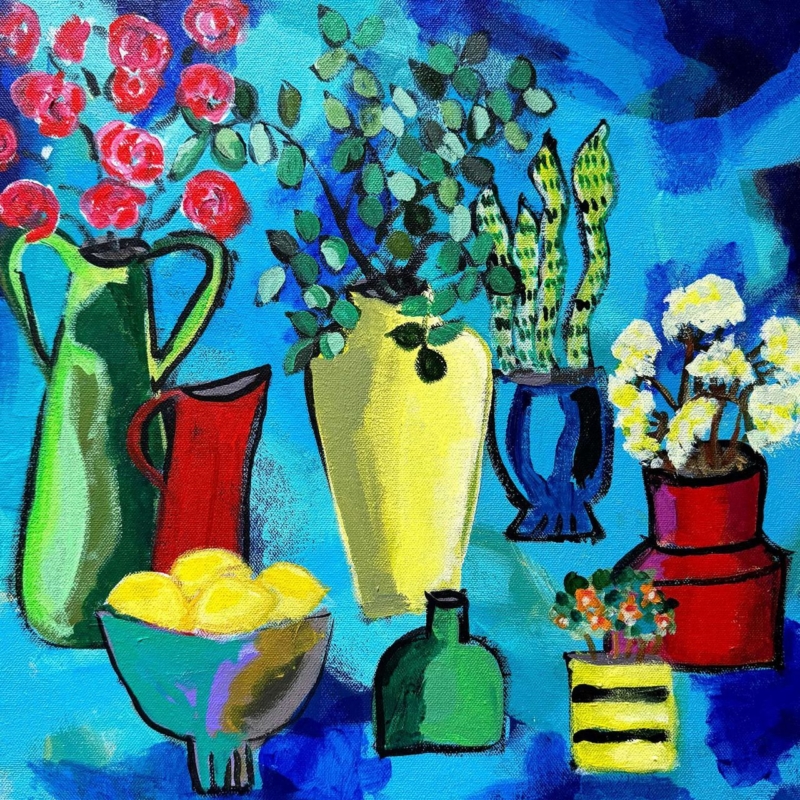
still life wall art for a handleless kitchen can give a sleek room the human irregularity it needs. Flat-front cabinets, integrated appliances, and uninterrupted worktops create welcome order, but the result may feel impersonal if every surface is equally controlled. Upside Down II by David Short introduces pitchers, plants, flowers, and lemons through loose black outlines and saturated colour. It brings everyday life into the scheme without weakening the architecture.
Why still life wall art for a handleless kitchen adds balance
Handleless cabinetry is effective because repeated doors read as calm planes rather than separate cupboards. The same discipline can make a kitchen feel spacious and easy to use. Yet a room built only from smooth rectangles may need one element with visible gesture, variation, and evidence of the hand.
Upside Down II provides that contrast. A tall green jug, red pitcher, yellow vessel, blue pot, lemons, and plants create a row of distinct silhouettes. Their outlines are intentionally lively rather than mechanically perfect. The square format keeps this abundance contained, so the image feels energetic without making the wider kitchen disorderly.
Use one strong colour relationship, not every colour
The picture includes intense blue, turquoise, red, green, yellow, and pink. Trying to repeat all of them around the kitchen would undermine the clarity of the cabinetry. Instead, identify one existing room colour and let the remaining hues belong to the artwork.
- Dark blue or charcoal cabinets: the vivid blue ground feels related, while yellow and red add lift.
- White or pale grey cabinets: the square becomes a clear block of colour against a quiet field.
- Green cabinetry: the jugs and foliage make a connection without requiring an exact paint match.
- Timber accents: warm red and yellow details stop natural wood from feeling detached from cooler surfaces.
A single bowl, tea towel, or pendant shade can repeat the chosen accent. Leave the worktop largely clear. The artwork already contains the visual equivalent of collected vessels and flowers, so it can supply personality without filling every shelf.
Find a safe wall away from heat, steam, and splashes
The obvious empty area is not always the correct place for framed art. Avoid the wall directly above a hob, kettle, sink, or high-steam appliance. Heat, grease, repeated moisture, and cleaning spray are poor conditions for paper and framing materials. A dining end, clear wall beside a pantry door, or seating area beyond the main work zone is usually more suitable.
The available square print sizes are 265, 500, and 800 millimetres before framing. This range allows the composition to work beside a compact table or across a more generous open-plan wall. Mark the complete intended dimensions, including mount and moulding, before ordering. Open every adjacent cupboard and door to check clearance.
| Kitchen position | What to check |
|---|---|
| Dining end | Centre the frame on the table or bench rather than on the entire room |
| Beside tall cabinetry | Leave enough wall for the square to avoid looking wedged into a gap |
| Open-plan transition | Make sure the colours read well from both cooking and seating zones |
| Near a glazed door | Watch direct sun and reflections at different times of day |
Frame expressive objects with a clean edge
A simple dark moulding can echo the black outlines and give the image a decisive boundary. A pale frame can sit quietly with lighter cabinets, while a restrained timber may connect the kitchen to an adjoining dining area. The frame should clarify the square composition rather than add a decorative flourish that competes with the objects.
First 4 Frames produces colour-managed Giclée prints and completes bespoke framing in-house in Falkirk. Careful production helps the blue field, green vessels, red accents, and smaller floral details remain distinct. The hand-finished presentation gives a modern kitchen a crafted counterpoint while retaining the precision the room already has.
Everyday objects made bold through colour
David Short makes contemporary work informed by familiar possessions, plants, pattern, and strong colour. His still lifes treat domestic objects as an expressive group rather than a formal inventory. See more on David Short’s official website, or explore the David Short collection at First 4 Frames.
Successful still life wall art for a handleless kitchen should complement clean cabinetry without making the room feel clinical or over-accessorised. View the framed Upside Down II print for a concentrated square of colour, plants, and useful objects brought together with confident hand-drawn energy.