
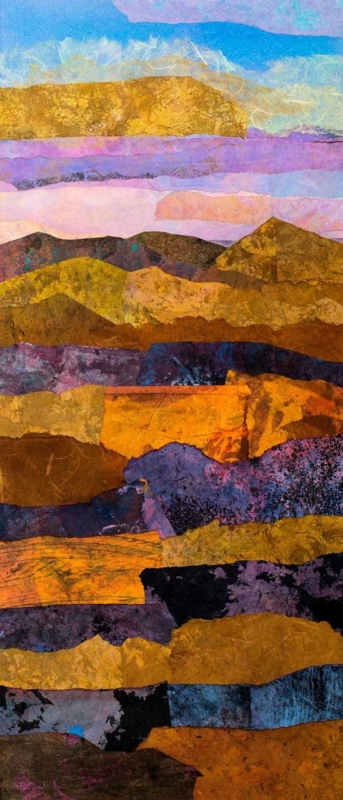
tall narrow abstract wall art can solve a part of the room that standard landscape and square pictures leave untouched. Golden Cloud by Emily Little is composed as a slim vertical stack of colour. Ochre, violet, rust, blue, and dark earth tones rise through the image in irregular bands, giving a narrow wall both height and visual depth without trying to disguise its proportions.
Why tall narrow abstract wall art suits difficult gaps
Many homes contain slim wall sections beside a doorway, at the end of a short corridor, between fitted furniture, or on a return beside a chimney breast. Leaving every one empty can make the room feel unfinished. Filling one with a picture designed for a wider wall usually creates the opposite problem: the frame looks squeezed and the wall feels even narrower.
A vertical image accepts the architecture instead of fighting it. In Golden Cloud, the eye moves upward through a sequence of layered forms. Some read like hills, fields, cloud, or distant horizons, while others remain purely textural. That uncertainty rewards a closer look and gives the compact position more interest than a simple decorative strip.
Measure the complete framed shape
The print is available at 120 by 280 millimetres and 240 by 560 millimetres before framing. Both versions are markedly taller than they are wide. The mount and moulding will increase those dimensions, so measure the finished presentation rather than treating the print size as the space required.
| Wall position | What to measure | What to protect |
|---|---|---|
| Beside a doorway | The clear width with the door fully open | Enough separation from handles and passing shoulders |
| Between cupboards | The actual plaster width, not the furniture gap | A balanced margin on both sides of the frame |
| Short corridor end | The view from the approach as well as close range | Clear circulation and freedom from door swing |
| Chimney-breast return | Depth, sightline, and any nearby heat source | Safe conditions for paper, mount, and frame |
Make a paper template for the expected outer dimensions. A margin that appears generous on a tape measure can feel tight when moulding and shadow are visible. The frame should look intentionally slim, not as though it only just fitted.
Use the vertical rhythm to guide hanging height
A tall picture can tempt people to hang its centre too high. Start from the usual sightline in the space, then account for how the wall is approached. In a corridor, the image should be comfortable to view while walking towards it. Beside furniture, it should relate to the top and side edges rather than floating independently.
- Mark the outer frame. Use low-tack tape or paper so the complete silhouette is visible.
- Stand at the main entrance. Check whether the picture draws the eye naturally or seems to climb towards the ceiling.
- Test the nearest route. Make sure the frame does not project into a place where bags, coats, or shoulders may catch it.
- Check the lower edge. It should remain clear of switches, radiators, and furniture corners.
Let layered colour connect the adjoining rooms
A narrow wall often sits at a transition. It may be visible from a hall and a sitting room, or link a kitchen to a dining space. The varied palette in Golden Cloud is helpful here. Warm gold and rust can relate to timber and brass, while blue and violet provide cooler counterpoints. Darker horizontal passages keep the brighter colours grounded.
Choose one or two connections rather than repeating every colour. An ochre chair seen from the next room or a blue ceramic on a nearby console may be enough. The picture should help the sightline feel joined, not turn the transition into a colour chart.
Frame a slim image without making it heavy
A wide or highly ornate moulding can consume the limited wall area and weaken the elegant ratio. A restrained dark frame may sharpen the deeper bands. A warm timber can respond to the gold and rust, while a pale neutral presentation can preserve breathing room on a compact wall. The actual print should lead the decision because several colours need to remain distinct.
First 4 Frames produces colour-managed Giclée prints and completes bespoke framing by hand at its Falkirk workshop. That in-house process is especially valuable with a narrow format. Mount width, moulding scale, glazing, and fixings can be considered as one finished object rather than added separately.
Layered landscape and memory from Emily Little
Emily Little creates expressive semi-abstract work shaped by colour, memory, emotion, and landscape. The stacked surfaces in this image suggest distance without fixing the viewer to one literal place. Explore more work on Emily Little’s official website, or browse the Emily Little collection at First 4 Frames.
Well-chosen tall narrow abstract wall art should make a difficult proportion feel intentional rather than merely occupied. View the framed Golden Cloud print for a slim composition that brings height, layered colour, and hand-finished craftsmanship to an often overlooked wall.