
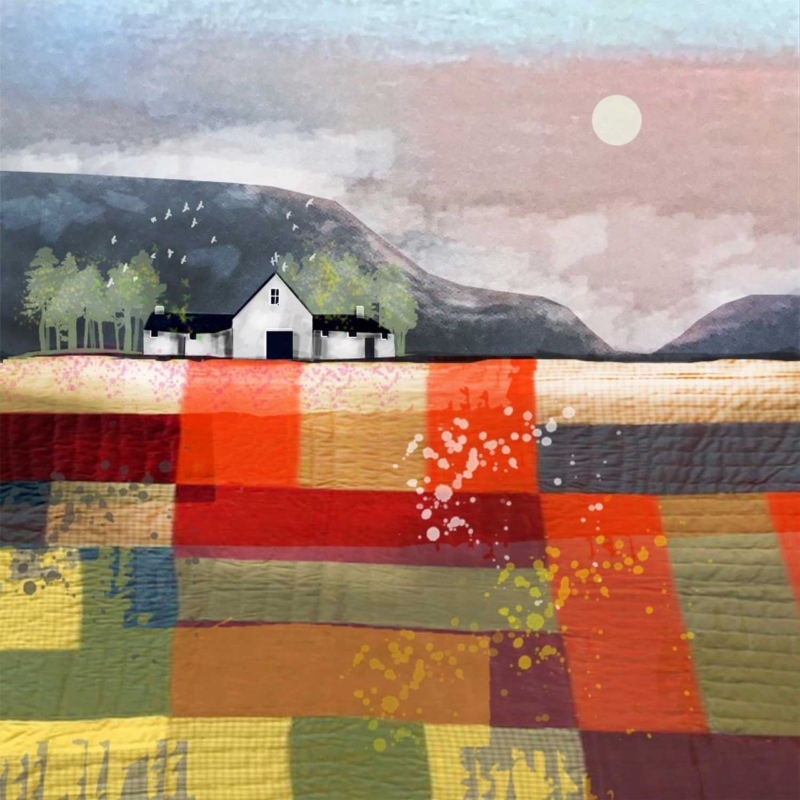
art for a room with patchwork textiles needs to respect the colour and hand-made character already in the room. It should not simply add another unrelated pattern. High Moon by Rikki O’Neill offers a thoughtful connection. Its lower half resembles joined pieces of richly coloured cloth, while the white cottage, distant hills, and pale moon create a quieter destination for the eye.
Why art for a room with patchwork textiles needs a resting point
Patchwork brings many small decisions together: cloth, stitch, tone, repeat, and contrast. That richness is part of its appeal, but it can leave a wall feeling unsettled if the artwork introduces several more competing motifs. A single framed piece creates a boundary. It can acknowledge the textiles while helping the wider room feel composed.
High Moon manages this through contrast. Blocks of rust, red, ochre, olive, charcoal, and cream give the foreground a fabric-like rhythm. Above them, the simple croft and open sky slow the composition down. The picture therefore feels connected to patchwork without looking like a literal sewing illustration.
Start with the dominant textile, not every fabric
Choose the quilt, throw, cushion, or upholstered chair that has the strongest visual presence. Identify two colours that appear across a useful area rather than focusing on the smallest accent square. In this print, warm red and muted green can connect with an earthy textile. Cream and soft grey can bridge the picture to a quieter wall.
| Textile situation | How the artwork can respond |
|---|---|
| Traditional scrap quilt | Use the varied foreground as a link, then keep the frame restrained |
| Modern geometric throw | Let the square picture and block-like colour provide structure |
| Soft neutral patchwork | Pick up cream and grey while allowing the warmer tones to lead |
| Several patterned cushions | Leave clear wall around one framed piece instead of adding a gallery cluster |
Avoid trying to match every colour. Exact repetition can make a room look over-planned and may date the scheme when one textile changes. A couple of clear relationships are enough. The remaining picture colours should be allowed to add depth rather than becoming instructions for more accessories.
Give a small square print enough space
The available print size is 265 by 265 millimetres before mounting and framing. That compact square can work above a side table, beside a reading chair, or on a short wall near a textile display. It should not be forced to fill a broad wall by itself. A deliberate pocket of clear space will make the picture feel more important.
If the room contains a quilt hung on the wall, place the print on a separate wall rather than immediately beside it. This lets each hand-made or artist-led element hold its own. Check the view from the doorway and the main seat. The cottage and moon should remain easy to read even when a colourful throw is in the foreground.
Choose framing that separates pattern from pattern
A measured mount can create valuable breathing room between the image and its moulding. A slim dark frame may connect with the cottage roof and charcoal sections. A warm timber can sit comfortably with natural fibres and older furniture. Highly decorated moulding is less helpful because it adds one more repeating surface around an already layered image.
First 4 Frames produces colour-managed Giclée prints and completes bespoke framing in-house at its Falkirk workshop. That approach protects the subtle texture and keeps the pale sky distinct from the saturated foreground. It also allows the mount, frame, and finished dimensions to be chosen for the actual textiles and wall colour.
A landscape built through colour and texture
Rikki O’Neill combines illustration, painting, and textile-influenced texture to create atmospheric, colourful landscapes. The Wraptious profile of Rikki O’Neill gives useful background on his approach, while the Rikki O’Neill collection at First 4 Frames shows more of his distinctive work.
Well-chosen art for a room with patchwork textiles can celebrate pattern while bringing the room back into focus. View the framed High Moon print for a compact landscape that connects layered colour, quiet Scottish scenery, and hand-finished presentation.