
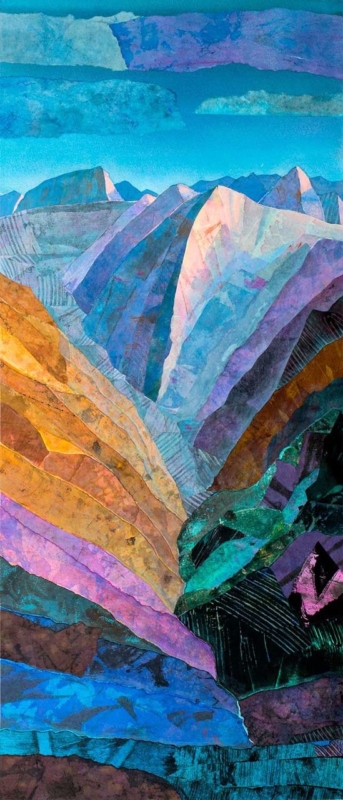
vertical mountain wall art for a home office video background needs to succeed in two views: the real room and the small rectangle seen by colleagues on screen. The Gloaming by Emily Little is particularly useful for that task. Its slim portrait format can occupy a narrow section of wall, while layered mountain forms introduce blue, violet, ochre, and green without depending on text that may appear reversed or become hard to read on camera.
What vertical mountain wall art for a home office video background should achieve
A good background should give the eye some depth and tell a quiet story about the person using the room. It should not become the main event in every meeting. Mountain imagery offers distance and structure, while abstraction keeps the scene from feeling like a literal travel poster or a corporate landscape chosen only to fill space.
The Gloaming creates a strong upward movement through overlapping ridges. Cool turquoise and blue occupy much of the image. Violet and pink sharpen the peaks, while ochre slopes bring warmth into the lower half. Darker passages provide enough definition to remain visible after a webcam reduces fine detail.
Begin with the camera frame, not the empty wall
Open the camera application you normally use, sit in the usual working position, and mark the visible edges of the background. The useful wall may be much smaller than expected. Doorways, shelves, and the crop above your shoulders all affect where the print will appear. A paper template is safer than guessing from the full wall.
- Set the camera first. Fix its height and angle before choosing the hanging point.
- Leave separation from your outline. The frame should not appear to grow from a shoulder or touch the top of your head.
- Check common crops. Test both full-screen calls and smaller gallery tiles.
- Review at night. Confirm that lamplight preserves the colour without reflecting across the glazing.
The artwork can sit slightly off-centre behind you. In fact, that arrangement often feels more natural than a perfectly symmetrical backdrop. The vertical shape is useful beside a bookcase or on the wall section between a desk return and a doorway, where a wider landscape might be cut off by the camera.
Choose between the two sizes with the full frame in mind
The print is available at 120 by 280 and 240 by 560 millimetres before mounting and framing. The smaller version suits a compact workstation or a background that includes shelves and other restrained details. The larger size has enough presence for a clearer wall or a camera positioned farther from the sitter.
Allow for the mount and moulding when testing proportions. The finished dimensions will be larger than the printed image. From the desk, the artwork should look deliberate and comfortable. On screen, it should remain recognisable without being tightly cropped at the top or bottom.
Balance mountain colour with skin tone and work lighting
Cool blue walls and a blue-heavy artwork can make a video image feel colder, especially under a single overhead light. A warm desk lamp outside the camera frame, a neutral wall, or a small timber element can balance the palette. The ochre and muted pink passages in this piece already provide useful warmth among the cooler ridges.
Avoid directing a bare lamp at the glass. Light your face from the front or slightly to one side, then use softer background illumination if needed. The goal is separation, not theatrical contrast. Run a short recording to judge the result, because a live preview may not reveal glare or exposure changes as clearly.
Keep the wider background edited
The layered surface already supplies plenty of visual information. Pair it with only a few purposeful objects: a small plant, a limited row of books, or one ceramic form. Remove loose cables, packaging, and changing household items from view. A consistent background reduces preparation before calls and allows the artwork to become a recognisable part of the workspace.
First 4 Frames uses colour-managed Giclée production and completes bespoke framing in-house at its Falkirk workshop. That careful process supports the transitions between turquoise, violet, ochre, and deep shadow. It also lets the final frame respond to the desk, wall, and camera view rather than being selected in isolation.
Emily Little studied drawing and painting at Edinburgh College of Art. Her semi-abstract practice explores colour, landscape, memory, and emotion. Learn more on Emily Little’s official website, or browse the Emily Little collection at First 4 Frames.
Effective vertical mountain wall art for a home office video background can make remote work feel more personal and professional at the same time. View the framed The Gloaming print and compare its two vertical sizes for a background with colour, depth, and a clear sense of craft.