
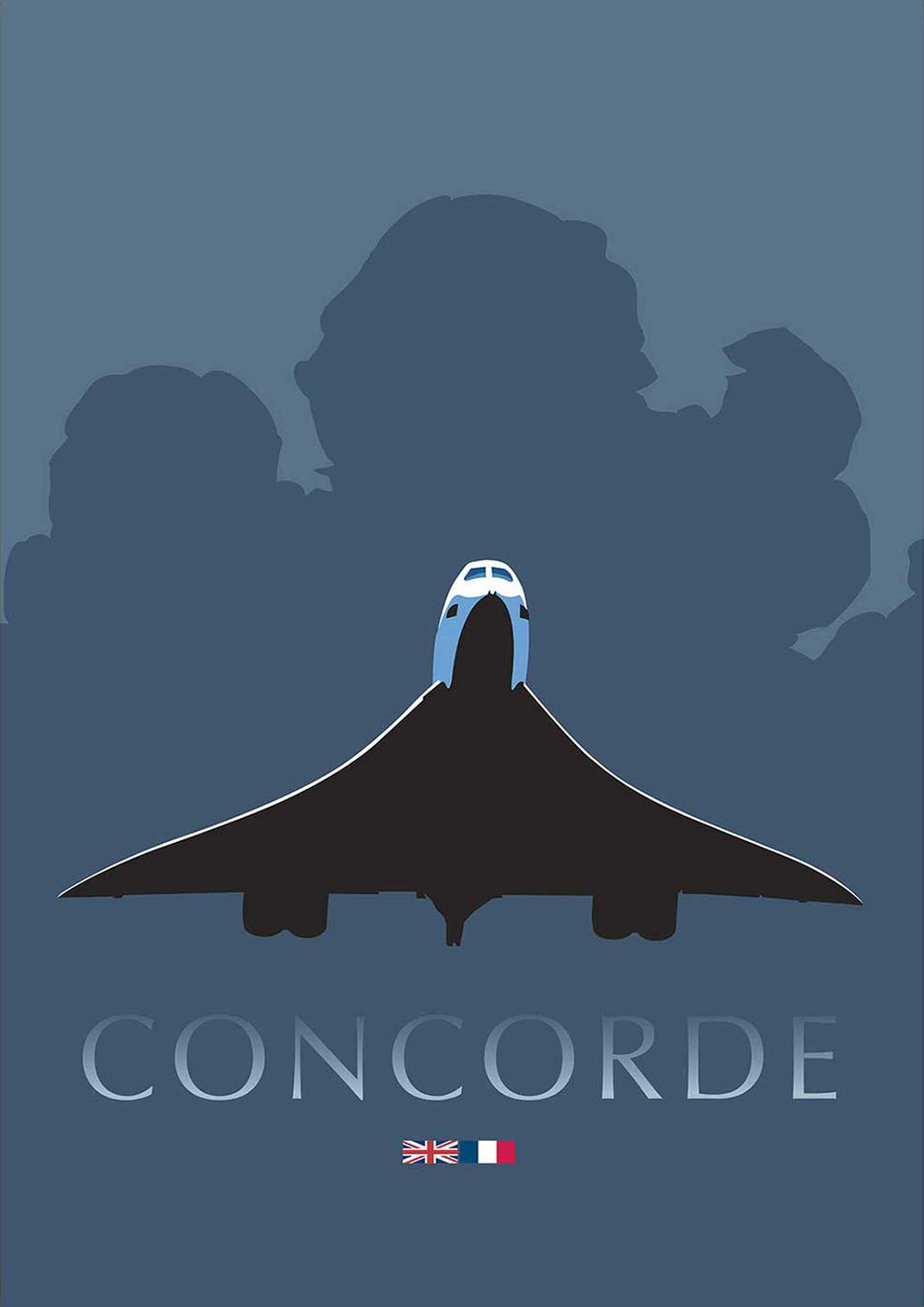
aviation wall art for a home cinema needs enough presence to hold its own in a darkened room, but it should not make the space feel like a themed attraction. Concorde by Peter McDermott offers a disciplined solution. The aircraft is reduced to a powerful frontal silhouette, set against layered blue-grey clouds. Its poster-like clarity brings drama from a distance, while the restrained palette remains easy to live with when the screen is off.
Why aviation wall art for a home cinema works
A home cinema often contains broad, quiet surfaces. Dark paint, acoustic panels and low furniture support viewing, yet they can leave the room looking unfinished in daylight. Concorde introduces a recognisable subject without adding lots of small detail. The near-symmetrical aircraft and centred lettering feel deliberate, much like a carefully composed film poster.
The portrait format is helpful too. It can occupy a narrower wall beside the screen, between doors or above a low equipment cabinet. The image creates height without requiring a wide gallery arrangement. Blue-grey colour also sits comfortably with charcoal, navy, black and natural timber, which are common choices for cinema rooms.
Choose a wall outside the main viewing cone
Artwork should enrich the room when people enter, then recede while a film is playing. Avoid placing glazed work directly beside the screen where it can reflect bright scenes. A side wall near the entrance or the wall behind the seating usually offers a better balance. The print remains visible during conversation without competing for attention during viewing.
- Mark the finished frame size. Use paper to judge the portrait proportions beside doors, speakers and cabinets.
- Sit in every seat. Check that the glazing does not catch the projector or television from an angle.
- Test the lights. View the paper template with task lighting, wall lights and the screen on.
- Protect the sound treatment. Fix into a suitable wall rather than attaching the frame to an acoustic panel.
- Keep controls clear. Leave comfortable access to switches, sockets and ventilation.
Build the palette from the clouded blue
The artwork is dark, but it is not simply black. Its blue-grey ground can soften a cinema scheme that might otherwise feel severe. Deep navy walls will create a close tonal relationship. Charcoal walls will make the cooler blue more visible. On a lighter grey wall, a dark frame can connect the silhouette to nearby speakers or equipment.
| Room finish | Useful response | Effect |
|---|---|---|
| Navy walls | Choose a slim dark frame | Keeps the poster-like image integrated and calm |
| Charcoal walls | Allow a modest pale mount | Separates the aircraft outline from the darker room |
| Timber panelling | Echo the black silhouette in small details | Balances warm material with graphic precision |
| Mid-grey paint | Use the blue ground as the main colour accent | Avoids adding unnecessary cinema-red accessories |
Use low light without creating glare
A narrow picture light can look impressive, but it may reflect in the glazing or remain distracting during a film. Dimmable ambient lighting is usually more flexible. Let a wall washer or shaded lamp reveal the aircraft before viewing, then lower it fully with the rest of the room. The cloud shapes should remain visible without becoming a luminous rectangle.
Check the artwork when the screen shows a very bright image. Reflections change with seating position, so one standing test is not enough. If necessary, move the frame farther from the screen or adjust the angle of the nearby light. Careful placement protects both the viewing experience and the print’s strong graphic effect.
Let one aircraft image carry the theme
Concorde has enough cultural and engineering presence to work alone. It does not need model aircraft, airport signs or a row of transport photographs around it. Keeping the surrounding wall clear makes the room feel designed rather than collected around a theme. A few materials from the image, such as dark metal and smoky blue fabric, can create connection more subtly.
Peter McDermott trained in art and design before becoming a professional painter based on Skye. This image shows a particularly graphic side of his work, using shape and tone to celebrate an instantly recognisable aircraft. Read more at Peter McDermott’s artist profile at Union Art, or browse the Peter McDermott collection at First 4 Frames.
First 4 Frames uses colour-managed Giclée production and completes bespoke framing in-house at its Falkirk workshop. That precise, hand-finished presentation suits the clean outline and subtle shifts in the blue-grey background. It also ensures the finished piece arrives ready to become a properly resolved part of the room.
Well-positioned aviation wall art for a home cinema can give a viewing room character before the opening credits without distracting from the screen. View the framed Concorde print for a bold focal point built on speed, form and controlled colour.