
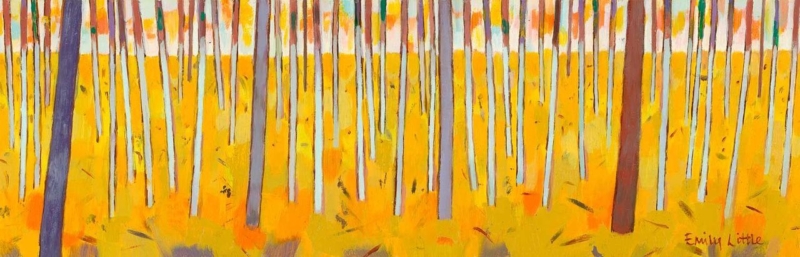
Minimalist wall art does not have to be blank or purely geometric. Birch Trees I brings the natural repetition of birch trunks into a pared-back interior. The subject offers rhythm and texture, while the woodland structure keeps the composition ordered enough for a room with few objects.
Let minimalist wall art organise a quiet wall
| Placement | Useful relationship |
|---|---|
| Above a console | Align the artwork with the furniture centre, then keep objects low and sparse. |
| Beside a reading chair | Leave a generous margin so the tree rhythm does not collide with the lamp. |
| In a calm bedroom | Position it where it can be seen on entry rather than directly above a busy headboard. |
Repetition is the strength of the subject, so the rest of the arrangement should avoid competing stripes. Slatted furniture, strongly ribbed wall panels and several tall vases nearby may create too many vertical beats. A smooth wall and one grounded piece of furniture give the image more clarity.
Minimal does not mean featureless; it means every line has enough space to register.
Use framing to separate woodland texture from the room
Birch imagery often relies on fine tonal shifts and repeated light-dark edges. Colour-managed Giclée production protects that detail. A slim hand-finished frame can provide a deliberate boundary, while a wider mount can add breathing room if the surrounding wall already contains architectural lines.
For natural-history context on the tree behind the subject, read the Woodland Trust guide to silver birch. Browse the Emily Little collection, or view the exact Birch Trees I product.
Birch Trees I makes a useful case for minimalist wall art with substance: it offers natural texture, measured repetition and enough quiet structure to shape the wall without filling every inch.