
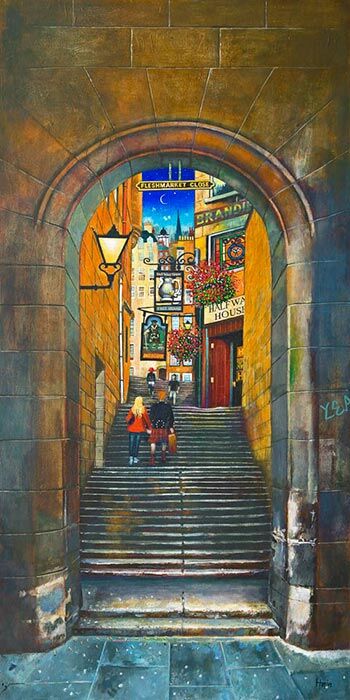
Edinburgh wall art for a dark vestibule should make the entrance feel more inviting without using floor space or narrowing the route. Halfway Home by Rob Hain is built around a deep stone arch and steps rising towards a warmly lit Edinburgh close. The eye moves from cool paving through shadow and into colour. That visual journey can give a compact vestibule the suggestion of another space beyond the wall.
What Edinburgh wall art for a dark vestibule needs to solve
A vestibule is often narrow, briefly occupied and short of daylight. Coats, shoes and door swings already claim much of its usable space. Small decorations can add clutter without changing how the entrance feels. One tall, clearly composed picture is more useful because it can create a destination for the eye while leaving the circulation route untouched.
Halfway Home makes its darkest area part of the solution. The surrounding arch behaves like a frame within the frame. Beyond it, shop signs, windows and figures become progressively brighter and smaller. That change in scale creates convincing depth, while the orange side walls make the interior feel warmer than the stone foreground.
Map the entrance before choosing the hanging position
Open the front door, inner door and any cupboard door fully. Mark where handles, bags and shoulders pass closest to the wall. The picture should sit outside those contact zones. A portrait print can fit a slim return wall, but it still needs enough width for its complete frame and a little clear plaster on both sides.
- Stand at the open front door. Check whether the arch is visible before entering.
- Step inside and close the door. Make sure the image remains readable from the main standing point.
- Walk towards the inner hall. Confirm the frame cannot catch a shoulder, coat or carried bag.
- Switch on the evening light. Look for a reflected bulb across the brighter upper close.
A paper template is especially helpful here. Include the outer frame size rather than only the image. Keep it in place for a normal day so that everyone uses the entrance around it. Marks or curled edges reveal a practical conflict before anything is fixed to the wall.
Let the painted route guide the real lighting
The artwork moves from a darker threshold to a pool of warm light. The vestibule can follow the same principle. Use a comfortable general source for safe entry, then allow the wall holding the picture to be slightly brighter. A shaded wall light or broad ceiling beam is usually calmer than a sharp spotlight aimed at glass.
| Entrance problem | Artwork response | Room adjustment |
|---|---|---|
| Little natural light | Warm illuminated close | Choose warm-white, high colour-rendering lamps |
| Short sightline | Steps and shrinking figures create depth | Keep the wall below the frame clear |
| Hard stone or tile floor | Painted texture and amber colour soften the view | Add one simple mat rather than several accessories |
| Narrow wall return | Portrait format follows the available height | Measure open doors and frame projection |
Very dim lighting will erase the figures and signs that reward closer viewing. Excessively bright lighting will flatten the shadow that creates the tunnel effect. Adjust the source until the stone arch remains deep while the signs and sky at the top can still be distinguished.
Keep storage quieter than the picture
The scene already contains lettering, windows, people and architectural detail. Open hooks crowded with patterned coats can compete with it. Closed storage is ideal, but a short row of matching hooks can also work if everyday items stay within a limited colour range. The vestibule does not need vintage signs or Edinburgh souvenirs to support the subject.
Pull one colour from the image if the entrance needs a connection. Deep green, muted orange or dark teal could appear on a single mat, umbrella stand or painted door edge. One repetition is enough. The picture should remain the place where the more complex street colour gathers.
Choose a frame for a busy threshold
A slim dark frame can extend the shadowed arch and give the portrait image a precise boundary. A warm timber can connect more gently with brick, terracotta or traditional internal doors. Avoid a very ornate profile in a tight entrance. It takes up visual room and collects dust on a wall that already receives more outdoor traffic.
First 4 Frames completes colour-managed Giclée production and bespoke framing in-house at its Falkirk workshop. Careful printing keeps the difference between deep stone, orange walls, blue night sky and small illuminated signs. A hand-finished, ready-to-hang presentation also gives the entrance a more permanent focal point than temporary hallway accessories.
Use the city scene as a welcome, not a theme
Rob Hain builds his town and city paintings around architecture and the people who give it life. Halfway Home turns a familiar Edinburgh route into a small story of movement, company and arrival. See more at Rob Hain’s official website, or browse the Rob Hain collection at First 4 Frames.
Thoughtful Edinburgh wall art for a dark vestibule can make a constrained entrance feel deeper and more personal while leaving the actual route clear. View the framed Halfway Home print for a tall Edinburgh scene that leads from a shadowed threshold towards light, colour and life.