
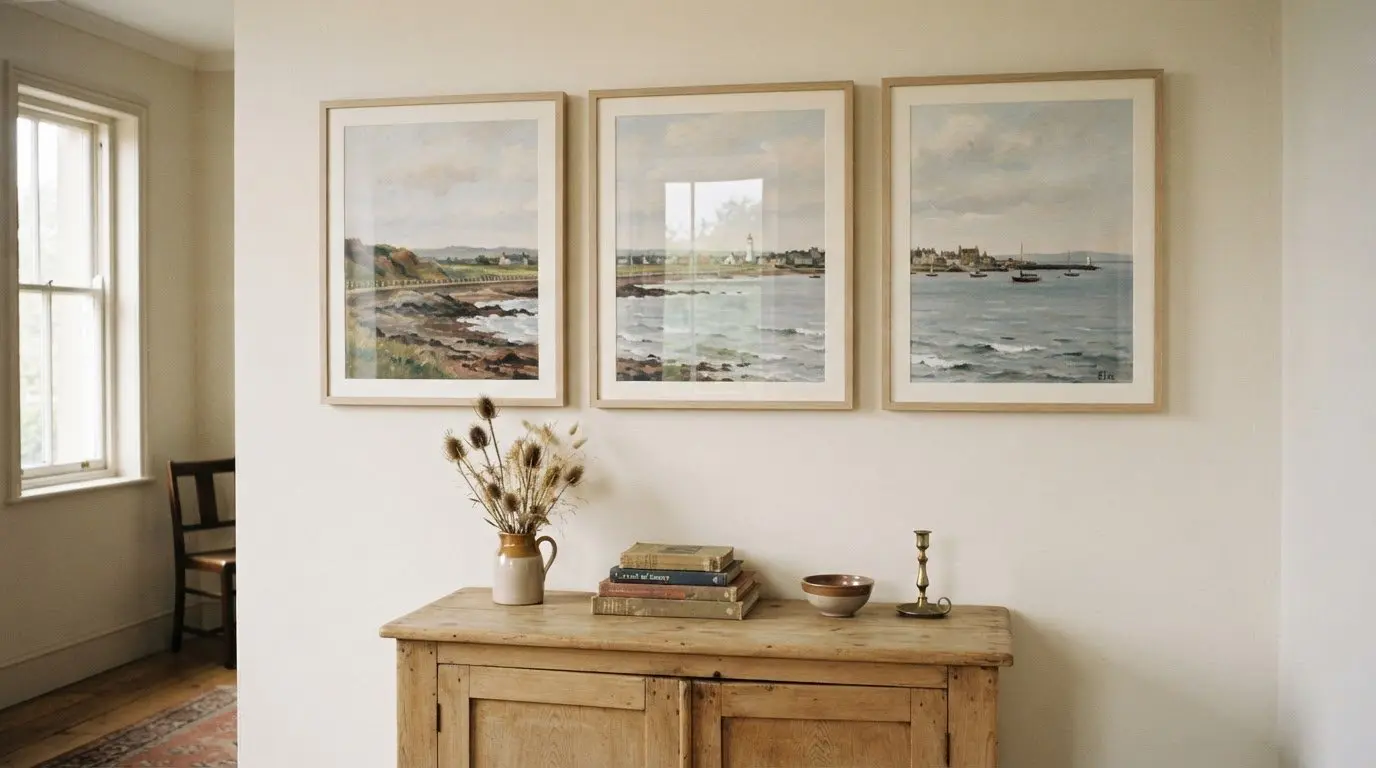
A balanced triptych is about more than hanging three panels in a straight line. If you’re considering how to frame a triptych panel artwork, the space between panels matters: a gap of 4 cm works for most rooms and panel sizes, while narrower or wider spacing changes how connected the artwork feels.
It’s natural to want each panel to sit neatly and the complete work to read as one considered composition. A professional framer can assess spacing in relation to the artwork, its proportions and the wall, rather than applying one measurement to every triptych.
You’ll learn how horizontal, vertical and staggered arrangements affect the finished look, and how a framer can advise on suitable gaps between panels. We’ll also explore the choices that help the three sections feel balanced together, whether you want them to read as a unified artwork or to show more separation.
Key Takeaways
- Choose a horizontal, vertical or staggered arrangement to suit the artwork and the wall, with a framer helping assess how the composition will read in the space.
- Use panel spacing to shape the visual connection: a narrower gap unifies the image, while a wider one makes each section more distinct.
- Plan the complete three-panel layout together, considering its overall proportions and how the panels relate to the furniture or feature below.
- Decide whether separate frames or one continuous frame best supports the artwork’s design, presentation and practical hanging needs.
1. Horizontal, vertical and staggered arrangements
A triptych’s three panels can be arranged horizontally, vertically or in a staggered composition. The right layout depends on the artwork’s orientation, the wall shape and how the image continues across the divisions. A wide landscape often reads naturally in a horizontal row, while a narrow wall may suit a vertical arrangement. Staggered panels sit at different heights, creating a more dynamic outline. Consider the artwork’s proportions as well as the available wall space when choosing the arrangement.
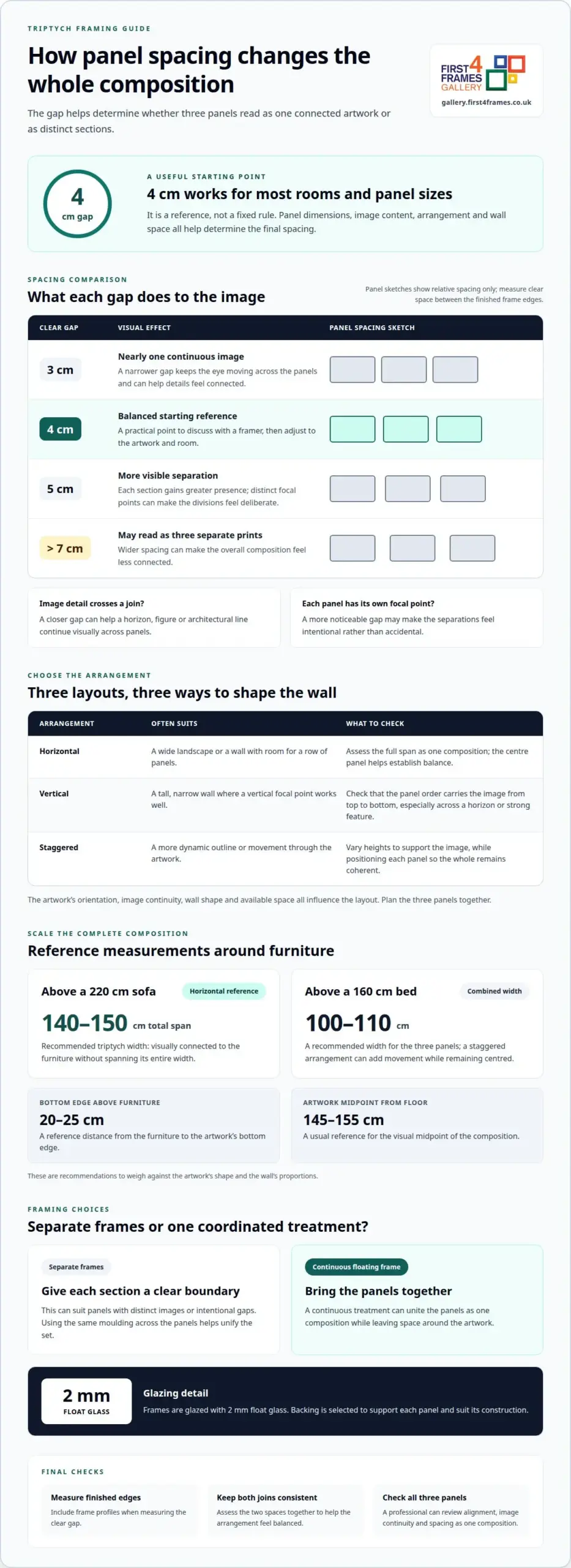
For a horizontal layout, the framer assesses the full span as one composition, not three unrelated pieces. Above a 220 cm sofa, a triptych spanning about 140 to 150 cm is recommended. That leaves the panels visually connected to the furniture without extending across its entire width. The centre panel helps establish the composition’s balance, while the two outer panels complete its visual rhythm. The visual midpoint should usually sit 145 to 155 cm from the floor.
A vertical arrangement can create a focal point on a tall, narrow wall. Check that the panel order carries the image from top to bottom, especially if a horizon or other strong feature crosses the divisions. With staggered panels, vary the heights to support the artwork’s movement rather than interrupt it. Position each panel in relation to its neighbours so the different heights still form a coherent whole.
Furniture also helps determine which arrangement feels proportionate. Above a 160 cm bed, a triptych with a combined width of 100 to 110 cm is recommended. In a horizontal layout, that width forms a compact band; a staggered version can introduce movement while keeping the overall composition centred. The bottom edge should sit about 20 to 25 cm above furniture. A professional can weigh these measurements against the artwork’s shape and the wall’s proportions before finalising the layout.
2. Spacing between panels
When advising on how to frame a triptych panel artwork, a professional considers how the gap affects the image’s unity. A 3 cm gap makes the panels read almost as a single piece, keeping the eye moving across the artwork. A 5 cm gap makes the separation more visible, giving each section greater presence. Gaps wider than 7 cm can make the composition read as three separate prints instead of one connected work.
A gap of 4 cm works for most rooms and triptych panel sizes. It offers a practical starting point, not a fixed rule for every artwork. The framer weighs panel dimensions, image content and intended arrangement before settling on spacing. A broad image with details crossing panel edges may benefit from closer spacing. Artwork designed with distinct sections may suit a more noticeable gap.
The image itself helps guide the decision. If a horizon, figure or architectural line continues across two panels, too much space can interrupt its visual flow. With a 3 cm gap, those details remain closely connected. If each panel has its own focal point, a 5 cm gap can make the divisions feel deliberate rather than accidental. The spacing should support the composition without competing with it.
Framing affects the visible distance between panels. Measure the clear space between the finished edges, including the frame profiles. Keeping both gaps consistent helps the arrangement feel balanced. An uneven gap can make one panel look detached, even when the artwork is aligned. Assess the two joins together rather than judging each space in isolation.
For a considered reference, compare how different compositions use visual rhythm in the artwork gallery. A professional advising on how to frame a triptych panel artwork can then tailor the spacing to its image, panel size and room. Starting with a 4 cm gap gives the discussion a useful reference while keeping the artwork’s connection in view.
3. Triptych artwork and three-panel layouts
A triptych divides one image or design across three panels, so a professional considers the sections together before choosing a frame. If you’re deciding how to frame a triptych panel artwork, the artwork’s colours, visual weight and edges help guide the moulding and materials.
Panels can be presented without individual frames. A clean, unframed look or a floating frame that leaves space around the artwork may suit the piece, depending on its construction and the finish you want.
There is no single UK price for framing every triptych. The cost depends on the dimensions of all three panels, the moulding, glazing and backing, and whether you choose separate frames or one coordinated treatment.
Choose moulding width in proportion to the panels, the artwork’s visual presence and the display space. A broad profile can give a large panel a stronger border, while a finer profile may suit a delicate image. Using the same moulding across the panels helps unify the set.
To preserve the artwork’s edges, measure the visible image area and position the frame opening accordingly. A floating treatment can leave the panel edges visible. Careful fitting also helps avoid covering printed or painted details.
Frames are glazed with 2 mm float glass. The framer selects backing to support each panel and suit its construction. Discussing how to frame a triptych panel artwork also means considering these materials together, so each section has a consistent finish.
Common risks include cropping image details, mismatched panel orientation and uneven alignment. A professional assesses all three sections before assembly, helping keep details that cross panel edges visually connected.
Should a professional frame triptych panels separately or as one continuous artwork?
The choice depends on how the three panels relate visually and how they’re built. Separate frames give each section a clear boundary, which can suit panels with distinct images or intentional gaps. A continuous floating frame can unite the panels as one composition while leaving space around the assembled work. A professional assesses the artwork’s edges, construction and intended arrangement before recommending an approach.
A landscape that continues across all three sections, for example, may suit a shared frame treatment. Check that the horizon and other details remain aligned across the joins. If each panel has its own subject, separate frames can define each image while keeping the overall presentation coordinated. Matching the frame finish helps the panels feel like parts of one display.
Panel construction matters too. In one floating-frame approach, each board is mounted on a panel painted black to match the frame, then the assembled work is framed. That treatment makes the space around the artwork part of its presentation. A professional considers the panel edges and the desired visual effect, so the frame complements rather than distracts from the artwork.
Separate frames allow the three sections to be arranged independently, while a shared frame gives the assembled artwork a unified outline. Consider how the framing will work with the panel gaps and wall layout. Consistent spacing and alignment help preserve the artwork’s rhythm, whether you choose individual frames or one shared frame.
Before deciding, consider whether the artwork should read as three framed images or one connected piece. The image’s composition, panel construction and display preference all help guide the recommendation. To explore artwork and consider which presentation might suit its design, browse the art gallery.
First4Frames Gallery: Ready-to-Hang Framed Art
First4Frames Gallery offers Custom Picture Framing for a considered finish, alongside Ready-to-Hang Framed Art and Giclée Fine Art Prints. Explore fine art, contemporary art prints and photography prints, with ideas ranging from coastal wall art and landscape wall art to Scottish landscape art. Browse work by best-selling artists and famous artists as you consider what suits your space.
For online picture framing, choose your frame online and consider how to design your framed artwork around its setting. Custom framed art prints and bespoke framed wall art can bring a personal touch to a room. Use the Wall art visualiser to visualise art on your wall or see artwork before you buy, and take time to think about the artwork and its presentation. An art print framing service helps bring those choices together, with framed wall art to complete your space.
Explore the gallery and, when you’re ready to discuss framing, contact First4Frames Gallery.
Give your triptych a place to belong
A triptych’s presentation becomes part of how it works in your room. Before choosing a finish, consider the wall, nearby furniture and colours, and whether the artwork should feel like one flowing image or three distinct panels. These details help guide the framing choices and connect the artwork’s character with your space.
If you’re considering how to frame a triptych panel artwork, treat the framing decision as part of the composition, not an afterthought. The right choice should let the image speak clearly while feeling at home on the wall. First4Frames Gallery brings together artwork and framing options, giving you a place to explore possibilities for your own space.
Take a moment to browse the gallery and explore the artwork. Let a piece catch your eye, then consider the setting and presentation that would make it feel truly yours. Your next favourite artwork may be closer than you think.
Frequently Asked Questions
How does a professional framer determine the gap between triptych panels?
Consider how the image continues across the joins, alongside each panel’s dimensions and frame edges. A continuous horizon, for example, needs spacing that preserves its visual flow; panels with separate focal points may work well with clearer divisions. Assess the finished edges as well as the artwork, so the moulding does not make the visible gaps feel inconsistent.
What does triptych mean in art?
A triptych is an artwork divided into three sections that hang next to one another on a wall. Each section contributes to a larger composition, though the panels may also contain distinct details or focal points. A landscape, for instance, may extend across all three sections, with each panel showing part of the wider scene.
How does a professional framer measure and space panels when framing a triptych?
Measure each panel and plan the arrangement, frame edges and intended gaps as one complete layout. Mark all three hanging points before fixing anything to the wall. Position the centre panel first, then work outwards so the outer panels align with it and the full composition fits the available wall space.
How much does it cost to frame a triptych in the UK?
There is no single UK price for framing a triptych. Cost depends on the panel dimensions, moulding, glazing and backing, and whether you frame the panels separately or as one coordinated piece.