
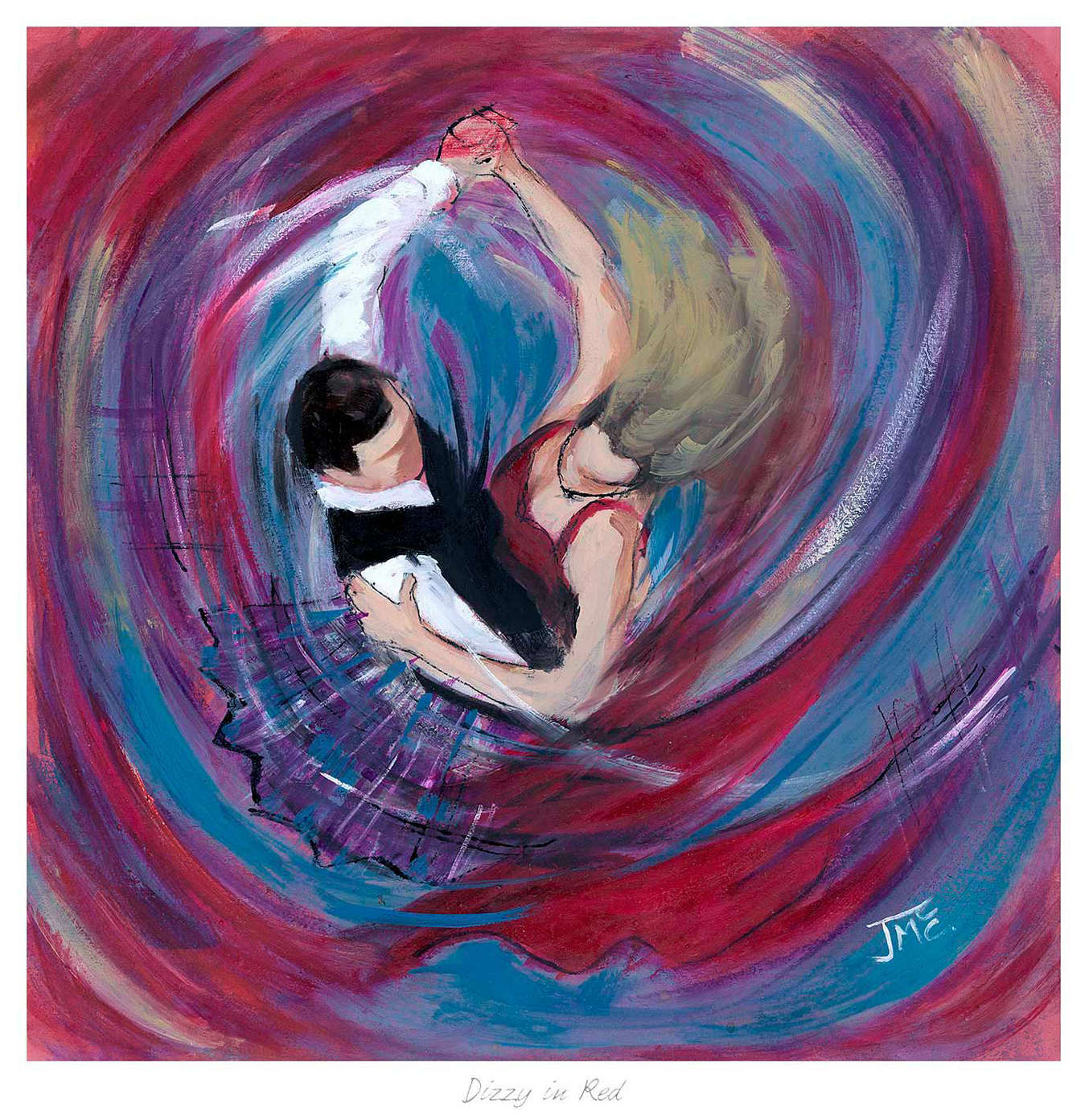
Scottish dance wall art with statement lighting needs to respond to the room as well as the subject. Dizzy in Red offers a useful starting point because Janet McCrorie’s dancers carry rhythm, tartan and vivid movement, so the artwork can answer a bold pendant without both features occupying the same visual line.
Separate Scottish dance wall art with statement lighting from the fitting
- Stand at the doorway and note where the pendant crosses the walls.
- Sit at the table or sofa and repeat the check.
- Choose a wall where dancers remain visible beside the fitting.
- Switch on each lighting circuit and inspect reflections.
- Mark the complete frame before fixing anything.
A dramatic light fitting occupies three-dimensional space. The picture needs a clear field behind furniture or across a diagonal. Centring both features on one axis may make the pendant obscure the dancers.
Let movement connect them
A curved fitting may echo the energy of dance without copying colour or tartan.
Let space separate them
Clear wall and a simple table prevent two confident features becoming clutter.
The print already provides Scottish pattern and red colour. Avoid tartan curtains, dance silhouettes and ceilidh signs. One disciplined reference feels more contemporary.
Light wall art for a room with statement lighting deliberately
Scraped marks, tartan cues and vivid red need accurate reproduction to retain energy. Colour-managed Giclée production preserves those relationships, while bespoke glazing and framing can be assessed under the room’s real lights.
For cultural context around the movement represented by the artist, explore the history and structure of Scottish country dance. Explore the Janet McCrorie collection, then view the exact product and framing choices.
Wall art for a room with statement lighting works when each focal point has a distinct job. Dizzy in Red supplies movement and colour; planned sightlines let the pendant shape the room without hiding the dance.