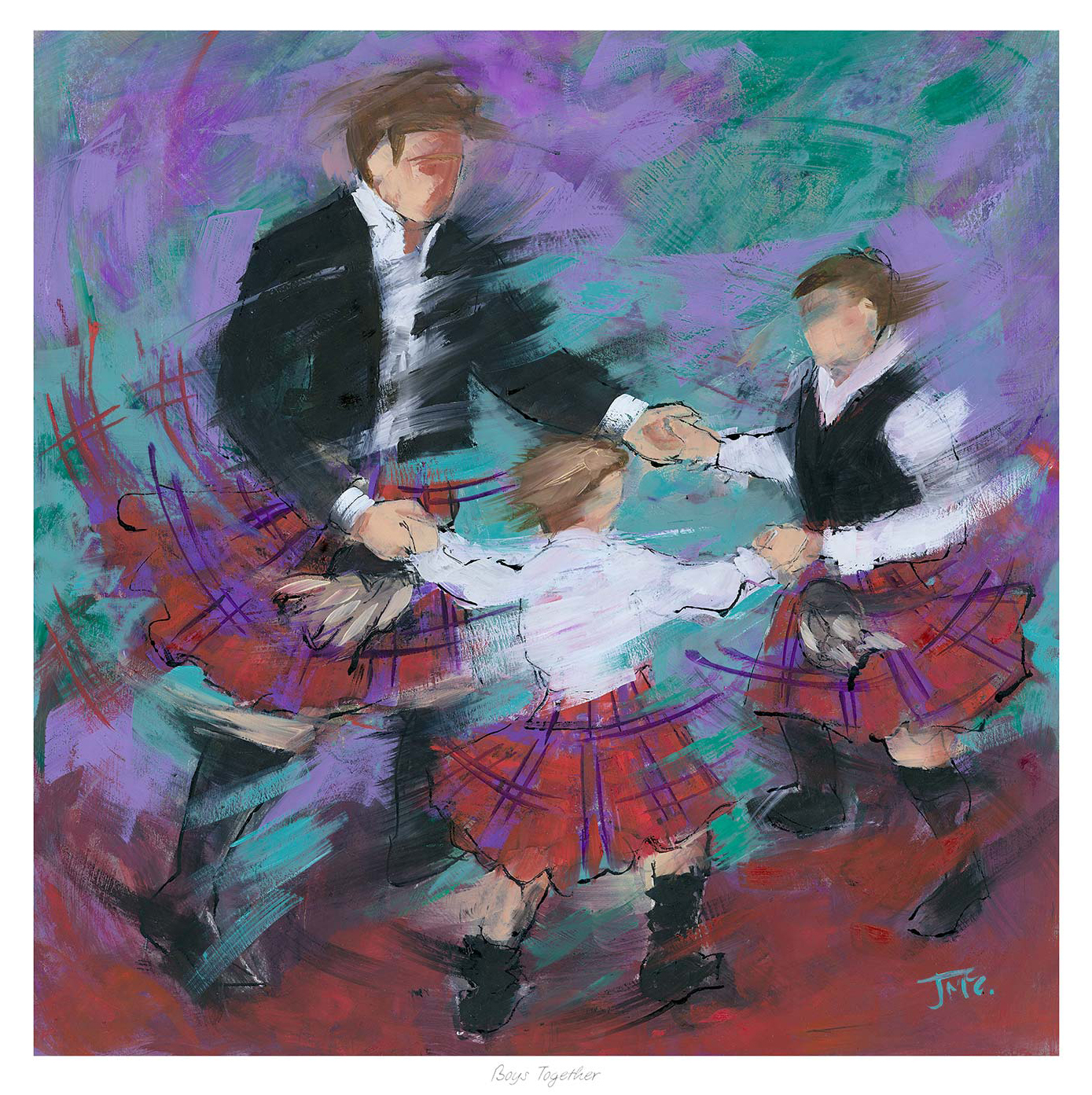
Scottish dance art gift feels meaningful when it recognises something the recipient actually does, teaches or remembers. Boys Together gives the decision a real subject and a professionally finished focal point.
Who will value a Scottish dance art gift?
A committed dancer
Mark years of participation, a special performance or a friendship formed through dancing.
A patient teacher
A shared class gift can recognise the energy and community a teacher has built.
A dancing family
The subject can recall ceilidhs or competitions without printing an event name across the art.
Ask about wall space if the gift is not a surprise. If it is, discreetly note the likely room and fixed furniture. The final frame needs clear wall rather than being squeezed among certificates and medals.
Good evidence
Weak assumption
They attend or teach Scottish dancing
They are Scottish, so they must like tartan
They enjoy figurative art
Any traditional subject will suit
You know the room
The frame can be guessed
Janet McCrorie studies dancers at competitions, country-dance events and ceilidhs. Her mixed-media approach emphasises familiar shapes, tartan and exuberant motion. That observed connection gives Boys Together specificity without reducing it to costume.
Present the limited edition as lasting artwork
Colour-managed Giclée production preserves scraped marks, active colour and textile detail. Bespoke framing, made and hand-finished in-house, gives the limited-edition print a substantial presentation suited to a milestone gift.
A Scottish dance art gift succeeds through recognition, not novelty. Boys Together celebrates shared movement; knowledge of the recipient makes it an enduring choice.
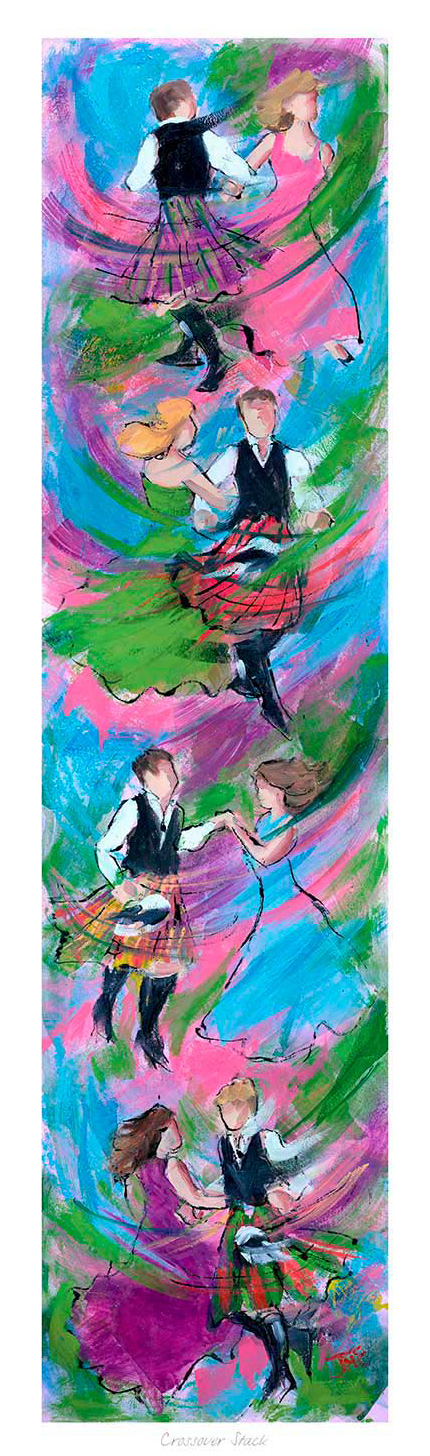
Scottish art gifts become meaningful when they recognise something the recipient actually does, organises or loves rather than relying on tartan and place names alone. Crossover Stack gives the decision a specific image, palette and finished product.
Choose Scottish art gifts through a shared dance floor
Crossover Stack shows four couples dancing energetically in traditional Scottish dress. Janet McCrorie builds movement through scraped and scratched mixed-media colour, giving familiar tartan and figures a lively modern treatment. The work can connect directly with someone who hosts ceilidhs, teaches, organises events or rarely leaves the dance floor.
Recipient
Personal reason to choose it
Ceilidh host
It recalls the shared energy they create for other people.
Dance teacher
It recognises movement, pattern and community without a printed thank-you slogan.
Event organiser
It marks the work behind a successful social floor.
Experienced dancer
It reflects a real activity rather than a generic Scottish theme.
Before buying, check the recipient’s taste and likely wall. Energetic figures and vibrant tartan deserve open space, not a corner already filled with photographs, rosettes and event posters. Ask a household member for a wall photograph if the gift must remain a surprise.
Should a group add names, a date or a plaque?
Usually the card is the better place for signatures and the event story. Keeping the artwork itself unlabelled allows the recipient to display it in a living room, hall or music space long after one occasion.
Confirm the dance connection is personal.
Check available wall and colour preferences.
Choose the frame for the recipient’s home, not the event venue.
Explain the shared memory in a handwritten card.
Present the framed work ready to hang and enjoy.
Present Scottish art gifts with energy and lasting craft
McCrorie’s layered marks, bright colour and tartan movement require crisp, controlled reproduction. Colour-managed Giclée production keeps the dancers distinct. In-house bespoke framing turns the limited-edition print into a substantial, hand-finished thank-you that can remain part of the home.
Scottish art gifts work best when the connection is real. Crossover Stack can thank a host, organiser or dancer by reflecting the movement and companionship they already value.
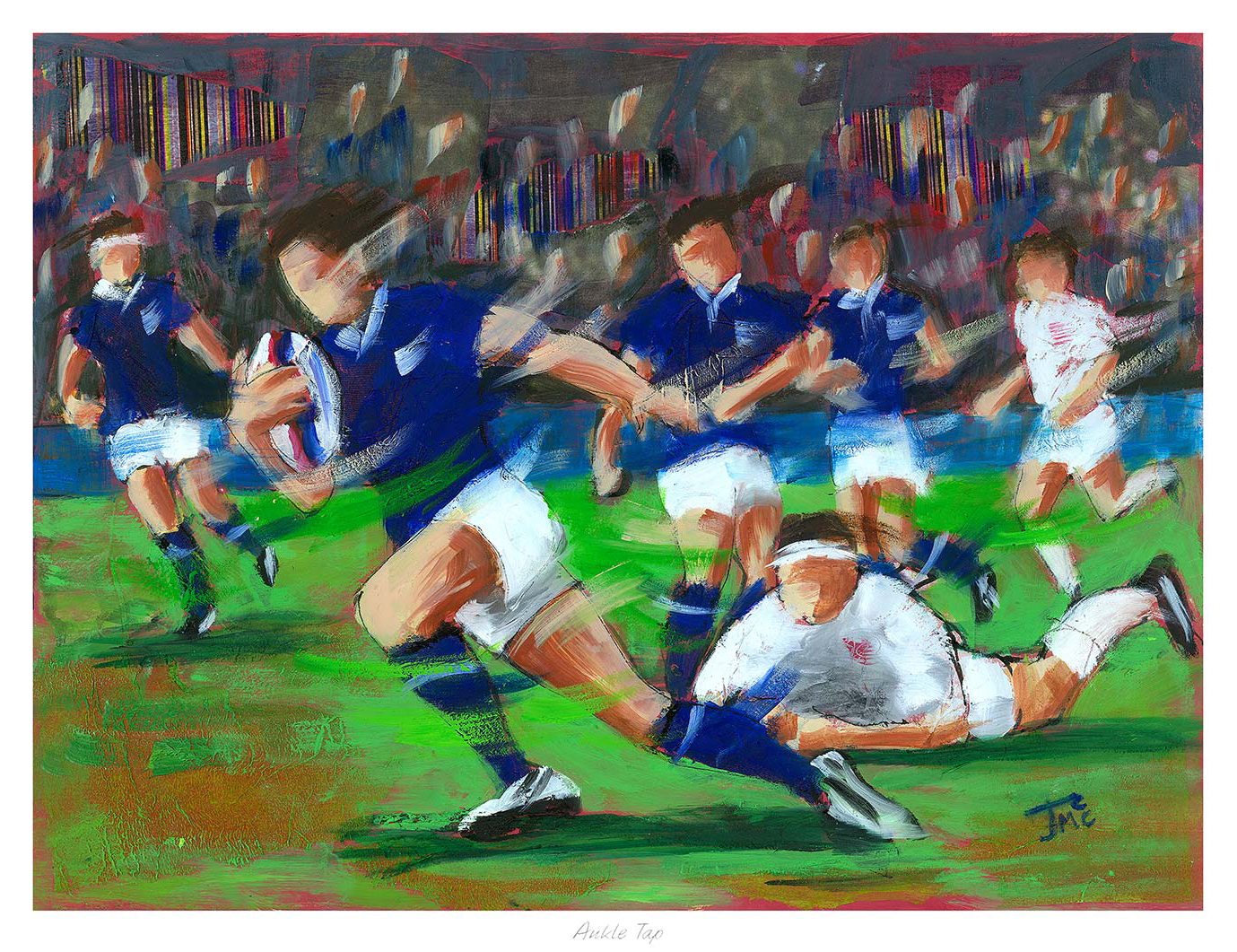
Scottish rugby wall art for a clubhouse lounge should express the energy of the game without making the social space feel like an equipment store. Ankle Tap by Janet McCrorie captures a decisive instant: a blue-clad runner drives forward as an opponent reaches for the ankle tackle. The loose marks and blurred background make speed the subject. That sense of motion can give a clubhouse lounge identity while leaving trophies, photographs and conversation room to breathe.
Start with the purpose of the clubhouse lounge
A good lounge serves several groups. Players may arrive after training, families may gather on match day and visitors may use the room for presentations or private functions. Artwork therefore needs clear sporting relevance, but it should not depend on one team photograph or one season’s result.
An action scene works well because it describes the game itself. The tackle, balance and forward movement are familiar across age groups and eras. Members can recognise the physical judgement behind the moment, while a visitor can still enjoy the colour and composition without knowing a particular player.
Place Scottish rugby wall art for a clubhouse lounge
Begin with the main sightlines. A picture above low seating can hold a conversation area together. A quieter wall near the entrance can establish the room’s character before guests reach displays and noticeboards. Avoid a position where open doors, tall screens or standing crowds regularly hide the central tackle.
Possible position
Why it can work
Check before hanging
Above a sofa
Connects the artwork to the social seating zone
Allow a safe gap above heads and centre on the furniture
Opposite the bar
Gives people a strong view while they wait
Control reflections from downlights and glass shelving
Near the honours display
Links present-day sporting energy with club history
Leave enough wall so neither display feels crowded
Inside the function area
Adds club identity when the room hosts outside groups
Keep portable screens and decorations clear of the frame
Mark the complete framed size with low-tack tape. Then check the outline from seated and standing positions. A clubhouse often has more viewing angles than a domestic room, so test it from the doorway, the main tables and the route to the bar. The image should read clearly without obstructing practical signs.
Let the action provide energy, not visual clutter
The blue kit, white opponent and warm crowd tones already give the image strong contrast. There is no need to repeat every colour around the lounge. Pick one connection instead. Upholstery in a related blue, warm timber tables or a restrained accent wall can help the picture belong without making the interior look over-coordinated.
Keep laminated notices and fixture sheets away from the artwork’s immediate edge.
Group small historic photographs separately instead of surrounding the action print.
Use closed storage for loose kit, awards packaging and event materials.
Choose warm, even lighting that reveals the brushwork without creating glare.
Club colours matter, but exact matching is rarely necessary. A frame that works with permanent joinery and seating will remain useful when the room is redecorated. If the team’s colours are already strong across the walls, a calmer mount and moulding can give the artwork a valuable visual pause.
Use sporting art beside memorabilia with discipline
Trophies, caps and signed shirts carry direct club history. Their value comes from specificity. Art plays a different role: it can convey the feeling of play and make the room welcoming even when visitors do not share those memories. Give each type of display its own zone rather than asking one wall to carry everything.
A useful arrangement might place trophies in a lit cabinet, team photographs in a chronological group and the print above the main seating. This creates a hierarchy. The action image is the broad focal point, while members can approach the smaller records when they want detail.
Choose presentation for a busy shared room
Clubhouse walls face more movement than most living rooms. Chairs may be rearranged, events may bring temporary decorations and people may pass close to the frame. Fixing, finished dimensions and glazing should therefore be considered alongside colour. The frame needs to support the print and suit the practical conditions of the site.
First 4 Frames produces colour-managed Giclée prints and completes bespoke, hand-finished framing in-house at its Falkirk workshop. A one-to-one consultation can help the club compare mouldings, mounts and the final scale against existing displays. That measured approach gives the limited edition print presence without making it feel oversized.
Well-placed Scottish rugby wall art for a clubhouse lounge can honour the game and improve the room without competing with the club’s real history. View the framed limited edition Ankle Tap print for a scene built around timing, balance and the instant before a runner breaks free.
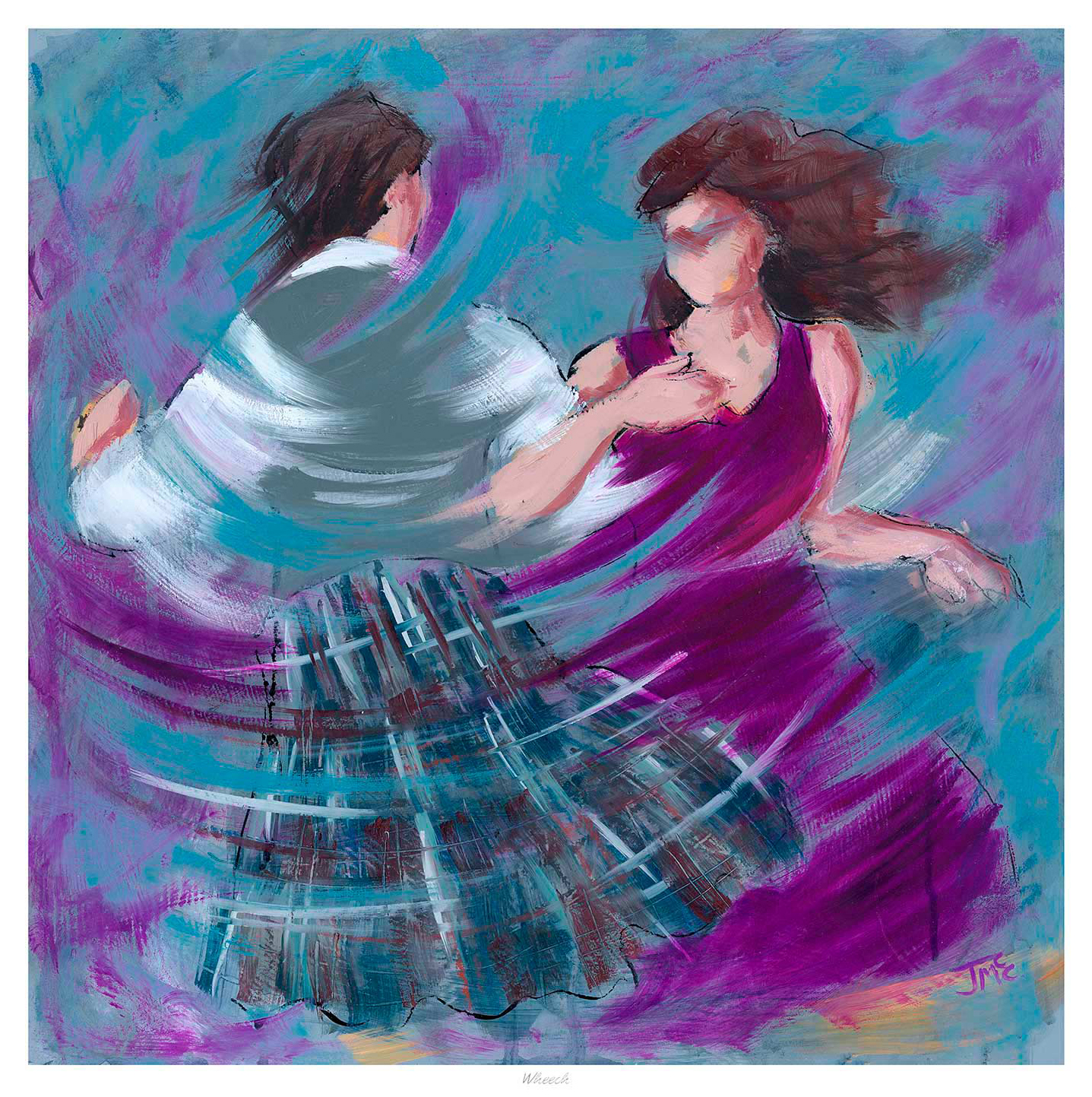
Scottish dance competition gift feels most personal when it reflects the dancer’s real experience rather than relying on a generic medal, date or slogan. Wheich provides a real subject, colour palette and finished frame to assess.
Choose a Scottish dance competition gift for the person
Wheich depicts two dancers moving together: one in tartan and one in a flowing purple dress. Scraped, layered colour suggests energy rather than recording a formal pose. That makes the limited edition print relevant to competition, ceilidh and country-dance memories without becoming a certificate on the wall.
Three questions before buying
Does the recipient enjoy expressive colour in their home?
Will a pair of dancers carry a genuine shared memory?
Is there a clear wall where movement can be seen from a little distance?
A gift does not need a printed name to be specific. A short handwritten note can explain why the image recalls a first competition, a regular dance partner or years of practice. Keep that message with the card rather than altering the artwork.
For a younger dancer
Ask about their room colours and available wall space. Avoid assuming that every dancer wants tartan accessories around the image.
For a teacher or partner
Connect the picture to encouragement, shared rhythm or a memorable event. The reason should be more important than the occasion label.
The strongest commemorative gift reflects an ongoing passion, so it still matters after the event has passed.
Frame a Scottish dance competition gift to preserve its energy
The blue and purple ground, tartan detail and moving figures need controlled reproduction. Colour-managed Giclée production keeps those relationships lively. In-house bespoke framing gives a limited edition print a substantial, hand-finished presentation suited to a lasting gift.
A Scottish dance competition gift should recognise more than one result. Wheich celebrates partnership and movement, making the connection personal enough to live beyond presentation day.
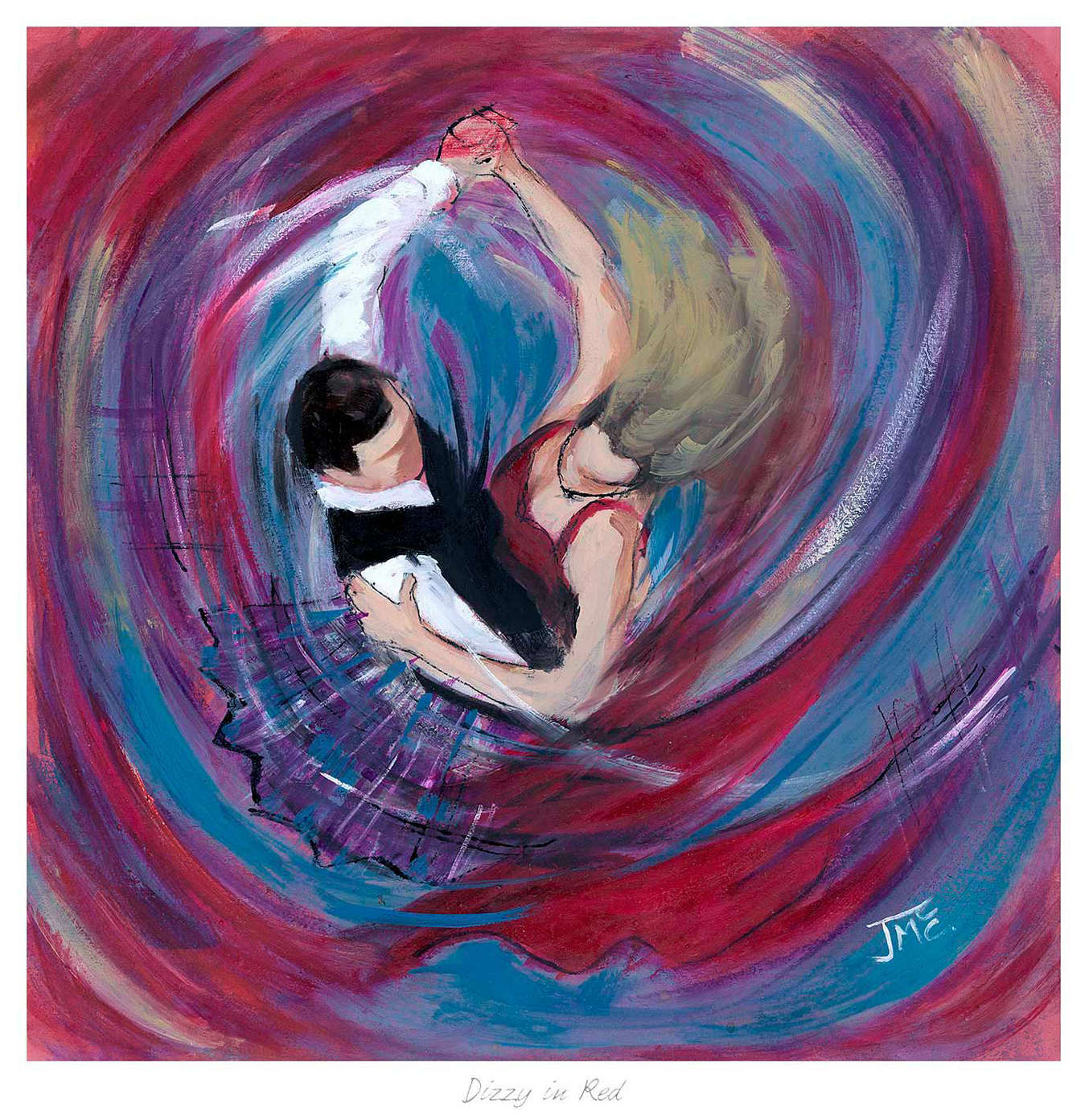
Scottish dance wall art with statement lighting needs to respond to the room as well as the subject. Dizzy in Red offers a useful starting point because Janet McCrorie’s dancers carry rhythm, tartan and vivid movement, so the artwork can answer a bold pendant without both features occupying the same visual line.
Separate Scottish dance wall art with statement lighting from the fitting
Stand at the doorway and note where the pendant crosses the walls.
Sit at the table or sofa and repeat the check.
Choose a wall where dancers remain visible beside the fitting.
Switch on each lighting circuit and inspect reflections.
Mark the complete frame before fixing anything.
A dramatic light fitting occupies three-dimensional space. The picture needs a clear field behind furniture or across a diagonal. Centring both features on one axis may make the pendant obscure the dancers.
Let movement connect them
A curved fitting may echo the energy of dance without copying colour or tartan.
Let space separate them
Clear wall and a simple table prevent two confident features becoming clutter.
The print already provides Scottish pattern and red colour. Avoid tartan curtains, dance silhouettes and ceilidh signs. One disciplined reference feels more contemporary.
Light wall art for a room with statement lighting deliberately
Scraped marks, tartan cues and vivid red need accurate reproduction to retain energy. Colour-managed Giclée production preserves those relationships, while bespoke glazing and framing can be assessed under the room’s real lights.
Wall art for a room with statement lighting works when each focal point has a distinct job. Dizzy in Red supplies movement and colour; planned sightlines let the pendant shape the room without hiding the dance.
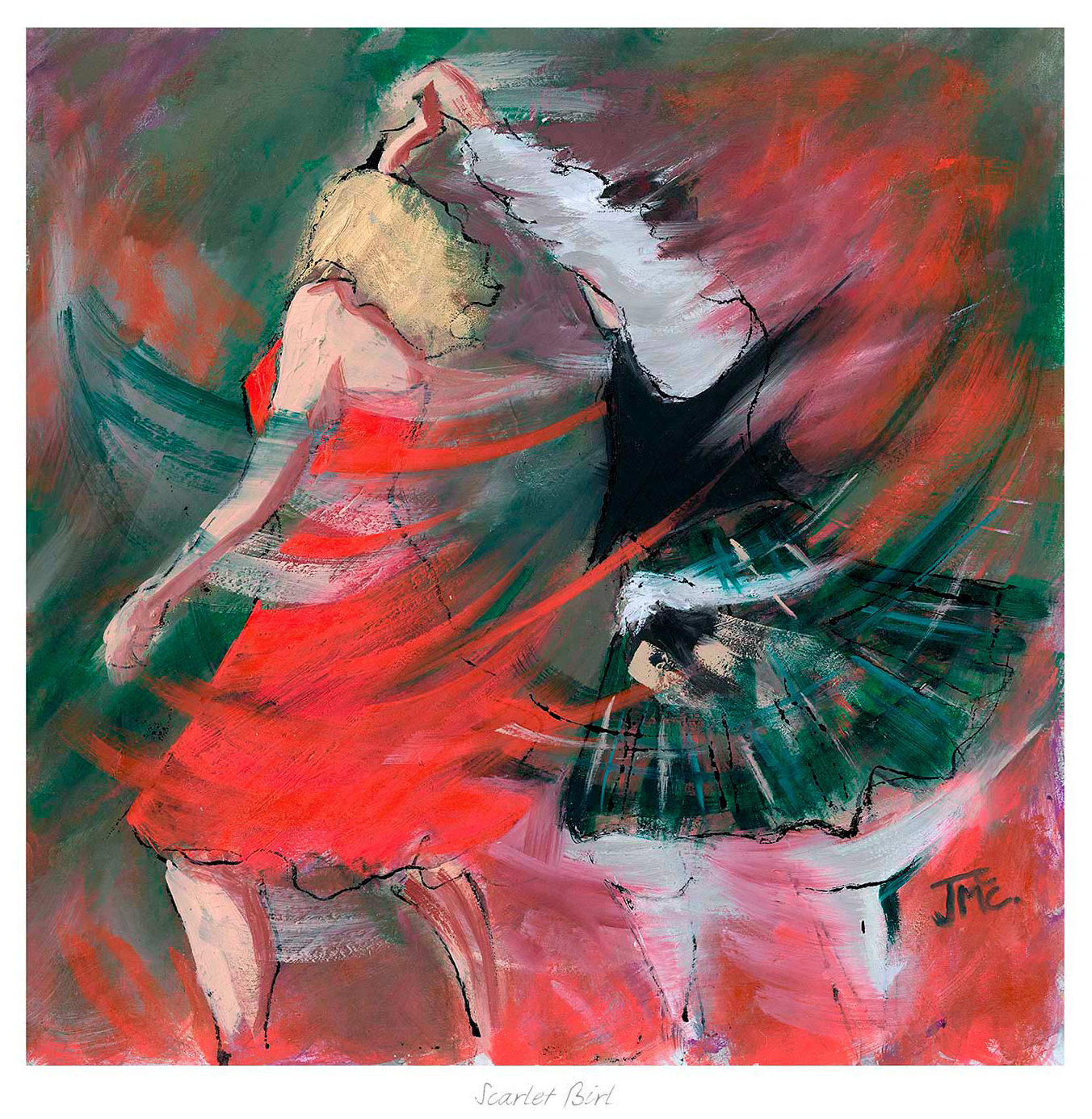
dance wall art for a rehearsal room should earn its place through a clear connection to the room, recipient or daily routine. Scarlet Birl provides a specific starting point because its two expressive figures carry the turn and momentum of a shared dance, so the room needs no extra instructional graphics.
Place dance wall art for a rehearsal room beyond the mirror
The mirror wall is rarely the best location. Reflections, barres and moving bodies can fragment the picture or create glare. A side wall near the entrance gives dancers a moment of energy before practice, while an end wall can provide a visual destination during floor work.
Protect the movement zone
Mark the outer frame, then test turns, travelling steps and carried equipment. Nothing should project into active clearance.
Control reflected light
Check ceiling spots from the instructor’s position and floor level. Shift the artwork before accepting a persistent bright patch.
Scarlet Birl needs little thematic support. Shoe silhouettes, motivational slogans and several performance photographs would turn a working room into a display. Let Janet McCrorie’s pair carry the expressive story while storage, flooring and sound treatment remain practical.
Movement in the artwork should encourage the room’s purpose without competing with the people using it.
Keep dance wall art lively but secure
Energetic marks and scarlet colour need a print process that retains separation instead of becoming a blur. Colour-managed Giclée production supports the motion, while accurate mounting and robust in-house framing suit an active shared room.
Dance wall art for a rehearsal room should support concentration as well as atmosphere. Scarlet Birl brings two figures and immediate momentum, provided the position respects mirrors, lighting and safe movement.
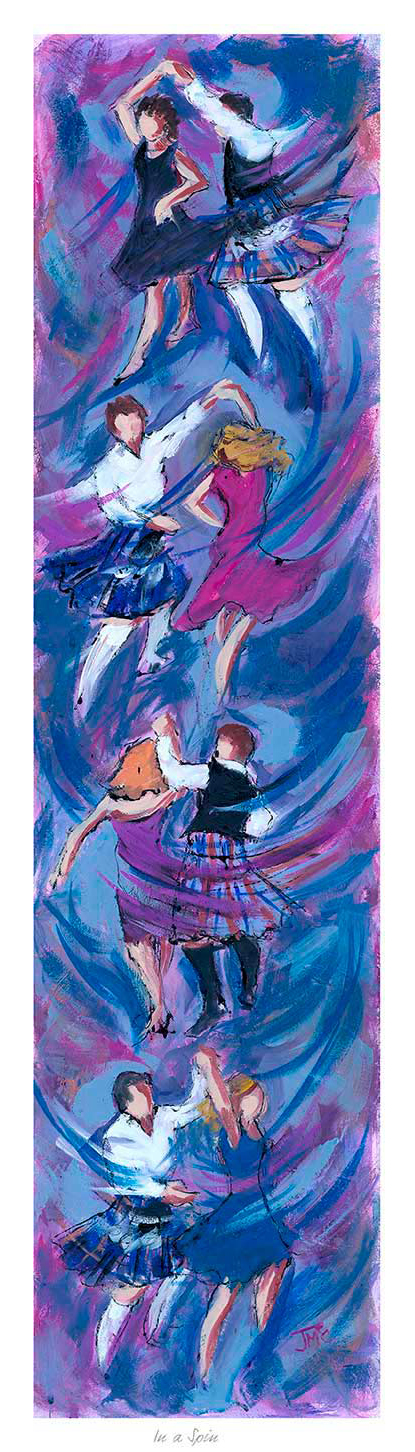
Scottish wall art for a staircase should earn its place by answering a real question about the room or recipient. In a Spin is a useful starting point because its turning couples, coloured dresses and kilts already describe circular movement that can echo the route around a landing.
Position Scottish wall art for a staircase in motion
Walk the staircase before marking the wall. Identify the point where the picture first appears, the place where it is seen straight on and the moment it disappears. A strong position often sits near a turn, where the dancers can draw the eye towards the next flight.
Mark the complete frame with low-tack tape.
Check the lower view without leaning over the handrail.
Confirm that the main figures are clear at landing height.
Keep switches and wall lights outside the composition’s visual edge.
Test shadows after dark before fixing the final height.
The staircase supplies the changing viewpoint; the artwork should supply the rhythm, not a long procession of smaller frames.
One energetic piece can be more effective than a gallery arrangement in this setting. It leaves the route safer and calmer while allowing the scratched colour, tartan and circular gestures to register from several levels.
Keep the mixed-media marks crisp at each viewpoint
Janet McCrorie’s scraped and scratched colour depends on detail that remains visible as the viewer moves. Controlled Giclée reproduction and a securely hand-finished frame help preserve that energy while giving the limited-edition print a resolved presence.
Scottish wall art for a staircase works especially well when subject and route share a sense of movement. In a Spin leads the turn with energy, while one deliberate hanging position keeps the architecture clear.
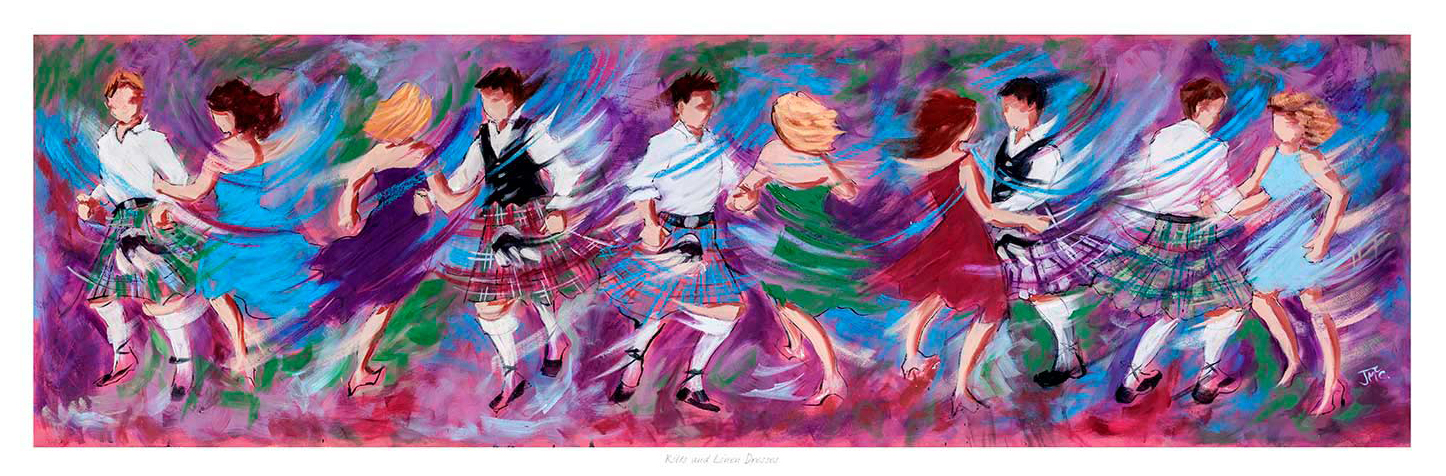
Scottish ceilidh gift ideas are most meaningful when they recognise the shared experience of dancing rather than relying on a slogan. Kilts and Linen Dresses captures turning figures, tartan and the social energy of the floor. As a signed limited-edition Giclée print, it can mark a wedding, anniversary, club milestone or friendship formed through dancing with lasting visual substance.
Choose a Scottish ceilidh gift for a real connection
For a couple
The paired movement can recall a wedding ceilidh or years of dancing together without printing names or dates across the image.
For a teacher or club organiser
The work recognises the movement and community they help sustain. A short handwritten note can carry the personal thanks while the art remains timeless.
For someone leaving Scotland
It offers a lively cultural connection that can travel into a new home without looking like a generic souvenir.
Before ordering, consider where the recipient is likely to display the piece and whether vivid colour already has a place in their home. The best gift is easy to live with. A considered frame can calm the energetic marks and help the dancing figures sit comfortably in a dining room, hall or music space.
Let the limited-edition craft support the memory
Janet McCrorie uses mixed media, scraping and scratching vibrant colour to suggest tartan and movement. A signed limited-edition Giclée print preserves that layered energy, while colour-managed production and bespoke in-house framing give the gift a polished finish suited to long-term display.
As a Scottish ceilidh gift, Kilts and Linen Dresses celebrates people in motion and the pleasure of dancing together. That shared human memory gives it more staying power than themed accessories or novelty text.
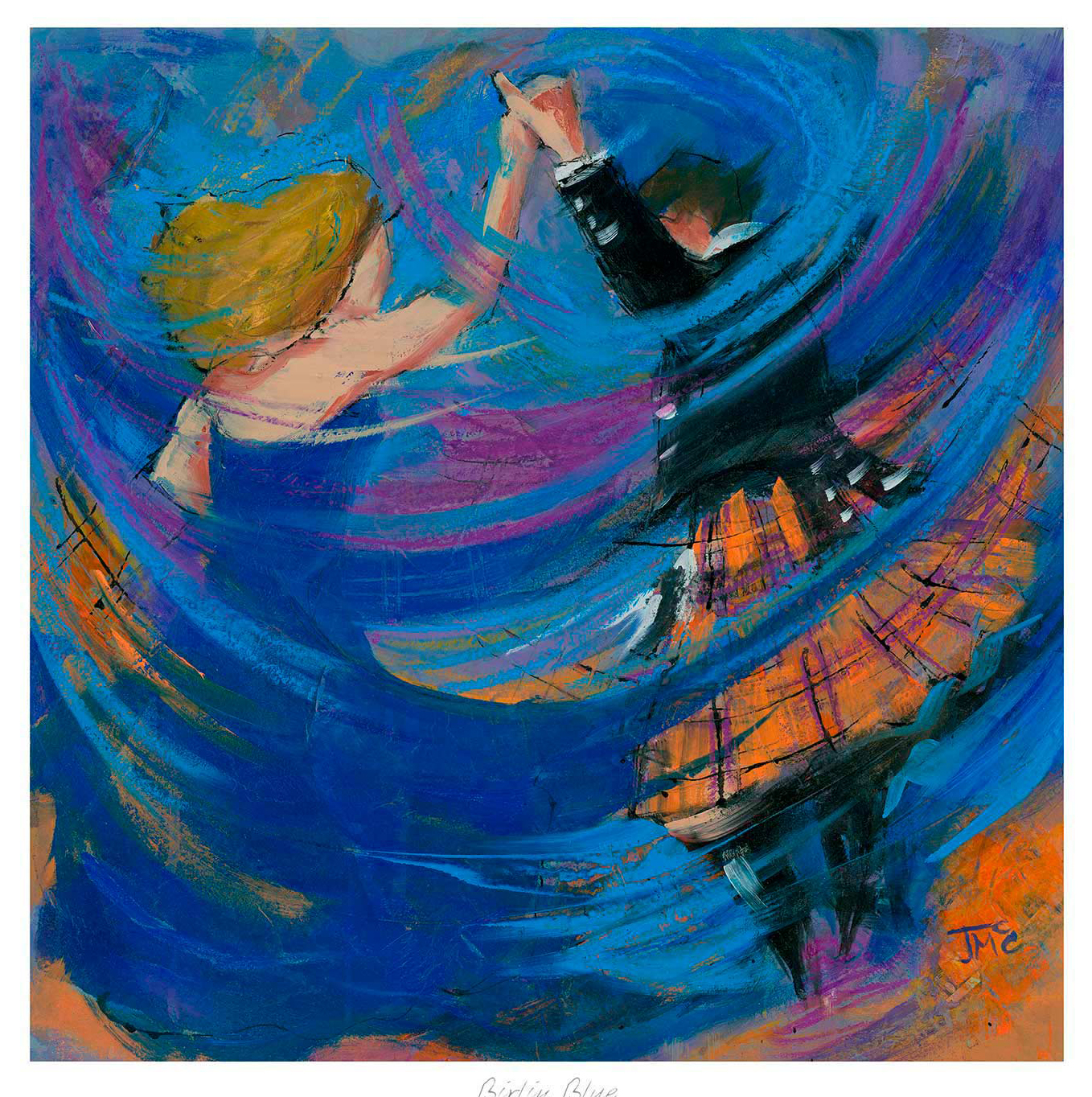
Scottish dance wall art for a music practice room can make rhythm visible without covering the walls in notes, clefs, or instrument diagrams. Birlin Blue by Janet McCrorie captures two turning dancers through vivid blue, purple, pink, black, and orange tartan. The result feels active even when the room is quiet.
Use Scottish dance wall art for a music practice room as the tempo
Place the picture where it can be seen during a pause, not directly behind a music stand. Above a low cabinet or on the wall opposite the instrument, it offers a change of focus without distracting from notation. The square composition can also work between acoustic panels if generous space remains around the frame.
Repeat rhythm through spacing
Align the frame with the useful zone below it, then keep stands, cases, and cables from clustering at one side. Balanced spacing supports the circling movement inside the image.
Choose only one or two colour echoes. A blue chair, warm timber instrument, or rust-coloured textile can connect with the dancers. Avoid tartan accessories throughout the room; the painted kilt is more effective when it remains a concentrated note.
Keep direct speakers and vibrating instrument surfaces away from the frame.
Test reflections under the main practice light.
Allow enough distance to read both figures together.
Use proper wall fixings in rooms where equipment is moved often.
Keep scraped marks and saturated colour articulate
Movement in this limited edition comes from both the figures and the artist’s scratched, layered marks. Colour-managed Giclée production protects those relationships instead of flattening them into one bright field. Bespoke hand finishing gives the energetic square a disciplined boundary within a working room.
As Scottish dance wall art for a music practice room, Birlin Blue supplies rhythm, memory, and exuberance while keeping the interior free of decorative clichés.
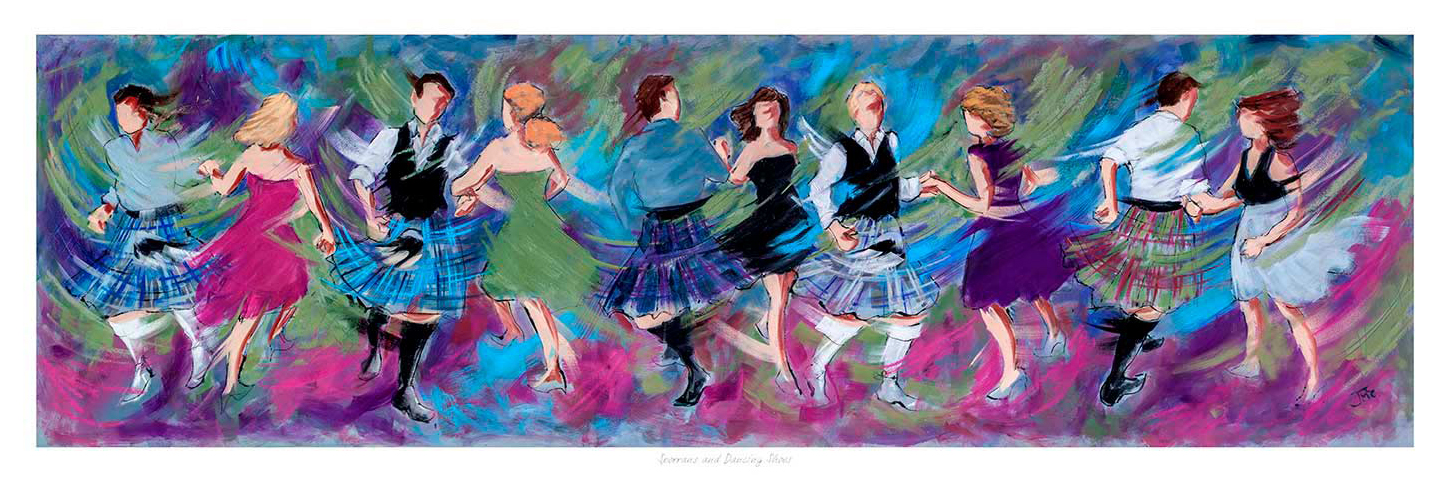
Scottish dance wall art for a dining room can make the space feel sociable even before the music starts. Sporrans and Dancing Shoes captures turning couples, visible sporrans, tartan, and quick footwork through scraped and layered colour. It conveys the pleasure of a ceilidh without asking the rest of the room to become a Scottish-themed set.
Use Scottish dance wall art for a dining room where people gather
Choose the social wall. Place the print near a dining table, music corner, or open area used when friends visit.
Allow for movement. Leave clear wall around the frame so the turning figures do not feel boxed in by shelves or tall objects.
Echo colour sparingly. One tartan note in a throw or one warm red accessory is enough to connect the image to the room.
Balance tradition with a modern finish
The subject has heritage, but the expressive surface keeps it lively. A simple frame and generous mount can emphasise that contemporary quality. This avoids the heavier look that carved furniture and multiple tartans might create.
The print can also hold personal meaning for someone who dances, attends ceilidhs, or associates Scottish music with family celebrations. Its energy remains enjoyable even when the viewer does not know a particular step.
Janet McCrorie’s limited-edition image relies on crisp changes between tartan, shoes, and gestural colour. First 4 Frames uses colour-managed Giclée production and completes the bespoke framing in-house, giving the lively surface a polished, ready-to-hang finish.