
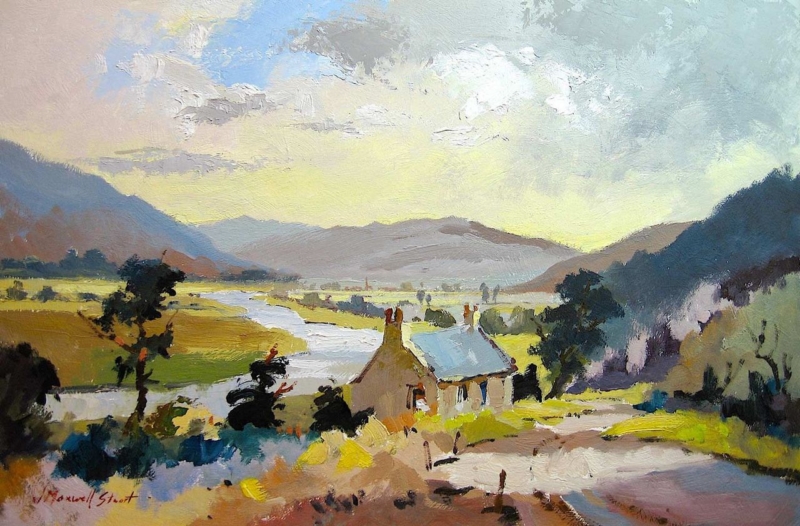
Scottish landscape wall art above a dining bench can make an informal eating area feel broader, calmer, and more connected to its setting. Walkerburn Retreat by Joseph Maxwell Stuart is especially well suited to the job. Its long valley, pale river, cottage roof, and open sky create a clear outward view. The landscape adds depth behind the seating without making the wall feel busy or heavily decorated.
Why Scottish landscape wall art above a dining bench works
A dining bench creates a strong horizontal line. Artwork that ignores that line can look detached, while a cluster of small frames may compete with people, cushions, tableware, and pendant lights. A single landscape gives the seating a visual destination. It also establishes a horizon that helps the whole arrangement feel settled.
Walkerburn Retreat has more than a distant view. The foreground path leads past the cottage and towards the River Tweed. Dark trees hold the two sides, while the brighter central valley keeps the composition open. Loose, expressive marks stop the scene from feeling photographic or overly formal. That balance suits a bench used every day rather than a dining room reserved for occasions.
Size the artwork to the bench, not the whole wall
Begin with the width of the bench or banquette. The finished frame should feel clearly related to the seating but should not extend beyond it. Mark the likely frame dimensions with low-tack tape or a paper template. Then sit down, stand at the table, and enter from the adjoining room. This reveals whether the picture feels properly centred from the viewpoints that matter.
- Check seated headroom. Leave a comfortable gap above the tallest regular user, including room for relaxed movement.
- Allow for cushions. Deep back cushions can change the usable wall and push people closer to the frame.
- Read the full composition. The cottage, river, and pale sky should remain visible above the table setting.
- Open nearby doors. Confirm that a door, blind, or cupboard does not cut across the finished frame.
The available print sizes include a broader 550 by 365 millimetre option and a compact 350 by 230 millimetre option. Finished dimensions will increase once the mount and moulding are added, so plan around the complete framed piece rather than the image size alone.
Use the valley colours without creating a country theme
The painting combines yellow-green fields, soft blue, chalky cloud, warm stone, and near-black trees. Those colours give several decorating routes, but they do not all need to be repeated. One warm timber table may connect to the cottage. A muted blue cushion can pick up the river and roof. Plain linen or wool adds texture without copying the landscape literally.
| Dining-area feature | Helpful response |
|---|---|
| Painted bench | Choose one quieter blue, green, or stone tone from the image |
| Natural timber table | Let the wood echo the warm path and cottage without exact matching |
| Patterned cushions | Keep the frame and surrounding wall restrained |
| Open-plan kitchen | Repeat one artwork colour in a small ceramic or textile only |
This controlled approach keeps the room contemporary. The recognisable Scottish subject supplies place and character, while the furniture can remain simple. Avoid adding several tartan, stag, or thistle motifs around it. They would turn a nuanced landscape into part of a decorating theme.
Protect the picture from dining-area conditions
A bench near a kitchen may receive steam, grease, and rapid temperature changes. Keep framed work away from a hob, kettle station, radiator, or wall that regularly becomes damp. If the bench sits below a window, watch direct sun and check whether the blind hardware leaves enough clearance.
Pendant lighting can help the picture after dusk, but the bulb should not create a bright reflection in the glazing. View the proposed position from the opposite chair at the hour when the table is normally used. A small shift in hanging height or light angle often solves glare before any fixing is made.
Frame the open view with enough definition
A slim dark moulding can relate to the trees and give the pale sky a crisp edge. A warm timber frame may sit more softly with an oak table or built-in bench. A measured mount can add breathing space, especially when the surrounding wall carries shelves or strong paint colour.
First 4 Frames produces colour-managed Giclée prints and completes bespoke framing by hand at its Falkirk workshop. This in-house approach helps the subtle sky, bright valley, and darker foreground retain their balance. It also allows the moulding, mount, glazing, and final dimensions to be considered for the actual dining area.
A real Tweed Valley setting behind the view
Joseph Maxwell Stuart studied drawing at the Ruskin School and fine art at Edinburgh College of Art. His direct, energetic landscape painting gives this view atmosphere without losing its structure. Browse the wider Joseph Maxwell Stuart collection at First 4 Frames. For local context, the Walkerburn community website introduces the village, its history, and its Tweed Valley surroundings.
Well-placed Scottish landscape wall art above a dining bench can turn an everyday bench into a properly resolved part of the room. View the framed Walkerburn Retreat print for a broad, lively landscape that brings depth, Scottish character, and hand-finished quality to informal dining.