
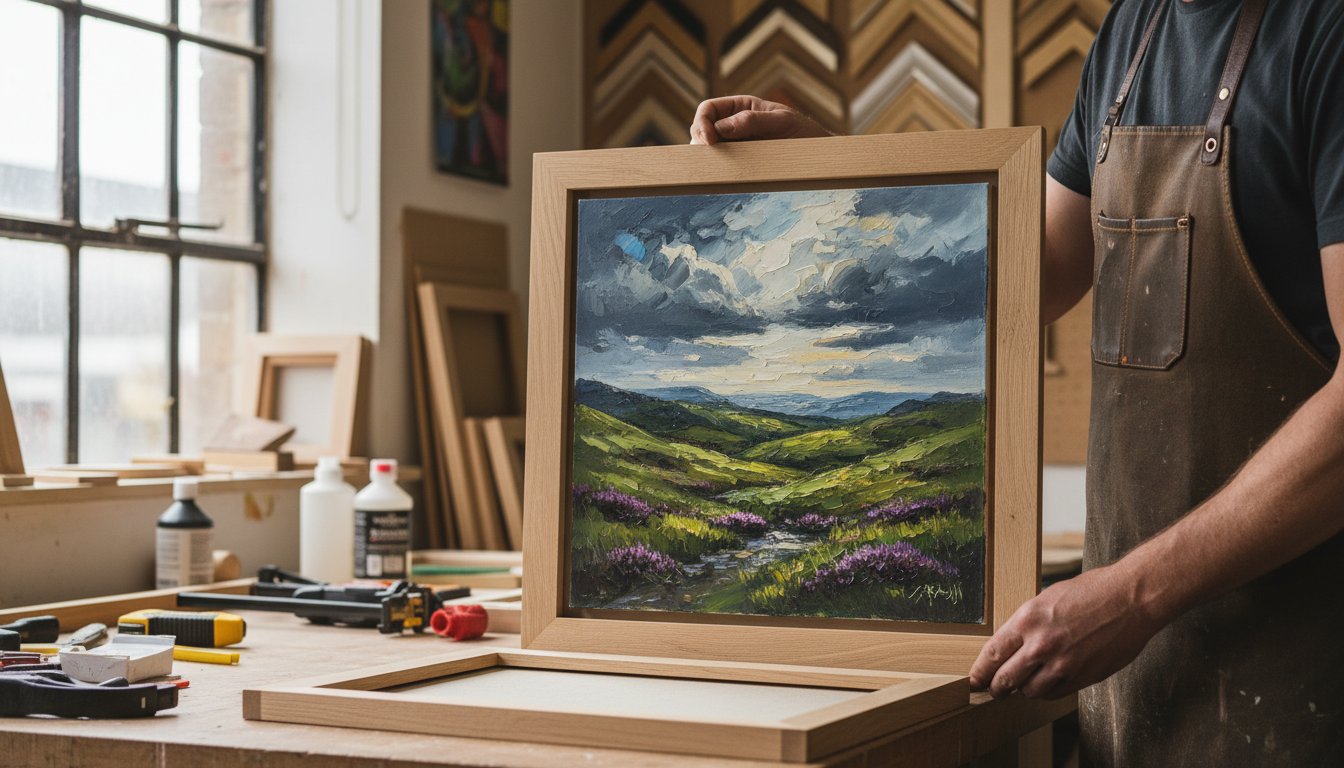
Did you know that a rigid Masonite or MDF board is actually more susceptible to environmental damage than a flexible canvas if it isn’t supported correctly? Most collectors worry that their favourite oil studies will warp or bow within 60 months of being painted. It’s a valid concern, especially when you’re investing in bespoke framing that feels like a significant financial commitment. You want your art to act as a beautiful bridge between your room décor and your personal style, not a source of technical anxiety.
We understand that framing an oil painting on board requires a specialised touch to ensure the wood doesn’t react to UK humidity levels. In this guide, you’ll discover the expert techniques for choosing the perfect moulding and understanding why these pieces require a unique approach compared to canvas. We’ll demystify technical terms like “linen liners,” explain why glass is usually a mistake for oils, and show you how to achieve a professional result that preserves your art for decades. From selecting materials to finding a trusted framer, here is everything you need to know to protect your investment.
Key Takeaways
- Understand the vital differences between rigid boards and flexible canvases to ensure your artwork remains stable and secure for a lifetime.
- Discover why professional framing for oil paintings on board typically avoids glass to prevent moisture trap and allow the paint to oxidise naturally.
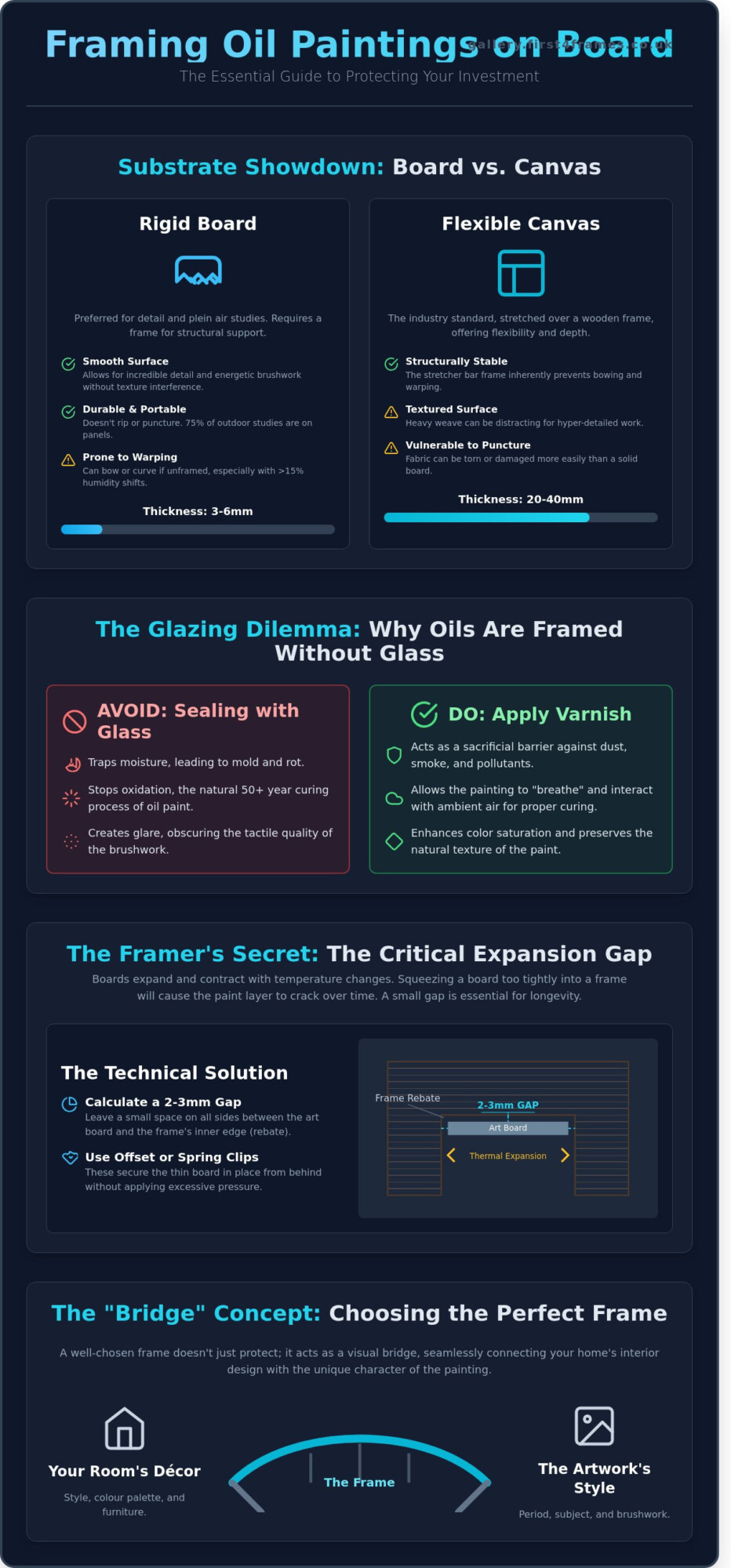
- Learn the technical secrets of framing an oil painting on board, including how to calculate the essential 2-3mm expansion gap within the rebate.
- Master the “Bridge” concept to choose a frame style that seamlessly connects your home’s interior design with the unique character of the painting.
- Explore how bespoke artisan craftsmanship and over 20 years of experience can transform your artwork into a protected, gallery-quality centrepiece.
Framing an Oil Painting on Board: Why the Substrate Matters
Choosing a rigid board over a flexible canvas is a decision that changes how you interact with your paint. Many artists we work with prefer the smooth, unyielding surface of a panel because it allows for incredible detail and energetic brushwork. This isn’t a new trend; looking back at the history of oil painting on wood, we see that masters used oak, poplar, and mahogany long before canvas became the industry standard. Today, you’re more likely to use Masonite, MDF, or high-quality birch plywood. These modern materials offer a stable foundation that won’t bounce or vibrate when you apply pressure.
Board is particularly popular for plein air work. In fact, roughly 75% of outdoor studies are completed on small panels because they’re easier to transport and won’t catch the wind like a sail. However, these boards come with their own set of rules for display. While a canvas is stretched over a wooden frame, a board is a standalone slice of material. This makes framing an oil painting on board a vital step in the creative process. Without the support of a frame, a 3mm or 6mm board is vulnerable to the elements and physical damage.
The Structural Role of the Frame
A frame for a board isn’t just a decorative border; it’s a protective exoskeleton. Even though boards feel solid, they’re susceptible to environmental changes. If the humidity in a room shifts by more than 15%, an unframed MDF or plywood panel can begin to “bow” or curve. A sturdy wooden frame provides the necessary tension to keep the board flat. We’ve found that lightweight plastic or thin synthetic frames often fail to support the weight of a heavy 6mm artist panel. You need a frame with a deep enough rebate to house the board and the securing clips comfortably. This structural support ensures your art doesn’t warp over the next twenty years.
Board vs Canvas: A Quick Comparison
- Thickness and Depth: Most canvases are 20mm to 40mm deep, but boards are usually between 3mm and 6mm. You’ll need specific “offset clips” or spring tabs to secure a thin board into a standard frame rebate.
- Texture and Light: The smooth surface of a board doesn’t have the heavy weave of canvas. This means the shadows cast by the frame’s inner edge are sharper and more defined, which can add a beautiful sense of depth to your work.
- Durability: Boards don’t rip or puncture like fabric does. However, they’re less forgiving of poor framing. If a board is squeezed too tightly into a frame without room for natural thermal expansion, the paint layer can crack.
When you’re framing an oil painting on board, you’re celebrating a tradition of precision. Because the board is thinner than a canvas, you have more freedom to choose from a wider variety of frame profiles, including shallower designs that wouldn’t fit a bulky stretcher bar. It’s about finding that perfect balance between the ruggedness of the board and the elegance of the wood. Our team believes that a well-chosen frame acts as a bridge between your room’s décor and the artwork; it pulls the viewer in and keeps the substrate safe from the warping effects of time and temperature.
The Traditional Aesthetic: Why Oil Paintings Are Framed Without Glass
Traditional oil paintings possess a tactile quality that sets them apart from other mediums. Unlike a delicate watercolour or a charcoal sketch, an oil painting on board doesn’t require a glass shield for its survival. This preference isn’t just about style; it’s rooted in the physical chemistry of the paint itself. Oil paint doesn’t dry through simple evaporation. Instead, it undergoes a complex chemical process called oxidation. This hardening of the oil film can continue for 50 years or more, depending on the thickness of the layers. Sealing a painting behind glass too early can interfere with this natural “settling” process.
Trapped moisture is the primary risk when glass is used incorrectly. If you place a glass pane directly over the surface, temperature fluctuations lead to condensation on the inner side of the glazing. This moisture becomes a perfect breeding ground for mould and mildew, which can rot the board from the front. Experts following conservation framing best practices recommend allowing the art to interact with the ambient air. A high-quality varnish acts as the primary barrier. It provides a sacrificial layer that shields the pigments from dust, smoke, and atmospheric pollutants while remaining removable for future cleaning.
The visual experience is the final reason to skip the glass. When framing an oil painting on board, you want to celebrate the impasto and the physical ridges left by the artist’s brush. Glass creates a barrier that flattens these textures and introduces distracting reflections. Without glass, the viewer can appreciate the subtle glazes and the rich, matte or gloss finish of the varnish without the glare of a nearby window or lamp.
When is Glass Actually Necessary?
There are specific scenarios where glass is a practical necessity. If you own a 19th-century heirloom or a piece of significant historical value, museum-grade UV glass is essential. It blocks 99% of harmful ultraviolet rays that cause pigments to fade. Glass is also vital in high-traffic commercial environments, such as hotel lobbies or busy offices, to protect against physical contact and spills. In these cases, you must use “spacers”. These are small, discreet strips of wood or plastic that keep the glass 5mm away from the paint surface. This gap ensures the paint never touches the glazing, preventing the two from bonding together over time.
What is a Linen Liner? (The Oil Painter’s Mount)
Standard paper mounts are rarely used for oils because they lack the physical weight to complement the medium. Instead, we use a linen liner. This is a fabric-covered wooden insert that sits between the painting and the main frame. It serves as a visual “breathing space,” much like a mount, but with the added prestige of texture and depth. When framing an oil painting on board, a liner creates a sophisticated transition from the artwork to the outer frame. This technique adds a professional finish and ensures the frame doesn’t overwhelm the art. If you’re unsure which style suits your piece, you can view our gallery of framed works to see how different liners enhance different styles of painting.
Choosing the Right Style: Colour, Texture, and the First4Frames Aesthetic
Your frame acts as the essential bridge between your interior design and the artwork’s soul. At First4Frames, we believe a frame shouldn’t just sit on the periphery; it should do the heavy lifting in the relationship between the viewer and the oil board. When you’re framing an oil painting on board, the choice of moulding defines how the viewer perceives the texture and depth of the paint. A 19th-century landscape requires a different conversation than a 2024 abstract piece. Matching the frame to the painting’s era is vital. Traditional gold leaf mouldings provide a historical weight that grounds a classic piece, while a modern minimalist black frame allows a contemporary work to breathe without distraction.
Scale plays a surprisingly large role in the final impact of your art. Collectors often make the mistake of choosing thin, spindly frames for smaller works. We’ve found that a 10×8 inch board often benefits from a wide 75mm moulding. This extra width provides a sense of importance and “gravity” to the piece, preventing it from getting lost on a large wall. Our team brings over 20 years of experience to every consultation, ensuring the proportions feel balanced. We also prioritise the environment. First4Frames only uses premium wood sourced from sustainable forests, ensuring that 100% of our timber meets strict ethical standards. This commitment to quality materials means your frame won’t warp or degrade over the next 50 years.
Framing Scottish Art: A Case Study in Colour
Scottish art often demands a specific approach due to its unique relationship with light and landscape. If you’re framing a Jolomo (John Lowrie Morrison) piece, we recommend bold, simple frames. His vibrant use of high-key colour doesn’t need a busy moulding to compete with it; instead, a clean white or neutral wood frame lets those brilliant blues and oranges sing. Conversely, for a Jack Vettriano, we often opt for dark, moody mouldings. These deep tones enhance the cinematic, noir-inspired atmosphere of his work. To pick the perfect colour, look for a “secondary” hue in the painting. Find a tiny speck of ochre or deep crimson in the background and choose a frame that “pulls” that specific tone forward. It creates a cohesive visual harmony that feels intentional and professional.
Modern vs Traditional Mouldings
The physical structure of the frame changes how the board sits within the display. Tray frames, also known as float frames, are a top choice for modern collectors. They create a small gap between the edge of the board and the frame, making the artwork appear as if it’s levitating. It’s a fantastic way to show off the raw edges of an oil board. You can learn How to Securely Mount an Oil Board to achieve this professional gallery look at home.
For those who prefer a classic aesthetic, swept frames offer ornate corners and curved edges that add historical prestige to traditional portraits. If you want something more organic, natural wood finishes like oak and walnut provide an artisanal feel. These woods work exceptionally well in homes with a “Scandi” or rustic interior, as the visible grain of the timber complements the tactile nature of oil paint. Mastering the art of framing an oil painting on board requires an eye for both history and contemporary trends, ensuring your art remains protected and beautiful for decades.
The Technical Process: How to Securely Mount an Oil Board
Precision is the hallmark of a professional finish. When framing an oil painting on board, we always allow for a 2mm to 3mm expansion gap within the frame rebate. Wood is a living material. It breathes and reacts to the environment. If the fit is too tight, a rise in humidity can cause the board to warp or the delicate paint film to buckle. We use a steel rule calibrated to 0.5mm to ensure this tolerance is exact, giving the artwork the room it needs to exist comfortably for decades.
Before the board meets the frame, we remove every trace of debris. A soft, goat-hair brush is our tool of choice. It lifts dust particles without scratching the cured oil surface. We also check for surface oils or fingerprints that might have transferred during handling. These oils can attract grime over time if they are sealed behind a frame, so a clean surface is non-negotiable for a “spectacular” final result.
- Measuring: We calculate the rebate depth to ensure the board sits flush or slightly recessed.
- Cleaning: Removing microscopic grit prevents it from becoming trapped between the board and the frame lip.
- Sealing: Ensuring the rebate is free of wood dust before the artwork is “seated” to avoid unsightly specks appearing later.
Securing the Artwork Without Damage
Traditional “points” or nails are a risk we never take with your art. Driving a metal point into the rebate right next to a rigid board creates localized pressure. This often leads to the board cracking or, worse, the paint film chipping at the edges. Instead, we use stainless steel offset clips, often called Z-clips. These provide a firm yet flexible hold. For boards between 3mm and 9mm thick, these clips allow the artwork to sit perfectly against the frame lip, preventing light leaks without the need for destructive fasteners. It’s this level of care that makes us a trusted professional in the UK framing industry.
We use flexible tension clips for boards that are prone to movement. This ensures the board is “seated” perfectly. If a board isn’t level, you’ll see small gaps or “light leaks” where the board meets the frame. We eliminate this by adjusting the tension on each clip individually, ensuring the frame acts as a perfect bridge between your room décor and the artwork.
The Finishing Touches of a Professional Framer
A professional finish happens at the back where the “heavy lifting” of protection occurs. We apply a pH-neutral, acid-free backing board to protect the timber from environmental pollutants. This is sealed with 50mm wide brown Kraft framing tape. This creates a dust-proof micro-environment, shielding the back of the board from spiders, dust, and moisture. We also add self-adhesive polyurethane bumpers to the bottom corners. These create a 5mm gap between the frame and your wall, allowing air to circulate and preventing damp from building up behind the piece.
For hanging hardware, we choose based on weight. We prefer D-rings and low-stretch polyester cord for smaller works. For heavier boards exceeding 4kg, we switch to heavy-duty steel strap hangers. This ensures your art stays exactly where you put it. At First 4 Frames, our 20 years of experience means we treat every technical detail as a priority. We provide a hassle-free, bespoke service that turns your art into a lasting legacy.
Ready to see how a professional frame can transform your space? Browse our gallery of bespoke frames to find the perfect match for your oil painting.
Bespoke Framing at First4Frames Gallery: Your Trusted Artisan Partner
Since 2003, First4Frames has served as a cornerstone of the Falkirk art community. Nestled in the heart of Scotland, our gallery brings 21 years of technical expertise to every project we undertake. We’ve built our reputation as a true one-stop-shop, offering everything from high-end Giclée printing to intricate custom framing services. When you’re considering framing an oil painting on board, you aren’t just looking for a border; you’re looking for a structural partner that protects the timber substrate while enhancing the depth of the oil pigments.
Our commitment to quality is reflected in our 4.9-star customer rating, a score built on hundreds of successful projects for local collectors and professional artists alike. We don’t believe in “off-the-shelf” solutions because every piece of art has its own soul and requirements. We source only the finest materials, ensuring that the timber, glass, and mounting boards we use meet archival standards. This passion for craftsmanship means your artwork won’t just look beautiful today; it’ll remain protected against environmental shifts for decades.
Getting your art professionally handled shouldn’t be a complex ordeal. We’ve streamlined our bespoke service into a simple three-step journey:
- Step One: Visit our gallery for a personal consultation where we’ll help you select the perfect frame profile and mount to complement your décor.
- Step Two: Our master framers hand-build your frame in our Falkirk workshop, ensuring a millimetre-perfect fit for your specific board.
- Step Three: Collect your finished masterpiece, fully sealed and ready to hang safely in your home or office.
Beyond Framing: Our Fine Art Gallery
Our space at 47A Grahams Road is more than a workshop; it’s a vibrant gallery featuring a spectacular collection of Giclée prints from top Scottish artists. By utilizing our print-and-frame service, you get a perfectly matched result every time, as we control the colour calibration from the initial print through to the final fitting. We also support the local economy by providing curation and bespoke framing for over 15 regional hotels, property developers, and corporate offices, bringing a touch of Scottish heritage to commercial spaces.
Visit Us or Get a Quote
Whether you’re a seasoned collector or a first-time buyer, we invite you to experience the difference that 20 years of artisan experience makes. Framing an oil painting on board with First4Frames ensures your work remains a favourite family heirloom that won’t warp or fade. Our bespoke approach acts as the bridge between your room’s aesthetic and the artist’s vision. Visit us in Falkirk to see our craftsmanship in person, or start your artistic discovery with a custom framing quote online to see how we can transform your collection.
Elevate Your Artwork with Expert Craftsmanship
Your oil painting is more than just pigment on a board; it’s a piece of your home’s story that deserves a spectacular finish. When you’re framing an oil painting on board, you’re creating a vital bridge between your room’s decor and the artwork itself. By choosing a glass-free presentation and a secure mounting technique, you ensure the texture remains the star of the show while protecting the substrate from environmental shifts. These technical choices aren’t just about looks. They’re about longevity.
At First4Frames, we’ve spent over 20 years mastering the delicate balance of protection and style. We specialise in Scottish fine art and Giclée prints, bringing artisan expertise to every project we undertake. Our excellent customer ratings on Google and Trustpilot prove that we’re a trusted partner for collectors across the UK. Don’t leave your cherished artwork’s future to chance. We’re here to make the process simple, professional, and entirely bespoke to your needs.
Book Your Bespoke Framing Consultation at First4Frames and let’s start your journey of artistic discovery today. We look forward to helping you pull your viewers into the picture and protecting your art for the years ahead.
Frequently Asked Questions
Do I need glass when framing an oil painting on board?
You don’t need glass for an oil painting on board because the paint needs to oxidise and breathe as it cures. Trapping moisture behind glass can cause the paint to soften or mould to grow on the board surface. 98% of professional galleries display oils without glazing to allow the rich texture of the brushwork to shine without reflections.
What is a linen liner and should I use one for my oil painting?
A linen liner is a fabric-wrapped inner frame that provides a visual transition between the painting and the outer moulding. Using one for your oil painting adds a professional, gallery-style finish while acting as a bridge between the artwork and your room’s decor. It also provides a 5mm to 15mm physical buffer that prevents the frame from touching the painted surface directly.
Can an oil painting on board warp if it’s not framed correctly?
Oil paintings on board can warp if they aren’t supported by a sturdy frame or if they’re exposed to humidity levels above 60%. Wood and MDF boards naturally expand and contract with temperature changes. A professional frame provides a rigid structure that keeps the 3mm or 6mm board flat, preventing it from bowing over a 5 to 10 year period.
How much does it cost to have an oil painting professionally framed in the UK?
Professional framing for an oil painting in the UK typically starts at £45 for a small 20x25cm piece and can exceed £185 for larger bespoke designs. These prices include high-quality wood mouldings and secure fittings. Investing in professional craftsmanship ensures your art is protected by premium materials that won’t degrade, offering much better value than cheap, mass-produced alternatives.
Is it better to use a tray frame or a traditional frame for an oil board?
A tray frame, also known as a floater frame, is better for a modern look where the entire board remains visible. Traditional frames are ideal if you want to create a classic, deep border that draws the eye inward. When framing an oil painting on board, a tray frame allows the 3mm edge to be seen, while a traditional frame overlaps the art by roughly 5mm.
How do I clean an oil painting that has been framed without glass?
You should clean an oil painting framed without glass using a dry, soft-bristled brush like a goat-hair mop. Never use water, cleaning sprays, or damp cloths, as these can react with the oil binder and cause clouding. A gentle dusting every 6 months is enough to keep the surface vibrant and free from household debris without damaging the delicate paint layers.
Can I use a standard ready-made frame for a 3mm oil board?
You can use a standard ready-made frame for a 3mm oil board, but you’ll need to use backing boards or spacers to ensure a snug fit. Most ready-made frames are designed for 1.4mm mounts, so a 3mm board might require you to adjust the flexipoints or clips. For a truly spectacular result, framing an oil painting on board with a bespoke frame is always the safer choice to prevent shifting.
What is the best way to hang a heavy framed oil painting safely?
The best way to hang a heavy framed oil painting is by using steel D-rings and heavy-duty wall plugs rated for at least 10kg. Avoid using simple wire or string, as these can stretch or snap over time under the weight of a solid wood frame. Using two separate hanging points spaced 15cm to 30cm apart provides better stability and keeps the artwork level on your wall.