
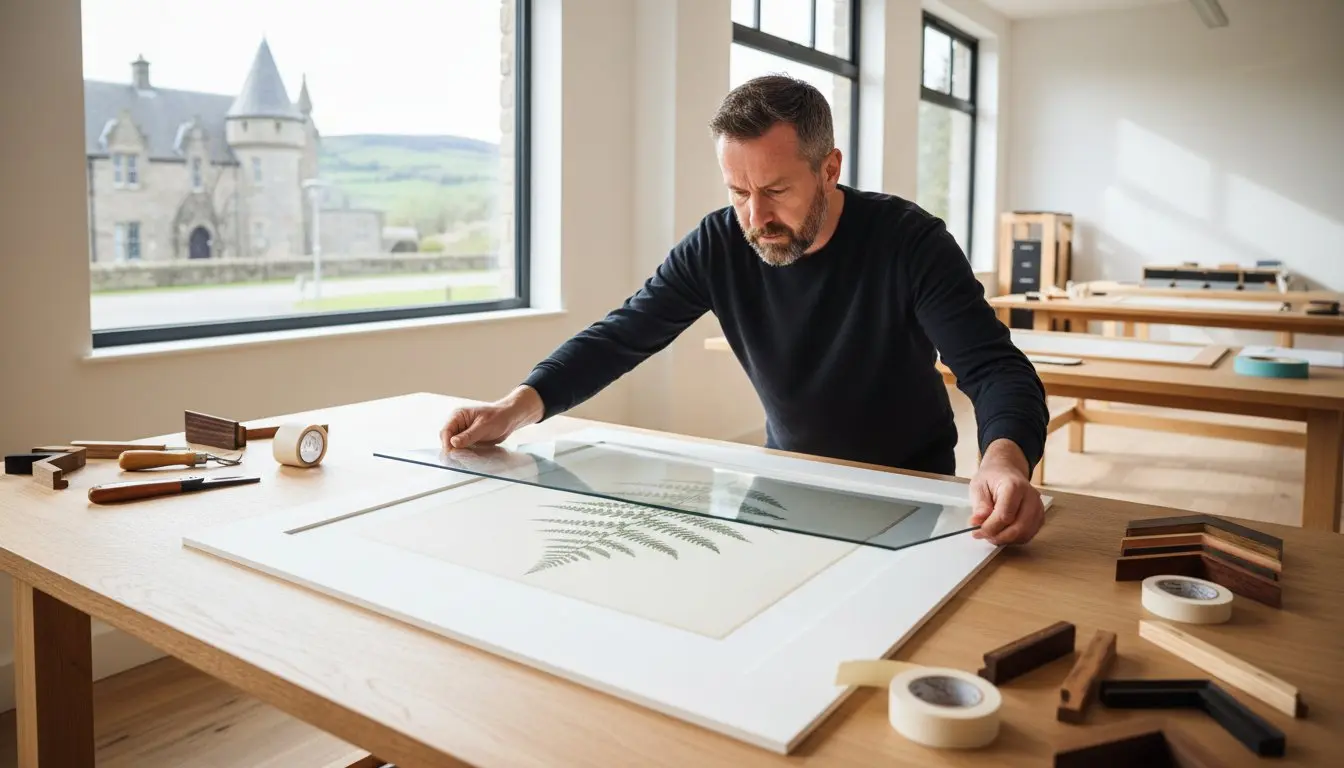
Last Tuesday, a collector visited our workshop with a 1950s original that had sadly developed nasty yellow stains around the edges. It’s a heartbreaking sight, but it happens more often than you’d think when standard materials are used instead of conservation-grade ones. You probably agree that your most precious memories, whether they’re family heirlooms or a signed print from the First4Frames Gallery, deserve better than a “one size fits all” approach. You want peace of mind that your investment is safe from acid burn and fading for the next 50 years.
In this guide, we will explain exactly how to frame something valuable using the same professional techniques that have earned our framing service over 450 five-star customer reviews. We’ll show you how to navigate the technical world of UV glass and museum-grade mounting without the confusion. You’ll learn how to select a bespoke frame that serves as a perfect bridge between your artwork and your home décor, ensuring your piece remains protected and spectacular for decades to come.
Key Takeaways
- Discover why pH-neutral, acid-free materials and UV-protective glazing are essential to prevent permanent damage like “acid burn” on your precious pieces.
- Learn the professional secrets of how to frame something valuable by selecting the correct conservation level to protect your item’s financial and sentimental worth.
- Explore how a bespoke frame serves as a vital bridge between your room’s décor and the artwork, perfectly complementing the palette of fine art from the First4Frames Gallery.
- Follow our straightforward process to organise your project with a trusted professional, backed by our 20-year heritage of craftsmanship and excellent customer ratings.
- Understand how professional gallery framing acts as a long-term investment, significantly increasing the perceived value and legacy of your most cherished memorabilia.
Understanding the Risks: Why Standard Frames Can Damage Your Valuable Art
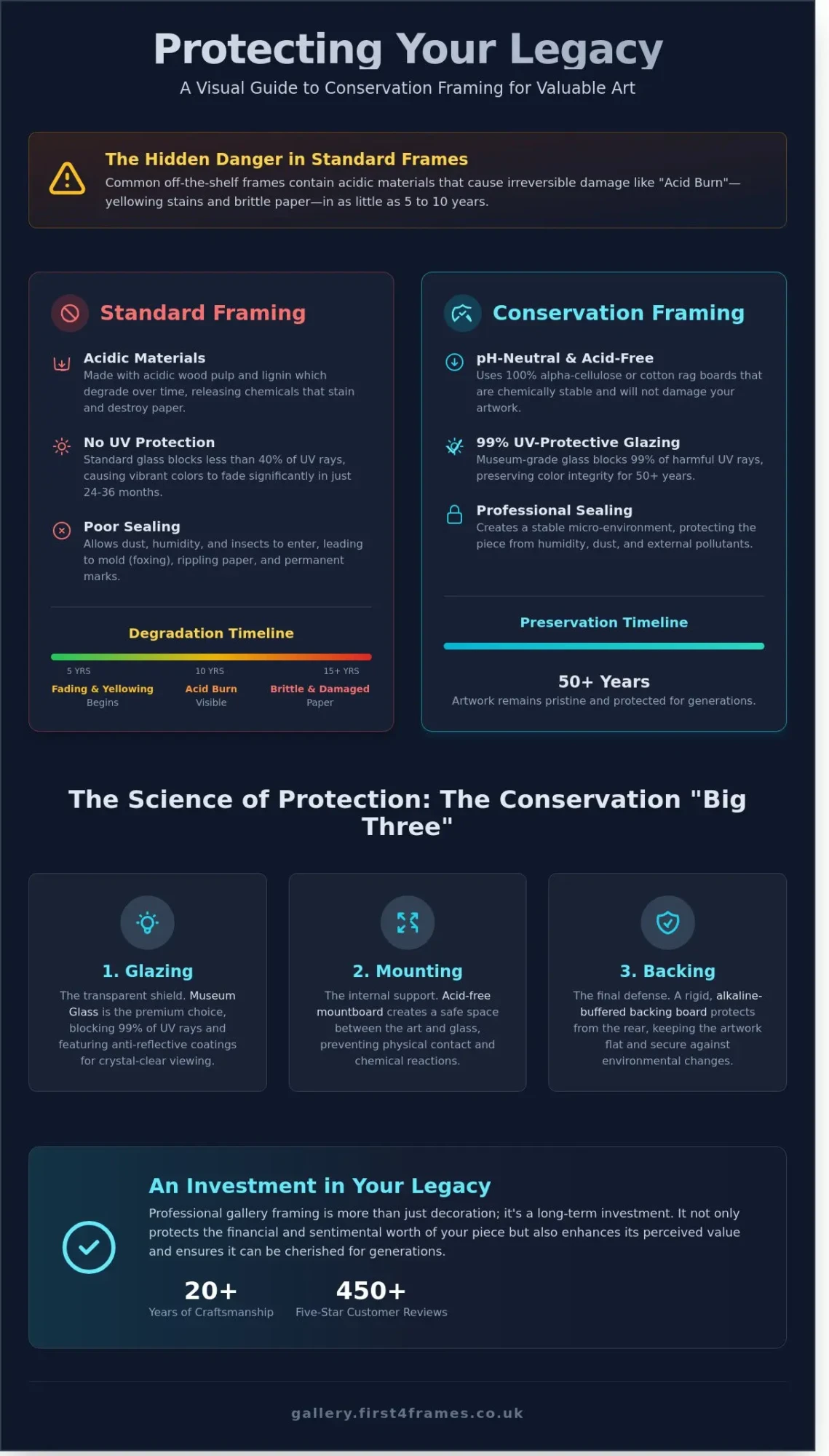
At the First4frames gallery, we believe that every piece of art tells a story that deserves to be preserved. When you consider how to frame something valuable, it’s vital to recognise that value isn’t always a high price tag. While a £2,000 original watercolour from one of our featured artists certainly qualifies, so does a historical family map or a sentimental photograph. Value is defined by financial, historical, or emotional significance, and all these items require professional care to survive the decades. Standard, shop-bought frames often fail this test because they are constructed with acidic wood pulp. Over a period of 5 to 10 years, these materials release lignin, leading to “acid burn” that turns paper brittle and yellow.
To better understand the nuances of identifying and protecting your treasures, watch this helpful video:
Beyond internal chemical reactions, your art faces constant threats from light, humidity, and temperature. These silent enemies work slowly. UV rays can fade a vibrant Giclée print in just 24 months if it lacks the proper shielding. Fluctuating humidity in UK homes can cause paper to ripple or “cockle,” while poor sealing allows dust and tiny insects to crawl behind the glass, leaving permanent marks on the surface.
The Long-Term Impact of Poor Framing
The damage caused by low-quality materials is often permanent. Foxing, those unsightly brown spots caused by fungal growth in damp or acidic environments, is incredibly difficult to reverse. When you choose archival or conservation picture framing, you are preventing these issues before they start. Conservation framing is the practice of using reversible, pH-neutral techniques and materials to safeguard art for future generations. This ensures that the mounting and backing don’t react with the artwork, keeping the paper as pristine as the day it was created.
When to Choose Bespoke over Ready-Made
Learning how to frame something valuable involves knowing when a standard size simply won’t do. Original watercolours, signed Giclée prints, and 3D memorabilia like sports shirts or medals require the depth and precision that only a bespoke service provides. Off-the-shelf frames rarely offer the correct clearance between the glass and the art, which can lead to the piece sticking to the glaze over time. With over 20 years of experience and a 4.9-star customer rating, our team understands that a frame should be a bridge between your room décor and the artwork. A bespoke frame doesn’t just protect; it enhances the visual impact of the piece, ensuring it sits perfectly within your space.
The Science of Protection: UV Glass, Acid-Free Mounts, and Sealing
Protecting a masterpiece requires more than a simple border. It involves the “Big Three” of conservation: glazing, mounting, and backing. When you are learning how to frame something valuable, these three layers act as a shield against the environment. At First 4 Frames, we use premium materials to ensure your investment remains pristine for decades. pH-neutral, acid-free materials are non-negotiable for any item of worth. Standard boards contain lignin, which eventually turns into acid. This leads to “mount burn”, those unsightly brown stains often seen on prints from the 1990s or earlier. By using 100% alpha-cellulose or cotton rag mats, we guarantee your artwork stays chemically stable.
- Glazing: The transparent front that shields against dust, moisture, and light.
- Mounting: The internal border that separates the art from the glass and provides structural support.
- Backing: The rigid, alkaline-buffered support that keeps the artwork flat and protected from the rear.
Choosing the Right Glazing (Glass)
Light is a silent thief. UV rays can cause a vibrant Giclée print to lose 45% of its colour saturation in just 36 months if left under standard glass. We recommend UV-protective museum glass for any valuable work. It blocks up to 99% of harmful rays while remaining virtually invisible. For larger pieces, such as the expansive landscapes often found in our featured artist collections, we suggest high-quality acrylic. It is lighter than glass and shatter-resistant, making it safer for frames over 100cm in width.
The Importance of Conservation Mounting
The mount, or mat, does more than look pretty. It creates a vital air gap between the artwork and the glazing. This prevents condensation from forming, which can lead to mould growth or the art sticking to the glass. We often use “spacers” for a modern, float-mounted look to ensure this gap remains consistent. Double-mounting is another excellent choice. It adds 3mm of extra depth and draws the eye toward the centre of the piece. When choosing colours, pick a shade that complements a secondary tone in the artwork. This pulls you into the picture rather than distracting you with a bold border. Using a professional mount is a crucial step in how to frame something valuable without risking long-term damage.
True conservation framing is always reversible. We never use permanent tapes or adhesives that could mark the paper. Instead, we use T-hinges or Japanese paper hinges with wheat starch paste. This means the art can be removed from the frame in its original condition at any time. Our 20 years of experience has taught us that the best framing shouldn’t leave a trace on the art itself. This level of craftsmanship is why we maintain a 4.9-star rating on Google Reviews; we treat every piece with the respect it deserves.
Choosing a Bespoke Style: Enhancing the Aesthetic of Fine Art
A frame acts as the essential bridge between your room’s décor and the artwork itself. It does the heavy lifting in the relationship between the art and the wall; it ensures the piece doesn’t just hang there but actually belongs in the space. When you are learning how to frame something valuable, you should select a colour that pulls from the artwork’s secondary palette rather than the dominant one. This subtle approach prevents the frame from competing with the subject while creating a cohesive visual flow. Our team at First4frames uses over 20 years of craftsmanship experience to help you find that perfect balance.
Matching the frame to the era of the piece is vital for maintaining its integrity. A contemporary Banksy print often requires the clean, industrial lines of a modern tray frame or a minimalist black wood. Conversely, a traditional oil landscape usually demands a more ornate, gilded profile to honour its heritage. Floating frames are currently a popular trend for unvarnished originals and canvas prints. These frames leave a 5mm gap between the canvas and the frame edge. This creates a sophisticated shadow that makes the art appear to hover within its border.
Framing Famous Scottish Artists
The First4frames gallery showcases how specific styles suit iconic artists. For Jolomo prints, we recommend bold, clean frames that highlight his vibrant use of colour and textured brushstrokes. Jack Vettriano’s work requires a different touch. His cinematic, 1940s-inspired atmosphere is best served by moodier, classic frames in dark wood or deep metallics. With our premium Giclée prints, the right bespoke frame can make a high-quality copy look virtually identical to an original. Our customers frequently mention this attention to detail in their five-star reviews.
Memorabilia and 3D Object Framing
Preserving history requires more than just a flat border. We use box frames to house medals, football shirts, and family heirlooms. These frames use depth to create a shadow box effect, which protects 3D items from touching the glass while providing a museum-quality display. It’s a vital technique when considering how to frame something valuable like a sports jersey or a military honour. You can create a compelling narrative by using multi-item layouts; placing a vintage photograph next to a medal turns a single item into a complete story. This professional approach ensures your most precious memories are both protected and spectacularly displayed.
A Step-by-Step Guide to Organising Your Framing Project
Understanding how to frame something valuable requires a blend of artistic vision and technical precision. At the First4frames gallery, we’ve spent over 20 years perfecting this balance, ensuring that every piece, from a rare original to a cherished family heirloom, receives the protection it deserves. We’ve simplified the process into four clear steps to help you achieve a professional result that lasts a lifetime.
- Step 1: Measure with precision. Accuracy is the foundation of a great frame. You can measure the item yourself using professional techniques or bring it directly to our Falkirk centre for a complimentary assessment.
- Step 2: Define your conservation level. We’ll help you choose materials based on the item’s financial or sentimental value. This includes selecting UV-protective glass if the piece will hang in a sunlit room.
- Step 3: Design the aesthetic “bridge”. Select mount colours and frame mouldings that complement both the artwork and your interior design. Our experts provide guidance to ensure the frame enhances the art without overpowering it.
- Step 4: Review and confirm. Before we begin the assembly, we’ll review the final design and discuss hanging requirements, especially for heavier bespoke frames that require specific wall fixings.
How to Measure Your Art Safely
Precision matters when you’re learning how to frame something valuable. It’s vital to distinguish between the “image area” and the “paper size”. The image area is the actual artwork, while the paper size includes any white borders or signatures. We recommend leaving a small gap between the mount and the image to show off a deckled edge or an artist’s signature. Never handle delicate art with bare hands; oils from your skin can cause permanent staining. Always use clean cotton gloves. For more help with dimensions, check our Standard Photo & Picture Sizes guide.
Consulting with a Professional Framer
When you visit our gallery in Falkirk, come prepared with a few key details. Describe your home décor or bring photos of the room where the art will hang. This helps our framers suggest a “bridge” style that connects the artwork to your space perfectly. Don’t be afraid to ask technical questions, such as “Are these mountboards acid-free?” or “Are these wood mouldings FSC certified?”. We source only the best materials to maintain our high standards. To transport your item safely, sandwich it between two pieces of stiff acid-free foam board and wrap it in a clean poly bag to protect against moisture during your trip to the gallery.
Why Professional Gallery Framing is an Investment in Your Legacy
Choosing the right frame is the final, essential stage for any piece of art to stand on. It acts as the bridge between your room’s décor and the artwork itself, ensuring the transition is seamless and sophisticated. When you consider how to frame something valuable, you aren’t just looking for a simple border; you’re creating a protective environment that secures the piece for decades. At First4Frames, we’ve spent over 20 years perfecting this craft in our Scottish workshop. Since 2004, our team has helped thousands of collectors in Falkirk and across the UK transform simple prints or family heirlooms into gallery-standard displays.
Professional framing significantly boosts the perceived value of your collection. A high-quality, bespoke frame signals to any observer that the work inside is worth protecting. We provide a unique one-stop-shop experience where you can buy art from our featured artists, utilise our premium Giclée printing services, and select a handcrafted frame all under one roof. This integrated approach ensures the highest quality control at every single step of the process. By handling the entire journey from the initial print to the final fitting, we guarantee a level of precision that separate services simply cannot match.
This principle of professional presentation boosting value extends to the digital world as well. For artists and galleries selling online, a professionally designed storefront is the digital equivalent of a bespoke frame, and e-commerce design specialists like those found at frooition.com help create these high-impact experiences.
The First4Frames Quality Guarantee
Trust is earned through consistency and care. Our 4.9-star customer rating across major review platforms reflects our commitment to excellence and the reliability of our work. We offer a hassle-free, speedy service that doesn’t compromise on the premium materials your art deserves. If you prefer a pre-curated look rather than starting from scratch, you can browse the gallery for ready-to-hang art that has been selected by our experts. Every item we produce is designed to stand the test of time without fading or warping, ensuring your investment remains as spectacular as the day it was framed.
Conclusion: Protecting Your Passion
A well-framed piece quickly becomes the focal point of any home. It draws the eye and pulls the viewer into the picture, doing the heavy lifting in your interior design by grounding the art in its surroundings. Whether it’s a rare original from one of our featured artists or a sentimental photograph, knowing how to frame something valuable ensures your passion remains vibrant for the next generation. We invite you to visit our Falkirk gallery to see our craftsmanship in person or contact our team today for a bespoke quote. Embark on a journey of artistic discovery with a partner who cares about your legacy as much as you do.
Invest in the Future of Your Collection
Your artwork is a vital part of your legacy. Protecting it requires more than just a decorative border; it demands a scientific approach to preservation. By utilising UV-protective glass and acid-free mounts, you prevent the gradual fading and yellowing that ruins unprotected pieces. At the First4frames gallery, we’ve spent over 20 years in Scotland refining a Red Dot Design-inspired approach to craftsmanship that treats every piece of art with the reverence it deserves. We’re proud to be a trusted partner for artists and commercial clients across the UK, maintaining a reputation for excellence backed by consistently high customer ratings on major review platforms.
Mastering how to frame something valuable means understanding that a frame is the bridge between your room’s décor and the artist’s original intent. Whether you’re selecting a new masterpiece from our featured artists, using our specialised print-and-frame service, or commissioning a bespoke frame for an heirloom, we ensure your investment stays pristine for decades. It’s about combining professional expertise with a genuine passion for the arts. We’re ready to help you transform your space while securing the longevity of your most prized possessions.
Explore our Bespoke Framing Services and Preserve Your Art Today
We can’t wait to help you begin your next artistic journey and see your collection shine in its best possible light.
Frequently Asked Questions
Is it worth framing a print that isn’t an original painting?
Yes, it’s absolutely worth it, especially for high-quality Giclée prints like those we showcase in the First4frames gallery. These prints use archival inks designed to resist fading for over 75 years. Professional framing acts as a vital bridge between your room décor and the artwork, protecting your investment. Even if it’s not a one-off original, a limited edition print can appreciate in value, so preserving its condition is a smart move.
How can I tell if my current frame is damaging my artwork?
Look for yellowing on the mount edges or small brown spots, known as foxing, on the paper. These are clear signs that acid is migrating from cheap materials into your art. If the paper touches the glass directly, moisture can get trapped and cause permanent sticking or mould. Our team has 20 years of experience spotting these issues, ensuring your cherished pieces remain in spectacular condition for decades to come.
What is the best glass to use for a frame that will be in direct sunlight?
You should choose Museum Glass or UV-protective glazing that filters out 99% of harmful ultraviolet rays. Standard glass allows UV light to pass through, which causes roughly 50% of all fading in artwork within just a few years. When you’re researching how to frame something valuable, selecting premium glazing is the most effective way to stop sunlight from bleaching the vibrant colours of a fine art print.
Can I change the mount and glass in an old frame to make it more protective?
Yes, we frequently upgrade existing frames with conservation-grade mounts and anti-reflective glass. This process allows you to keep a frame you love while ensuring the internal environment is entirely acid-free. By replacing standard 2mm glass with 99% UV-filter glazing, you provide a much safer home for your artwork. It’s a practical way to modernise the protection of your piece without the cost of a completely new bespoke frame.
How do I clean the glass on a valuable framed piece without damaging it?
Spray a small amount of ammonia-free glass cleaner onto a soft microfibre cloth rather than directly onto the frame. This prevents liquid from seeping under the rebate and soaking into the mount or the artwork itself. For museum-grade acrylic or anti-reflective glass, use only the specific cleaners we recommend in our workshop. This avoids scratching the delicate coatings that keep your art looking perfect and clear.
Does framing memorabilia like football shirts require special materials?
Framing memorabilia requires deep rebate frames and specialist shadow box techniques to ensure the fabric doesn’t touch the glass. We use stainless steel pins or invisible stitching to secure the item, avoiding glues that typically perish or stain fabrics after 5 to 10 years. This bespoke approach protects the 3D nature of the shirt while creating a beautiful, professional display that’s earned us excellent ratings from collectors across the UK.
What is the difference between acid-free and museum-grade mounting?
Acid-free mounts are pH neutral and suitable for many decorative items, but museum-grade cotton rag boards offer the highest level of protection available. While standard boards might start to degrade after 15 years, museum-grade materials are 100% alpha-cellulose and designed to last for centuries. Our experts at First4frames recommend these premium materials for any piece from our gallery that holds significant financial or sentimental value.
How long does a bespoke framing project typically take?
Our typical turnaround for a bespoke framing project is between 7 and 10 working days. This timeframe allows our craftsmen to source the best materials and complete the work to the high standards our customers expect. If you’re using our print-and-frame service for a piece by one of our featured artists, we often complete these orders within a similar window. We pride ourselves on providing a speedy, hassle-free service that doesn’t compromise on quality.