
Posted on

What Happens if You Use the Wrong Frame Backing? The Hidden Risks to Your Art

What Happens if You Use the Wrong Frame Backing? The Hidden Risks to Your Art

That standard piece of cardboard sitting behind your print feels solid enough, but it could be a ticking time bomb for your artwork. Many people assume that as long as a frame looks good on the outside, the internal components don’t matter. However, understanding what happens if you use the wrong frame backing is the difference between a lifetime of enjoyment and watching a sentimental landscape wall art piece slowly turn yellow. Cheap, mass-produced frames often rely on high-acid materials that leach chemicals into your art, a process that is often irreversible once the damage is done.

It’s natural to feel overwhelmed by technical jargon like ‘pH-neutral’ or ‘lignin-free’, especially when you just want to protect a beautiful Scottish landscape art print. You deserve to feel confident that your investment is safe. In this guide, we’ll demystify these terms and show you how First4Frames Gallery uses premium components, such as 2mm float glass and conservation-grade backing, to provide a chemical shield. You’ll learn how to identify acid burn and how to use tools like a wall art visualiser to design your framed artwork with total peace of mind. By choosing bespoke framed wall art or custom framed art prints crafted with care, you can ensure your favourite pieces remain as vibrant as the day they were printed.

Key Takeaways

  • Understand how professional frame backing acts as a vital chemical and structural shield, protecting your art from wall moisture and environmental pollutants.
  • Discover exactly what happens if you use the wrong frame backing, including irreversible acid migration that causes yellowing and the development of destructive foxing.
  • Learn the difference between standard MDF and archival barrier boards to ensure you choose the correct level of protection for your specific type of artwork.
  • Explore why bespoke, hand-made frames featuring 2mm float glass offer superior clarity and preservation compared to mass-produced alternatives using perspex.
  • Gain confidence in using a wall art visualiser to design your framed artwork, knowing every component is selected to ensure the longevity of your collection.

The Hidden Role of Frame Backing: More Than Just a Cover

When you choose your frame online, it’s easy to focus on the beautiful wood or the perfect mount. However, the backing is the unsung hero of the entire assembly. It’s the final layer that provides structural support and environmental protection. While some might think it’s just a way to hold the art in place, professional framing treats it as a critical shield. If you’ve ever wondered what happens if you use the wrong frame backing, the answer often involves a silent decay that starts from the back and works its way forward.

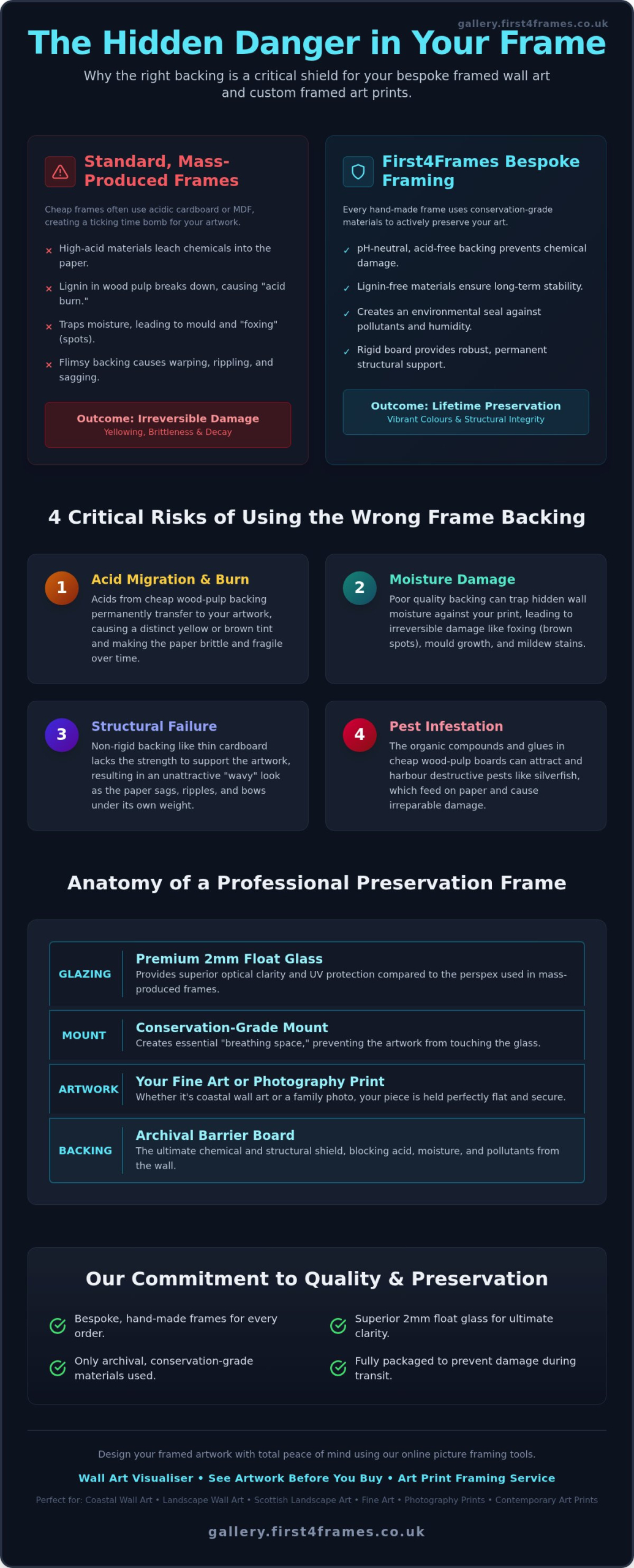
Think of your frame as a protective sandwich. Our bespoke, hand-made frames use 2mm float glass to provide superior clarity at the front, while the mount creates essential breathing space. The backing seals the unit, creating a stable micro-environment. A ‘pretty’ frame with poor backing is essentially a ticking time bomb. Without a proper barrier, your artwork is vulnerable to the very wall it hangs on. Walls often hold hidden moisture or transmit cold temperatures directly onto the paper, leading to long-term chemical damage.

Structural Integrity and Support

A high-quality backing ensures your art stays perfectly flat. Over time, gravity and humidity can cause paper to sag or bow if it isn’t supported by a rigid, professional-grade board. In our bespoke framed wall art, we ensure the backing maintains a consistent focal plane. This prevents the “wavy” look often seen in cheap, mass-produced frames where the backing is little more than thin cardboard that lacks the strength to resist warping or bending under its own weight.

The Environmental Shield

The rear of the frame is a common entry point for dust, insects, and atmospheric pollutants. A professional backing board acts as a physical filter and regulates minor humidity shifts within the frame. This level of protection is consistent with the standard practices found in the conservation and restoration of painting frames. By creating this seal, we protect your contemporary art prints or photography prints from the invisible threats lurking in the air. Understanding what happens if you use the wrong frame backing helps you see that it’s much more than a simple cover; it’s a dedicated partner in the preservation of your most cherished pieces.

4 Critical Risks of Using the Wrong Frame Backing

Choosing a frame is an exciting part of the creative process, but the internal materials matter just as much as the external aesthetic. If you’ve ever wondered what happens if you use the wrong frame backing, the reality is a series of chemical and physical threats. Unlike our bespoke, hand-made frames, many budget options use standard acidic cardboard that acts as a catalyst for decay. This is especially dangerous for high-quality items like Scottish landscape art or coastal wall art, where paper integrity is paramount.

  • Acid Migration: The slow transfer of acids from the backing into your art.
  • Moisture Trapping: Non-breathable materials that cause foxing or mould.
  • Mechanical Damage: Physical rippling caused by poor structural support.
  • Pest Infestation: Cheap wood-pulp boards that attract insects like silverfish.

Understanding Acid Burn and Yellowing

The primary danger in cheap backing boards is lignin. This organic polymer, found in wood-pulp cardboard, breaks down over time and releases acidic gases. This leads to ‘acid burn’, where your fine art prints develop a distinct yellow or brown tint and become brittle. The Canadian Conservation Institute framing guide highlights how these environmental fluctuations and poor materials can lead to physical damage. If you notice a dark line around the edge of your mount, your backing is likely ‘burning’ your artwork. Our online picture framing service prevents this by using only archival-grade materials.

The Danger of Warping and Rippling

Humidity is a constant threat to paper. When you use a backing that doesn’t breathe or expands at a different rate than the frame, your art may begin to ripple or ‘cockle’. This mechanical stress is common in contemporary art prints that aren’t properly supported. Bespoke framed wall art is designed with specific tolerances to allow the art to breathe, ensuring it stays flat and vibrant behind our high-clarity 2mm float glass. Before you commit, you can use our wall art visualiser to see artwork before you buy and ensure your design includes the protection it deserves. It’s a simple way to plan your collection and ensure your photography prints are preserved for years to come.
What Happens if You Use the Wrong Frame Backing? The Hidden Risks to Your Art

Choosing the Right Materials: MDF vs. Acid-Free vs. Barrier Boards

Selecting the correct material is about matching the protection to the value of your piece. While we previously explored the chemical dangers, the solution lies in a layered defense. Different materials serve different roles within the frame assembly. Understanding what happens if you use the wrong frame backing helps you appreciate why professional material selection is so nuanced. It’s not just about the back; it’s about the entire assembly working together to shield your art.

  • MDF and Hardboard: These provide excellent structural strength for larger frames but aren’t archival. They must be used with a barrier layer to prevent acid transfer.
  • Foam Board (CFC-free): Lightweight and perfectly flat, this is a professional staple. Ensure you’re using the archival version for long-term safety.
  • Barrier Boards: This is the essential ‘shield’ layer. It sits directly behind the art to block chemical migration from less stable outer layers.
  • Corrugated Plastic: Often used in humid environments, this waterproof material won’t warp or hold moisture like paper-based boards.

When you choose your frame online, consider the environment where the piece will hang. If you ignore the specific needs of the art, what happens if you use the wrong frame backing is a slow loss of both sentimental and financial value.

When to Use Conservation-Grade Backing

Original watercolours, limited editions, and Giclée prints demand conservation-grade materials. These items are often printed on high-quality papers that are incredibly sensitive to their surroundings. Using pH-neutral materials is essential for preserving Scottish landscape art or delicate contemporary art prints. This level of care ensures that the ‘white’ of the paper remains crisp and the colours stay true to the artist’s original vision for decades.

The DIY Trap: Why Cardboard is Never the Answer

It’s tempting to use a recycled shipping box for a quick DIY project, but this is a significant risk. Recycled cardboard contains a cocktail of hidden chemicals and glues that accelerate the decay of your art. Cheap, mass-produced frames often hide these low-grade materials behind a thin sheet of paper to save costs. Our bespoke framed wall art contrasts this by using individually crafted components for every order. You can design your framed artwork with confidence, knowing we never cut corners on the materials that keep your art safe.

At First4Frames Gallery, we believe that the soul of a frame lies in its invisible details. While we have discussed the chemical risks of inferior materials, our workshop focuses on providing a complete archival solution. Understanding what happens if you use the wrong frame backing has led our artisans to reject standard components in favour of individually crafted, preservation-grade materials for every order. This bespoke approach ensures that your artwork isn’t just displayed, but truly protected within a stable micro-environment that prevents the slow decay associated with mass-produced alternatives.

A cornerstone of our quality is the use of 2mm float glass. Unlike the thin perspex found in many high-street alternatives, float glass offers superior clarity and structural rigidity. When paired with our professional backing boards, it creates a secure seal that safeguards your photography prints from the moment they’re mounted. To ensure this perfection reaches you, every frame is fully packaged and shipped via professional couriers. This careful logistical process prevents damage during the journey from our workshop to your wall.

Visualise and Design Your Perfect Frame Online

Our Online picture framing tool makes it easy to protect your collection from the comfort of your home. You can use our wall art visualiser to see artwork before you buy, allowing you to design your framed artwork with total confidence. This art print framing service is designed to be straightforward and inspiring, whether you’re framing a new landscape wall art piece or a cherished family portrait you’ve printed through our “print and frame” service.

Expert Advice for Your Custom Project

Our Falkirk-based team brings years of experience to every custom project. We understand that Scottish landscape art requires different considerations than contemporary art prints or heavy oils. If you have unique requirements or a high-value piece, we invite you to contact us. We can advise on the specific barrier boards needed to avoid what happens if you use the wrong frame backing, ensuring your art remains a legacy for future generations.

Protect Your Art for a Lifetime

By moving beyond the surface of your frame, you’ve taken the first step in ensuring your collection stands the test of time. Understanding what happens if you use the wrong frame backing transforms framing from a simple aesthetic choice into a long-term investment in your art’s survival. Whether it’s a coastal wall art piece or a rare fine art print, the right internal components act as a silent guardian against the elements, preventing the slow chemical decay that ruins so many unprotected works.

At First4Frames Gallery, we combine this technical expertise with a passion for traditional craftsmanship. Every frame is hand-made in our UK workshop, featuring 2mm float glass for unmatched clarity and protection. We’re proud to be trusted by artists across Scotland to preserve their most meaningful work with the care it deserves. You can design your bespoke framed artwork with professional protection today through our online gallery. Let’s work together to make sure your art remains a beautiful and vibrant part of your environment for generations to come.

Frequently Asked Questions

Can I use regular cardboard as a frame backing?

No, you should never use regular cardboard for anything other than temporary decorative items. Standard cardboard contains lignin and recycled chemicals that release acidic gases over time. This is exactly what happens if you use the wrong frame backing; the acids leach into the paper, causing irreversible yellowing and brittleness. For valuable Scottish landscape art or fine art, always opt for professional, pH-neutral materials that won’t decay.

What is the best material for the back of a picture frame?

The best material depends on the level of protection needed, but archival-grade foam board or conservation barrier board are the professional standards. These materials are chemically stable and provide a flat, rigid support system for your art. Our bespoke framed wall art uses high-quality, preservation-grade components that act as a shield against the environment. For moisture-prone areas, corrugated plastic is an excellent choice as it won’t warp or hold dampness.

How do I know if my frame backing is acidic?

You can often identify acidic backing by looking for visual cues like ‘mat burn’, which appears as a dark brown or yellow line on the edges of your artwork. If the backing board itself is brown and brittle, it’s likely a high-lignin wood-pulp material. Professional framers also use pH testing pens to check for acidity. If you’re unsure what happens if you use the wrong frame backing, these visual warnings are your first sign that the art is in danger.

What is a barrier board in framing?

A barrier board is a thin, chemically inert layer placed directly between the artwork and the structural backing board. Its primary job is to block the migration of acids and pollutants from the outer frame layers to the art itself. This is a critical component in custom framed art prints, as it creates a purified micro-environment. It ensures that even if the outer frame is wood, the art remains untouched by harmful chemicals.

How often should I replace my frame backing?

You should inspect your framing every five to ten years to ensure the materials are still performing their protective duties. If you notice any warping, foxing, or discolouration on the backing board, it’s time for a replacement. High-quality conservation framing can protect art for up to 20 years, but environmental factors like humidity can accelerate wear. Regularly checking your frames ensures your photography prints and contemporary art prints stay in gallery condition for a lifetime.
Posted on

Picture Frame Restoration Service: A Guide to Preserving Your Art in 2026

Picture Frame Restoration Service: A Guide to Preserving Your Art in 2026

What if that dusty, chipped frame in your attic is more valuable than the painting inside? It’s a dilemma many art lovers face. You see the cracking gesso and worry, because you know that in the UK, over 30% of pre-1950s frames contain acidic materials that can cause irreversible damage to your artwork. You love the frame’s history, but you also want to protect what’s inside and ensure it complements your home.

This guide will help you make the perfect choice. We’ll explore when a professional picture frame restoration service is the right path to preserve a piece’s heritage and when a new, bespoke frame is the superior option for long-term protection and modern style. We’ll break down the potential costs, compare the conservation benefits, and give you the confidence to ensure your art looks beautiful and stays safe for the next 20 years and beyond.

Key Takeaways

  • Discover if your antique frame is secretly harming your artwork with “acid burn” and learn the key warning signs to look for.
  • Assess whether your frame has significant “Heritage Value” to determine if a professional picture frame restoration service is the right investment for you.
  • Learn when a modern, bespoke frame is the superior choice for preserving your art, especially for cherished prints by artists like Jolomo or Jack Vettriano.
  • Confidently weigh the costs and benefits to decide between restoring a vintage piece and commissioning a new, conservation-quality frame to perfectly protect your art.

What is Picture Frame Restoration and When is it Necessary?

A beautiful picture frame does more than just border your art; it acts as a bridge between your décor and the piece itself, protecting and enhancing it. Over time, however, even the most spectacular frames can suffer from age, accidents, or environmental factors. Picture frame restoration is the meticulous craft of repairing this damage. It involves everything from stabilising a frame’s structure and replacing missing ornamental details to carefully reviving its original surface finish. It’s a process that honours the frame’s history while preparing it for a beautiful future.

To see how a craftsman approaches a common repair, watch this helpful video:

Recognising when a frame needs professional attention is key. Look for tell-tale signs like visible cracks in the wood, chipped corners, or a dull, tarnished finish on gilded surfaces. It’s crucial to distinguish between a simple clean and a full-scale restoration. While a light dusting is routine maintenance, attempting to clean decades of grime with household products can cause irreversible damage. A professional picture frame restoration service is necessary when there is structural or significant surface decay, such as when ornate gesso work has crumbled away. This is about preserving a piece of craftsmanship, ensuring it continues to be a worthy and protective vessel for the artwork it holds, whether it’s a family heirloom or a fine art print from our gallery.

The Most Common Types of Frame Damage

Frames are susceptible to a range of issues developed over many years. The most frequent problems we encounter include:

  • Surface Contaminants: A frame that has hung in a home since the 1960s can accumulate a tough film of dust, soot, and nicotine. This build-up obscures the original finish and can degrade the materials underneath.
  • Structural Failure: Mitred corners can loosen over time, making the frame unstable and putting your artwork at risk. Antique frames are also vulnerable to woodworm, which can compromise the entire structure if not treated properly.
  • Aesthetic Decay: The delicate beauty of a gilded frame can be marred by flaking gold leaf. Another common issue is “blooming,” where old varnish develops a cloudy or milky appearance, completely hiding the frame’s intended lustre.

The Traditional Craft of Gilding and Gesso

Many ornate and antique frames rely on traditional materials that require specialist knowledge. Understanding these is central to authentic restoration. Gesso, a plaster-like mixture of chalk or gypsum and animal-skin glue, forms the smooth, white base layer upon which gold leaf is applied. It’s this base that allows for the carving and moulding of intricate details. The detailed techniques involved in the Conservation and restoration of painting frames are a testament to centuries of craftsmanship. When this gesso cracks or chips, it must be carefully reapplied and re-carved by an artisan to match the original design.

The method of applying gold leaf, known as gilding, also varies. Water gilding allows the gold to be burnished to a brilliant, mirror-like shine but is a more intensive and costly process. Oil gilding provides a softer, more matte finish and is less expensive. Choosing the right method is vital for a seamless repair. This work demands immense patience and a steady hand, a level of dedicated craftsmanship that has earned our bespoke framing services consistently excellent customer ratings.

The Invisible Dangers: Why Your Old Frame Might Be Harming Your Art

That beautiful antique frame you’ve cherished for years might be holding a dark secret. While its ornate carvings and aged patina add character to your room, its interior components could be actively damaging the very artwork it’s meant to protect. Many frames built before the 1980s were assembled with materials we now know are destructive: acidic wood-pulp backing boards, glues that off-gas harmful chemicals, and standard glass that offers zero protection from light.

Have you ever noticed a faint, brownish stain creeping in from the edges of an old print or photograph? That’s called “acid burn.” It’s a permanent discolouration caused when acids from poor-quality mount boards and backing papers migrate into the fibres of the artwork. This is the most common form of damage we see. In fact, industry experts estimate that up to 90% of damage to framed art originates from the inside out, caused by these very materials. This is why a professional picture frame restoration service involves more than just repairing the exterior; it requires a complete, conservation-grade internal overhaul to ensure the frame is safe for the future.

Acid-Free Mounts and Conservation Grade Backing

The primary culprit behind yellowing and acid burn is a natural polymer called lignin, found in all wood-based paper products. Over time, lignin breaks down and releases acid, staining your art. Our bespoke framing service exclusively uses 100% lignin-free, pH-neutral mountboards that meet the Fine Art Trade Guild’s strict conservation standards. We also use specialised barrier papers to isolate your artwork from the wooden rebate of the antique frame, creating a safe, acid-free enclosure that preserves your piece for decades.

The Role of UV Protective Glass in Preservation

Light is another silent threat. Both direct sunlight and ambient indoor lighting emit ultraviolet (UV) rays that break down pigments in prints, watercolours, and photographs, causing irreversible fading. A vibrant Giclée print can lose its spectacular colour in just a few years behind standard glass. Upgrading the glazing is one of the most significant investments you can make in your art’s longevity. We offer a range of options:

  • Standard Float Glass: Offers basic physical protection but blocks less than 45% of UV rays.
  • Conservation Clear Glass: Blocks over 99% of UV rays, providing exceptional protection against fading.
  • Museum Glass: The premium choice. It blocks over 99% of UV rays while incorporating an advanced anti-reflective coating for breathtaking clarity.

Our comprehensive picture frame restoration service always includes a consultation on glazing. While we expertly restore the frame, if your artwork itself has suffered severe tears or chemical damage, we believe in honest guidance. In these cases, we recommend you Find a professional conservator for specialised treatment. It’s this commitment to total preservation that ensures your art not only looks beautiful but is also perfectly protected. You can see the stunning results of museum-quality presentation for yourself across our curated online gallery of fine art prints.

Restoration vs. Bespoke Reframing: Which is Right for You?

You have a cherished piece of art in a frame that has seen better days. The corners are chipped, the finish is faded, or perhaps it just feels dated. The immediate question is whether to repair or replace. This decision hinges on a careful balance of history, cost, and personal style. Before committing to a full picture frame restoration service, it’s crucial to evaluate what you truly have and what you hope to achieve.

First, consider the frame’s “heritage value.” Is it a genuine antique, perhaps a hand-carved piece from the 19th century that is integral to the artwork’s story? Or is it a mass-produced vintage frame from the 1980s? A signed, period-correct frame can be an artifact in its own right, adding significant value. A cost-benefit analysis is essential here. If a complex restoration costs £350 but the artwork and frame combined are only valued at £150, a bespoke new frame is almost always the more practical choice. Finally, think about aesthetic alignment. That heavy, ornate frame might have been perfect in its original setting, but does it complement your clean, contemporary decor today?

When to Choose Specialist Restoration

Opting for restoration is the right path when the frame itself is a piece of history. This is especially true for genuine antiques (typically pre-1900), where preserving the original craftsmanship is paramount. If the frame was designed by the artist, as was common with painters like Dante Gabriel Rossetti, it is part of the complete artwork. Such pieces require careful work that follows professional conservation guidelines for picture frames. Finally, if a frame holds deep sentimental value that no new frame could replace, restoration is the only way to honour that connection.

This same appreciation for historical craftsmanship is shared by collectors of fine antique furniture. For those interested in learning more about period pieces, the experts at Nicholas Wells Antiques offer detailed guides on everything from history to placement.

The Benefits of Bespoke Reframing

Choosing a new, bespoke frame is an act of creative renewal. It offers access to thousands of modern and traditional styles, ensuring you find the perfect partner for your art and your home. Unlike some older frames, every new bespoke frame we craft guarantees the use of 21st-century conservation materials from the start, including acid-free mounts and UV-protective glazing to safeguard your art for decades. A new frame becomes the perfect “bridge between your room decor and the artwork,” making the entire piece feel fresh, intentional, and beautifully integrated into your space.

Ultimately, our goal as a one-stop-shop for fine art is to ensure your artwork is presented perfectly. Whether it’s a print from an artist in the First4Frames Gallery or a family heirloom, we provide the expertise to guide you. For many of our clients, the speed, creative freedom, and guaranteed protection of bespoke reframing offers a more satisfying and straightforward solution than a lengthy and expensive picture frame restoration service. It’s a chance to give your art a spectacular new life.

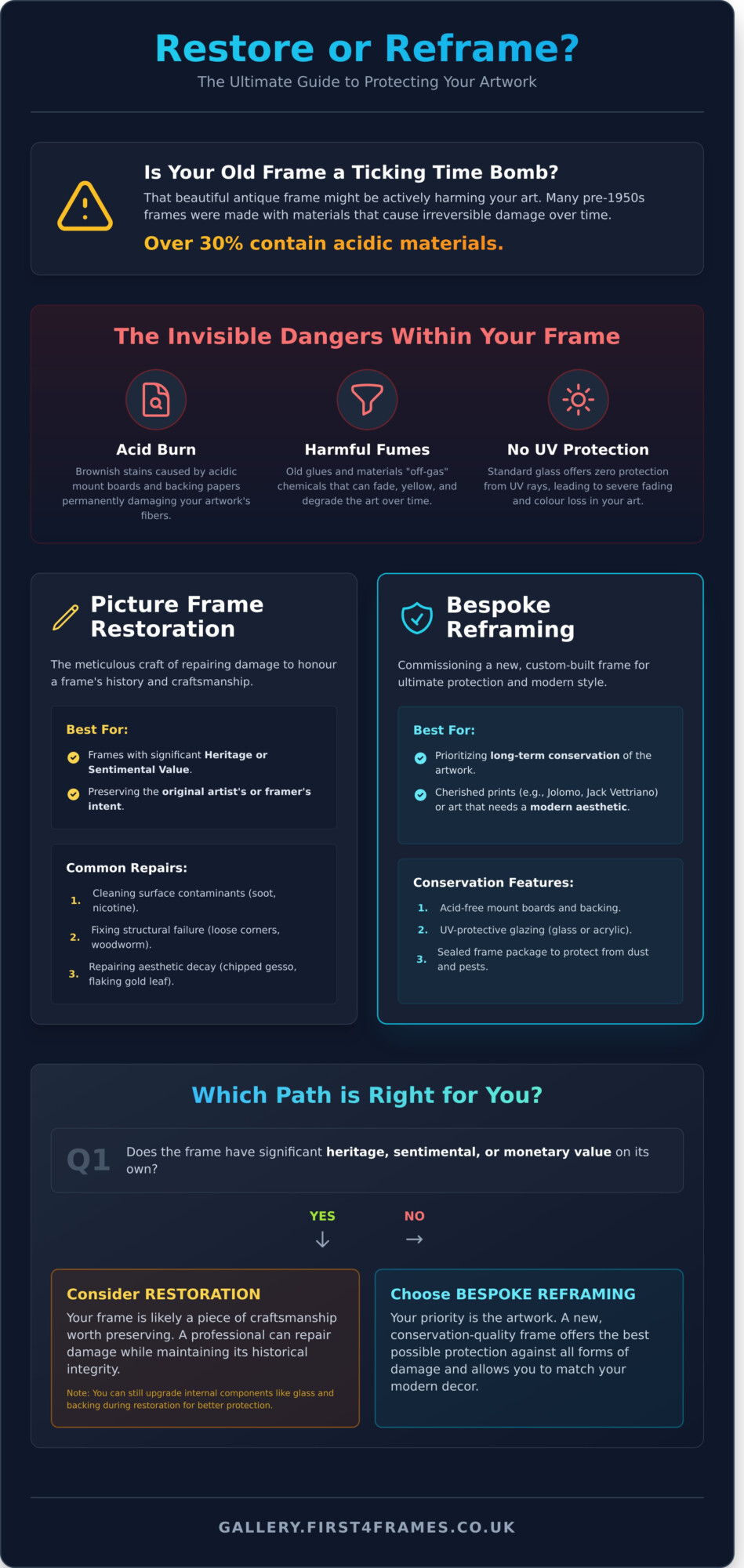
An infographic compares restoring versus reframing artwork, listing risks of old frames, restoration benefits, common repairs, when to reframe, and guidance on choosing the best option based on heritage or sentimental value.

Preparing Your Artwork for a New Life: The Process

A damaged or dated frame doesn’t just detract from your artwork; it can actively harm it. Our expert picture frame restoration service is a meticulous process designed to breathe new life into your cherished pieces. It’s a journey from tired and neglected to vibrant and protected, handled with the same care we afford the fine art prints in our own gallery. Our process, refined over 20 years and reflected in our 5-star customer ratings, ensures your art is not only beautifully presented but preserved for the future.

The transformation unfolds in four distinct stages, each executed with precision and a deep respect for the artwork.

  • Step 1: Careful Deconstruction. The first step is a delicate operation. We carefully remove your artwork from its old housing, which often contains damaging materials like acidic backing boards or high-lignin mounts common before the 2000s. These materials can cause permanent discolouration, so we treat this stage as a rescue mission.
  • Step 2: Condition Assessment. Once freed, we assess the condition of the paper or canvas. While we don’t perform art restoration itself, we inspect for issues like foxing (brown spots) or fading. This allows us to recommend the best conservation materials, such as UV-protective glazing, which blocks over 97% of harmful light rays.
  • Step 3: The Bespoke Frame Selection. This is where creativity meets craftsmanship. We help you select a new bespoke frame that enhances the artist’s original vision, not overpowers it. The right frame acts as a bridge between the art and your decor, a principle we apply when framing pieces for our gallery artists like the vibrant landscapes of John Lowrie Morrison.
  • Step 4: Professional Assembly. Finally, we rehouse your art using only premium, conservation-grade materials. This includes acid-free tapes, sturdy mounts that meet Fine Art Trade Guild standards, and precisely cut spacers to create a vital air gap between the art and the glass.

Measuring and Consultation

Precision is the foundation of a perfect bespoke frame. Our measurements are accurate to the millimetre, ensuring a flawless fit. We incorporate essential “breathing room,” a small, calculated gap between the art and the glazing, which prevents moisture transfer and protects the artwork’s surface. Our Falkirk gallery team will personally guide you through every choice, from moulding profile to mount colour, ensuring the final result is exactly what you envisioned.

Preserving Your Investment

A professionally framed print doesn’t just look better; it retains its value. Artwork in a damaged or acidic frame can lose up to 20% of its potential value over a decade compared to a piece housed using conservation methods. The psychological impact is just as significant; seeing a tired piece of art transformed is a truly rewarding experience. Think of our picture frame restoration service as the ultimate insurance policy for your art, protecting its beauty and financial worth for generations.

See for yourself how the perfect frame elevates an artwork. Explore our online gallery to see stunning examples of our craft.

While this article focuses on our expert picture frame restoration service, our passion for presentation extends to creating brand-new masterpieces. For over 20 years, First4Frames has been the heart of high-quality bespoke framing in Scotland. Our Falkirk gallery isn’t just a workshop; it’s a space where creativity meets craftsmanship, and where your art is treated with the reverence it deserves. We’ve built our reputation on a simple promise: to provide a premium, hassle-free, and speedy service that brings your vision to life.

This commitment to excellence is reflected in the glowing reviews we consistently receive across platforms. Our customers don’t just buy a frame; they invest in a piece of craftsmanship that enhances and protects their art. They praise our meticulous attention to detail, our use of superior materials, and the personal touch we bring to every single project. It’s this trust that has made us a leading destination for art lovers across the country.

Showcasing Scottish Art

A frame is the bridge between your room and the artwork. We specialise in creating that perfect connection for iconic Scottish artists. Consider the vibrant, joyful colours of John Lowrie Morrison (Jolomo); our bespoke frames are chosen to make those spectacular blues and fiery oranges truly “pop” from the wall. For the moody, cinematic works of Jack Vettriano, we craft frames that lend a professional, gallery-style finish, deepening the narrative within the print. We source only the best mouldings, mounts, and glazing to ensure your treasured Scottish art is preserved and looks its best for a lifetime.

Start Your Framing Journey Today

Your journey to perfectly framed art is simple. We invite you to visit our gallery in Falkirk for a personal consultation, where you can browse our collections and discuss your needs with our friendly experts. See the quality for yourself. If you prefer the convenience of ordering from home, our online process is designed for complete ease. You can have a beautiful, professionally framed piece of art ready to hang in just three simple steps:

  • Step One: Browse our spectacular collections from celebrated artists.
  • Step Two: Select your favourite fine art print and choose the perfect bespoke frame.
  • Step Three: Place your order, and we’ll deliver your ready-to-hang art directly to your door.

Whether you’re commissioning a new piece or seeking our dedicated picture frame restoration service, your art is in the hands of passionate professionals. Let us help you create something truly special for your space.

Discover our Bespoke Framing Service

Your Artwork’s Future Starts Today

A frame is so much more than a border; it’s the dedicated guardian of your artwork. Understanding that old, acidic materials can cause lasting damage is the first step toward preservation, whether that path leads to expert restoration or beautiful bespoke reframing for your cherished piece.

At First4Frames, we believe every piece deserves the best. Whether you need a professional picture frame restoration service for a family heirloom or a new handcrafted frame for a modern print, our passion is your peace of mind. As Falkirk-based specialists in Scottish fine art with over 20 years of experience, our service is backed by excellent customer ratings for both quality and craftsmanship.

Your art has a story to tell; don’t let a failing frame have the final word. Browse our Gallery and Bespoke Framing Services to see our passion in action and give your treasured pieces the beautiful future they deserve.

Frequently Asked Questions

Is it worth restoring a frame that is not an antique?

Absolutely. It’s often worth restoring a non-antique frame, especially if it holds sentimental value or is a high-quality piece that perfectly suits the artwork. A well-made contemporary frame is a piece of craftsmanship in its own right. Using our expert picture frame restoration service preserves its unique character and structural integrity, saving you the cost of a completely new bespoke replacement while maintaining a look you already love.

How much does professional picture frame restoration typically cost?

Professional picture frame restoration costs vary, typically starting from around £50 for minor repairs and potentially exceeding £300 for extensive work on ornate or gilded frames. The final price depends entirely on the level of damage, the materials needed, and the artisan time required. We provide a detailed, no-obligation quote after carefully assessing your frame at our Falkirk gallery, ensuring complete transparency before any work begins.

Can a damaged frame actually decrease the value of my artwork?

Yes, a damaged or unsuitable frame can significantly decrease both the perceived and monetary value of your artwork. A broken or dirty frame detracts from the art’s presentation and can even cause physical harm from instability or acidic materials. Professional framing not only protects your investment but enhances its aesthetic appeal, ensuring it’s presented beautifully, which is crucial for any potential valuation.

What is the difference between bespoke framing and a standard shop-bought frame?

The key difference is that bespoke framing is custom-made to perfectly protect and complement your specific artwork, while a standard frame is mass-produced in set sizes. With our bespoke service, you select from hundreds of premium mouldings and conservation-grade materials for a perfect fit and long-term protection. Shop-bought frames offer limited choices and often use lower-quality materials that may not preserve your art effectively.

How long does it take to have a custom frame made at First4Frames Gallery?

Our typical turnaround for a custom-made frame at our gallery is between 7 and 14 working days. This timeframe allows our skilled framers to give your piece the dedicated attention it deserves, from precise cutting to meticulous hand-finishing. We believe in craftsmanship over speed to deliver the quality reflected in our 5-star customer ratings. If you have an urgent request, please speak with us about express options.

Can you put a new frame on a canvas painting that was previously in an old frame?

Yes, we can absolutely re-frame a canvas painting that was housed in an old or dated frame. This is a wonderful way to update the look of a beloved piece or provide it with superior, conservation-quality protection. Our team will carefully remove the canvas and help you select a beautiful new bespoke frame that enhances the artwork and fits perfectly with your current decor, just as we do for works by our featured artists.

Will a new frame help prevent my art from fading?

A new, professionally specified frame is one of the best ways to prevent your art from fading. We offer specialist glazing options with up to 99% UV protection, which is essential for blocking the harmful rays that cause colours to degrade. By combining UV-protective glass with acid-free, archival mounts and backing boards, our framing creates a safe environment that preserves your art’s vibrancy for decades to come.

Do I need to make an appointment for a framing consultation in Falkirk?

While appointments aren’t mandatory, we highly recommend booking a consultation at our Falkirk gallery. An appointment guarantees you dedicated, one-on-one time with a framing expert to explore all your options without feeling rushed. It allows us to provide the focused, high-quality service our clients praise us for. You can easily book a convenient time slot by giving us a call or contacting us through our website.