
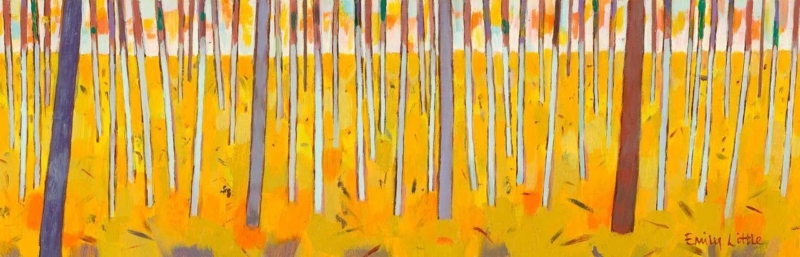
panoramic woodland wall art above a dining bench can solve a proportion problem that standard square pictures often leave behind. A bench creates one long, low line. Birch Trees I by Emily Little answers it with a remarkably wide woodland composition. Repeated pale trunks stretch across a field of yellow and orange, while darker trees introduce an irregular beat. The image follows the furniture without making the dining area feel rigid.
Measure panoramic woodland wall art above a dining bench
Begin with the bench, not the empty wall. Measure the usable seating width and mark its centre. Then tape out the complete framed dimensions above it. First 4 Frames currently offers this image in long print proportions, so the outer frame and any mount must be included in the plan. Judging only from the printed area can lead to a finished piece that feels larger than expected.
The artwork should feel connected to the bench without appearing squeezed between furniture and ceiling. Test the lower edge while someone is seated. It needs to clear heads during normal use, yet remain low enough to belong to the dining arrangement. If the bench has a tall back, measure from its highest point rather than from the seat.
- Mark the bench centre. Do not centre the artwork on a longer wall if the furniture sits off-centre.
- Draw the outer frame. Use removable tape and include the mount and moulding.
- Sit at every place. Check head clearance and sightlines rather than judging only while standing.
- Move the table fully. Make sure chairs, serving dishes and pendant lights do not interrupt the view.
- Check after dark. Look for a reflected pendant bulb running across the pale trunks.
Let the birch rhythm organise a long wall
Wide walls can tempt people to fill them with many small frames. Above dining seating, that can become restless because the table already holds plates, glasses, flowers and conversation. Birch Trees I supplies variety within one continuous image. The close vertical trunks create rhythm, while the panoramic shape holds them together as a single calm statement.
The irregular spacing is important. Some trunks are narrow and pale; others are wider, darker or slightly angled. This stops the repeated subject from feeling like a stripe pattern. The eye can travel along the work slowly, which suits a dining area where people remain seated and see the picture at close range.
Balance warm woodland colour with the table materials
Yellow and orange dominate the lower part of the scene, but slim notes of blue, green, mauve and white appear among the trunks. Choose one quiet connection rather than repeating the whole palette. A blue-grey bench cushion, a green ceramic bowl or natural linen can be enough. The stronger colour should remain concentrated in the artwork.
| Dining-area material | Why it works | Simple adjustment |
|---|---|---|
| Light oak | Echoes the pale trunks and warm ground | Add one darker object to prevent the scheme becoming washed out |
| Dark timber | Connects with the deeper purple-brown trees | Keep the wall and table linen lighter |
| Painted bench | Can pick up a small blue, green or soft grey note | Avoid matching the strongest yellow exactly |
| Metal legs | Give the organic subject a clean contemporary edge | Use a warm textile to soften the dining zone |
Birches are naturally associated with light woodland and their distinctive pale bark. The Woodland Trust guide to silver birch offers useful background on the tree itself. In this semi-abstract interpretation, recognisable trunks provide the structure, while colour and simplified marks create the mood.
Control pendant glare and dining-room reflections
A pendant over the table may sit directly opposite the glazing. View the taped position from every seat with the light on. Raising or lowering the picture slightly can move a reflected bulb away from the centre. If that is not enough, a broader shaded source is often calmer than a clear exposed lamp.
Daylight needs checking too. A long image can catch several windows at once. Side light often reveals the colour well, but direct reflection can hide a run of trunks. Move the template sideways before changing the whole lighting scheme. A few centimetres may be enough to improve the view from the main seats.
Choose one panorama rather than a row of fillers
The continuous woodland already performs the job of a sequence. Adding several small pictures beside it can weaken the clear horizontal relationship with the bench. Leave the neighbouring wall quieter, especially if shelves, tableware or a patterned seat already provide detail below.
Emily Little’s semi-abstract work explores colour, memory and the surrounding world. Browse the Emily Little collection at First 4 Frames to compare this low, rhythmic format with her more vertical and architectural compositions.
First 4 Frames uses colour-managed Giclée production and completes bespoke framing in-house at its Falkirk workshop. Careful output keeps the pale trunks distinct from the warmer ground and preserves the small cool notes between them. A hand-finished frame gives the unusually long composition a precise edge and arrives ready to hang.
Thoughtful panoramic woodland wall art above a dining bench can make a long seating wall feel deliberate without adding visual clutter around the table. View the framed Birch Trees I print for a warm, rhythmic panorama designed to work with the proportions of a dining bench.