Posted on

Aviation Wall Art for a Heritage Study: Give the Halifax Room to Fly

A painting of the Handley Page Halifax flying above green fields, with clouds partly covering the landscape. The aircraft shows WWII camouflage and roundel markings on its wings and fuselage.

aviation wall art for a heritage study should reward curiosity without turning the room into a display set. Handley Page Halifax provides a specific starting point rather than a generic decorating formula.

aviation wall art for a heritage study - Handley Page Halifax

Position aviation wall art for a heritage study from the desk

  1. Sit in the working chair and find a wall visible beyond the monitor.
  2. Mark the complete framed outline, not only the print.
  3. Check whether a bookcase interrupts the aircraft from the doorway.
  4. Switch on task and ceiling lights to reveal reflections.
  5. Leave clear wall around the open sky and wing shape.

Rod Harrison shows the named aircraft above green fields with clouds partly masking the landscape. Its WWII camouflage and roundels provide real visual information. Do not repeat them through propeller clocks, squadron signs and rows of models on the same wall.

Connect with timber, not costume

An old desk or panelled door can support the subject. The frame need not imitate aged cockpit material. A clean moulding may separate the picture more effectively from surrounding wood.

The landscape keeps the image from reading as a technical diagram. Let the study remain a place to work and read, with a few carefully catalogued objects elsewhere rather than a crowded aviation wall.

Finish historical aircraft art with contemporary precision

Aircraft markings, cloud and terrain need dependable detail. Colour-managed Giclée production preserves those relationships, while bespoke framing allows scale, mount and moulding to be chosen for the actual study.

For background on the four-engined aircraft, read the Handley Page Halifax historical overview. Browse the Rod Harrison collection, then view the exact product.

Aviation wall art for a heritage study feels strongest when history is specific and the room remains usable. The Halifax supplies the story; measured placement gives it authority.

Posted on

Railway Wall Art for a Hobby Room: Caledonian Railway No 419

A detailed illustration of Caledonian Railway No 419 Built 1907 at St Rollox, a vintage blue steam locomotive with black and red accents labeled C & R, shown on railway tracks against a white background.

railway wall art for a hobby room should do more than fill a convenient gap. Caledonian Railway No 419 Built 1907 at St Rollox offers a specific starting point because Rod Harrison identifies a real locomotive built at St Rollox in 1907, giving an enthusiast a subject with engineering and regional history rather than generic steam nostalgia.

railway wall art for a hobby room - Caledonian Railway No 419 Built 1907 at St Rollox

Place railway wall art for a hobby room above a calm zone

A workbench wall usually carries tools, plans and active projects. Place the framed print above a low cabinet, reading chair or completed-model display instead. That separation protects the glazing from knocks and lets the locomotive remain readable rather than becoming another item in visual storage.

Room pressurePractical response
Small detailed modelsKeep one clear strip of wall around the picture.
Task lightingAngle lamps onto the bench, then check reflections in the glazing.
Reference booksLet the framed work sit above closed storage or an edited shelf.
Dust and toolsAvoid the active cutting, sanding or paint zone.

The exact locomotive matters. A collector may value its Caledonian Railway connection, St Rollox origin or relationship to preserved railway history. Confirm that interest rather than assuming every railway enthusiast wants the same engine.

Keep the history visible

A small label on the cabinet can record the name and 1907 build date if useful. Avoid surrounding the print with reproduction station signs that dilute the specific subject.

Finish railway wall art for a hobby room precisely

Locomotive illustration depends on clean line, controlled tone and readable engineering detail. Colour-managed Giclée production supports that precision. Bespoke in-house framing then creates a stable boundary between the artwork and an equipment-rich room.

For background on the locomotive class and the preserved No 419, read this history of the Caledonian Railway 439 Class. You can also browse the Rod Harrison collection and inspect the exact product and framing options.

Railway wall art for a hobby room works best when it respects the enthusiast’s knowledge and the room’s practical purpose. Caledonian Railway No 419 supplies an exact historic subject while careful placement protects concentration and display space.

Posted on

Scottish Art Prints for a Railway Enthusiast: Choose a Real Local Engine

LNER D49 No 246 approaches Manuel on the Bo’ness and Kinneil Railway, pulling two orange passenger cars through lush greenery with white steam rising into the blue sky.

Scottish art prints works best when the subject solves a real decorating or buying question. LNER D49 No 246 approaching Manuel on the Bo ness and Kinneil Railway offers a useful example because the named locomotive, orange passenger cars, white steam and Bo’ness heritage setting offer a real connection rather than generic transport nostalgia.

Scottish art prints - LNER D49 No 246 approaching Manuel on the Bo ness and Kinneil Railway

Choose Scottish art prints from the recipient’s railway story

Begin with what the recipient actually knows and enjoys. Have they visited the Bo’ness and Kinneil Railway, volunteered on a heritage line or followed LNER history? A named locomotive on a recognisable route has more gift value when it connects to a real memory or specialist interest.

What should you check before choosing a railway print?

Confirm that the engine, railway and period fit the person’s interest. Then ask where the finished piece could hang. A useful gift respects both technical enthusiasm and the recipient’s actual home.

  1. Ask a family member for a likely wall and furniture width.
  2. Template the complete framed outline, not only the printed sheet.
  3. Choose a moulding that suits the room instead of imitating railway timber or metal.
  4. Add a handwritten note explaining the personal connection.

The composition contains its own movement: the locomotive approaches through greenery, orange carriages follow and white steam rises into blue sky. It does not need model trains, station signs and vintage luggage arranged around it. One accurate subject can express the interest with greater confidence.

If the gift will hang in a study, place it where details can be viewed closely without sitting behind a monitor. In a hall or living room, preserve enough distance for the full train and landscape to read as one scene.

Present Scottish art prints as lasting specialist gifts

Rod Harrison’s locomotive subject depends on recognisable engineering detail as well as colour and movement. Colour-managed Giclée production and precise in-house framing give the image a substantial, ready-to-hang finish without turning it into novelty memorabilia.

For current visitor information and the heritage route behind the subject, see the Bo’ness and Kinneil Railway’s official website. Browse the Rod Harrison collection, or view the exact framed product and its options.

Scottish art prints make memorable gifts when their subject is specific. LNER D49 No 246 approaching Manuel connects railway history, place and personal enthusiasm in a form designed to remain part of the home.

Posted on

A Flying Scotsman Wall Art Gift Can Celebrate Railway Enthusiasm Properly

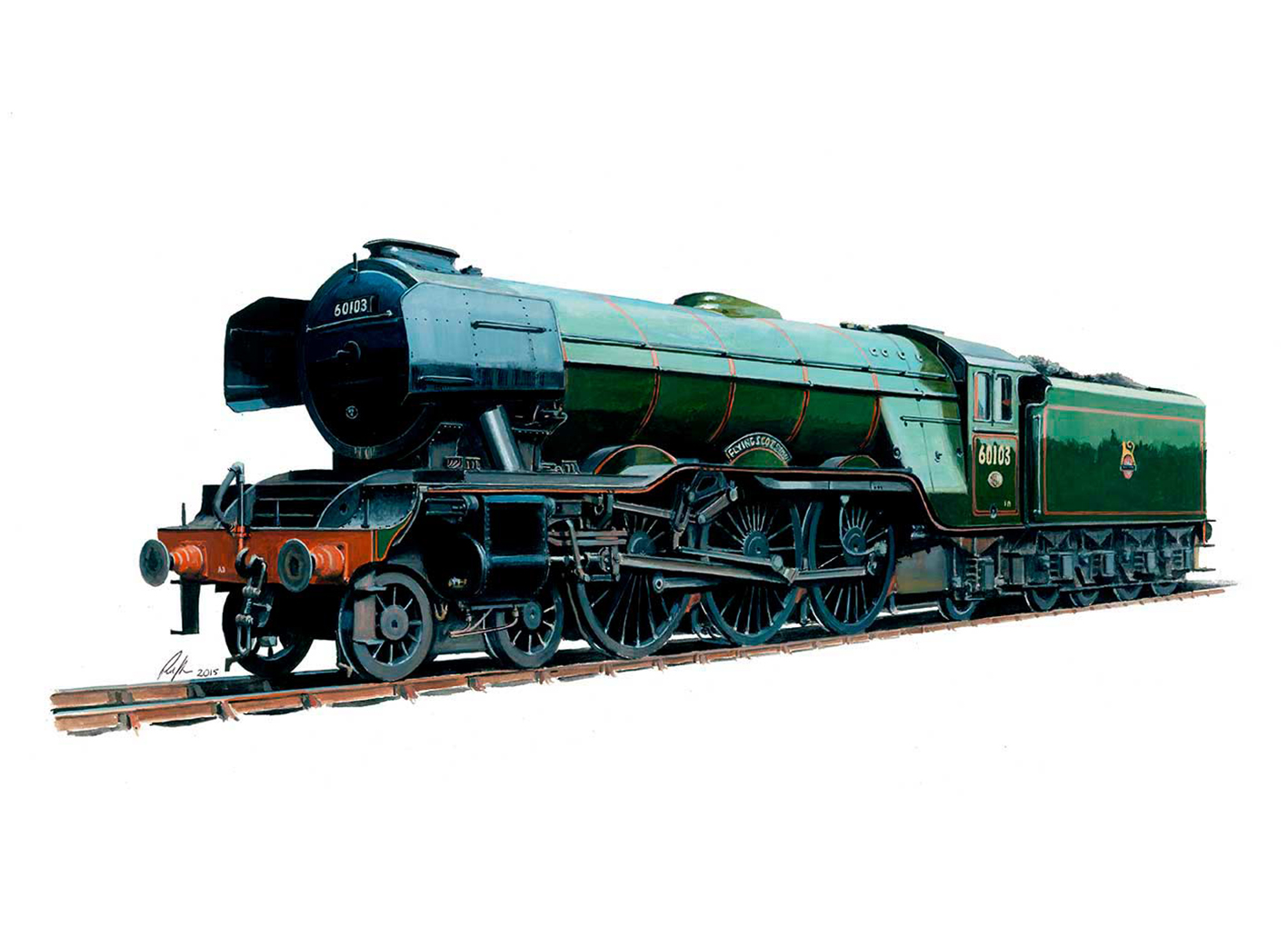
Illustration of the LNER A3 No 60103 Flying Scotsman built 1923 at Doncaster, shown in classic green on train tracks with its number and nameplate, set against a white background.

A Flying Scotsman wall art gift for a railway enthusiast feels more personal when it names the locomotive precisely and respects the recipient’s knowledge. LNER A3 No 60103 Flying Scotsman built 1923 at Doncaster by Rod Harrison does exactly that. The subject is specific, the illustration is purposeful, and the framed format gives the gift a life beyond the occasion.

Flying Scotsman wall art gift for a railway enthusiast - LNER A3 No 60103 Flying Scotsman built 1923 at Doncaster

Choose a Flying Scotsman wall art gift for a railway enthusiast thoughtfully

Start with what the recipient enjoys. Some enthusiasts care about engineering, others about railway history, childhood journeys, or the experience of seeing steam locomotives in service. A clearly identified Flying Scotsman print gives the gift a genuine point of connection without requiring invented sentiment.

For a study

Choose a measured frame that sits comfortably above books or a desk. Keep model engines and reference material nearby orderly so the print remains the focal point.

For a living space

Relate the frame to existing timber or darker accents. Avoid adding signs, clocks, and railway plaques that turn a shared room into a themed corner.

  • Confirm that Flying Scotsman is meaningful to the recipient.
  • Allow for the finished frame size, not only the printed image.
  • Include the product details so the subject and artist remain recorded.
  • Choose one strong framed gift instead of several novelty items.

This approach works for a retirement, significant birthday, or milestone visit. The occasion explains why the gift is given; the locomotive and presentation explain why it is worth keeping.

Give a technical subject a lasting presentation

Detailed railway illustration benefits from controlled lines, dependable tonal separation, and accurate reproduction. Colour-managed Giclée production supports that precision. Bespoke framing completed in-house in Falkirk turns the print into a finished gift that can be hung immediately and enjoyed for years.

For authoritative context about the locomotive, visit the National Railway Museum’s history of Flying Scotsman. Browse more work by Rod Harrison, or view the exact LNER A3 No 60103 Flying Scotsman built 1923 at Doncaster framed print.

As a Flying Scotsman wall art gift for a railway enthusiast, LNER A3 No 60103 Flying Scotsman built 1923 at Doncaster combines specific knowledge, useful display value, and craftsmanship without falling back on generic memorabilia.

Posted on

Railway Wall Art for a Home Office Can Add Direction Without Corporate Clichés

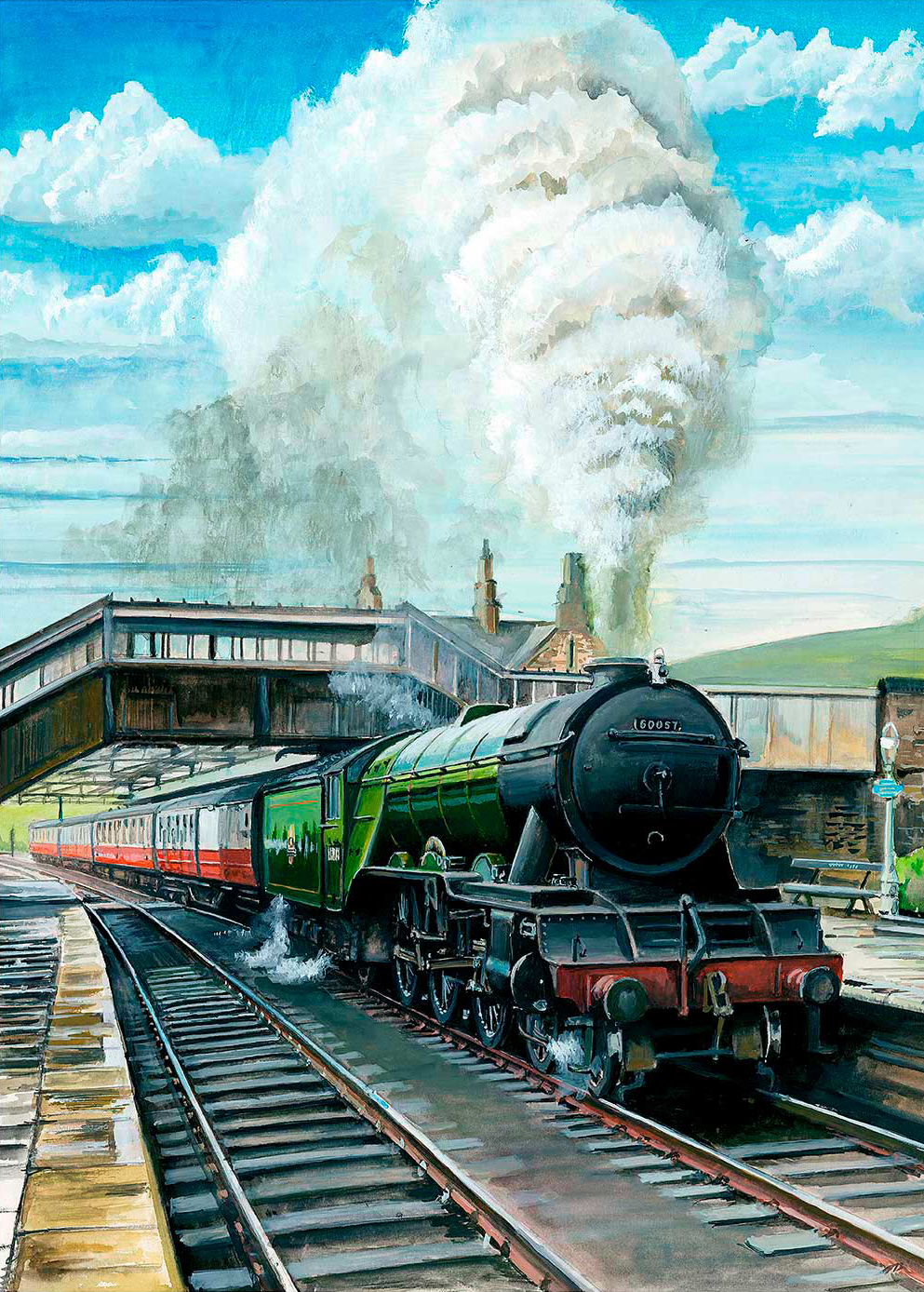
A3 No 60057 at Galashiels is a green steam locomotive pulling passenger cars at a station beneath a footbridge, with white smoke billowing and a bright blue sky with scattered clouds in the background.

Railway wall art for a home office can suggest purpose and progress without introducing another slogan to the working day. A3 No 60057 at Galashiels by Rod Harrison shows a green steam locomotive beneath the station footbridge at Galashiels. Its billowing white smoke, passenger carriages, and open blue sky give the image movement as well as useful historical character.

railway wall art for a home office - A3 No 60057 at Galashiels

Place railway wall art for a home office on the thinking wall

Choose the view between tasks

The strongest position is often opposite the desk rather than directly behind it. Looking up from a screen then reveals a scene with depth and direction. The rails and carriages carry the eye onward, while the station architecture gives the composition a steady framework.

  1. Sit at the desk. Mark a centre point that is comfortable to view without turning.
  2. Check the monitor. Keep bright window reflections out of the glazing.
  3. Stand at the door. Make sure the locomotive reads clearly on entry.
  4. Edit nearby objects. One model or railway book is enough; a collection would turn the room into a display.

Movement in an image can imply momentum more naturally than words telling someone to be productive.

A dark timber or restrained black frame can relate to the locomotive and bridge details. A lighter mount leaves room around the smoke and sky, so the finished piece feels focused rather than mechanically heavy.

Fine engineering detail depends on clean reproduction. Colour-managed Giclée printing retains the greens, white steam, and crisp station structure, while bespoke hand finishing at the Falkirk workshop gives the work professional presence.

For background on the locomotive design, read about the history of the LNER Class A3. Browse more work by Rod Harrison, or view the exact A3 No 60057 at Galashiels framed print.

As railway wall art for a home office, A3 No 60057 at Galashiels offers history, energy, and visual direction while keeping the workspace personal and composed.

Posted on

Wall Art for a Home Office Can Put Purpose Into the Backdrop

CR-419 at the High Bridge: A blue steam engine pulls maroon and cream carriages through a grassy cutting, passing under a brick bridge on a sunny day. White steam billows from the locomotive, surrounded by lush green trees.

Good wall art for home office spaces should support the mood of work without copying corporate décor. CR-419 at the High Bridge offers engineering, movement, and a clear destination. The steam engine gives the room a sense of purpose, while the green cutting and brick bridge keep the image grounded and approachable.

wall art for home office - CR-419 at the High Bridge

Position wall art for home office focus and video calls

Decide whether the picture is mainly for you or for the camera. On the wall opposite the desk, it can create a rewarding view during pauses. Behind the chair, it becomes part of a video-call background. In either position, leave clear space around the frame so the railway scene looks intentional rather than squeezed between shelves.

Should a working space use energetic artwork?

Yes, when the image has a clear structure. Directional movement can make a room feel purposeful. Balance it with orderly storage and a calm wall colour so the overall workspace remains easy to concentrate in.

The landscape orientation suits a wall above a low cabinet or a broad section behind a desk. The bridge creates a firm horizontal marker, while the train draws the eye through the scene. This combination offers visual momentum without the restless effect of a very abstract or densely patterned print.

Connect the picture to the room subtly

A timber desk can pick up the warmth of the bridge. A blue accessory may echo the locomotive. One or two links are enough; model trains and railway signs would turn a considered office into a theme. Let the artwork carry the interest.

First 4 Frames completes the Giclée printing and bespoke frame in-house in Falkirk. The colour-managed process preserves the relationship between steam, greenery, and darker engineering detail, while the hand-finished frame gives the picture a professional edge.

Visit the Bo’ness and Kinneil Railway for Scottish railway heritage. You can also explore Rod Harrison’s other work or see CR-419 at the High Bridge.

As wall art for home office use, CR-419 at the High Bridge adds direction, history, and personality without weakening the room’s professional purpose.

Posted on

Vintage Poster Prints Can Give a Study Real Momentum, as A3 at St Enoch Glasgow Shows

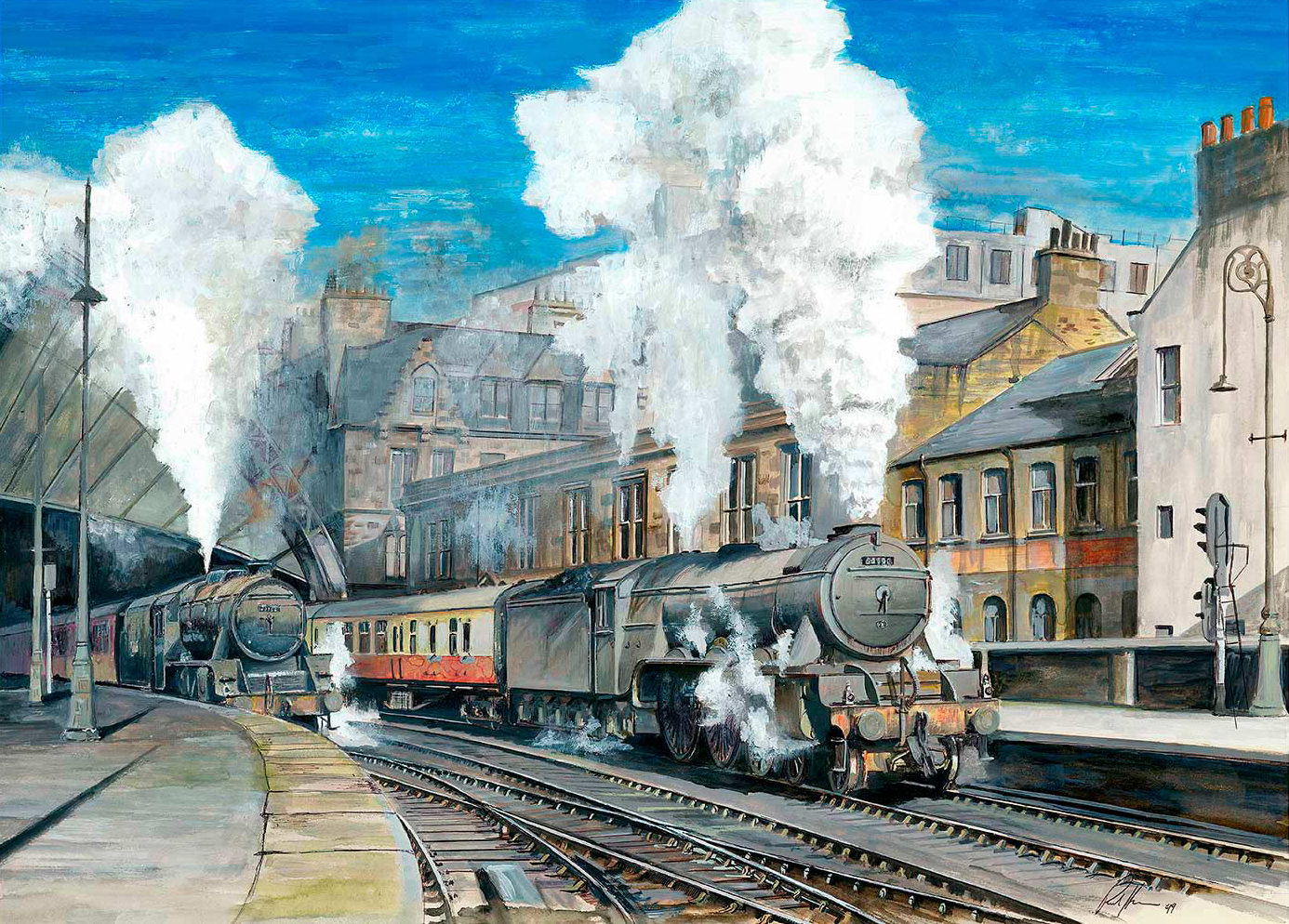
The painting "A3 at St Enoch Glasgow" shows two steam locomotives releasing white steam on parallel tracks at a city station, set against historic buildings and a blue sky.

Vintage poster prints appeal because they turn travel and engineering history into graphic room character. Although A3 at St Enoch Glasgow is a fine art print rather than a reproduction travel poster, it offers the same narrative energy. Two steam locomotives, parallel tracks, and rising white steam give a study a welcome sense of movement.

vintage poster prints - A3 at St Enoch Glasgow

What A3 at St Enoch Glasgow shares with vintage poster prints

  1. A clear destination: the station setting gives the picture immediate context.
  2. Strong direction: rails lead the eye and help a workspace feel purposeful.
  3. Human-scale history: steam and architecture make the engineering feel lived in rather than clinical.

In a study, library, or home office, place the work where it can be seen from the desk but does not sit directly behind a bright monitor. Deep blue, charcoal, olive, and warm timber can all support railway imagery. The aim is to acknowledge its heritage while keeping the room current.

Transport art works best when it suggests a journey, not simply a machine.

The print is produced and framed in-house by First 4 Frames. Colour-managed Giclée printing preserves detail in the steam and station, while bespoke framing gives the scene the authority it needs on a working wall.

For more railway context, explore the National Railway Museum. Then discover the Rod Harrison collection or look closely at A3 at St Enoch Glasgow.

If vintage poster prints have caught your eye, this Glasgow railway scene offers the same momentum with the finish and depth of framed fine art.

Posted on

Why Boness Locomotive Works Is Such a Strong Choice for Heritage Railway Wall Art

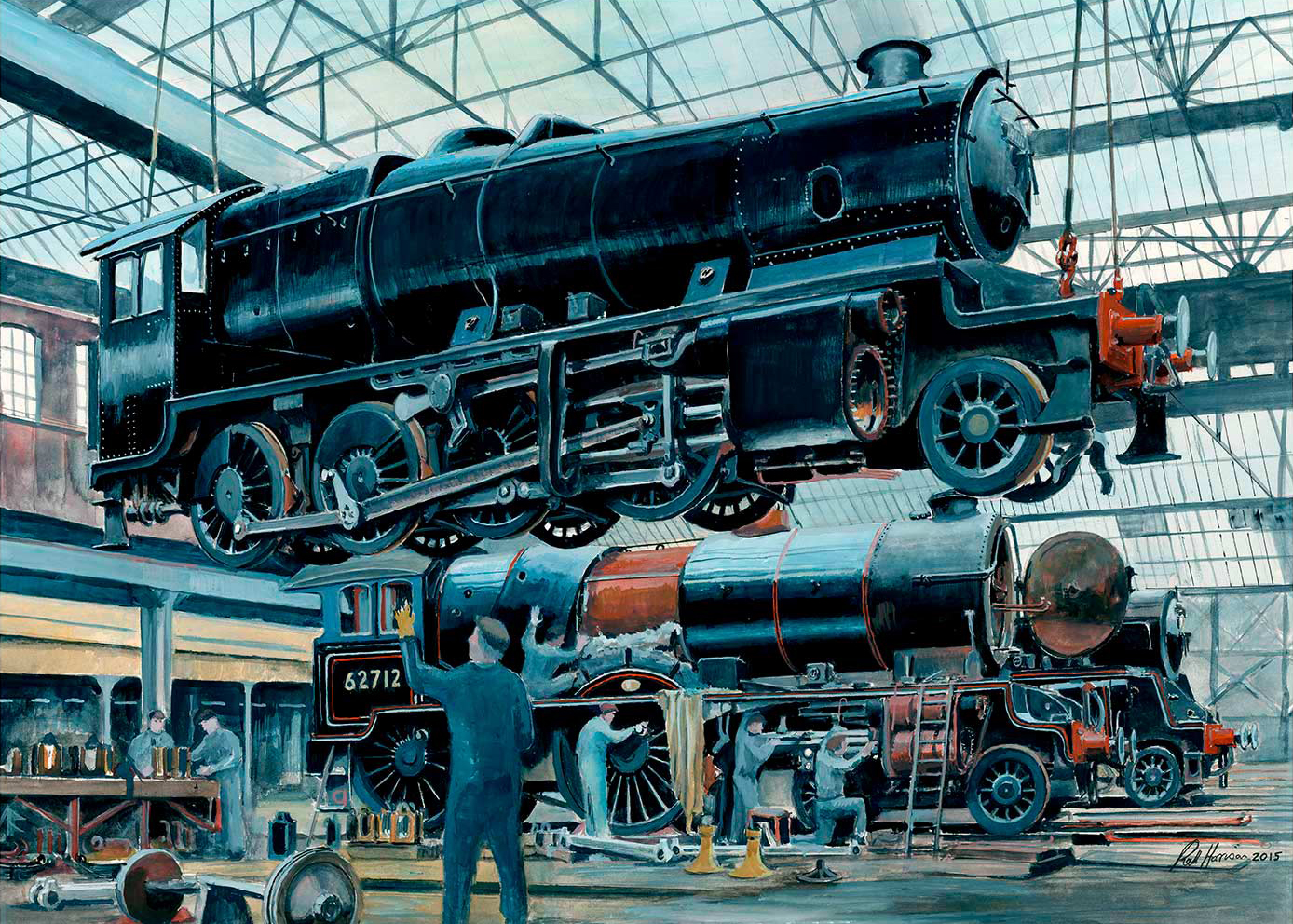
A painting of Boness Locomotive Works shows a large black steam locomotive suspended above another engine, with workers beneath and tools scattered around, all brightly lit by skylights.

Good heritage railway wall art should do more than signal an interest. It should still work as part of the room. Boness Locomotive Works does that particularly well because it brings real workshop atmosphere, engineering detail, and Scottish railway character without slipping into novelty or purely collector-led styling.

heritage railway wall art featuring Boness Locomotive Works

Why heritage railway wall art needs atmosphere as well as subject matter

Railway-themed artwork can easily become too literal, too nostalgic, or too dependent on the viewer already knowing the technical backstory. The strongest piece still rewards that knowledge, but it also has enough structure, mood, and visual clarity to stand on its own in a study, hallway, office, or sitting room.

Boness Locomotive Works has that balance. The suspended locomotive, workshop interior, and sense of active restoration give it genuine story, while the composition keeps the image strong enough for everyday display. It feels informed and characterful rather than gimmicky.

Why Boness Locomotive Works works so well as heritage railway wall art

  • It captures real engineering atmosphere rather than generic transport nostalgia.
  • It has enough structure and contrast to hold a wall confidently.
  • It suits railway enthusiasts while still feeling refined enough for a broader interior.

First 4 Frames completes every piece in-house in Falkirk with bespoke framing, colour-managed Giclee printing, and hand-finished craftsmanship. That superior finish matters with detailed subject matter, because line, shadow, and workshop light all need to stay clear if the print is going to feel as strong on the wall as it does on screen.

You can browse more work by Rod Harrison, learn more about the real location at Bo’ness & Kinneil Railway, and view the exact framed print here.

If you are comparing heritage railway wall art and want something with real subject depth, Scottish character, and lasting display value, Boness Locomotive Works is well worth considering.

Posted on

Graphic Art Prints With Structure, Why Boness Locomotive Works Stands Out

A painting of Boness Locomotive Works shows a large black steam locomotive suspended above another engine, with workers beneath and tools scattered around, all brightly lit by skylights.

Strong graphic art prints often succeed because they bring order as well as interest. Boness Locomotive Works does exactly that, using line, engineering character, and a clear sense of subject to create a focal point that feels sharper without becoming hard or overly specialist.

That makes it more versatile than many transport-themed pieces. The artwork has enough structure for a study or hallway, but also enough warmth and story for everyday living spaces.

Why The Linear Quality Works So Well

Rooms that already contain shelving, desks, sideboards, or architectural detail often respond well to artwork with clear line. This piece echoes that discipline, which helps the wall feel deliberate rather than loosely decorated.

  • It gives the room sharper definition.
  • It adds nostalgia without turning novelty led.
  • It suits buyers who want artwork with story and structure together.

Best Places To Use A Piece Like This

Boness Locomotive Works would fit naturally in a study, home office, hallway, stair wall, or sitting room where one print needs to bring shape and personality. It pairs well with darker timber, leather, black accents, and muted wall colours because the image already carries strength in a controlled way.

Why The Final Presentation Counts

Work built around line and detail needs a finish that stays crisp. First 4 Frames handles both bespoke framing and colour-managed Giclee production in-house, helping the final piece keep its clarity and authority on the wall.

You can view the exact framed product here, and browse more from Rod Harrison if you enjoy subject-led prints with the same graphic strength.

If you are considering graphic art prints that feel structured, memorable, and easy to place, Boness Locomotive Works is a strong choice.

Posted on

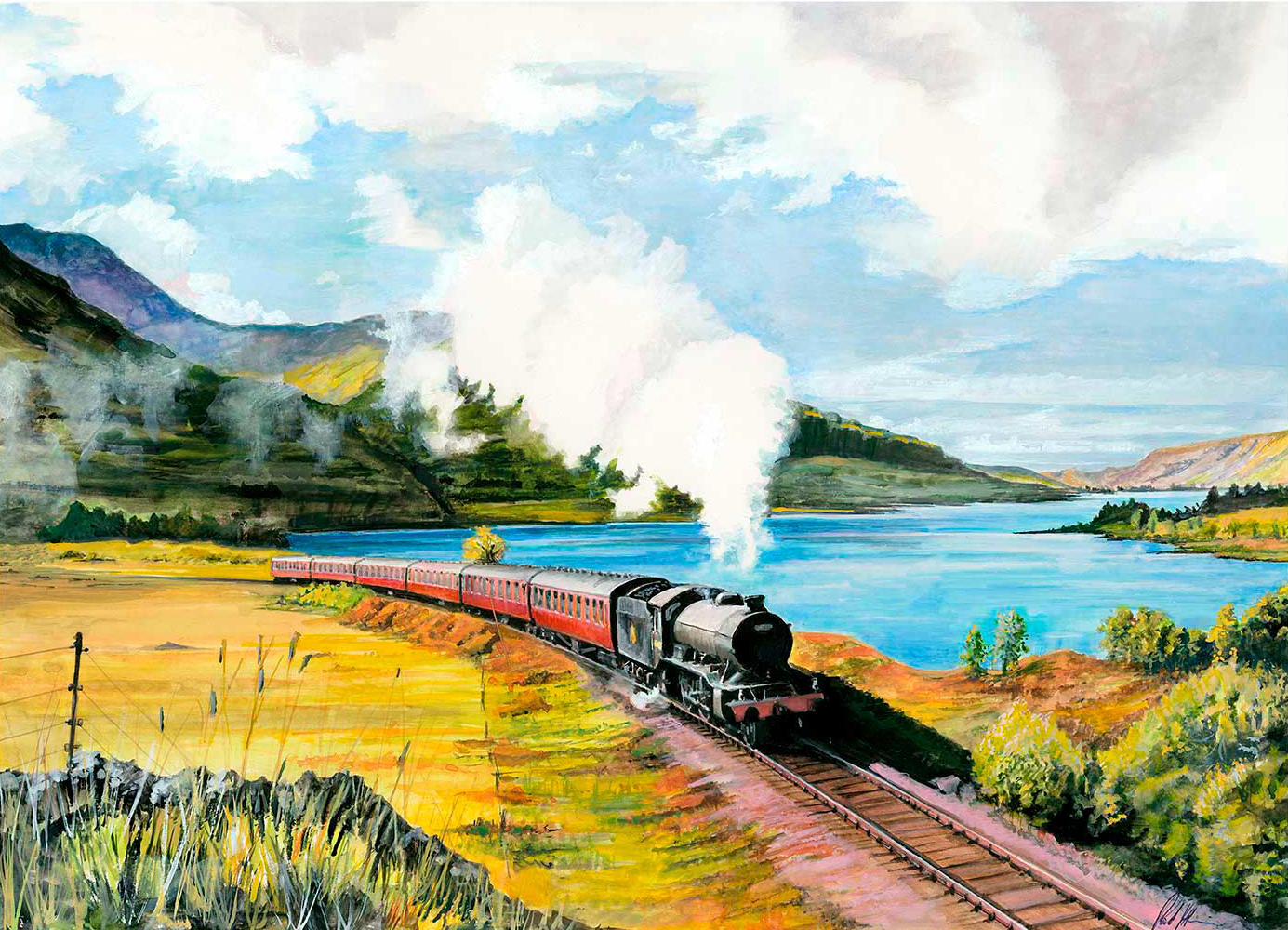
The Jacobite and the Appeal of a Framed Gift for a Train Lover

The Jacobite, a steam train with red carriages, travels past a blue lake amid green hills and mountains under a partly cloudy sky, its smoke trailing high as it moves through fields and grass in the scenic landscape.

Finding the right gift for a train lover usually means moving beyond novelty. The best present should reflect the fascination properly, while still feeling refined enough to display in a real home. The Jacobite stands out because it captures story, movement, and place in a way that feels substantial rather than collectible for its own sake.

Why framed art makes a stronger railway gift

People who love trains often appreciate detail, craft, and history. A well-framed print respects that interest while also giving them something they can keep on display for years rather than pack away after the occasion has passed.

  • It suits birthdays, retirements, and thank-you gifts.
  • It feels more thoughtful than standard railway memorabilia.
  • It gives the recipient something personal and lasting.

Why The Jacobite is such a memorable choice

The subject already carries romance and atmosphere, but the artwork keeps enough polish to work in everyday interiors. That is what makes it feel like a real gift rather than a niche purchase.

Why the First 4 Frames finish matters

First 4 Frames completes every piece in-house in Falkirk using bespoke framing, colour-managed Giclée printing, and hand-finished craftsmanship. That superior quality gives the piece the weight and presence a meaningful gift should have.

This artwork is by Rod Harrison, and you can view the exact framed product here.

If you are looking for a gift for a train lover that feels atmospheric, polished, and genuinely worth keeping, The Jacobite is an excellent option.