
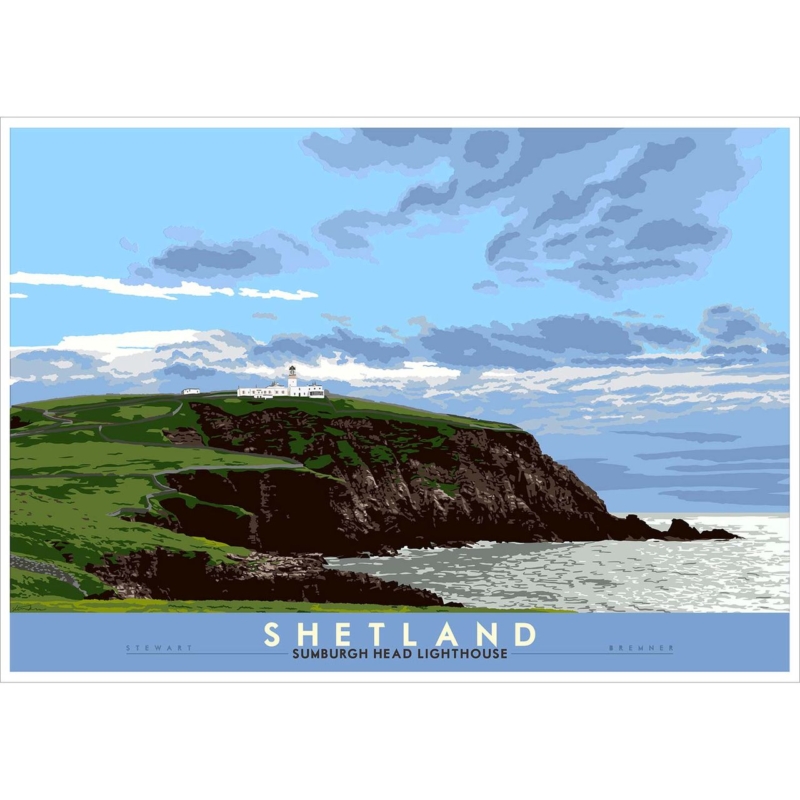
Scottish coastal art should earn its place by answering a real question about the room or recipient. Shetland: Sumburgh Head Lighthouse is a useful starting point because the remote Shetland landmark gives a small corner a view, a destination and enough narrative to reward repeated looking.
Let Scottish coastal art expand a compact corner
A reading nook is viewed at close range, so bigger is not automatically better. Mark the finished framed outline above or beside the chair. Leave enough wall around it for the lighthouse and surrounding coast to feel open.
The picture should create distance for the eye while the chair, light and table continue to do practical work.
Place the task lamp so its beam falls on the page rather than the glazing. Wool, timber and one quiet blue or stone tone can support the coastal atmosphere. Avoid adding rope, model boats or lighthouse ornaments; the artwork already carries the location clearly.
Consider the view when entering the room as well as the seated view. A strong landmark can help the nook feel intentional from a distance, while finer details offer something different when the reader settles nearby.
Protect clarity in the sea light and landmark
Controlled Giclée output helps coastal colour and graphic detail remain distinct at close range. A measured mount and hand-finished frame made in Falkirk can give the scene definition while preserving its sense of air and distance.
For the lighthouse’s history, wildlife and Shetland setting, explore Sumburgh Head Lighthouse and visitor centre. You can also browse the Stewart Bremner collection or see the exact framed product.
Scottish coastal art can make a reading nook feel larger and more personal. Sumburgh Head offers a destination for the eye, while restrained styling leaves the corner calm enough for a book.